Paying Partner or Future Competitor? Following Ageras's
A whole-deck walkthrough of Ageras's 31-slide growth-stage deck: how accountants pay for its marketplace and act as a sales channel.
Paying Partner or Future Competitor? Following Ageras's Deck from Accountant Marketplace to Software Upsell
Some companies earn money from a group of partners and also sell to those partners' customers. Ageras, a Danish company that started as a marketplace matching small businesses with accountants, describes exactly that structure in its 31-slide deck. Accountants pay Ageras a yearly fee to bid for small-business clients. Those same small businesses are, in the deck's words, 'a large pool of prospective customers that we can upsell our software to', and that software lets a business owner run their finances 'with or without an accountant'. We follow this thread from the marketplace pages through the software, banking and financing pages to the platform strategy, and check what the deck shows about keeping accountants on side.
TL;DR
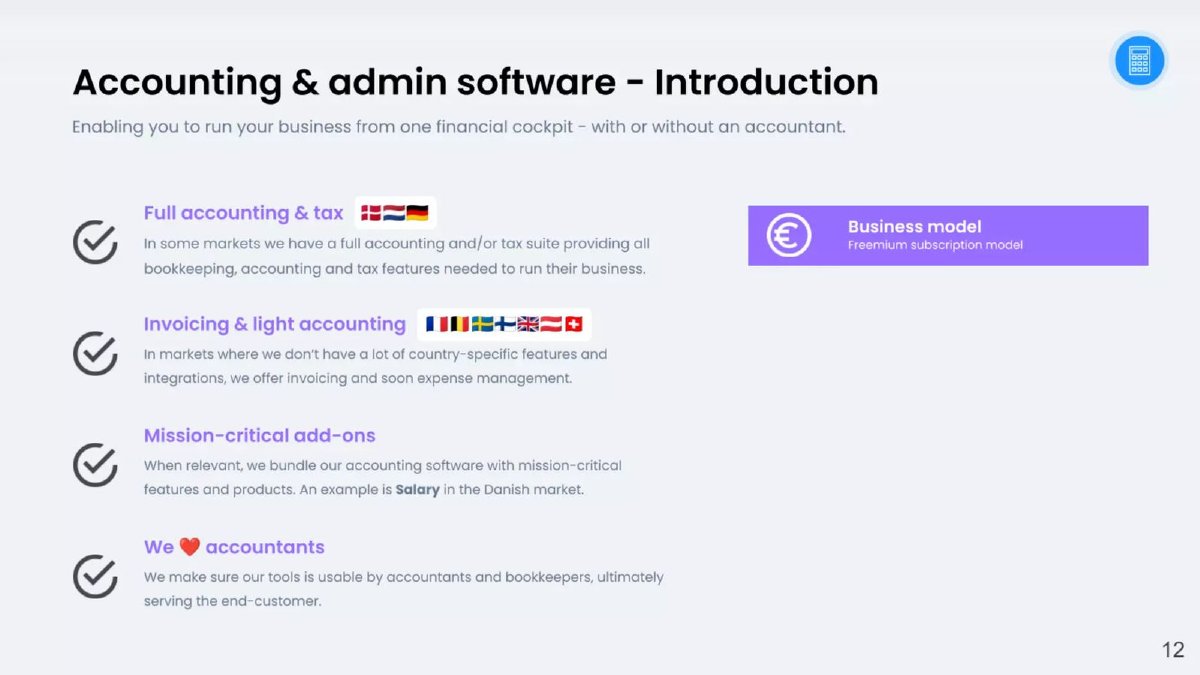
When a company's paying partners also stand between it and its end customers, the deck has to show why the partners keep helping as the company sells more to those customers. Ageras sets out both roles clearly. On the marketplace, 'The SME (our primary target) does not pay anything to us' and 'The accounting firm pays an individual annual subscription fee to Ageras to get access to bid on clients' (page 11). The marketplace is also 'A spearhead for customer acquisition' for software (page 10). The software is a 'Freemium subscription model' for running a business 'with or without an accountant' (page 12).
The deck answers the alignment question with statements rather than figures: the software is 'a tool for both SMEs and their accountant' (page 4), accountants are onboarded onto Ageras software during marketplace signup (page 11), and 'We ❤ accountants: We make sure our tools is usable by accountants and bookkeepers' (page 12). The figures that would test it are blacked out: partner counts, customers per product, paying customers, LTV/CAC and the cost per lead (pages 4 to 10).
The lesson for founders: if your partners pay you and also sit between you and your customers, show the numbers that prove they gain as you grow, such as partner renewal, the share of software customers who arrive through an accountant and what an accountant earns from clients using your tools.
The argument page by page
Eight pages from Ageras's 31-slide deck, from the product map to the platform strategy.
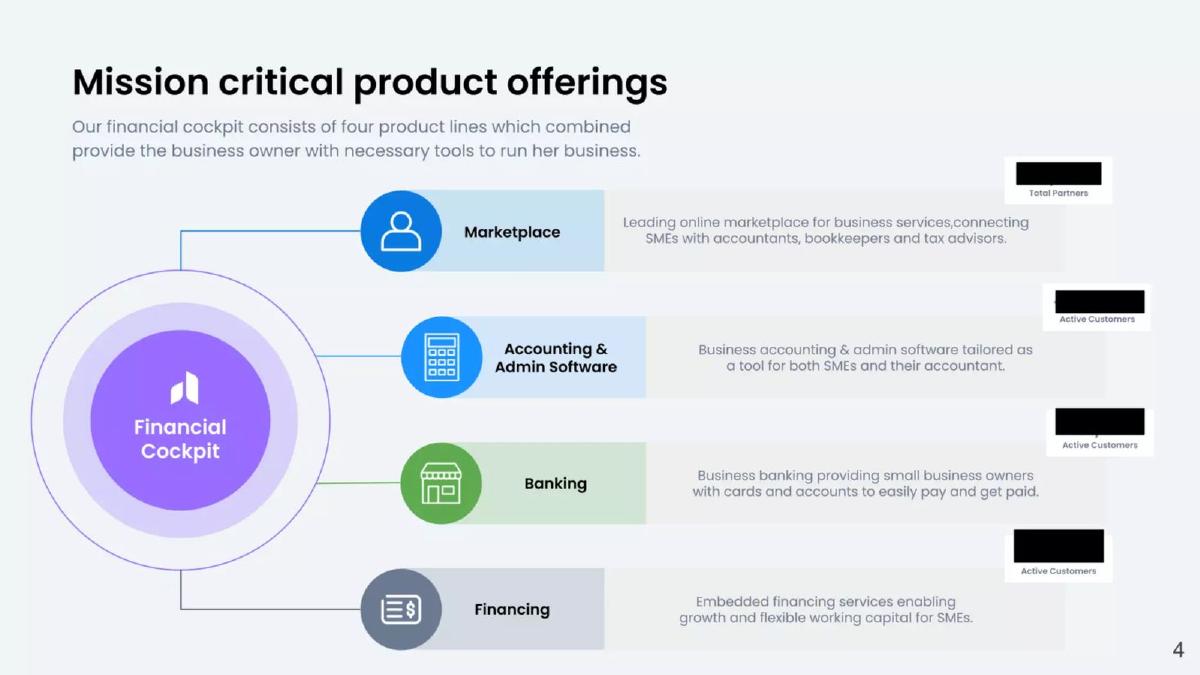
Ageras executive summary slide — slide 4
Small-business finance platform, growth stage, 2022. The product map.
Ageras deck, slide 4. Exact stored slide matched to this analysis.
Our analysis: Our reading: the deck's first statement that the software serves accountants too.
Evidence and limitation: Labels visible, counts hidden.
What a founder can adapt: Name who pays and who uses each product on one page.
Supporting analysis
What the deck claims: Four product lines; the software is 'tailored as a tool for both SMEs and their accountant'; partner and customer counts blacked out.
Presentation choice: The product map sets up every role a partner will play.
When it does not fit: Don't leave a partner's role implicit when it matters to the model.
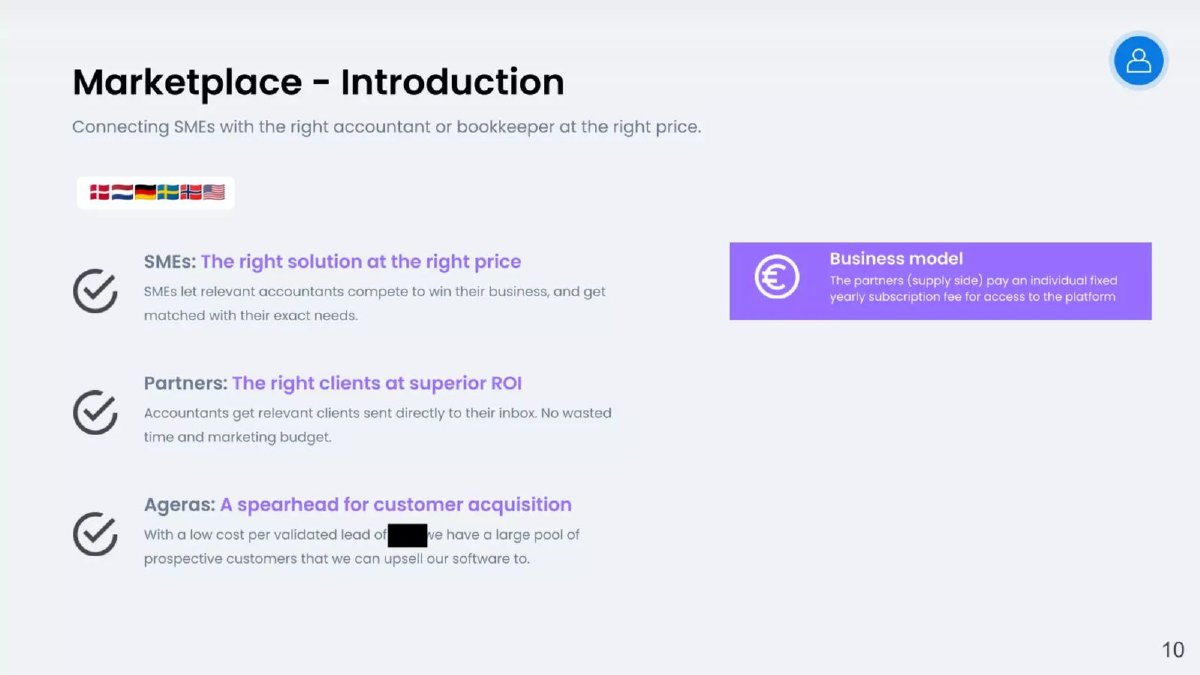
Ageras deck, slide 10. Exact stored slide matched to this analysis.
Our analysis: Our reading: accountants pay, and their prospective clients are Ageras's software pipeline.
Evidence and limitation: Cost per validated lead blacked out.
What a founder can adapt: Say what the paying side gains when you upsell the free side.
Supporting analysis
What the deck claims: 'The partners (supply side) pay an individual fixed yearly subscription fee'; 'A spearhead for customer acquisition… prospective customers that we can upsell our software to'.
Presentation choice: This page holds both roles at once.
When it does not fit: Don't describe partners' clients as your pipeline without addressing the partner.
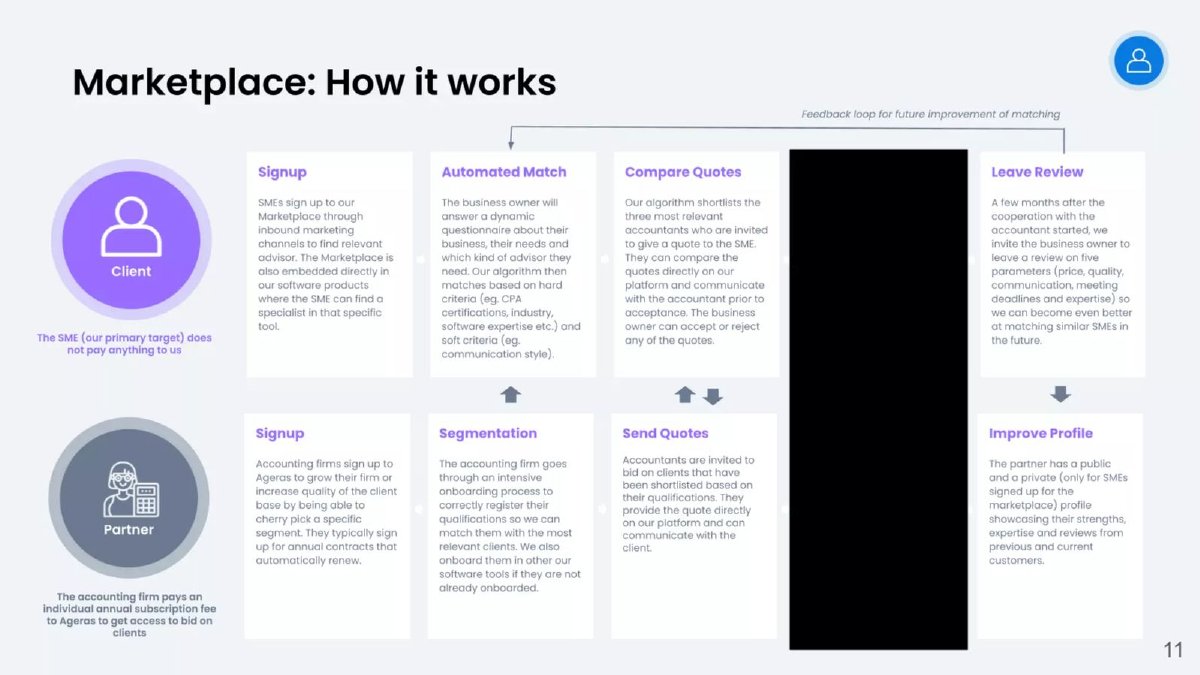
Ageras deck, slide 11. Exact stored slide matched to this analysis.
Our analysis: Our reading: onboarding accountants onto the software is the deck's practical alignment step.
Evidence and limitation: One process step blacked out.
What a founder can adapt: Report partner renewal next to this process.
Supporting analysis
What the deck claims: 'The SME (our primary target) does not pay anything to us'; firms 'sign up for annual contracts that automatically renew'; partners onboarded onto Ageras software.
Presentation choice: Process detail shows how the two sides connect.
When it does not fit: Don't rely on 'automatically renew' without a renewal rate.
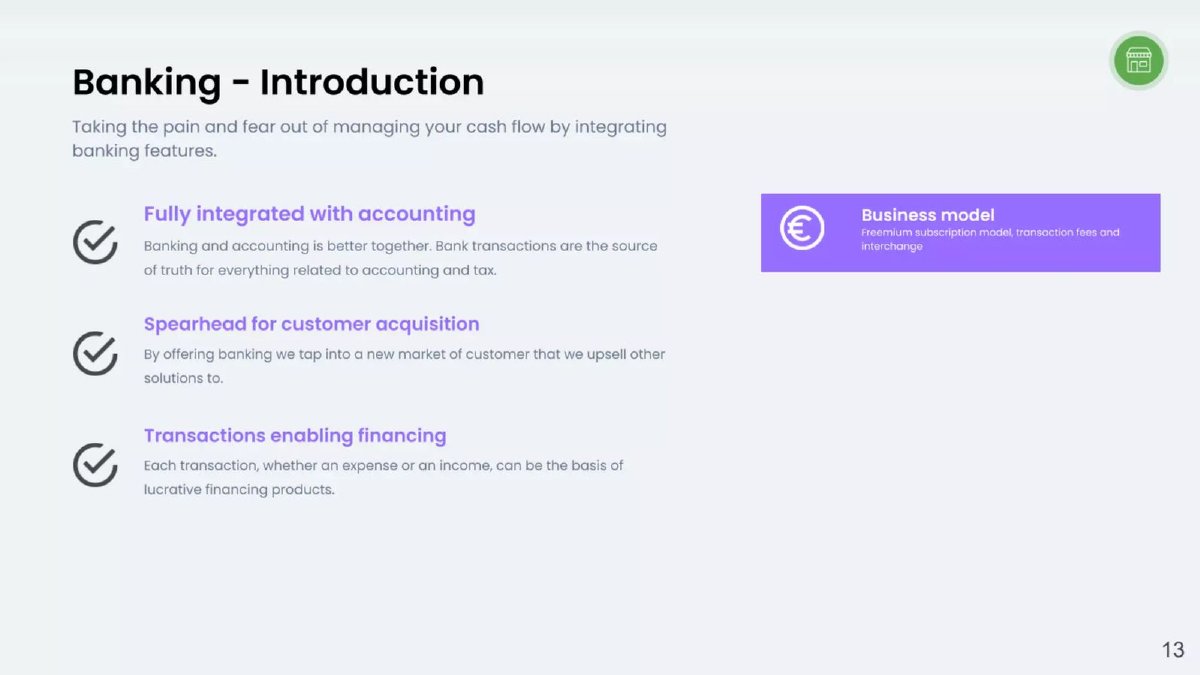
Ageras deck, slide 13. Exact stored slide matched to this analysis.
Our analysis: Our reading: a second route into the same software platform.
Evidence and limitation: Business model: subscription, transaction fees, interchange.
What a founder can adapt: Report customers and upsell by route.
Supporting analysis
What the deck claims: 'Spearhead for customer acquisition: By offering banking we tap into a new market of customer that we upsell other solutions to'.
Presentation choice: Several acquisition routes should each show their own results.
When it does not fit: Don't call several products a 'spearhead' without ranking them.
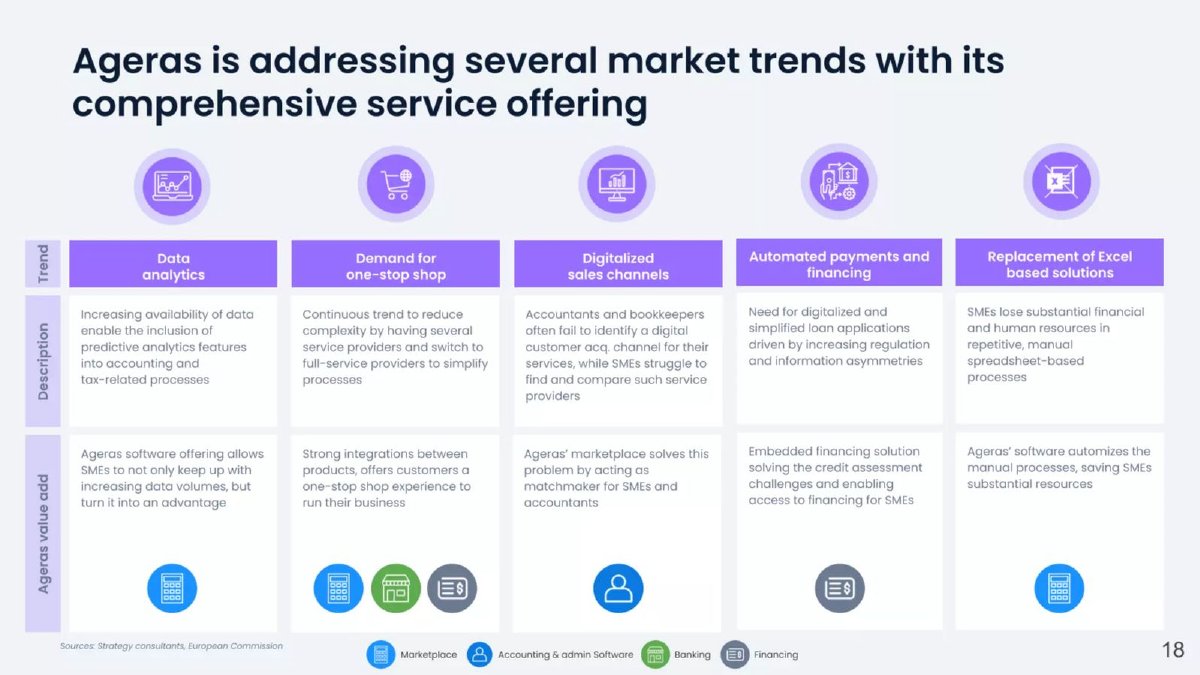
Ageras deck, slide 18. Exact stored slide matched to this analysis.
Our analysis: Our reading: accountants framed as customers of a sales channel.
Evidence and limitation: Trend table; no figures.
What a founder can adapt: Back the partner value with what partners actually win.
Supporting analysis
What the deck claims: 'Accountants and bookkeepers often fail to identify a digital customer acq. channel'; 'Ageras' marketplace solves this problem by acting as matchmaker'.
Presentation choice: It explains why accountants pay at all.
When it does not fit: Don't state partner value without partner outcomes.
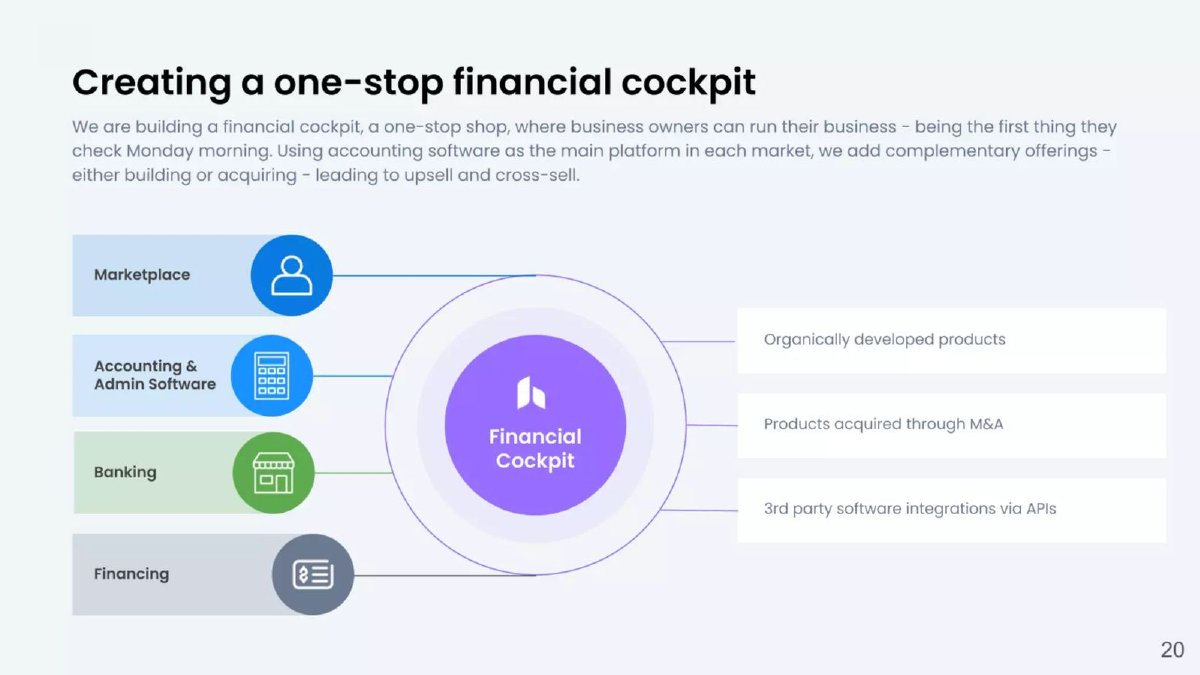
Ageras deck, slide 20. Exact stored slide matched to this analysis.
Our analysis: Our reading: the software sits at the centre, so accountants' choice of tool matters most.
Evidence and limitation: Diagram of four products, organic, acquired and integrated.
What a founder can adapt: Show what share of platform customers each route supplies.
Supporting analysis
What the deck claims: 'Using accounting software as the main platform in each market, we add complementary offerings - either building or acquiring - leading to upsell and cross-sell.'
Presentation choice: The strategy page shows where every route leads.
When it does not fit: Don't present the platform without the partners who use it.
Where Ageras's deck places accountants, and what it shows for each role.
Role
Where in the deck
Evidence shown
Gap
Payer
Marketplace fee (pp. 10–11)
Annual auto-renewing contracts
Partner count and renewal blacked out or absent
Channel
Matchmaker for SMEs (pp. 10, 18)
'Spearhead for customer acquisition'
Software customers from marketplace not shown
User
Software for 'both SMEs and their accountant' (pp. 4, 11, 12)
Partners onboarded onto software
Partners using the software not counted
Possible competitor
'with or without an accountant' (p. 12)
'We ❤ accountants'
Accounts with an accountant attached not shown
Key Takeaways
Name every role a partner plays: payer, channel, user, or competitor.
Show what partners gain when you sell more to their clients.
Report partner renewal next to customer growth.
Say how many customers arrive through partners versus directly.
Mark blacked-out figures clearly; don't let the story stand in for them.
Show that your partners win as you grow
Fill in one line per partner role. A role with only statements and no numbers is where investors will push.
Partner roles. Every way partners relate to you: payer, channel, user, competitor.
Partner economics. What a partner pays you and what they earn through you each year.
Partner renewal. Renewal rate by year, next to your customer growth.
Route share. Share of new customers arriving through partners versus directly.
Shared accounts. Share of your customers who also work with a partner on your product.
Conflict plan. What you won't sell directly, or how partners share in what you do sell.
Copyable framework: Partners pay us [fee] and earn about [amount] a year through us. [x]% renewed last year while customers grew [y]%. [z]% of new customers came through partners. [w]% of our customers work with a partner inside our product. We [rule] so partners gain when we grow.
Illustrative example 1 — written by us
Before: We ❤ accountants: We make sure our tools is usable by accountants and bookkeepers, ultimately serving the end-customer.
After: [x] accounting firms use our software; [y]% of software accounts have an accountant attached; partner renewal was [z]% while software customers grew [w]%.
What improved: Our illustrative rewrite. Bracketed values are placeholders, not Ageras's figures; it turns the alignment claim into numbers an investor can check.
The question this guide answers
Our Ageras teardown summarises the deck as a multi-product ecosystem for small-business finance. One unpublished draft uses page 20 alone, for the idea of selling a second product to existing customers. None follows the accountants through the deck, as payers on one product, a channel for another and the professionals a third product partly replaces.
Our other walkthroughs answer different questions. 100Plus asks who pays whom when patient, doctor and Medicare differ; Golfalong whether the paying side's prices fit the market; Aircall whether results are split by the mechanism that supposedly drives them. This guide asks: when a company's paying partners also stand between it and its customers, does the deck show why those partners keep helping as it grows?
How we read the deck
We rendered all 31 pages of the original deck file held in our library and read each one. The deck is undated. It shows 2022 estimates, a cost chart covering January to December 2022 and a product roadmap starting in Q4 2022, and it lists the German neo-bank Kontist, which Ageras announced buying in July 2022, so it was probably prepared in late 2022. Ageras is a private company founded in Copenhagen in 2012. Tech.eu reported in August 2022 that it had secured €35 million of growth financing from CIBC Innovation Banking, and a published teardown describes this deck as the one behind a roughly $35M round. Because the deck seems to post-date that announcement, we don't tie it to any specific round and use funding facts only as background.
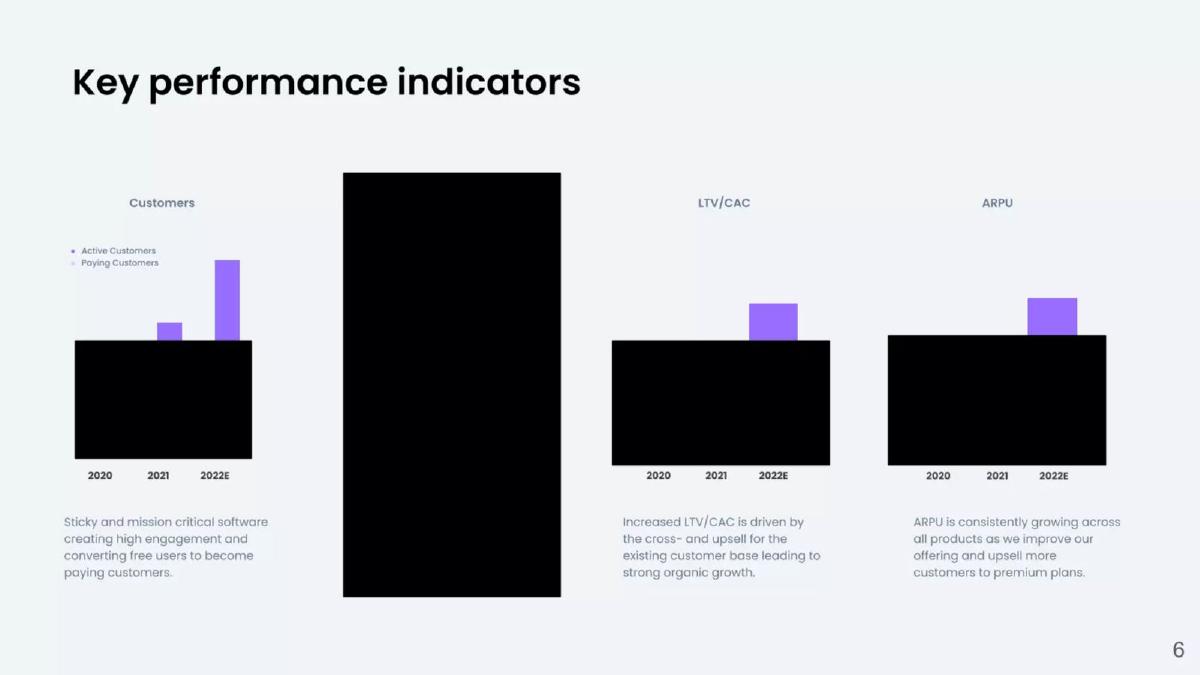
The company blacked out a great deal before the deck was shared: every count on pages 4, 5 and 9, the customer, LTV/CAC and ARPU charts on page 6, most of page 7, part of page 11's process, the cost per lead on page 10, parts of page 15, the signups and cost charts on page 19, and the whole of pages 21, 22, 24, 25, 26, 27 and 30. We point these gaps out and never estimate them. The only revenue figures left visible are the end-of-year ARR points on page 7: €6.9m (2019), €10.3m (2020) and €16.1m (2021), plus a 98% recurring ratio for 2022E and '+1,000,000' registered customers on page 5.
Step one: accountants are the paying side
Page 10, 'Marketplace - Introduction', names three winners. 'SMEs: The right solution at the right price'; 'Partners: The right clients at superior ROI', where 'Accountants get relevant clients sent directly to their inbox. No wasted time and marketing budget'; and 'Ageras: A spearhead for customer acquisition'. The business-model box says 'The partners (supply side) pay an individual fixed yearly subscription fee for access to the platform'.
Page 11, 'Marketplace: How it works', shows two tracks. Small businesses sign up, answer a questionnaire, are matched with 'the three most relevant accountants', compare quotes and later leave a review. Accounting firms sign up 'to grow their firm or increase quality of the client base', go through 'an intensive onboarding process', and 'typically sign up for annual contracts that automatically renew'. One step in the middle is blacked out.
Our reading: this is a clear two-sided model with an unusual payer. The free side is the target customer; the paying side is the professional who serves it. The deck calls accountants 'partners', which signals that Ageras sees them as allies, not just buyers of leads.
Step two: the same customers are upsold software
Back on page 10, the 'spearhead' line continues: 'With a low cost per validated lead of [blacked out] we have a large pool of prospective customers that we can upsell our software to.' Page 11 adds that the marketplace 'is also embedded directly in our software products where the SME can find a specialist in that specific tool'.
Page 12, 'Accounting & admin software - Introduction', is subtitled 'Enabling you to run your business from one financial cockpit - with or without an accountant.' It offers 'Full accounting & tax' in some markets ('all bookkeeping, accounting and tax features needed to run their business') and 'Invoicing & light accounting' in others, under a 'Freemium subscription model'. Page 6's customer chart is captioned 'converting free users to become paying customers'.
Our reading: here the two roles meet. A small business found through an accountant's bid is a prospect for software that, in some markets, covers everything needed 'to run their business'. The deck doesn't say the software replaces accountants, and 'with or without' leaves room for both. But an accountant paying to win a client could reasonably ask what happens when that client starts doing its own books in Ageras.
Step three: what the deck says about alignment
The deck answers that question in three places. Page 4 describes the software as 'tailored as a tool for both SMEs and their accountant'. Page 11 says partners are onboarded 'in other our software tools if they are not already onboarded'. Page 12's last point is 'We ❤ accountants: We make sure our tools is usable by accountants and bookkeepers, ultimately serving the end-customer.' Page 18 adds the channel logic: 'Accountants and bookkeepers often fail to identify a digital customer acq. channel for their services', and 'Ageras' marketplace solves this problem by acting as matchmaker for SMEs and accountants'.
Our reading: this is a coherent answer in words. If accountants use Ageras software to serve their clients, a client moving onto Ageras software makes the accountant's job easier rather than replacing them, and the marketplace keeps sending them work. What the deck doesn't show is whether that happens: how many partners use the software, whether partner renewal held as software sales grew, or how many software customers have an accountant on the account.
Step four: banking and financing extend the chain
Page 13, 'Banking - Introduction', repeats the pattern: 'Fully integrated with accounting'; 'Spearhead for customer acquisition: By offering banking we tap into a new market of customer that we upsell other solutions to'; and 'Transactions enabling financing'. Its business model is 'Freemium subscription model, transaction fees and interchange'. Page 14, 'Financing - Introduction', says 'We have on average more than 3,000 transactions per customer' and live access to financial data, so it 'can therefore make better automated credit decisions'. Page 20 states the strategy: 'Using accounting software as the main platform in each market, we add complementary offerings - either building or acquiring - leading to upsell and cross-sell.' Page 23 lists the acquisitions: Billy, Tellow, Salary, Zervant and Kontist.
Our reading: three products are each called a 'spearhead' or acquisition route (the marketplace, banking, and accountants themselves on page 18), and all lead to the accounting software at the centre. That makes the accountant relationship more important, not less: the software is the platform, and accountants are both a channel to it and some of its most demanding users. Page 14's financing claim also depends on businesses keeping their books in Ageras, which is where an accountant's choice of tool matters.
Step five: what the visible numbers show
Page 7 plots ARR at €6.9m, €10.3m and €16.1m for 2019 to 2021, with a 98% 'Recurring Ratio' for 2022E. Our checks: ARR grew about 49% in 2020 and about 56% in 2021. Page 5 reports '+1,000,000' registered customers. Page 16 sizes the market: €13bn 'TAM 2022', €17bn 'TAM 2025', and €179bn and €264bn as a maximum, from 53,939 thousand SMEs in Europe and the US in 2022 and 57,736 thousand in 2025.
Our reading: the visible figures show a growing, mostly recurring business with a very large registered base. They don't separate marketplace revenue from software, banking or financing revenue, so a reader can't see whether the accountant-paid marketplace is a growing or shrinking share. A million registered customers alongside €16.1m of ARR also means most registered users pay little or nothing, which fits a freemium model; the paying-customer count that would show conversion is blacked out on pages 5 and 6.
What a reader can't tell
From this copy, a reader can't tell how many accountants pay for the marketplace or how many renew, how much revenue each product line brings, how many software customers came from the marketplace, how many software accounts have an accountant attached, the cost per validated lead, or the conversion rate from free to paid. Most of these were blacked out by the company; a few, such as partner renewal and revenue by product, aren't shown at all. Investors who saw the full version may have had them.
When this structure is the right choice
Our view, drawing on this deck: using a partner-paid marketplace as a low-cost route to software customers is a strong strategy, and Ageras explains it unusually openly, naming the free side, the paying side and the upsell. The structure is complete when the deck also shows that the partners still win as the upsell grows. For Ageras that would be one small table: partners, partner renewal, partners using Ageras software, and software customers with an accountant attached, by year. With it, 'We ❤ accountants' becomes evidence; without it, an investor has to take the alignment on trust.
Common mistakes
Partner roles left implicit. Name every role a partner plays in the model.
Partners' clients called your pipeline. Say what partners gain when you sell to them.
Renewal claimed, not shown. Report a renewal rate next to 'automatically renew'.
Several 'spearheads', no ranking. Show results by acquisition route.
Slogan instead of evidence. Replace 'we love partners' with partner numbers.
Diagnostic checklist
Every partner role is named.
Partner economics are shown in both directions.
Partner renewal sits next to customer growth.
New customers are split by route.
Shared accounts with partners are counted.
Blacked-out figures are clearly marked.
Frequently asked questions
What is channel conflict in a pitch deck?
It's when a company's partners, who sell to or serve its customers, could lose out as the company sells more directly. A deck should show why partners keep helping anyway.
Who pays Ageras on its marketplace?
Accountants. Page 11 says small businesses pay nothing and accounting firms pay an annual subscription to bid on clients.
Does Ageras's software compete with accountants?
The deck doesn't say it does. Page 12 says the software works 'with or without an accountant' and is built to be 'usable by accountants and bookkeepers'. The deck doesn't show how many accounts actually involve an accountant.
Why are so many figures missing?
The company blacked them out before the deck was shared, including customer counts, LTV/CAC, the cost per lead and whole financial pages. We point these gaps out and don't estimate them.
Which funding round is this deck from?
It's undated and probably from late 2022. Ageras announced €35M of growth financing in August 2022, and a published teardown links this deck to that round, but the deck seems to post-date the announcement, so we don't tie it to a specific round.
How we chose these examples
Selection (2026-10-02): saved lead from the previous run (free tool to paid conversion). On inspection, conversion figures are all blacked out, so that lesson lacked evidence; the deck's visible thread is the accountants' several roles, which runs from page 4 to page 20. Distinctness check: the teardown summarises the deck; one unpublished draft uses page 20 alone; no guide follows the partner relationship across the deck; the other walkthroughs answer different questions. A second library copy of this deck exists under another slug (different file); we used this one.
All 31 pages of the original deck file (sha256 6057db4e…, matching our inventory) were rendered and read (AI editorial model review, not human). Eight images are used: pages 10, 11, 12, 13 and 18 were stored for this draft on 2026-10-02 and are byte-identical to the renders; pages 4, 6 and 20 reuse images already in our library. Blacked-out figures and pages are pointed out, never estimated. ARR growth rates were computed from the printed page 7 points.
Eligibility: Ageras is a private company; the deck was shared publicly with redactions and is already in our library with an existing teardown; no takedown request is recorded. Funding facts are background only.