Ideal Investor Slide Examples: How to Say Who Should Invest
Should a pitch deck say what kind of investor you want? Six real slides, from "we need smart money" to investor profiles matched to cheque size and time.
Ideal Investor Slide: Say Who Should Invest, What They Bring and On What Terms
Some founders add a line or a whole slide describing the investor they want: "smart money", "our ideal investor", "investor profile". Founders ask whether this helps, and what it should say. Done well, it tells the right investor that this round is meant for them and tells everyone else what the company needs besides cash. Done badly, it is a list of qualities every investor claims to have. This guide uses six slides from five startup decks to show the difference.
TL;DR
If you describe the investor you want, make the description specific enough that some investors would rule themselves out. Name the type of investor, the cheque size, the time horizon, and the one or two things beyond money you need from them, tied to a milestone in the plan. Health Cuisine does this best in the set: two numbered "Investor Profile" slides separate small crowdfunding investors ("Foodies + Cookbook buyers", €60 or €100 tickets) from "Business Angels and Informal Investors with an interest in Food, Luxury Travel & Tourism and Health & Wellness" investing up to €150K. Avalon Energia matches an investor profile to each phase of its plan, with horizon and size, though the scale of its later phases overwhelms the near-term ask. Hindxr's "Our Ideal Investor" list is mostly qualities anyone would claim, with one useful line: "Expertise in the XR industry". Alamo and CrowdSec both use the words "smart money" without saying what the smart part should be.
Six investor-description slides, read in full
Each example shows what the slide says about the intended investor, what it achieves, and what to change. Quotes are taken from the slide images at full size.
Health Cuisine ask slide — slide 35
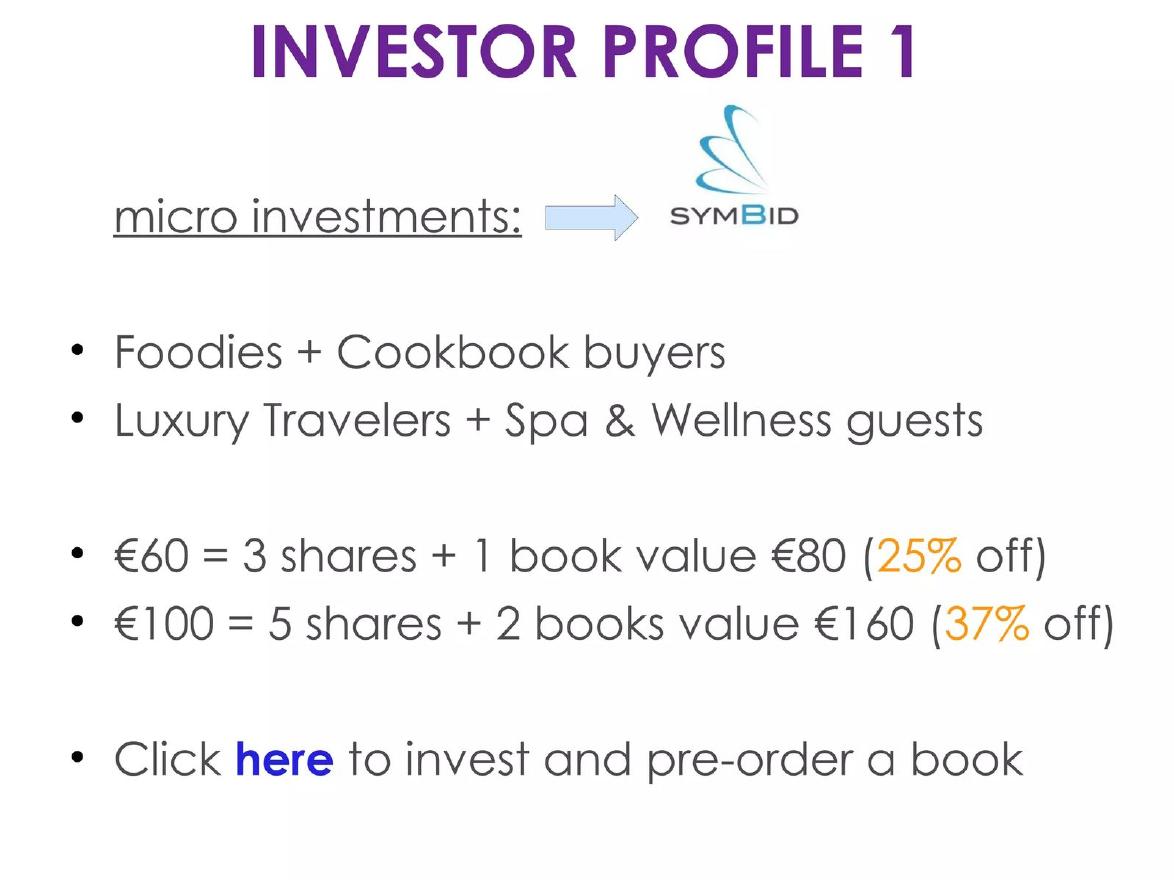
Cookbook and food content business tied to spa and wellness hospitality. Slide titled "Investor Profile 1".
Health Cuisine deck, slide 35. Exact stored slide matched to this analysis.
Our analysis: Names the small investor, the channel and the exact ticket.
Evidence and limitation: Offer terms stated by the company; no share value or valuation given.
What a founder can adapt: State the share price or valuation the tickets imply.
Supporting analysis
What the deck claims: "micro investments" via Symbid; "Foodies + Cookbook buyers"; "Luxury Travelers + Spa & Wellness guests"; "€60 = 3 shares + 1 book value €80 (25% off)"; "€100 = 5 shares + 2 books value €160 (37% off)".
Presentation choice: A reader knows at once whether this tier is meant for them.
When it does not fit: Bundling product with shares without explaining the split.
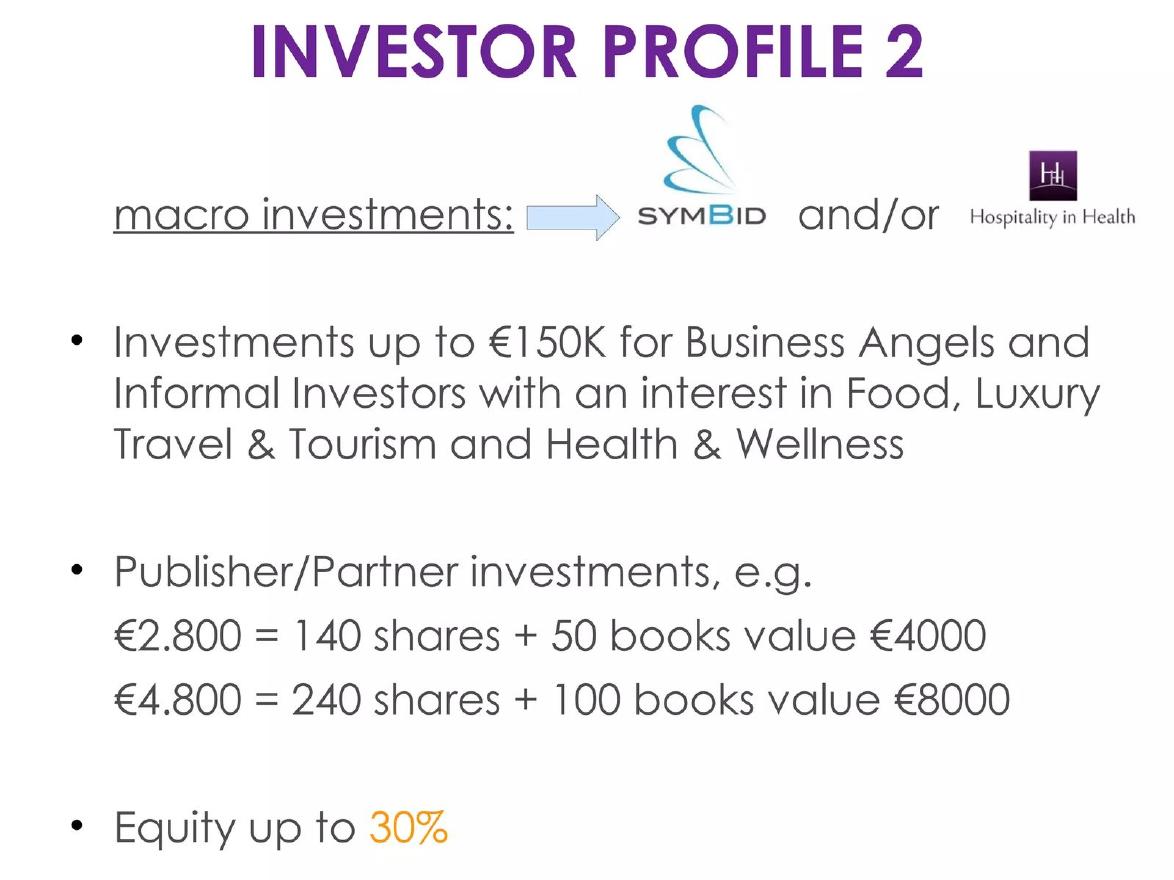
Second investor tier on the following slide, titled "Investor Profile 2".
Health Cuisine deck, slide 36. Exact stored slide matched to this analysis.
Our analysis: Names investor type, sector interest and maximum cheque.
Evidence and limitation: Offer terms stated by the company; amount raised and valuation not on the slide.
What a founder can adapt: Add the total raise and valuation beside the equity figure.
Supporting analysis
What the deck claims: "Investments up to €150K for Business Angels and Informal Investors with an interest in Food, Luxury Travel & Tourism and Health & Wellness"; partner tickets "€2.800 = 140 shares + 50 books value €4000"; "Equity up to 30%".
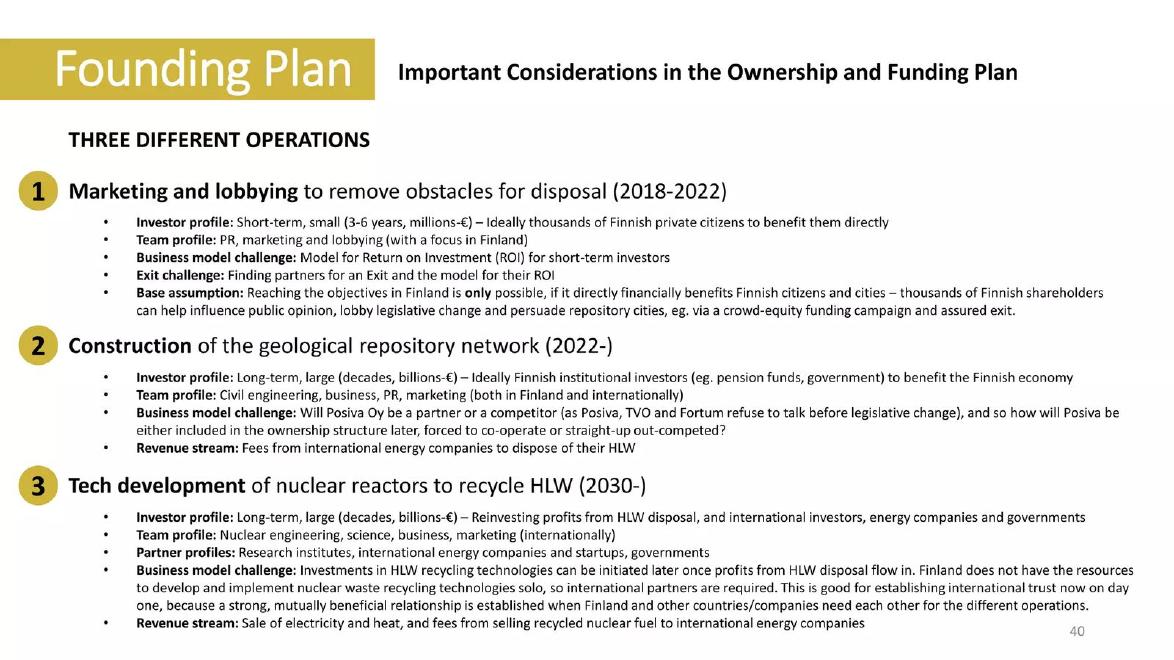
Planned nuclear-waste disposal and recycling business in Finland. Slide titled "Founding Plan".
Avalon Energia deck, slide 40. Exact stored slide matched to this analysis.
Our analysis: Matches investor size and horizon to each phase.
Evidence and limitation: Plan and intentions; no investors named as committed.
What a founder can adapt: Lead with the current round's profile in most detail.
Supporting analysis
What the deck claims: Phase 1 investor profile "Short-term, small (3-6 years, millions-€) – Ideally thousands of Finnish private citizens"; phase 2 "Long-term, large (decades, billions-€) – Ideally Finnish institutional investors"; phase 3 international investors, energy companies and governments.
Presentation choice: States horizon, which most decks omit.
When it does not fit: Letting later billion-euro phases bury the near-term ask.
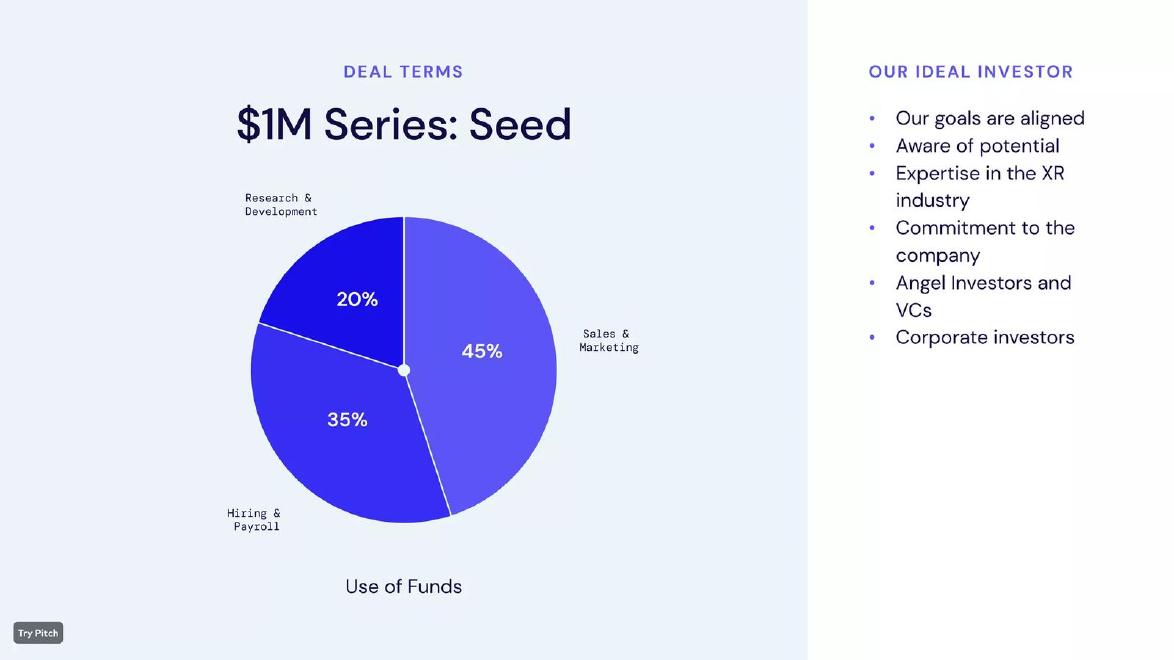
Extended reality (XR) startup. "Our Ideal Investor" beside "Deal Terms" and a use-of-funds chart.
Hindxr deck, slide 14. Exact stored slide matched to this analysis.
Our analysis: Right placement; mostly generic qualities, one specific need.
Evidence and limitation: Preferences stated by the company.
What a founder can adapt: Keep the XR line, say what the expertise is for, name one lead type.
Supporting analysis
What the deck claims: "$1M Series: Seed"; use of funds 45% sales and marketing, 35% hiring and payroll, 20% R&D; ideal investor: "Our goals are aligned", "Aware of potential", "Expertise in the XR industry", "Commitment to the company", "Angel Investors and VCs", "Corporate investors".
Presentation choice: "Expertise in the XR industry" tells a generalist a specialist is preferred.
When it does not fit: Listing every investor type and qualities no one can check.
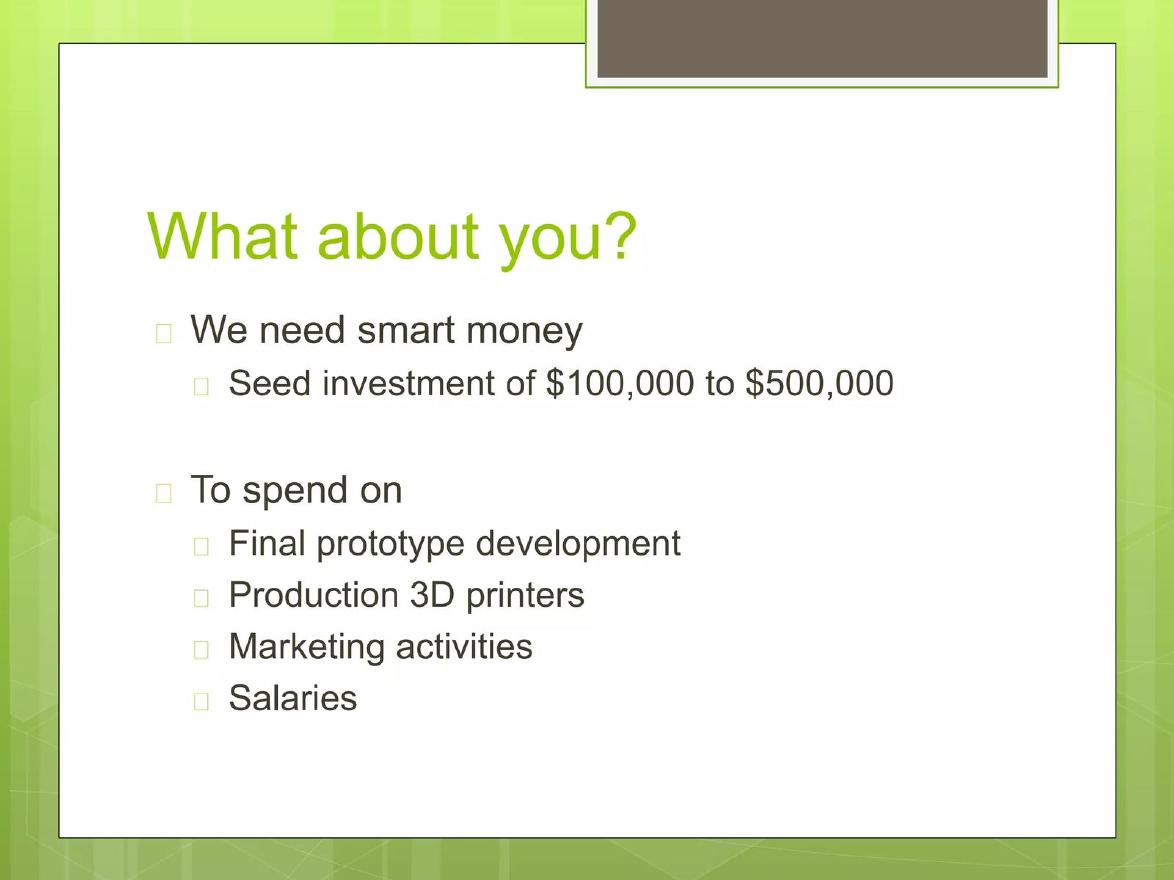
3D-printing product startup. Slide titled "What about you?".
Alamo deck, slide 18. Exact stored slide matched to this analysis.
Our analysis: Asks for smart money without saying what kind.
Evidence and limitation: Ask stated by the company; no amounts per use.
What a founder can adapt: Name the expertise wanted and narrow the range to one target.
Supporting analysis
What the deck claims: "We need smart money"; "Seed investment of $100,000 to $500,000"; to spend on "Final prototype development", "Production 3D printers", "Marketing activities", "Salaries".
Presentation choice: Shows how an undefined phrase leaves every investor guessing.
When it does not fit: A fivefold range and uses with no amounts.
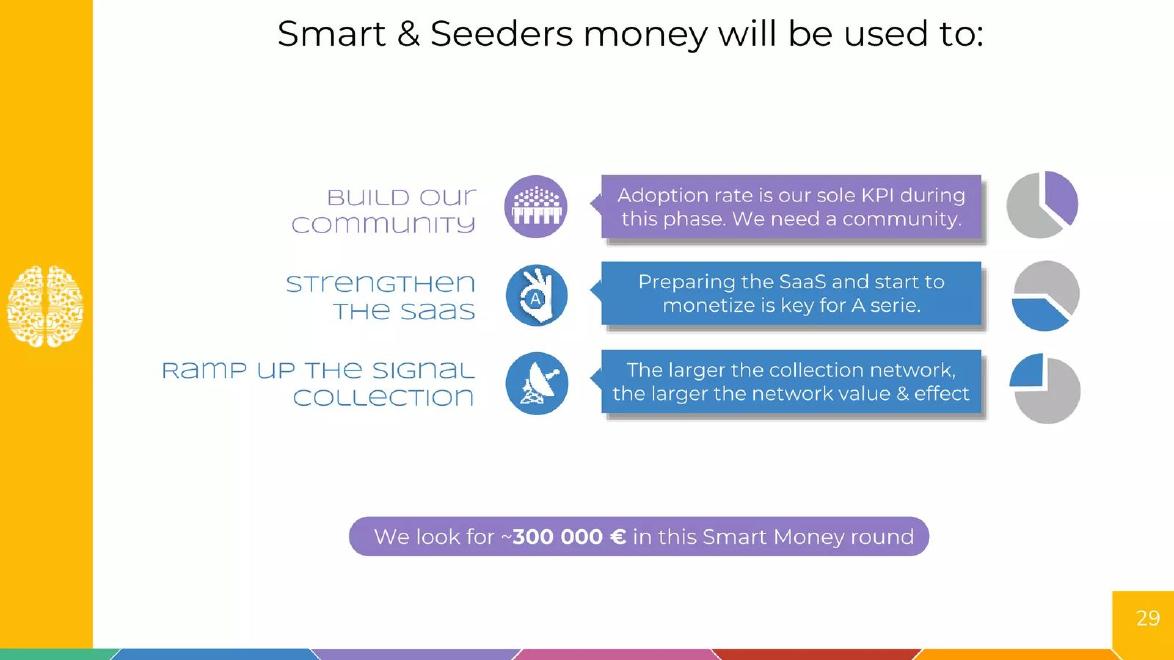
Open-source security company. Slide titled "Smart & Seeders money will be used to:".
CrowdSec deck, slide 29. Exact stored slide matched to this analysis.
Our analysis: Clear amount and stage goals; never says what makes the money smart.
Evidence and limitation: Plan stated by the company; pie charts unlabelled.
What a founder can adapt: Say what investors should bring, such as developer-community or security-sales experience.
Supporting analysis
What the deck claims: "Build our community" ("Adoption rate is our sole KPI during this phase."); "Strengthen the SaaS" ("Preparing the SaaS and start to monetize is key for A serie."); "Ramp up the signal collection"; "We look for ~300 000 € in this Smart Money round".
Presentation choice: Ties the round to the next financing, but not to investor help.
When it does not fit: Pie charts with no labels or percentages.
Whether each slide names an investor type, a cheque size and a specific need beyond money.
Example
Investor type
Cheque or raise
Need beyond money
Health Cuisine (35)
Crowd: food and wellness customers
€60 or €100 tickets
No
Health Cuisine (36)
Angels with sector interest
Up to €150K
Sector interest only
Avalon Energia
Per phase
Millions to billions, with horizon
No
Hindxr
Angels, VCs, corporates
$1M raise
XR expertise
Alamo
Not stated
$100,000 to $500,000
"Smart money", undefined
CrowdSec
Not stated
~€300,000
"Smart money", undefined
Key Takeaways
Specific enough that some investors rule themselves out.
Name investor type, cheque size and horizon.
Say what you need besides money, and for which milestone.
Define "smart money" or drop the phrase.
Keep each profile's terms clear and consistent.
Write your investor description
Answer each prompt; if an answer would fit every investor, make it more specific or drop it.
Type. Which type of investor should lead this round, and which could join?
Size. What is the total raise, and what cheque size are you looking for?
Horizon. Is the expected time to return unusual for your stage? If so, say it.
Help. What one or two things beyond money do you need, and for which milestone?
Exclusion test. Which investors would this description rule out?
Copyable framework: Raising [amount] [instrument]. Looking for [investor type] writing [cheque size], ideally with [specific expertise or network] to help us [milestone] by [date].
Illustrative example 1 — written by us
Before: Our ideal investor: aligned goals, aware of potential, committed, angels and VCs.
After: Raising $1M seed. Looking for a lead angel or seed fund writing $250K-$500K, ideally with retail-hardware distribution contacts to help us sign two retail partners by Q3.
What improved: Our illustrative rewrite; figures and details are invented for the example. It names the lead type, cheque size and one concrete need tied to a milestone, so investors can tell whether they fit.
The question this guide answers
Founders ask whether a pitch deck should say what kind of investor they are looking for, and if so, how. Other guides in this library cover the money side of the ask: how much to raise, how to show use of funds, deal terms, the cap table and runway. None of them covers the investor side: who the round is for, and what the company expects from those investors apart from capital.
That question matters more than it looks. Investors receive many decks and decide quickly whether a company fits their focus, cheque size and stage. A clear description of the intended investor helps the right ones say yes faster and saves the wrong ones a meeting. It also shows that the founder has thought about what the next stage needs: an industry introduction, a first enterprise customer, a hiring network or a later lead investor.
How we chose and read the examples
We searched the extracted text of the slide library for phrases such as "ideal investor", "investor profile", "smart money", "strategic investor" and "what we are looking for" in an investor. We removed public companies, mining and resource companies, listed-company presentations, investor-fund decks, decks about fundraising itself, and slides where the phrase meant something else (for example a product or a press mention). We kept six slides from five startup decks, each showing a different way to describe the investor. Every slide was rendered from the original deck at full size and read in full before we wrote about it.
We quote what is visible on each slide. We have not checked any company's figures against other sources, and we make no claim that any of these slides affected who invested or whether a round closed.
Separate investor groups by cheque size and what each gets
Health Cuisine, a cookbook and food content business connected to spa and wellness hospitality, uses two numbered slides titled "Investor Profile 1" and "Investor Profile 2". The first covers "micro investments" through the crowdfunding platform Symbid. It names the people it expects to invest, "Foodies + Cookbook buyers" and "Luxury Travelers + Spa & Wellness guests", and gives two tickets: "€60 = 3 shares + 1 book value €80 (25% off)" and "€100 = 5 shares + 2 books value €160 (37% off)", followed by "Click here to invest and pre-order a book".
The second covers "macro investments" through Symbid and/or Hospitality in Health: "Investments up to €150K for Business Angels and Informal Investors with an interest in Food, Luxury Travel & Tourism and Health & Wellness", publisher or partner investments such as "€2.800 = 140 shares + 50 books value €4000" and "€4.800 = 240 shares + 100 books value €8000", and finally "Equity up to 30%".
This is the clearest example in the set of describing investors precisely. Each slide says who the investor is, how much they put in, through which channel, and what they receive. A reader can tell at once which group they belong to, and an angel without an interest in food, travel or wellness can see that the round is not aimed at them. The small-ticket profile also does double duty: the investors are likely customers, and every ticket includes product.
Two cautions apply. Bundling shares with discounted product mixes an investment with a sale, which some investors and platforms will want explained, and the slides do not say what each share is worth or what valuation the prices imply. And "Equity up to 30%" appears on its own, without the amount raised or the valuation, so a reader cannot tell what 30% would cost.
Match the investor to the phase of the plan
Avalon Energia, a Finnish company planning a business around disposal and later recycling of high-level nuclear waste, has a slide titled "Founding Plan" with the subtitle "Important Considerations in the Ownership and Funding Plan". It splits the company into "Three different operations", and each has its own "Investor profile". For marketing and lobbying (2018-2022): "Short-term, small (3-6 years, millions-€) – Ideally thousands of Finnish private citizens to benefit them directly". For construction of a geological repository network (2022-): "Long-term, large (decades, billions-€) – Ideally Finnish institutional investors (eg. pension funds, government)". For reactor technology development (2030-): reinvested profits plus "international investors, energy companies and governments". Each phase also lists a team profile, a business model challenge and a revenue stream or exit challenge.
The useful idea is matching. Different stages of a plan need different money: different sizes, different horizons and different expectations of return. Saying so openly helps an investor see which stage they are being asked to fund and who is expected to fund the next one. The time horizon in particular ("3-6 years" against "decades") is information many decks leave out entirely.
The warning is scale. The near-term ask, a crowd of private citizens funding lobbying, sits on the same slide as billions of euros of institutional money years later. A reader asked to fund phase one has to believe that phases two and three will be financed by others. The slide itself names the risks ("Exit challenge: Finding partners for an Exit and the model for their ROI"), which is honest, but it means the first investors are being asked to back a return model the company has not yet worked out. If you use this approach, put the current round's investor profile first and in the most detail.
Make the list specific enough to rule people out
Hindxr, an extended reality (XR) startup, puts "Our Ideal Investor" beside its deal terms ("$1M Series: Seed") and a use-of-funds chart (45% sales and marketing, 35% hiring and payroll, 20% research and development). The list reads: "Our goals are aligned", "Aware of potential", "Expertise in the XR industry", "Commitment to the company", "Angel Investors and VCs" and "Corporate investors".
Placing the investor description on the ask slide is sensible: the reader sees the amount, the plan and the intended investor together. But most of the list would describe any investor who agrees to invest. Aligned goals, awareness of potential and commitment are not things an investor can check themselves against. The last two lines name almost every type of investor, so nobody is ruled out.
One line does real work: "Expertise in the XR industry". It tells an investor what Hindxr needs beyond money, and it would let a generalist investor see that a specialist is preferred. The slide would be stronger if it kept that line, said what the expertise is for (customer introductions, hardware partnerships, recruiting), and named one investor type to lead the round.
Define "smart money" or leave it out
Alamo, a startup building a product with 3D printing, has a slide titled "What about you?". It reads: "We need smart money", "Seed investment of $100,000 to $500,000", then "To spend on": "Final prototype development", "Production 3D printers", "Marketing activities" and "Salaries". The title addresses the investor directly, which is a friendly way to open the ask.
The phrase "smart money" usually means investors who bring knowledge or contacts as well as cash, but the slide never says which knowledge or which contacts. An investor experienced in manufacturing, in consumer marketing or in the 3D printing industry would each read it differently. The range is also wide: a fivefold spread between $100,000 and $500,000 makes it hard to judge what the money achieves, and the spending list has no amounts or milestones.
CrowdSec, an open-source security company, names its whole round after the idea. Its slide is titled "Smart & Seeders money will be used to:" and ends with "We look for ~300 000 € in this Smart Money round". The three uses are tied to the company's stage: "Build our community" ("Adoption rate is our sole KPI during this phase. We need a community."), "Strengthen the SaaS" ("Preparing the SaaS and start to monetize is key for A serie.") and "Ramp up the signal collection" ("The larger the collection network, the larger the network value & effect"). Each has a small pie chart beside it.
CrowdSec's slide is better than Alamo's at saying what the round is for: one amount, three stage-specific goals, and a stated link to the next round. But like Alamo it never says what makes the money smart. Given its own goals, a natural answer would be investors who can help build a developer community or who know security software sales. The pie charts also carry no labels or percentages, so the split between the three uses cannot be read.
What a specific investor description includes
Across the six slides, the useful descriptions share a few features. They name the type of investor (crowd investors, angels, specialist funds, corporate or strategic investors, institutions). They give a cheque size or range, and the total being raised. They say the expected horizon when it differs from the norm. And they name one or two concrete things the company needs besides money, linked to a milestone in the plan: "introductions to three hotel groups before launch" is useful in a way that "aligned goals" is not.
A good test is to read your description and ask which investors it excludes. If the answer is none, it is not yet telling anyone anything. If it excludes investors you would actually take money from, it is too narrow, or it belongs in a conversation rather than on a slide.
Where to put it, and when to leave it out
The investor description works best next to the ask, as Hindxr and CrowdSec place it, so the amount, the use of funds and the intended investor are read together. A separate slide makes sense only when, like Health Cuisine, you are offering different terms to different groups.
It is fine to leave it out. Many strong decks never describe the investor at all, and an investor will assume that a company raising a seed round wants a seed investor. Add the description when it carries real information: you need a specialist, you are offering separate tiers, or the round's timing or horizon is unusual. Do not add it to fill space, and do not tailor it so closely to one investor that the deck reads oddly when forwarded to another.
Common mistakes
Qualities anyone would claim. "Aligned" and "committed" rule no one out.
Undefined smart money. Say which expertise or contacts you need.
Every investor type listed. Name who should lead the round.
Equity without an amount. Pair any percentage with the raise and valuation.
Future phases bury the ask. Describe the current round's investor first.
Diagnostic checklist
Investor type that should lead.
Total raise and target cheque size.
Horizon, if unusual.
One or two specific needs tied to milestones.
Description rules some investors out.
Frequently asked questions
Should a pitch deck describe the ideal investor?
Only when it adds information: you need a specialist, you offer separate tiers, or your horizon is unusual. Otherwise investors assume a seed company wants seed investors.
What does "smart money" mean on a slide?
Usually investors who bring knowledge or contacts as well as cash. On a slide it only helps if you say which knowledge or which contacts, and what they are for.
Where should the investor description go?
Next to the ask, so the amount, use of funds and intended investor are read together. Use a separate slide only for separate investor tiers.
How we chose these examples
Corpus: published pitch deck teardowns on StartupFundraising.com. Founder-uploaded private decks are excluded.
Selection (2026-10-01): we searched extracted slide text for "ideal investor", "investor profile", "smart money", "strategic investor" and related phrases, excluded public companies, mining and resource companies, listed-company presentations, fund decks, decks about fundraising and unrelated uses, and kept six slides from five startup decks that each show a distinct approach.
Review: all six slides were rendered from the source decks at full size on 2026-10-01 and read in full against company, deck and page number (editorial model review, with AI assistance in drafting). No person has yet completed an editorial review of this page. We did not verify any company's figures or offer terms against outside sources.