Pitch Deck Ask Slides: Use of Funds Examples and What Works
How to write the ask and use-of-funds slide: the amount, the milestones it buys, the runway and the allocation.
Pitch Deck Ask Slides: Use of Funds Examples and What Works
Compare twelve real ask and use-of-funds slides, from small angel rounds to Series A, and connect the amount raised to measurable progress.
TL;DR
An ask slide should state the amount, the runway, and the two or three milestones the money is intended to buy. These examples show why outcomes and sequencing are more informative than an allocation chart alone, while keeping company targets distinct from verified results.
Ask slides from real pitch decks
Each example shows the exact ask slide from its public deck where we hold the image; three stay text-only because their ask slide is beyond the slides we store. Ask slides in short decks can appear early, which is why some examples are slide 2–4. Company targets remain claims rather than results; missing exact images are recorded and never replaced.
Equals ask slide — slide 9
A seed-stage spreadsheet product raising its first institutional round, with a slide simply titled "Plan".
Verified source excerpt — slide 9
Raising a seed round of around $4M to fund an initial team for 24 months, build version one and show product-market fit with a small number of paying users; it states another raise will follow.
The exact ask slide image is not present in the stored slide-image set. No substitute is used.
Our analysis: It gives amount, runway and milestone in three short lines, and it is honest that this round is a step, not the finish.
Evidence and limitation: "A small number of paying users" is vague; a target count or usage level gives investors something to check.
What a founder can adapt: Write your ask as amount, months and the one thing you will have proven by the end. Say what the next raise will be based on.
Supporting analysis
What the deck claims: Raising a seed round of around $4M to fund an initial team for 24 months, build version one and show product-market fit with a small number of paying users; it states another raise will follow.
Presentation choice: It gives amount, runway and milestone in three short lines, and it is honest that this round is a step, not the finish.
When it does not fit: "A small number of paying users" is vague; a target count or usage level gives investors something to check.
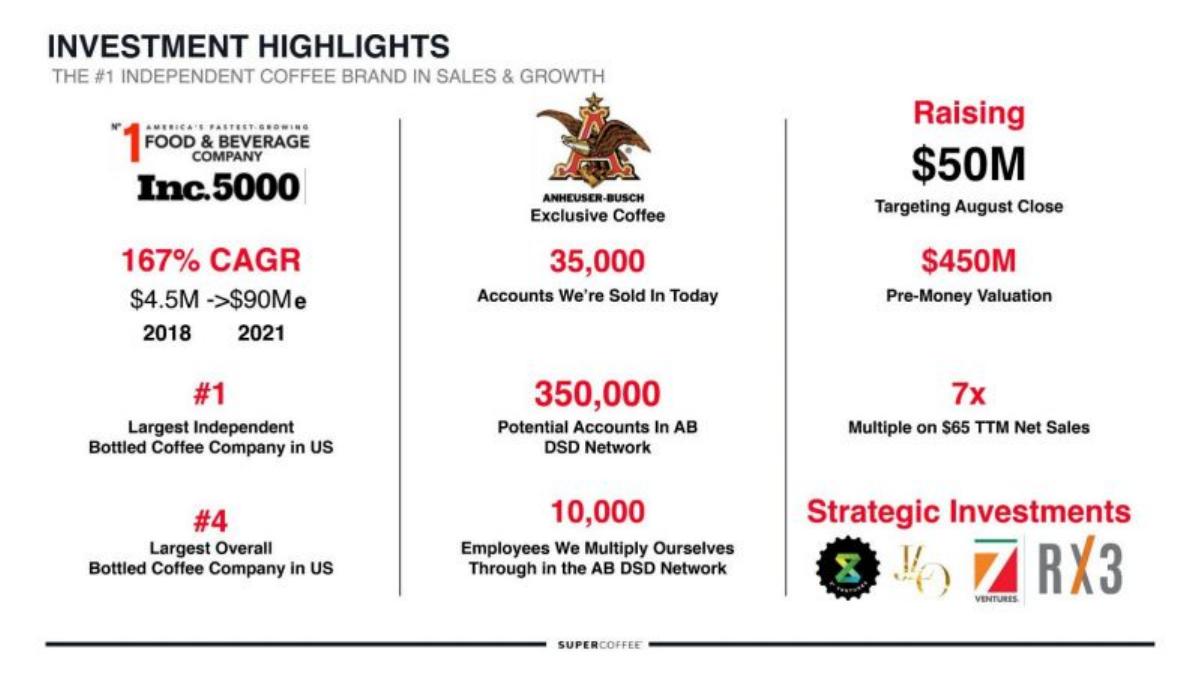
A bottled coffee brand; slide 2 is titled "Investment highlights". The slide shows figures for 2018 and 2021.
Super Coffee (Kitu) deck, slide 2. Exact stored slide matched to this analysis.
Our analysis: At a later stage it states amount, close date, valuation and the revenue multiple behind it, so investors can test the price immediately.
Evidence and limitation: "$65 TTM" has no unit (presumably millions), "#1" rankings are the company's claims, and the slide says nothing about what the $50M will fund. At seed, showing a valuation this way is uncommon and can narrow negotiation.
What a founder can adapt: If you are raising a priced later-stage round, show valuation with the metric that justifies it.
Supporting analysis
What the deck claims: A third column reads "Raising $50M — targeting August close", "$450M pre-money valuation", "7x multiple on $65 TTM net sales" and strategic investor logos, beside growth claims (167% CAGR, $4.5M to $90Me from 2018 to 2021) and distribution figures (35,000 accounts sold in today, 350,000 potential through Anheuser-Busch).
Presentation choice: At a later stage it states amount, close date, valuation and the revenue multiple behind it, so investors can test the price immediately.
When it does not fit: "$65 TTM" has no unit (presumably millions), "#1" rankings are the company's claims, and the slide says nothing about what the $50M will fund. At seed, showing a valuation this way is uncommon and can narrow negotiation.
Legal work software; a later-stage deck. Year not recorded.
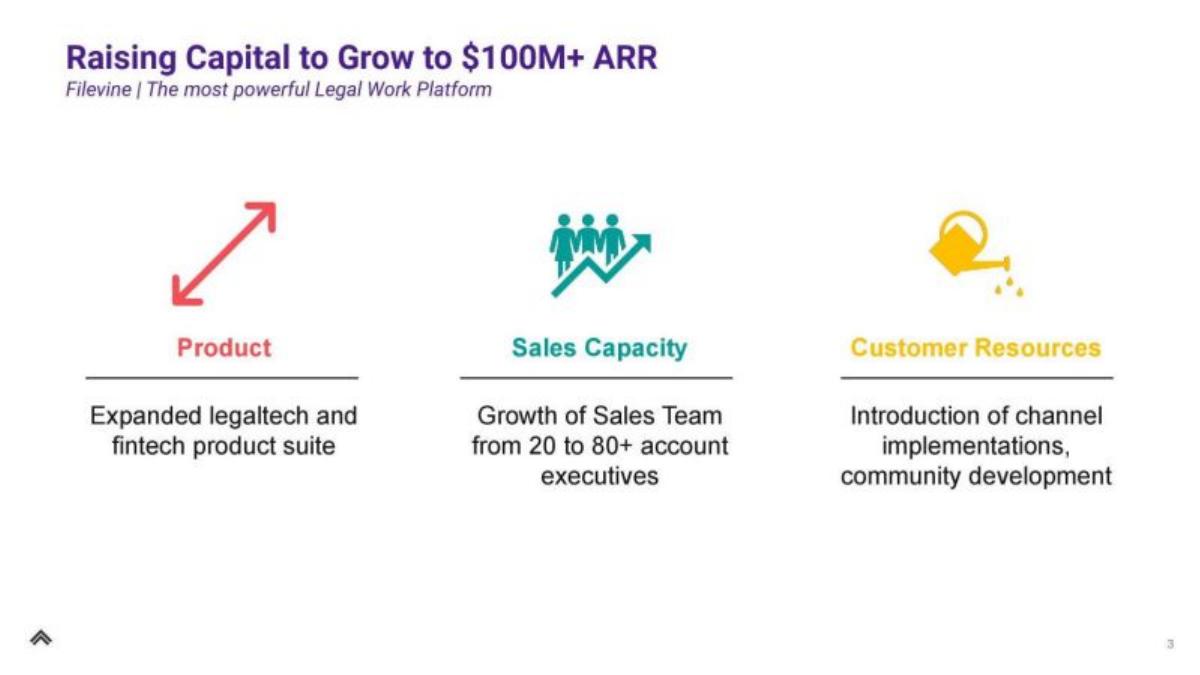
Filevine deck, slide 3. Exact stored slide matched to this analysis.
Our analysis: The headline states the outcome the money is for, and the sales line gives a concrete, checkable plan: roughly four times the account executives.
Evidence and limitation: The slide shows no amount, timeline or current ARR, so the $100M goal can't be judged from it. Only one of the three levers has a number.
What a founder can adapt: Title the slide with the goal, then give each lever one measurable number, as Filevine does for sales hires.
Supporting analysis
What the deck claims: Headline "Raising capital to grow to $100M+ ARR" over three levers: product (expanded legaltech and fintech suite), sales capacity (growing the sales team "from 20 to 80+ account executives") and customer resources (channel implementations, community development).
Presentation choice: The headline states the outcome the money is for, and the sales line gives a concrete, checkable plan: roughly four times the account executives.
When it does not fit: The slide shows no amount, timeline or current ARR, so the $100M goal can't be judged from it. Only one of the three levers has a number.
A consumer beverage brand raising to launch in the United States.
Verified source excerpt — slide 12
Funding will support a US launch with key strategic retailers, deepen the natural channel in Canada and develop a new product format, with marketing at 30% and innovation at 25% of the allocation.
The exact ask slide image is not present in the stored slide-image set. No substitute is used.
Our analysis: The allocation is tied to named channels, so each percentage has a visible purpose.
Evidence and limitation: Retailer launches depend on buyer decisions; distinguish confirmed placements from targets.
What a founder can adapt: In consumer goods, name the retailers or channels the money opens; that is the milestone investors care about.
Supporting analysis
What the deck claims: Funding will support a US launch with key strategic retailers, deepen the natural channel in Canada and develop a new product format, with marketing at 30% and innovation at 25% of the allocation.
Presentation choice: The allocation is tied to named channels, so each percentage has a visible purpose.
When it does not fit: Retailer launches depend on buyer decisions; distinguish confirmed placements from targets.
Workplace-training software selling to enterprise L&D and HR teams; a growth-stage round. Year and round name not shown; figures are redacted in the published deck.
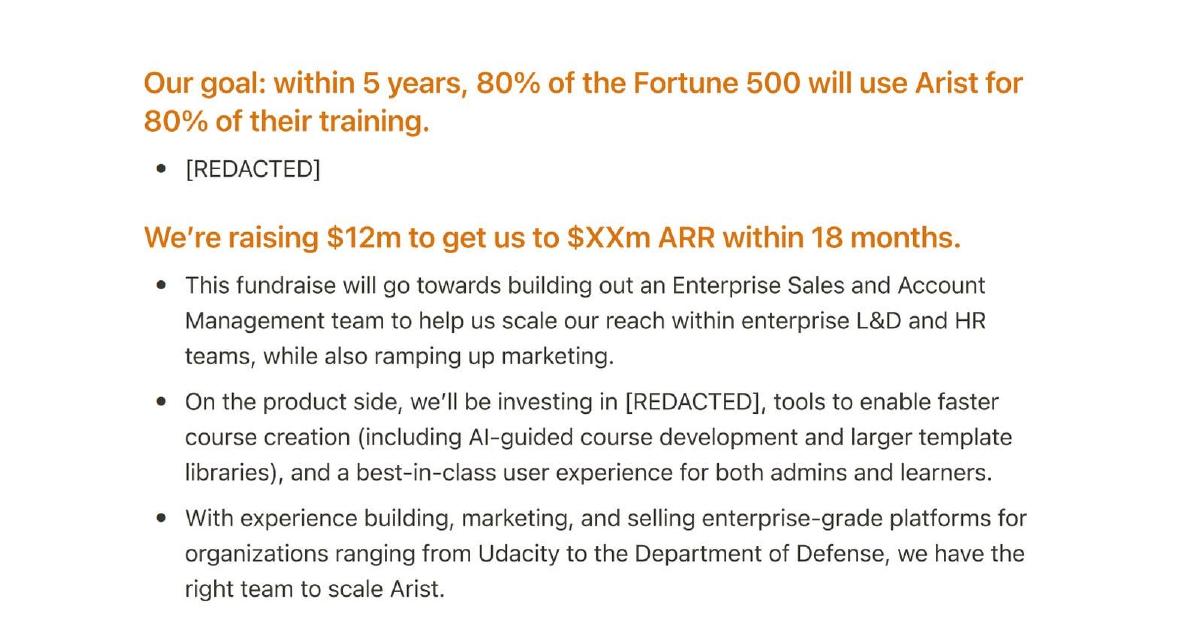
Arist deck, slide 3. Exact stored slide matched to this analysis.
Our analysis: The headline ties amount, a revenue outcome and a time window in one sentence, which is the scaling-stage pattern: the money grows something that exists.
Evidence and limitation: The five-year goal is aspirational rather than a milestone, there is no split between sales and product, and the redacted ARR target must be complete in the version investors see.
What a founder can adapt: Write your headline as "raising X to reach Y by Z", then give each use of funds one line.
Supporting analysis
What the deck claims: "We're raising $12m to get us to $XXm ARR within 18 months", funding an enterprise sales and account-management team, more marketing and course-creation tools, under a five-year goal that "80% of the Fortune 500 will use Arist for 80% of their training".
Presentation choice: The headline ties amount, a revenue outcome and a time window in one sentence, which is the scaling-stage pattern: the money grows something that exists.
When it does not fit: The five-year goal is aspirational rather than a milestone, there is no split between sales and product, and the redacted ARR target must be complete in the version investors see.
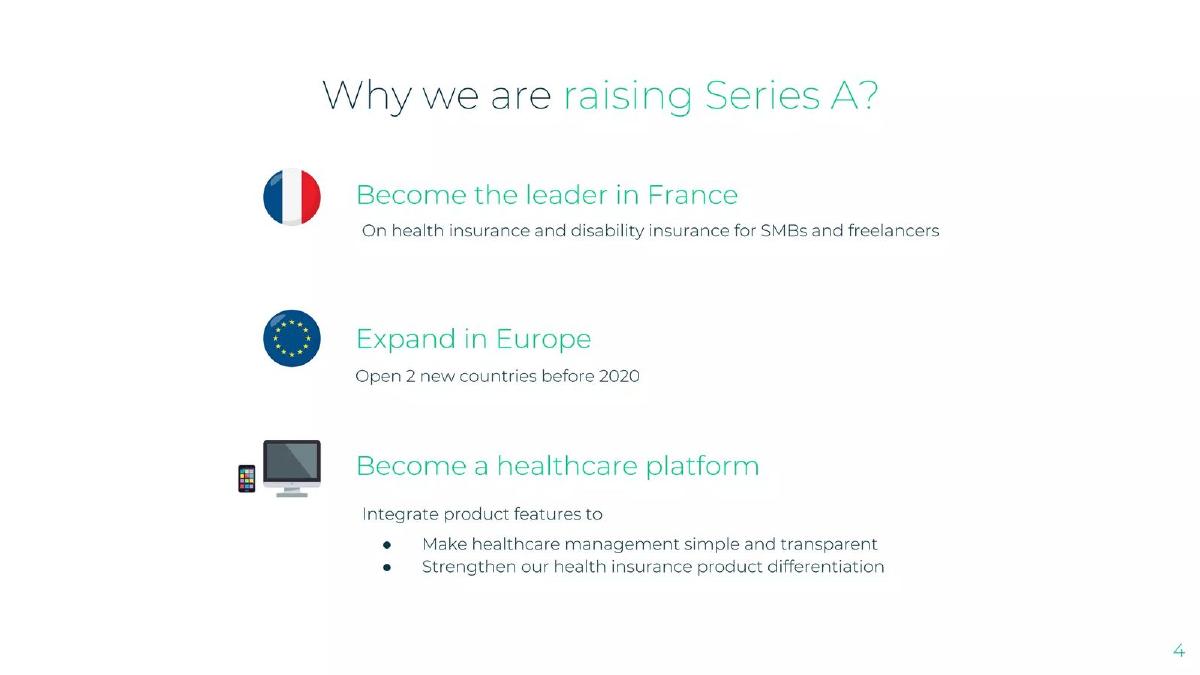
A French health insurer for small businesses and freelancers, raising its Series A.
Alan deck, slide 4. Exact stored slide matched to this analysis.
Our analysis: Framing the slide as a question makes the purpose of the money the headline rather than the amount.
Evidence and limitation: Four goals is at the upper limit; the slide works best when one goal is clearly first.
What a founder can adapt: Try titling your ask slide with the question it answers; it forces the milestones to lead.
Supporting analysis
What the deck claims: Asks "Why we are raising Series A?" and answers: become the leader in France, open two new countries within a stated period, build a healthcare platform and strengthen product differentiation.
Presentation choice: Framing the slide as a question makes the purpose of the money the headline rather than the amount.
When it does not fit: Four goals is at the upper limit; the slide works best when one goal is clearly first.
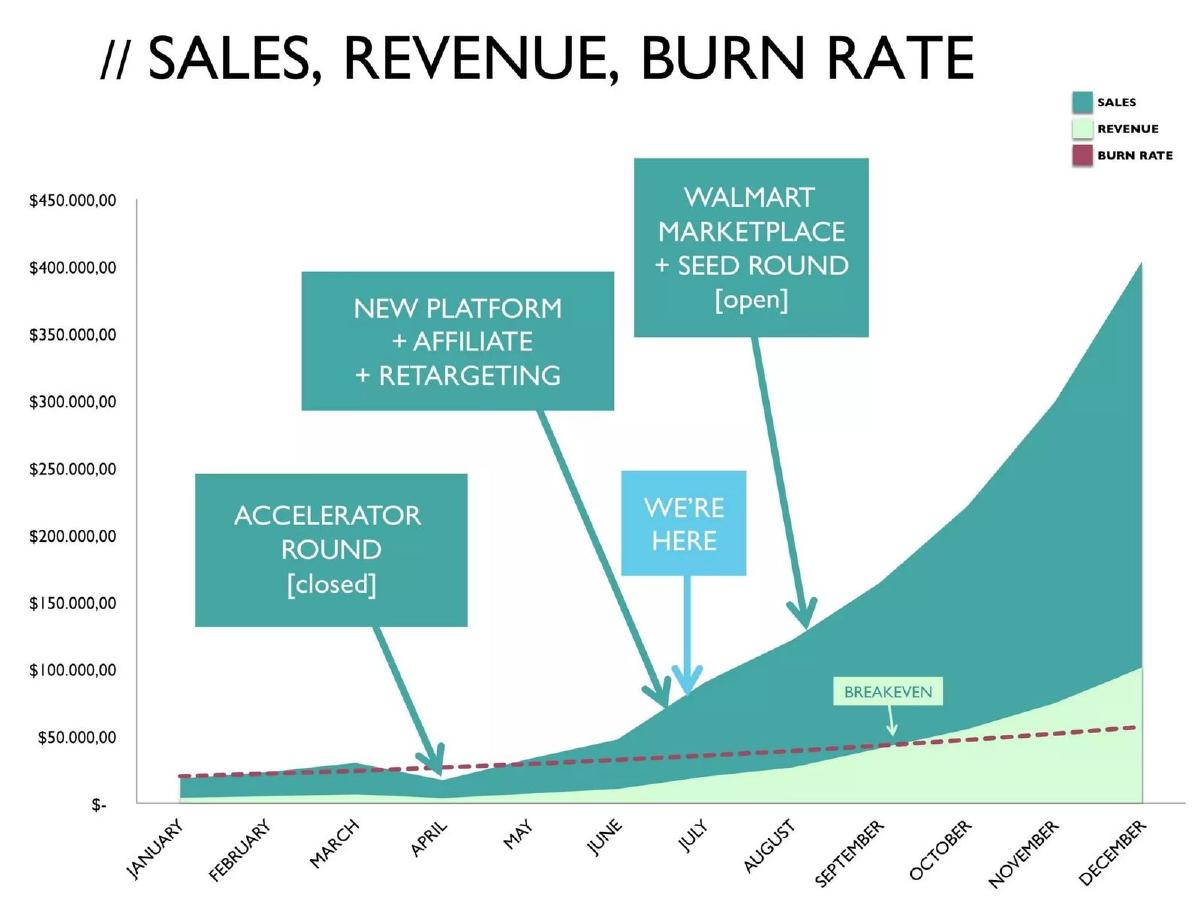
An e-commerce marketplace; slide 4 is titled "Sales, revenue, burn rate". Year not recorded.
Solidarium deck, slide 4. Exact stored slide matched to this analysis.
Our analysis: Placing the open round on the growth chart ties the raise to what it unlocks (a Walmart marketplace launch) and to a breakeven point, in a single picture.
Evidence and limitation: Most of the curve is projection, and the slide doesn't separate actual from forecast months. There is no amount for the seed round, and the axis labels are hard to read.
What a founder can adapt: Mark past and future rounds on your projection so investors see what each round pays for and when you break even.
Supporting analysis
What the deck claims: A monthly chart of sales, revenue and burn rate with callouts: "Accelerator round [closed]", "We're here", "New platform + affiliate + retargeting", "Walmart marketplace + seed round [open]", and a breakeven marker where revenue crosses burn.
Presentation choice: Placing the open round on the growth chart ties the raise to what it unlocks (a Walmart marketplace launch) and to a breakeven point, in a single picture.
When it does not fit: Most of the curve is projection, and the slide doesn't separate actual from forecast months. There is no amount for the seed round, and the axis labels are hard to read.
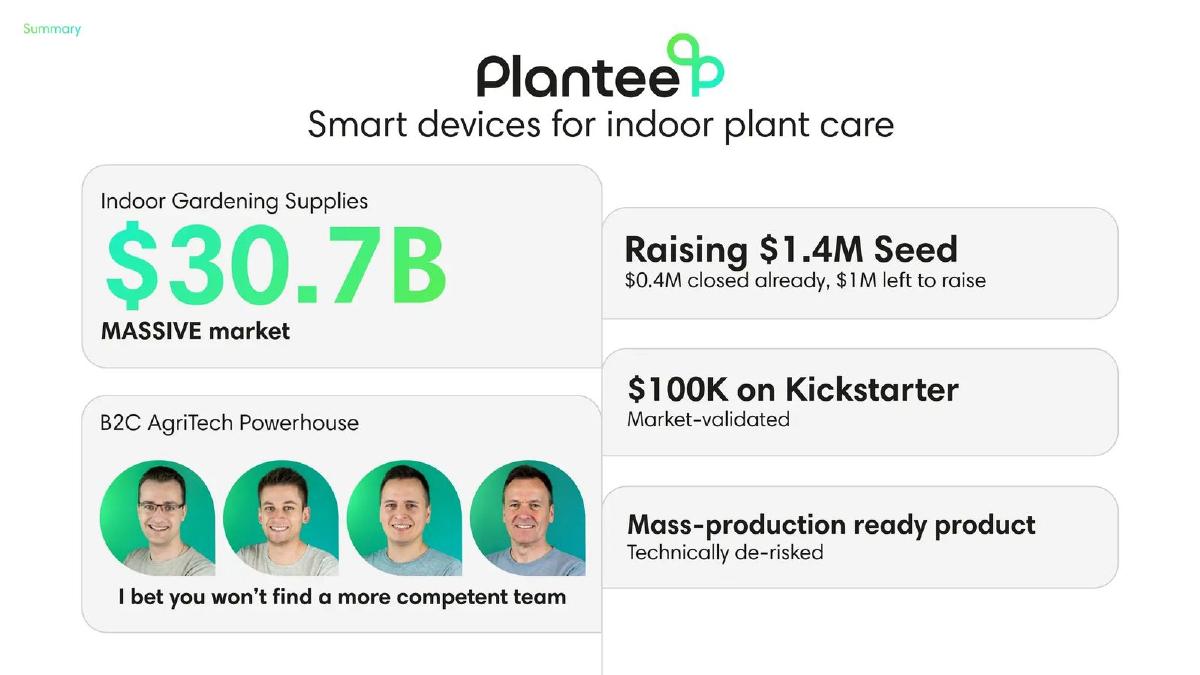
Smart indoor plant-care devices. The ask sits on a summary slide at slide 2. Year not recorded.
Plantee deck, slide 2. Exact stored slide matched to this analysis.
Our analysis: Stating how much is already committed tells investors the round has momentum and how much space is left, and putting it on slide 2 means nobody reaches the end wondering what is being asked.
Evidence and limitation: There is no milestone for the money at all, and the team caption is a boast rather than evidence. Kickstarter pre-sales are validation, but the slide doesn't say how many units they represent.
What a founder can adapt: Show closed versus remaining amounts if part of the round is committed, and put the ask early in a short deck.
Supporting analysis
What the deck claims: "Raising $1.4M Seed — $0.4M closed already, $1M left to raise", beside a $30.7B indoor gardening market figure, "$100K on Kickstarter — market-validated", "mass-production ready product — technically de-risked" and four founder photos captioned "I bet you won't find a more competent team".
Presentation choice: Stating how much is already committed tells investors the round has momentum and how much space is left, and putting it on slide 2 means nobody reaches the end wondering what is being asked.
When it does not fit: There is no milestone for the money at all, and the team caption is a boast rather than evidence. Kickstarter pre-sales are validation, but the slide doesn't say how many units they represent.
A green-energy equipment company; slide 3 is titled "Investment opportunity". Year not recorded.
Mapal deck, slide 3. Exact stored slide matched to this analysis.
Our analysis: Included as a common pattern to improve on. The uses are specific (a rental fleet, catalogue items), which is better than generic categories.
Evidence and limitation: A $1M range invites investors to assume the lower figure, five uses with no split or priority are hard to weigh, and nothing says where the company will be when the money runs out.
What a founder can adapt: Keep uses as concrete as "fund a rental fleet", then add what each should produce.
Supporting analysis
What the deck claims: "Mapal is seeking to raise between US$2 million and US$3 million" to accelerate sales growth, fund a rental fleet, continue R&D, provide general working capital and develop standardised catalogue items for "off the shelf" sales.
Presentation choice: Included as a common pattern to improve on. The uses are specific (a rental fleet, catalogue items), which is better than generic categories.
When it does not fit: A $1M range invites investors to assume the lower figure, five uses with no split or priority are hard to weigh, and nothing says where the company will be when the money runs out.
A three-year-old last-mile delivery aggregator; slide 2 is an "Elevator Pitch". The slide cites 2014 sales, so the deck dates from 2015 or later; the company name is not shown.
Delivery aggregator deck, slide 2. Exact stored slide matched to this analysis.
Our analysis: The ask arrives on slide 2 inside a five-line summary, so investors know the size and price of the conversation before the detail.
Evidence and limitation: Stating a pre-money valuation this early anchors negotiation, and citing Metapack's $33M Series B as proof of concept is a comparison, not evidence for this company.
What a founder can adapt: If you open with a summary, put the amount and the two uses in it, and make sure the later ask slide uses the same numbers.
Supporting analysis
What the deck claims: "Seeking $1M in funding under $3M pre-money valuation" to expand physical coverage and build a SaaS platform bridging e-commerce and last-mile couriers, after "100%+ annual consecutive growth rates". The 2014 sales figure is covered by a star on the published slide.
Presentation choice: The ask arrives on slide 2 inside a five-line summary, so investors know the size and price of the conversation before the detail.
When it does not fit: Stating a pre-money valuation this early anchors negotiation, and citing Metapack's $33M Series B as proof of concept is a comparison, not evidence for this company.
Media-library and content-management software; slide 2 is a text "Summary". Year not recorded.
Iconicloud deck, slide 2. Exact stored slide matched to this analysis.
Our analysis: Included as a pattern to improve on. The amount and stage are clear in one sentence, which many summaries omit.
Evidence and limitation: "Select" markets are unnamed, there is no runway or allocation, and claims such as "solid investment candidate" add nothing an investor can check.
What a founder can adapt: Keep the one-sentence ask, then replace the adjectives with the specific launch milestone and the months the $500K should last.
Supporting analysis
What the deck claims: "We are seeking $500K in seed funding to accelerate product launch into select CMS platform markets", followed by paragraphs on team, business model and "excellent strategic exit potential".
Presentation choice: Included as a pattern to improve on. The amount and stage are clear in one sentence, which many summaries omit.
When it does not fit: "Select" markets are unnamed, there is no runway or allocation, and claims such as "solid investment candidate" add nothing an investor can check.
The same information can be written to answer the investor's real question or to avoid it.
Element
Weak version
Stronger version
Amount
"Raising $500k–$2.5M"
"Raising $2.5M" with a note on what a smaller close would still achieve
Purpose
Pie chart of spending categories
Two or three milestones the money buys
Runway
Not stated
"24 months of runway at planned hiring"
Allocation
Eight thin slices
Three or four categories tied to milestones
Next round
Not mentioned
What will be proven before raising again
Key Takeaways
Lead with what the round should prove. Doorvest's repeatability goal gives the raise a next-round purpose rather than only a spending plan.
Connect amount and time. Equals pairs roughly $4 million with 24 months, making the intended runway visible even though its user milestone remains vague.
Use stage-appropriate verbs. Alan and Arist describe expansion and revenue targets; seed examples such as Iconicloud focus on launching and proving demand.
Say how much is already committed. Plantee shows $0.4M closed and $1M left to raise, which tells investors the round has momentum.
Write your ask slide
Work backwards from the evidence the company must have before its next financing decision.
Amount. State one target amount, or explain exactly what changes across a narrow range.
Runway. Calculate the months funded at the hiring and spending plan shown in the financials.
Milestones. Choose two or three dated, measurable outcomes the round is intended to achieve.
Allocation. Group spending into three or four categories and connect each to a milestone.
Copyable framework: We are raising [amount] for [months] to achieve [milestone 1], [milestone 2], and [milestone 3].
After: $2.5M for 20 months to launch, reach 100 paying customers, and prove repeatable acquisition
What improved: The rewrite turns expense categories into measurable intended outcomes.
What the ask slide is really for
By the time an investor reaches the ask, they have formed a view of the company. The ask slide answers a narrower question: is this amount of money the right amount to get this company to a point where it is worth much more? Too little and the company will be back raising before it has proven anything. Too much and the founders either give away more of the company than they need to or have not thought hard about what the money is for.
That is why the milestone matters more than the number. An investor is buying a share of the company as it will be at the next round. The ask slide should describe that future company: what it will have built, what it will have proven, and why that proof makes the next round easier to raise.
The slide also sets up the practical conversation that follows. Once a partner is interested, the next questions are about instrument, valuation, who else is investing and when the round closes. You do not need all of that on the slide, but the amount and the milestones should make those questions easy to answer.
The four parts of a strong ask
The amount. State a single number or a narrow range. "We are raising a seed round of around $4M" is clear. A range such as "$500,000 – $2.5M", which appears on one aerospace deck in our corpus, is wide enough that investors will wonder what the company does at each end of it. If you have a range, explain what the top of the range adds.
The milestones. Two or three concrete outcomes the money should produce. Equals ties its seed round to 24 months, a first version and product-market fit with paying users. Filevine gives its sales plan a number: growing "from 20 to 80+ account executives". These give an investor something to measure the company against.
The runway. How many months the money lasts. Equals states it directly: "To fund an initial team for 24 months." Many early-stage investors expect a seed round to last long enough to reach the next round's milestones with some margin; the exact expectation varies by market and investor, so state yours and be ready to explain it.
The allocation. A simple split across the three or four areas where money will actually go, usually hiring, product, and sales and marketing. Blume's slide, for a consumer goods brand, gives percentages (marketing 30%, innovation 25%) linked to a clear goal: a US launch with key retailers. Keep the categories few enough that each is meaningful.
Sizing the round: working backwards from the milestone
The most defensible way to size a round is to start from the milestone and work backwards. Decide what the company must prove before the next raise, estimate the team and spending needed to prove it, add the time it will realistically take, and add a buffer for things going slower than planned. The number that falls out is the ask.
This approach shows on the slide. Doorvest's ask reads "Raising $2.5m to achieve" followed by three goals: accelerating customer adoption after finding product-market fit, expanding the founding team, and expanding into new markets to "demonstrate repeatability". The last word is the important one: it tells the investor what the next round will be raised on.
Y Combinator's guidance on SAFEs describes the ownership side of the same decision: start from how much you are targeting and how much ownership you are willing to sell, and the valuation cap follows. Their worked example is a $1M raise selling 15%, which implies a post-money cap of about $6.7M. You do not need that arithmetic on the slide, but you should have done it before you present, because it will be the next question. (Y Combinator)
Seed versus Series A: how the ask changes
At seed, the ask is usually about proving that customers want the product. The milestones are product releases, first paying customers, early retention and a small team. Equals' ask — build version one and "demonstrate product market fit with a small number of paying users who deeply use the product" — is a typical seed shape, and it is honest that another round will follow.
At Series A and later, the ask is about scaling something that already works. Arist's slide reads "We're raising $12m to get us to $XXm ARR within 18 months" and puts the money into enterprise sales and account management. Alan's Series A slide is organised around a question — "Why we are raising Series A?" — and answers with market leadership in France, opening two new countries within a stated period, and product expansion.
The difference is visible in the verbs. Seed asks build, test and prove. Series A asks expand, scale and lead. If your seed ask reads like a Series A ask, investors may conclude you are raising too much for the evidence you have; if your Series A ask reads like a seed ask, they may conclude the company has not yet found what works.
How much detail belongs on the slide
Keep the slide readable at a glance. Kevin Hale's advice at Y Combinator is that a slide should be understood immediately; his test is to show it to a stranger and ask them to say what it means. An ask slide that passes the test has the amount in large type, the milestones as short lines, and at most a simple allocation chart.
If the plan depends on something outside your control, such as a licence, a key partner or the next round closing on time, say so near the ask. A short risk slide can name that dependency, estimate how likely and how costly it is, and state what you will do if it slips; our guide to risks and mitigation on the ask slide compares five real examples.
Put the detailed budget in an appendix or a separate model. Line-item hiring plans, monthly burn and scenario analysis belong in the data room, where an investor doing diligence can find them. The slide should give the investor enough to decide whether to ask for that detail.
Leave terms out unless they are set. If you have a lead investor and agreed terms, it can help to show them. If you do not, putting a valuation on the slide anchors a negotiation before the investor is interested, and a figure that looks high can end the conversation early. (Y Combinator)
Where the ask sits in the deck
Most decks we have read put the ask near the end, after traction, team and financials, so that the investor has the evidence before seeing the number. Some place a short version in the summary slide at the front: Rattle Radio's summary ends with "Seeking $3.5M" and a revenue run-rate target, so the investor knows the size of the conversation from the start.
Either placement works if it is consistent. If the ask appears twice, the numbers must match exactly. If the financials slide shows a burn rate, the runway on the ask slide should agree with it. Investors notice when the arithmetic across slides does not add up.
Common mistakes
Leading with the pie chart. Spending categories answer where, not why. Put milestones first and the allocation underneath.
A range too wide to mean anything. If the top of your range is several times the bottom, investors will ask which company they are funding. Narrow it or explain the difference.
No runway. Without months, investors cannot tell whether the milestones are reachable. State the runway at planned spending.
Numbers that disagree with the financials. If burn on the financials slide implies twelve months and the ask says twenty-four, the investor will trust neither. Check the arithmetic across slides.
Putting a valuation on the slide too early. A number before interest is established anchors the negotiation and can end it. Keep terms for the conversation unless they are already set by a lead.
Goals without numbers. "Scale customer adoption" cannot be measured. Attach a count, a revenue level or a date to each milestone.
Diagnostic checklist
One amount, or a narrow range with the difference explained
Two or three milestones, each with a number or date
Runway in months at planned spending
Three or four allocation categories at most
A line on what the next round will be raised on
Amount and runway match the financials slide
Existing funding shown if you have raised before
Detailed budget in the appendix, not on the slide
Frequently asked questions
Should I put the valuation on the ask slide?
Usually not, unless a lead investor has already set terms. A valuation on the slide anchors the negotiation before the investor has decided they want to invest. Have the figure ready for the conversation, and understand how your amount and target ownership relate to it. (Y Combinator)
How long should a seed round last?
Long enough to reach the milestones the next round will be raised on, with a buffer for delays. Many founders plan for around eighteen to twenty-four months, but the right figure depends on your milestones and market. State yours on the slide and make sure your financials support it.
Is a use-of-funds pie chart enough?
It is useful supporting detail but not enough on its own. Investors want to know what the money achieves, so lead with milestones and use the chart to show roughly how spending is divided.
Where should the ask slide go?
Most decks place it near the end, after traction, team and financials. Some also put a one-line version on the summary slide at the front. Either works as long as the numbers are identical wherever they appear.
What if I am open to raising more or less than my target?
Give a target and explain what changes at a lower or higher close — for example, fewer hires or a later market launch. That shows you have thought about the plan rather than picked a number.
Should I name the instrument, such as a SAFE or priced round?
It can help if it is decided, especially for smaller angel rounds, because it tells investors what they are signing. Y Combinator publishes its standard SAFE documents and explains how the amount and ownership sold determine the cap. (Y Combinator)
How we chose these examples
Corpus: published pitch deck teardowns on StartupFundraising.com. Founder-uploaded private decks are excluded entirely.
Selection: our slide-type classifier labels very few ask slides, so we searched extracted slide text for ask and use-of-funds language (use of funds, use of proceeds, we are raising, seeking, the ask) between slides three and twenty-five. We read 38 matching slides and chose ten that show a clear approach, including one common pattern to improve on. On 2026-09-24 we added three early-deck asks (slides 2–3) found by searching for raising, seeking or the ask followed by an amount, replacing the text-only Daydream example with an illustrated one.
Review: examples were selected and described by our editorial model from the extracted slide text and checked against that text. No person has yet reviewed these examples for this page.
Amounts and goals quoted are the companies' own statements on their slides; we have not verified them, and we do not know whether each round closed at the stated amount.
We make no claim that any ask slide caused a fundraising outcome.