Filevine's Series D deck is a sophisticated example of late-stage enterprise fundraising. Rather than focusing on basic product features, the narrative centers on market maturity and the 'once-in-a-generation' shift from fragmented server-based tools to integrated cloud suites. The deck successfully positions Filevine as the 'ServiceNow for Legal,' leveraging heavy usage data—1.2 million actions per day—to prove product-market fit. While it lacks explicit financial tables or a detailed cap table, the focus on expanding sales capacity from 20 to 80+ account executives clearly signals a transit…
Key takeaways
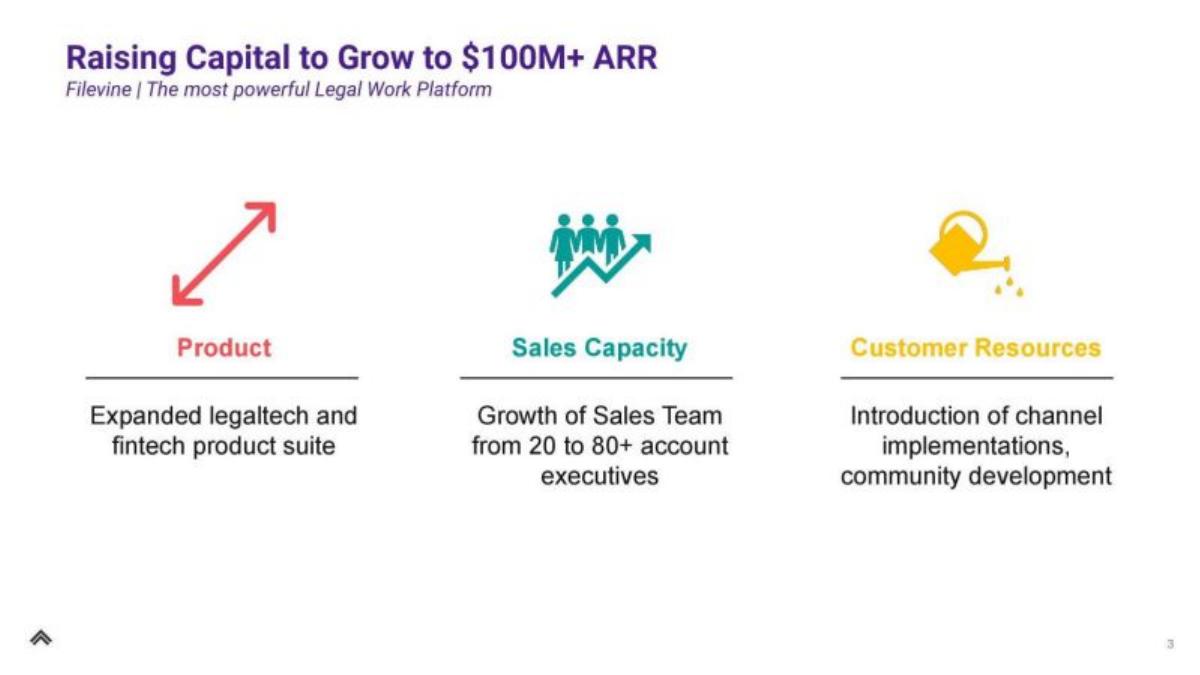
- The company explicitly states its goal is to raise capital to grow to $100M+ ARR on slide 3.
- Filevine plans to scale its sales team from 20 to over 80 account executives using the new capital, as noted on slide 3.
- Market demand is framed by a -1.7% year-over-year decline in lawyer FTE growth against rising regulation on slide 5.
- The deck identifies a $15.9B Total Addressable Market (TAM) with a $4.1B Serviceable Obtainable Market (SOM) on slide 9.
- Slide 10 highlights that 81.6% of firms with 10+ lawyers are still on server-based systems, representing a massive migration opportunity.
- Product usage is high, with the deck reporting 503 average weekly actions per user on slide 13.
- The platform has processed over 292 million documents and 20 million emails, according to slide 14.
- Customer ROI claims include an 80% faster deal cycle and a 4x increase in case load capacity on slide 15.
The Series D Narrative: From Tool to Infrastructure
Filevine’s 2022 Series D deck is a textbook example of how a scaling SaaS company shifts its narrative from "look at our cool features" to "we are the inevitable industry infrastructure." Raising $108M requires proving that the company can handle massive scale and that the market is ready for a dominant, consolidated platform. Filevine uses 18 slides to argue that the legal industry is undergoing a once-in-a-generation shift to the cloud, and they are the only ones with the integrated suite to capture it.
Slides 1-4: The Ambition and the Architects
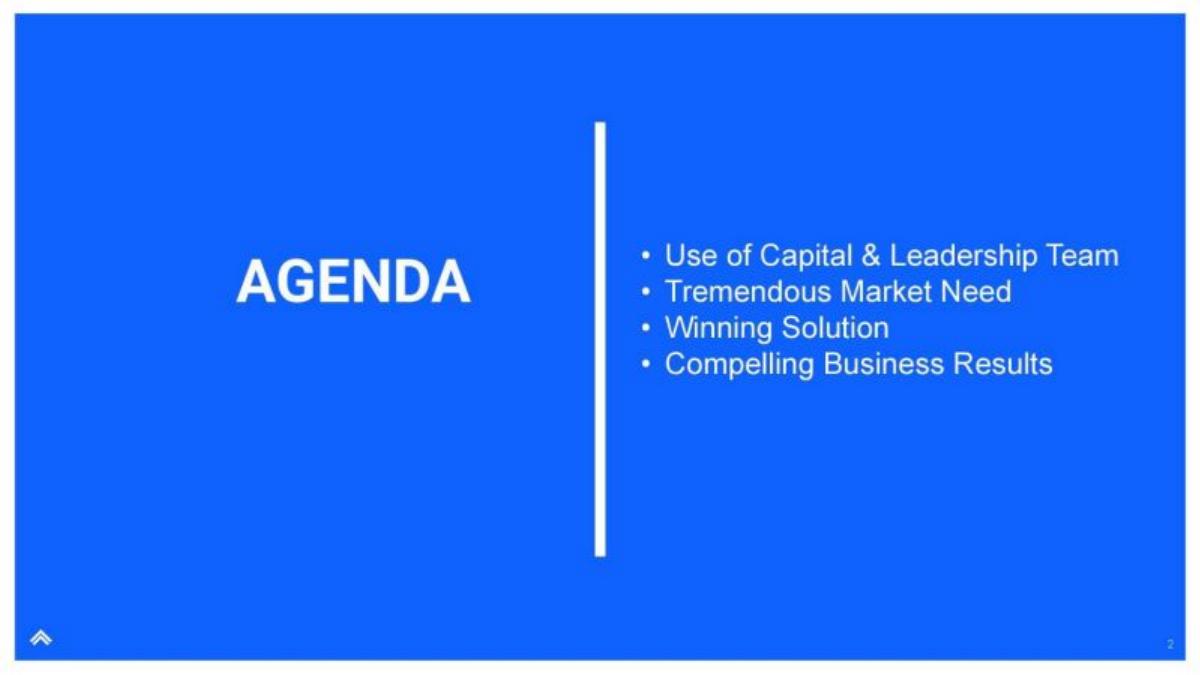
Slide 1 is a standard confidential title slide, dated November 2021. It sets a professional, corporate tone immediately. Slide 2 provides a four-point agenda: Use of Capital, Market Need, Winning Solution, and Business Results. This is a logical flow for a late-stage round where investors are primarily looking for a repeatable growth engine.
Slide 3 is perhaps the most important slide for a Series D investor. It explicitly states the goal: "Raising Capital to Grow to $100M+ ARR." It breaks down the use of funds into three pillars: Product (expanding into fintech), Sales Capacity (growing the team from 20 to 80+ account executives), and Customer Resources (channel implementations). The specificity of the sales team growth—a 4x increase—tells investors exactly where the bulk of the $108M is going: aggressive market capture.
Slide 4 introduces the team. It is a high-pedigree lineup, featuring founders with legal backgrounds (Bighorn Law) and executives with experience at Adobe, Qualtrics, and Goldman Sachs. Highlighting "Head Legal Futurist" Dr. Cain Elliott suggests the company is thinking beyond current software needs and toward the long-term evolution of the profession.
Slides 5-8: The Macro Problem and Stakeholder Complexity
Slide 5 tackles the "Why Now?" question. It presents a compelling macro-economic problem: "Too Much Legal Work and Too Few Lawyers." The slide uses three charts to show rising federal regulations against a -1.7% decline in lawyer FTE growth. This creates a narrative of a "labor shortage" that can only be solved by software efficiency.
Slide 6 reinforces this with a "social proof" montage of news headlines about court backlogs and labor shortages. This moves the problem from abstract data to real-world consequences, like "Justice delayed" in Philadelphia courts. Slide 7 and 8 use complex chord diagrams to visualize the "Intersection Between a Huge Variety of Stakeholders." These slides illustrate that legal work isn't just for lawyers; it involves HR, Finance, IT, and outside counsel. By showing the mess of tasks in the middle—from billing to document management—Filevine positions itself as the central nervous system that organizes this chaos.
Slides 9-10: Market Size and the Cloud Migration Opportunity
Slide 9 breaks down the market. They claim a $15.9B TAM, a $6.9B SAM, and a $4.1B SOM. What is interesting here is the $4.1B SOM is labeled as "60% Market Share." This implies they believe they can capture a majority of the core legal tech market. The slide lists 12 different sub-sectors, from "Matter Management" ($2.9B) to "IP Management" ($768M), showing the breadth of their potential reach.
Slide 10 identifies the specific catalyst for growth: the cloud migration. According to the ABA Tech Survey cited on the slide, 81.6% of firms with 10 or more lawyers are still on server-based systems. This is the "Once-In-A-Generation Shift" mentioned in the header. For an investor, this represents a massive, untapped replacement market rather than just a greenfield opportunity.
Slides 11-12: The Integrated Suite Strategy
Slide 11 shows the product architecture. It highlights "The Vine Platform" as the core, surrounded by modules like Lead Management (LeadDocket), E-Signature (Vinesign), and Contract Lifecycle Management (Outlaw). The footnotes indicate that LeadDocket and Outlaw were acquired in 2020 and 2021, signaling that Filevine is an active consolidator in the space. Slide 12 maps this to the "Ecosystem of Corporate Law," showing a seamless flow from CRM (Salesforce) to CPQ, CLM, and ELM. This slide is designed to show how Filevine fits into the existing enterprise tech stack, making it a "safe" bet for large corporate legal departments.
Slides 13-15: Usage Metrics and Customer ROI
Slide 13 shifts to engagement. It claims 1.2 million "Actions Per Day" and an average of 503 weekly actions per user. The bar chart shows a steady upward trend in user activity from 2018 to 2021. In SaaS, high usage frequency is the best predictor of low churn. Slide 14 provides the "big numbers": 20 million emails received, 292 million documents generated, and 580,000+ documents signed. These are "vanity metrics" in some contexts, but here they serve to prove the platform's reliability and scale.
Slide 15 is a table of "ROI and Improvement Results." It includes impressive claims: an 80% faster deal cycle, a 4x increase in case load capacity, and 433 hours saved per year. By pairing these metrics with direct customer quotes, the deck attempts to prove that the software isn't just a cost—it's a revenue generator and a labor-saving device.
Slides 16-18: The Closing and Legal Disclaimers
Slide 16 delivers the final pitch: "What Workday is to HR, what ServiceNow is to IT, Filevine is to Legal." This is a classic "X for Y" framing that helps late-stage investors categorize the company's potential valuation and market dominance. Slide 17 is a standard legal disclaimer regarding forward-looking statements, and Slide 18 is a promotional slide for the source of the deck.
What Works in This Deck
The "ServiceNow for Legal" Framing: By comparing themselves to established giants like Workday and ServiceNow, Filevine gives investors a mental model for their potential $10B+ valuation. It moves the conversation away from "legal software" to "enterprise platform."
Usage as a Proxy for Value: The focus on "Actions Per Day" (Slide 13) is a strong way to show that the product is sticky. In a crowded legaltech market, proving that users actually live in the app every day is a significant competitive advantage.
Clear Use of Capital: Many decks are vague about what they will do with $100M. Filevine is explicit: they are quadrupling the sales team. This shows a company that has figured out its unit economics and is ready to pour fuel on the fire.
What Is Missing
Historical Financials: While the deck mentions a goal of $100M+ ARR, it does not show the actual historical revenue growth curve. Investors would want to see if the growth is accelerating or decelerating leading up to the Series D.
Unit Economics: There is no mention of Customer Acquisition Cost (CAC), Lifetime Value (LTV), or Net Revenue Retention (NRR). For a Series D round, these metrics are usually the primary focus of due diligence.
Competitive Landscape: The deck assumes Filevine is the only integrated player. It does not address other major legaltech platforms or how they plan to win against incumbents like Clio or specialized enterprise tools.
Founder Takeaways
Sell the Shift, Not the Tool: Filevine doesn't just sell software; they sell the "once-in-a-generation shift to the cloud." Founders should frame their product as an inevitable response to a massive market transition. · Quantify the Labor Gap: If your software increases efficiency, prove that there is a labor shortage in your target industry. Slide 5’s use of the -1.7% lawyer growth metric is a brilliant way to make the software feel like a necessity rather than a luxury. · Show the Ecosystem: If you are building a platform, show how you integrate with the tools your customers already use (like Salesforce on Slide 12). This reduces the perceived risk of adoption for enterprise buyers. · Be Specific About Scaling: If you are raising a large round, be as specific as Slide 3. Tell investors exactly how many people you are hiring and in which departments. It demonstrates operational maturity.
Frequently asked questions
- What was the primary objective of Filevine's Series D deck?
- The primary objective was to secure funding to scale the company to over $100M in Annual Recurring Revenue (ARR). Slide 3 explicitly outlines that the capital would be used to expand the product suite into fintech, quadruple the sales team from 20 to 80+ account executives, and build out channel implementations and community development resources.
- How does Filevine define its market opportunity?
- Filevine defines its market through a supply-demand imbalance in the legal sector. Slide 5 shows that while federal regulations are increasing, the growth of the lawyer workforce is actually shrinking (-1.7% in 2020). They position their software as the necessary efficiency layer to bridge this gap, targeting a $15.9B total market.
- What evidence of product-market fit does the deck provide?
- The deck relies on high-velocity engagement metrics rather than just revenue. Slide 13 and 14 show that users perform an average of 503 actions per week, totaling 1.2 million actions per day across the platform. This includes 292 million documents generated and 580,000+ documents signed, suggesting the platform is deeply embedded in daily workflows.
- Who are the key members of the Filevine leadership team?
- The team is led by Co-Founder/CEO Ryan Anderson and Co-Founder/CCO Nathan Morris, both formerly of Bighorn Law. The executive bench includes veterans from Adobe, Qualtrics, and Goldman Sachs, such as CFO Ian Charles and EVP of Product Michael Anderson, as detailed on slide 4.
- What is Filevine's 'Integrated Suite' strategy?
- Filevine is moving away from being a single-point tool to an 'Integrated Suite.' Slide 11 and 12 show how they have acquired or built components like Lead Docket (lead management) and Outlaw (contract lifecycle management) to cover the entire legal workflow from CRM to ELM, effectively competing with legacy server-based systems.