PRAGATI is a conceptual fintech project aimed at solving financial exclusion through a community-driven, blockchain-based lending model. The deck identifies four primary problems: limited access to fair credit, financial exclusion of the unbanked, emergency support gaps, and a lack of trust in existing P2P models. The proposed solution involves community-based savings pools, peer-to-peer engagement, and a trust-based credit scoring system. While the deck provides a clear logical flow of how the platform might operate—including revenue streams like transaction fees and membership plans—it is e…
Key takeaways
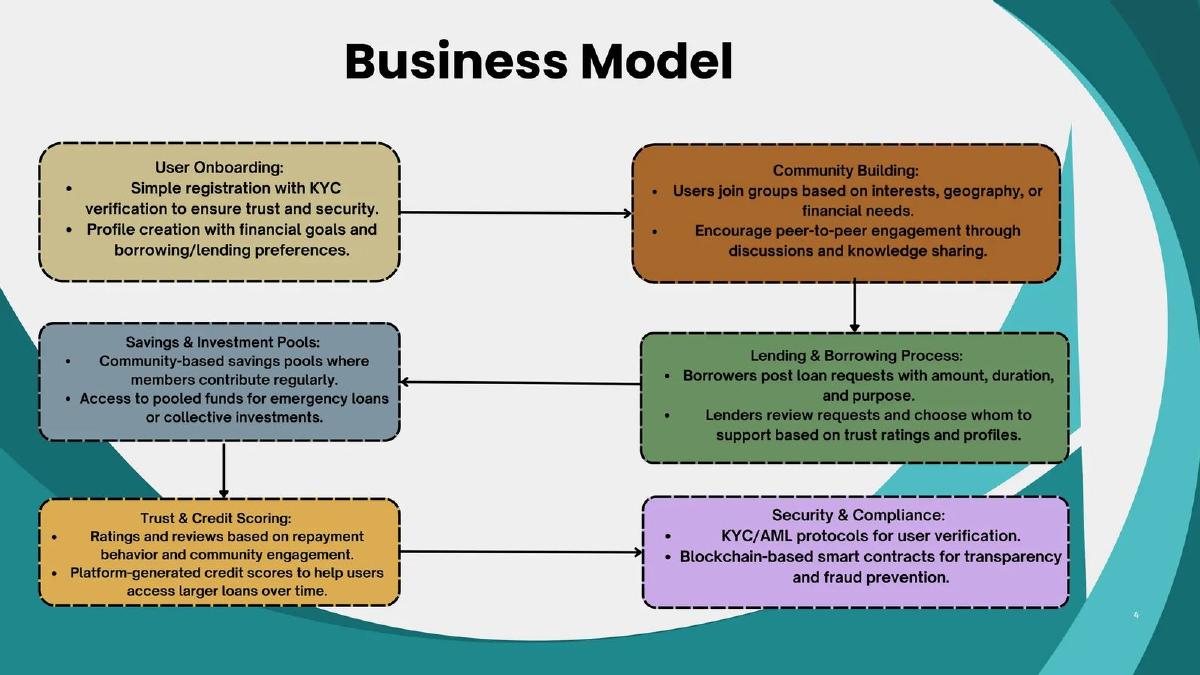
- The platform intends to use blockchain-based smart contracts for transparency and fraud prevention as stated on slide 4.
- The business model relies on community-based savings pools where members contribute regularly to fund emergency loans (slide 4).
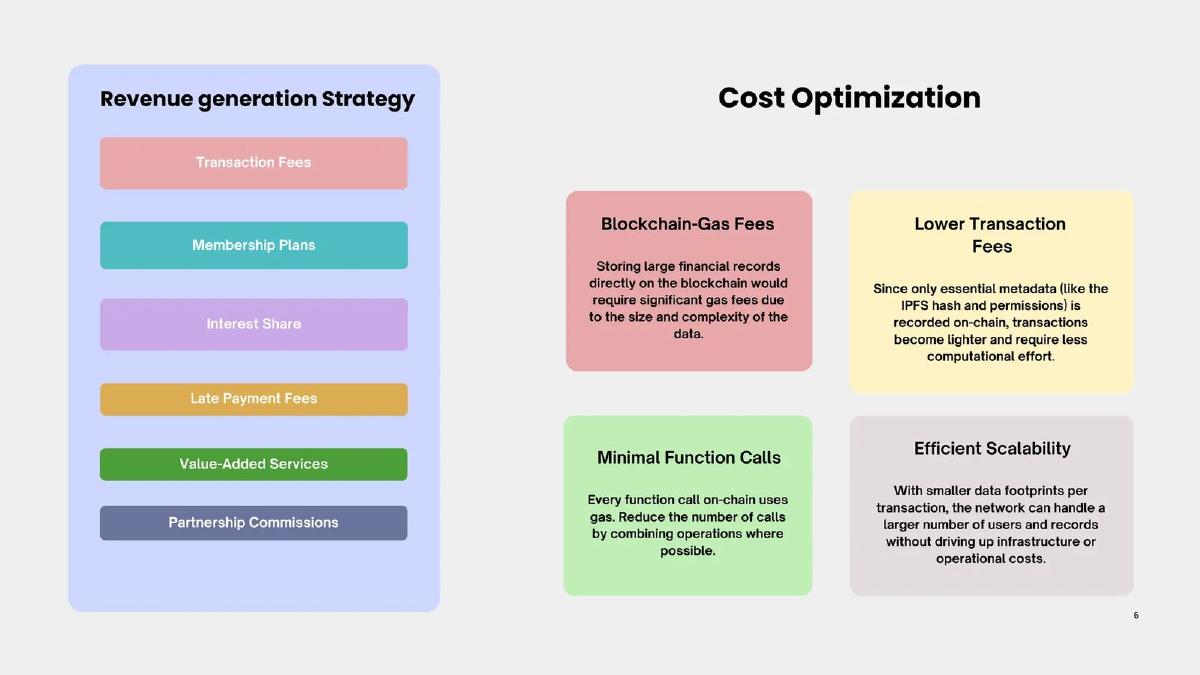
- Revenue is projected to come from six distinct streams: transaction fees, membership plans, interest share, late payment fees, value-added services, and partnership commissions (slide 6).
- The deck claims a break-even timeline of 2-3 years, though it provides no underlying financial data to support this forecast (slide 7).
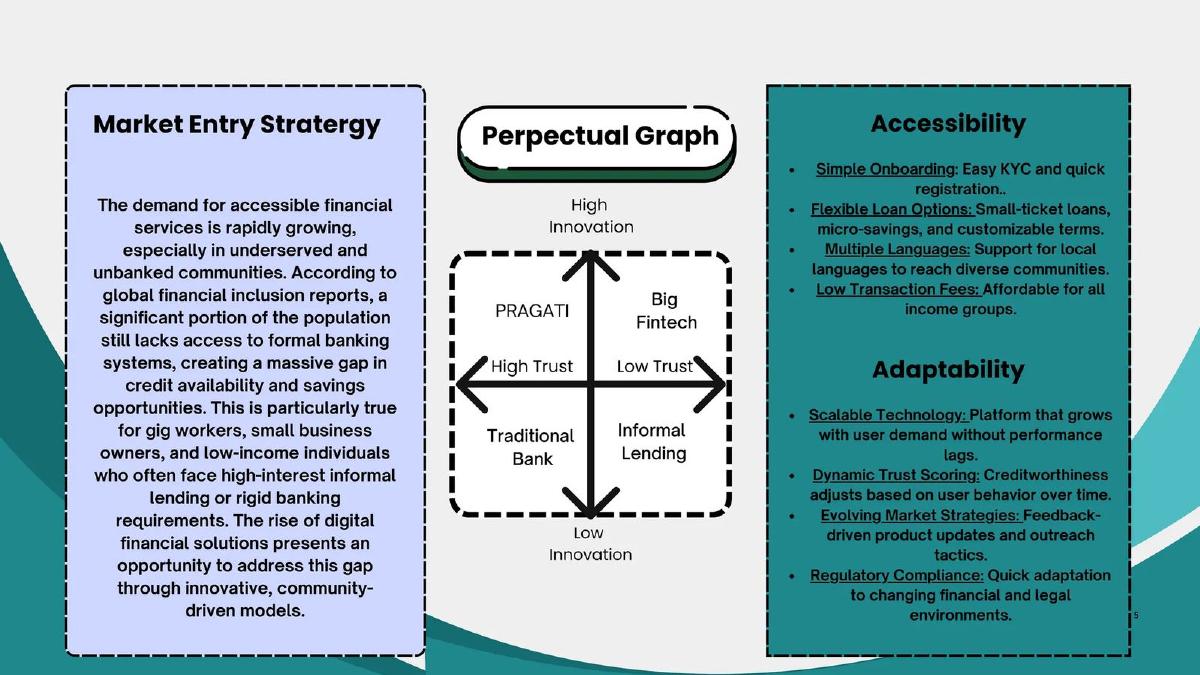
- A 'Perpectual Graph' (likely a misspelling of Perceptual) positions PRAGATI as a high-innovation, high-trust alternative to 'Big Fintech' and 'Traditional Banks' (slide 5).
- The deck completely omits a team slide, leaving the founders' backgrounds and execution capabilities unknown.
- There is no specific funding 'ask' or breakdown of how capital would be deployed, which is a critical omission for a pitch deck.
- The solution includes an unusual mention of analyzing health data to forecast medical conditions, which appears disconnected from the core lending model (slide 3).
PRAGATI Pitch Deck Analysis
The PRAGATI pitch deck, titled "PRAGATI Business pitch deck financial idea," is an 8-slide presentation that outlines a conceptual framework for a decentralized, community-driven financial platform. The deck focuses heavily on the logic of the business model and the theoretical application of blockchain technology to solve for financial exclusion. However, it lacks the empirical data and team validation typically required for a professional fundraising round.
Slide 1: Title Slide
The deck opens with "Project PRAGATI" and a sub-caption "Team Name: RANK." The visual design is minimal, using a teal and white color palette. There is no company logo, only the project name in a bold, sans-serif font. The lack of a specific company entity or website URL suggests this may be a project for a competition or an early-stage conceptual pitch.
Slide 2: Problem Statement
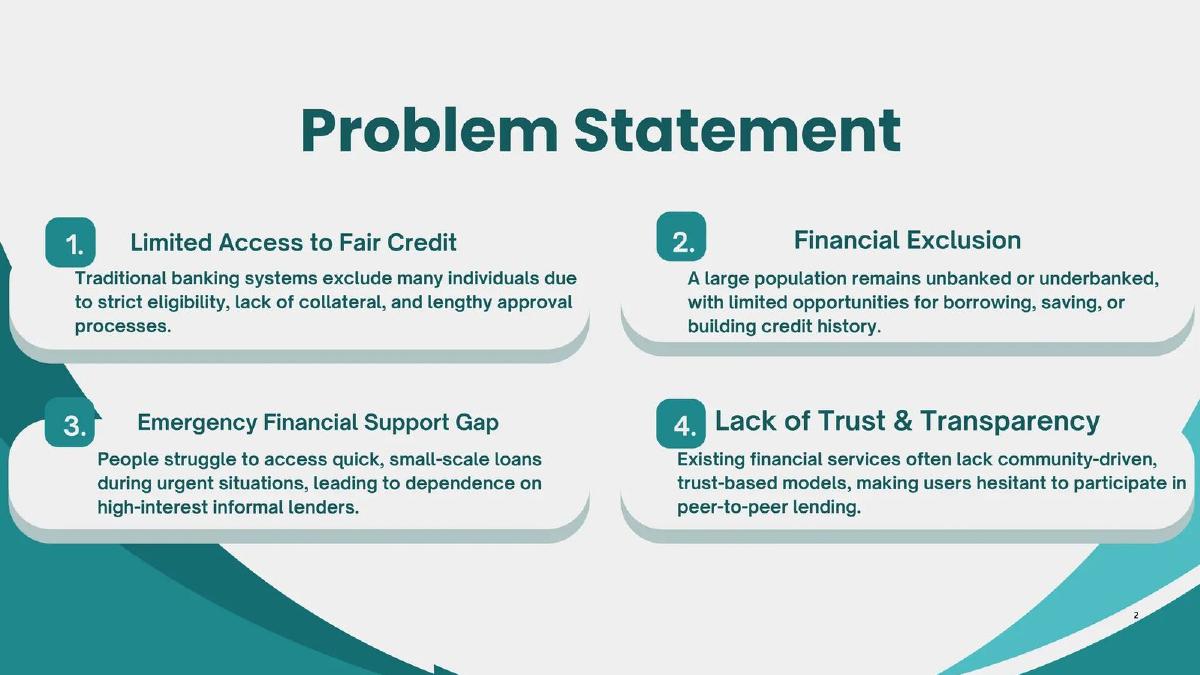
Slide 2 identifies four key pain points in the current financial landscape: 1. Limited Access to Fair Credit (strict eligibility and lack of collateral), 2. Financial Exclusion (unbanked populations), 3. Emergency Financial Support Gap (dependence on high-interest informal lenders), and 4. Lack of Trust & Transparency in P2P lending. The slide effectively sets the stage by highlighting the barriers that prevent low-income individuals from accessing formal banking.
Slide 3: Our Solution
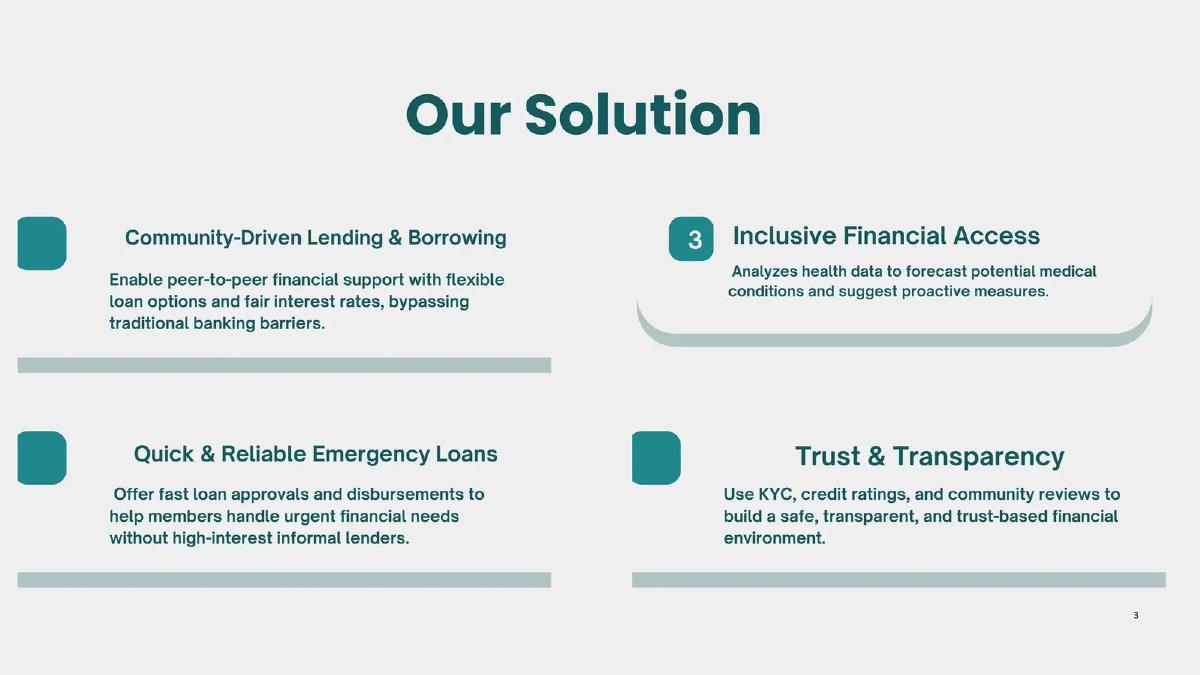
The solution is presented as a direct counter to the problems identified. It promises community-driven lending, quick emergency loans, and trust through KYC and community reviews. Notably, point 3 mentions that the platform "Analyzes health data to forecast potential medical conditions and suggest proactive measures." This is a significant pivot from pure fintech into health-tech, yet the deck provides no explanation of how health data is acquired or how it legally integrates with a lending platform.
Slide 4: Business Model
This slide uses a flowchart to describe the user journey. The process begins with User Onboarding (KYC and profile creation), moves to Community Building (joining groups based on geography or interests), and leads to the Lending & Borrowing Process . The model includes Savings & Investment Pools where members contribute regularly. The final stages involve Trust & Credit Scoring and Security & Compliance using blockchain-based smart contracts. This is the most detailed slide in the deck, explaining the mechanics of the peer-to-peer ecosystem.
Slide 5: Market Entry Strategy and Perceptual Map
Slide 5 attempts to define the market opportunity. It cites "global financial inclusion reports" but does not provide specific numbers or dates. The 'Perpectual Graph' (a misspelling of Perceptual) plots PRAGATI in the top-left quadrant: High Innovation and High Trust. It positions the company against 'Big Fintech' (High Innovation, Low Trust), 'Traditional Banks' (Low Innovation, High Trust), and 'Informal Lending' (Low Innovation, Low Trust). The slide also lists 'Accessibility' and 'Adaptability' as core pillars, mentioning support for multiple languages and scalable technology.
Slide 6: Revenue and Cost Optimization
The revenue strategy is diversified across six categories: Transaction Fees, Membership Plans, Interest Share, Late Payment Fees, Value-Added Services, and Partnership Commissions. On the right side, the deck addresses the technical costs of blockchain. It suggests using IPFS hashes to store data off-chain to reduce "Blockchain-Gas Fees" and "Minimal Function Calls" to keep operations efficient. This shows a level of technical consideration regarding the high costs of Ethereum or similar networks.
Slide 7: Financial Projections
This slide is purely qualitative. It lists four headers: 1. Initial Investment , 2. Revenue Forecast , 3. Cost Structure , and 4. Profitability Timeline . The only specific figure provided is a claim that the project will "Break-even within 2-3 years." There are no spreadsheets, no projected user counts, and no estimated revenue totals. This slide serves as a placeholder for a financial model that has not yet been shared.
Slide 8: Conclusion
The deck ends with a simple "Thank You!" slide. There is no contact information, no call to action, and no summary of the investment opportunity. This reinforces the impression that the deck is a conceptual overview rather than a formal solicitation for capital.
What PRAGATI Does Well
The deck follows a logical narrative flow. It identifies a clear, massive problem—financial exclusion—and proposes a solution that leverages modern technology (blockchain) and ancient social structures (community savings pools). The business model flowchart on slide 4 is a strong visual aid that explains a complex peer-to-peer interaction simply. Additionally, the inclusion of a cost optimization strategy on slide 6 demonstrates that the founders are thinking about the practicalities of blockchain scalability, which is often overlooked in early-stage crypto-fintech pitches.
What is Missing from the PRAGATI Deck
The omissions in this deck are significant and would prevent a professional investor from moving to due diligence. First, there is no Team Slide. In early-stage investing, the team is often more important than the idea; without knowing who is building this, there is no way to assess execution risk. Second, there is no Ask. A pitch deck must state how much money is being raised and what that money will be used for. Third, there is no Traction. There is no mention of a prototype, a pilot program, or even a waitlist of interested users. Fourth, the Financial Projections are empty. Stating a 2-3 year break-even without any numbers is a red flag for investors. Finally, the mention of health data analysis on slide 3 is a major regulatory and privacy concern that is never addressed.
Founder Takeaways: What to Copy and What to Avoid
Copy the Flowchart: The way slide 4 breaks down the user journey and the interaction between savings, lending, and credit scoring is excellent. It makes a complex ecosystem easy to understand. · Copy the Cost Awareness: Addressing the high cost of blockchain transactions (gas fees) on slide 6 shows technical maturity. Investors like to see that you understand your infrastructure costs. · Avoid Qualitative Projections: Never include a financial projection slide that doesn't have at least a high-level summary of actual numbers. A slide with four bullet points and no currency signs is not a projection. · Avoid the 'Health Data' Pivot: Unless your core business is medical, do not add "health data analysis" as a side feature. It introduces massive regulatory hurdles (like HIPAA or GDPR) that distract from your primary fintech value proposition. · Include a Team Slide: Even if you are a solo founder, you must include your background, your technical skills, and why you are the right person to solve this specific problem.
Frequently asked questions
- What is the core technology behind PRAGATI?
- According to slide 4, PRAGATI plans to utilize blockchain-based smart contracts to ensure transparency and prevent fraud. Slide 6 further details a cost optimization strategy involving the use of IPFS (InterPlanetary File System) hashes to store only essential metadata on-chain, thereby reducing gas fees and computational effort while maintaining a secure record of financial transactions.
- How does PRAGATI determine creditworthiness without traditional bank data?
- The platform proposes a 'Trust & Credit Scoring' system. As described on slide 4, scores are generated based on internal repayment behavior and community engagement. Slide 5 adds that this is a 'Dynamic Trust Scoring' model where creditworthiness adjusts over time based on user behavior within the platform's ecosystem, rather than relying on external credit bureaus.
- What are the primary revenue drivers for the business?
- Slide 6 lists six revenue generation strategies: transaction fees, membership plans, interest share, late payment fees, value-added services, and partnership commissions. However, the deck does not provide specific pricing for these services or a breakdown of which stream is expected to be the primary contributor to the projected 2-3 year break-even timeline.
- Does the deck identify a specific target market or geography?
- No. Slide 5 mentions 'underserved and unbanked communities' and 'gig workers, small business owners, and low-income individuals' in a general sense. While it mentions support for 'local languages' to reach diverse communities, it never specifies a country, region, or city for its initial market entry or pilot program.
- What information is missing that an investor would require?
- The deck is missing several critical components: a team slide (founders and advisors), a specific funding ask (how much money is needed), a use of funds breakdown, current traction or MVP status, and a detailed competitive analysis beyond a generic perceptual map. It also lacks a clear regulatory strategy for operating a lending business.