Dynamaxx Clinics SPV I LLC presents a structured investment opportunity to fund the expansion of its 'Maxx Health' anti-aging clinics. The company is raising $1,000,000 in Class B Membership Interests with a minimum check size of $100,000. The deal is structured as an SPV where 80% of EBITDA is distributed to investors until their capital and a 6% preferred return are repaid, after which they convert to a 20% equity stake in the SPV. Notably, 20% of the investment is diverted into stock of the parent company, Full Alliance Group, Inc. (FAGI). The deck focuses heavily on the unit economics of…
Key takeaways
- The company is raising $1,000,000 with a $100,000 minimum investment for Class B Membership Interests (Slide 2).
- Investors receive a 6% preferred annual return and 80% of EBITDA until all capital is returned (Slide 2).
- Twenty percent of the total offering is invested into the parent company, Full Alliance Group, Inc. (FAGI) (Slide 2).
- The primary services offered include EBOO Therapy ($2,500/treatment), IV Therapy, Shockwave Therapy, and Stem Cell treatments (Slide 3).
- The customer acquisition strategy relies on a 'DynaMAXX MLM' model where members refer clients for products and services (Slide 3).
- Estimated build-out costs per location are $135,000, which includes $27,000 for an EBOO machine (Slide 5).
- Pro forma projections assume 20 customers per day and a five-day work week with 4 staff members (Slide 6).
- The deck claims a pro forma estimate showing a payback of investment plus preferred return in the second year (Slide 7).
Executive Summary and Investment Terms
Slide 1: Title Slide
The deck opens with the branding 'MAXXHEALTH Anti-Aging & Rejuvenation.' The visual features an older couple, signaling a target demographic of seniors or aging adults. The subtitle identifies this as an 'Investor Presentation.'
Slide 2: DynaMAXX Clinics SPV I, LLC Overview
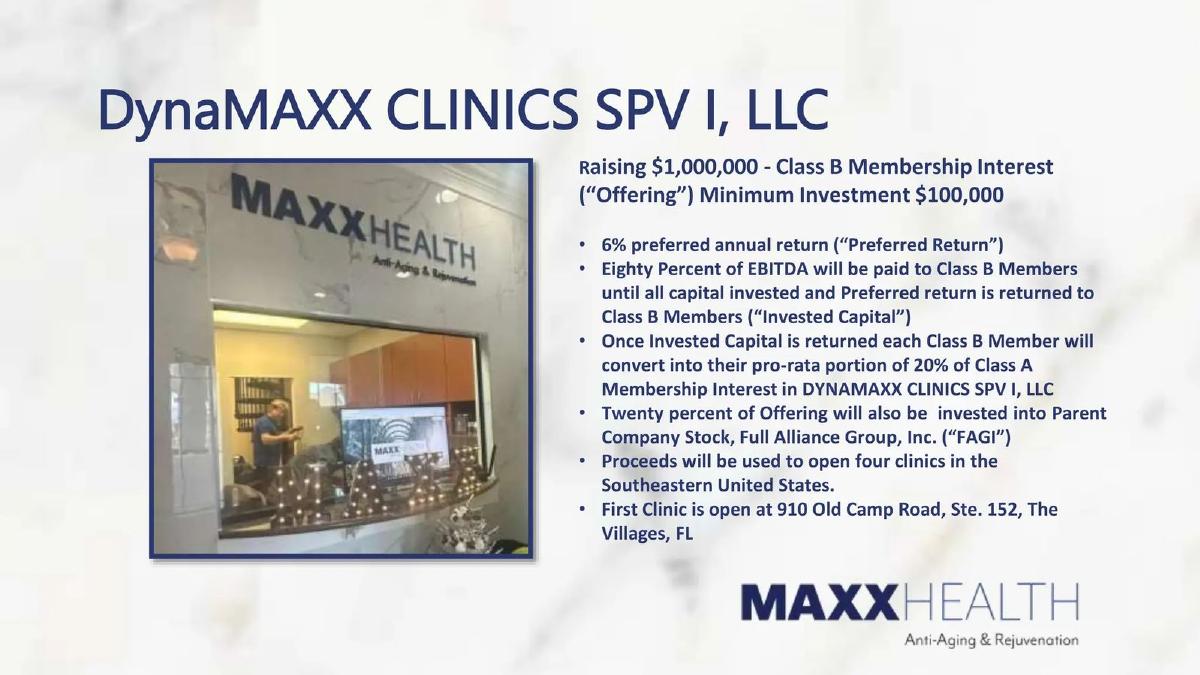
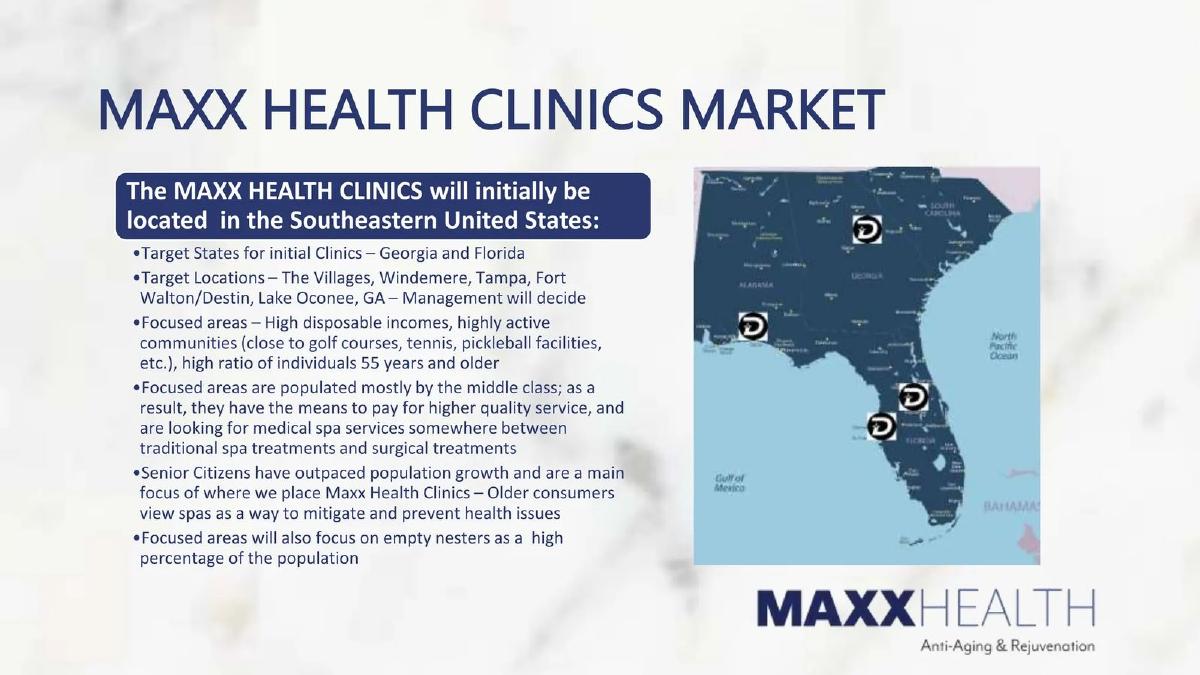
This slide provides the core financial terms of the offering. The company is raising $1,000,000 through Class B Membership Interests with a $100,000 minimum investment . The terms include a 6% preferred annual return . A significant detail is the distribution waterfall: 80% of EBITDA will be paid to Class B members until all capital and the preferred return are paid back. After this point, Class B interests convert into a 20% stake in Class A Membership Interests. The slide also notes that 20% of the offering will be invested into the parent company, Full Alliance Group, Inc. (FAGI). The proceeds are earmarked to open four clinics in the Southeastern United States, with the first clinic already open in The Villages, FL.
Service Offerings and Market Opportunity
Slide 3: Maxx Health Clinics Services
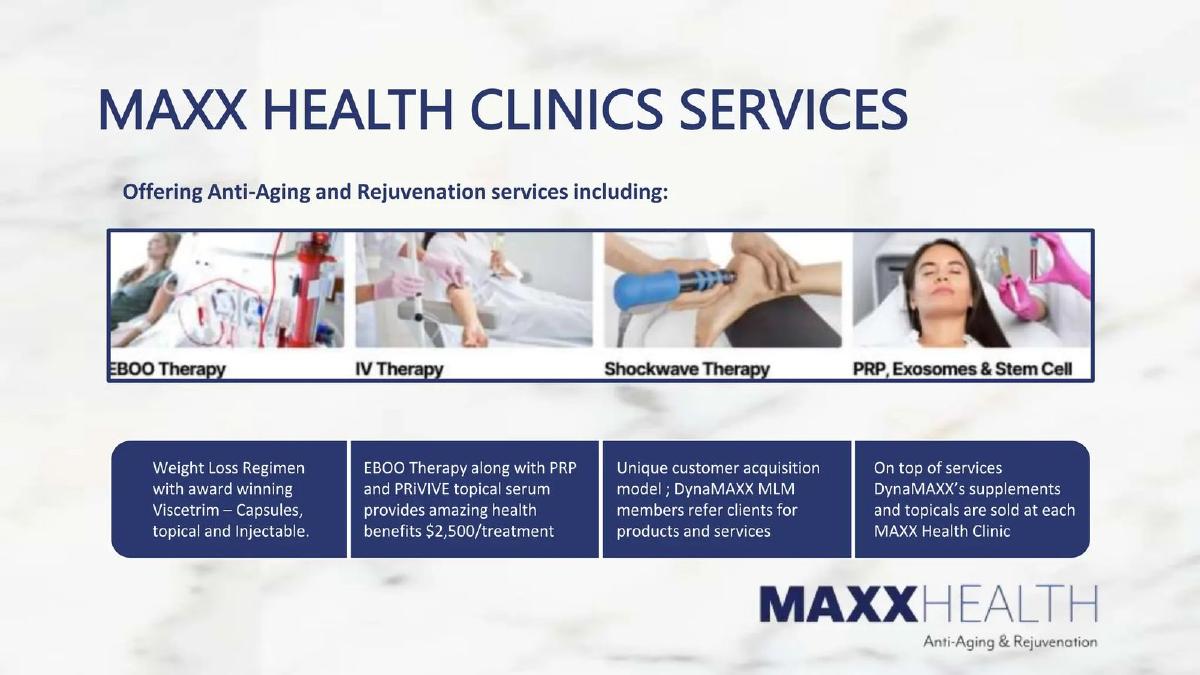
This slide enumerates the clinical offerings, which include EBOO Therapy , IV Therapy , Shockwave Therapy , and PRP, Exosomes & Stem Cell treatments. It highlights a weight loss regimen using 'Viscetrim' capsules and injectables. Notably, it mentions that EBOO therapy costs $2,500 per treatment . The slide introduces the customer acquisition strategy: a DynaMAXX MLM model where members refer clients. It also mentions the sale of proprietary supplements and topicals at each location.
Slide 4: Why Invest? Opportunity
This slide frames the medical aesthetics industry as a 'Gigantic Size and Scale Potential' that has been 'Generally Left Alone by Private Equity.' It cites a 2022 Medical Spa State of the Industry Report by AmSpa, noting growth of greater than 20% each year since 2015 (excluding 2020). A quote from Dominic Mazzone, CEO of MSP, emphasizes that the sector is attractive because it is 'private pay, primarily, without insurance reimbursement,' making it 'recession-resilient.'
Unit Economics and Pro Forma Projections
Slide 5: Pro Forma Start Up Costs Per Location
The company estimates a build-out cost of $135,000 per location . This includes $27,000 for an EBOO Machine and $65,000 in working capital . To minimize these costs, the company explicitly states it will only lease properties previously used as medical facilities. This slide uses a background image of a beach, maintaining the lifestyle/wellness aesthetic of the brand.
Slide 6: Pro Forma Profit & Loss Per Location
This slide details the operational assumptions for a single clinic. It assumes 20 customers per day during the first year, operating on a five-day work week with 4 staff members . The revenue model relies on high-value patients: one PRP patient per day at $1,750 and one EBOO patient per day at $2,000 . All other services are averaged at $73.50 per customer. The visual shows the exterior signage of a Maxx Health facility.
Slide 7: Pro Forma Cash Flow for Investment
The company projects a payback of investment plus the 6% preferred return in the second year . The slide clarifies that this payback calculation does not include any potential returns from the 20% of capital diverted into the parent company (FAGI) Series F Preferred Stock. It claims that once the SPV is fully funded and revenue is stabilized, the estimated Return on Investment is 80+% in the first fiscal year , though it is unclear if this refers to the first year of full operation or the first year of the SPV's existence.
Slide 8: Investment Overview Table
This slide summarizes the terms previously mentioned in a tabular format. It reiterates the $1,000,000 cap , the $100,000 to $1,000,000 investment range , and the 20% diversion to FAGI . It confirms the distribution of 80% of EBITDA after the preferred return and the eventual conversion into a 20% equity stake in the SPV.
What Works in This Deck
Specific Unit Economics: The deck provides clear, granular estimates for build-out costs ($135,000) and specific equipment costs ($27,000 for EBOO machines). This allows investors to verify the feasibility of the $1M raise against the goal of opening four clinics. · Defined Investor Waterfall: The use of a 6% preferred return and an 80% EBITDA sweep until payback is a very specific, investor-friendly structure that clearly defines how and when capital is returned. · Targeted Geography: By focusing on The Villages, FL, and the Southeastern US, the company is targeting one of the highest-density retiree populations in the country, which aligns with their anti-aging service offering. · Operational Efficiency Strategy: The decision to only lease existing medical facilities to reduce CAPEX is a practical operational detail that shows a focus on capital efficiency.
What Is Missing From This Deck
Team Slide: The 8 slides provided contain no information regarding the management team, medical directors, or clinical staff. In a medical services business, the credentials of the practitioners are critical. · Competitive Analysis: There is no mention of other anti-aging clinics, medical spas, or wellness centers in the Southeastern US. The deck assumes a vacuum in the market. · Risk Factors: Given the mention of 'Stem Cell' and 'Exosomes' treatments, which are subject to evolving FDA regulations, the lack of a regulatory or risk disclosure slide is a significant omission. · Historical Performance: While the deck mentions the first clinic is open in The Villages, it provides no actual revenue or patient data from that location, relying entirely on 'pro forma' estimates. · MLM Details: The deck mentions a 'DynaMAXX MLM' model for customer acquisition but does not explain the cost of this channel or how it integrates with the clinical operations.
Founder Takeaways
Structure the deal for the stage: This deck is an excellent example of how to structure a 'rollout' investment. Instead of selling vague equity in a parent company, the founders created an SPV with a clear path to capital recovery (the 80% EBITDA sweep). This is often more attractive to private investors looking for yield and downside protection.
Be transparent about capital allocation: The deck is very clear that 20% of the money isn't going to the clinics, but to the parent company. While this might be a point of negotiation, stating it upfront in the terms prevents surprises during due diligence.
Focus on high-margin anchors: The revenue model isn't built on $73 facials; it's built on $2,000 EBOO treatments. By identifying the 'anchor' services that drive the majority of the margin, the founders make the path to profitability look much shorter.
Use 'Pro Forma' carefully: While pro formas are necessary for expansion decks, they should be balanced with actuals if a pilot location exists. If you have one clinic open, investors will expect to see how its actual performance compares to the projections for the next four.
Frequently asked questions
- What is the specific legal structure of this investment?
- The investment is structured as a Special Purpose Vehicle (SPV) named Dynamaxx Clinics SPV I LLC. Investors purchase Class B Membership Interests. A unique feature of this deal is that 20% of the invested capital is allocated to purchase Series F Preferred Stock in the parent company, Full Alliance Group, Inc. (FAGI), rather than being used directly for clinic operations.
- How does the company plan to acquire new patients?
- According to Slide 3, the company utilizes a 'unique customer acquisition model' involving DynaMAXX MLM (Multi-Level Marketing) members. These members refer clients to the clinics for both services and the company’s line of supplements and topicals. This suggests a decentralized, commission-based sales force rather than traditional clinical marketing.
- What are the primary revenue drivers for a single clinic?
- Revenue is driven by high-ticket anti-aging treatments. Slide 6 highlights two primary procedures: PRP (Platelet-Rich Plasma) at $1,750 per patient and EBOO (Extracorporeal Blood Oxygenation and Ozonation) at $2,000 per patient. The pro forma assumes one of each per day, with other services averaging $73.50 per customer.
- What are the capital requirements for opening a new location?
- Slide 5 estimates the build-out cost at $135,000 per location. This budget includes $27,000 for an EBOO machine and $65,000 in working capital. To keep costs low, the company states it will only lease properties that were previously used as medical facilities to minimize renovation expenses.
- What is the exit or return strategy for investors?
- The strategy is based on cash flow distributions. Investors receive 80% of EBITDA plus a 6% preferred return until their initial capital is recovered. Once the 'Invested Capital' is returned, the Class B interests convert into a pro-rata portion of 20% of the Class A Membership Interest in the SPV.