Dwolla's 2013 Series C pitch deck is a masterclass in narrative-driven fundraising, prioritizing a visionary overhaul of the US payment system over granular metrics. By visually indicting the complex 'card rail' status quo and proposing an elegant, API-first alternative, Dwolla secured $16.5M from a16z. While the deck lacked the hard traction data expected today, its focus on building a technical moat through 'FiSync' successfully predicted the company's eventual pivot from a consumer app to a leading B2B payment infrastructure provider.
Key takeaways
- Master visual storytelling by using before-and-after diagrams to simplify complex industry problems and novel solutions.
- Frame your company as foundational infrastructure or a platform rather than just a single application to attract top-tier VCs.
- Use a simple, disruptive pricing model as a strategic message to highlight value propositions against incumbent percentage fees.
- Weaponize your origin story to demonstrate founder-market fit and build trust through authentic, personal connections to the problem.
- Develop a 'frenemy' strategy by identifying which incumbents to disrupt and which can be turned into partners or sales channels.
The Pitch: A New Financial Rail for the Internet
In mid-2013, the fintech landscape was heating up, but it hadn't yet reached the boiling point we see today. Stripe was gaining serious traction but wasn't the default developer choice yet. Plaid was just a year old. In this environment, Dwolla, a Des Moines, Iowa-based startup, went out to raise its Series C. They secured a formidable $16.5 million round led by Andreessen Horowitz (a16z), with Scott Weiss joining their board. This was a significant validation for a company outside Silicon Valley, pitching a radical overhaul of the US payments system. The deck we are analyzing is a reflection of that ambition, a masterclass in narrative-driven fundraising that prioritized vision over spreadsheets.
The core thesis was simple yet audacious: the interchange fees and infrastructure of credit and debit cards were a multi-billion dollar tax on the economy, and the internet deserved a better, cheaper, and more open way to move money. Dwolla positioned itself not as another app, but as the foundational layer to make that happen.
Slide-by-Slide Analysis: Building a New World Order
The Problem: A Visual Indictment of the Status Quo
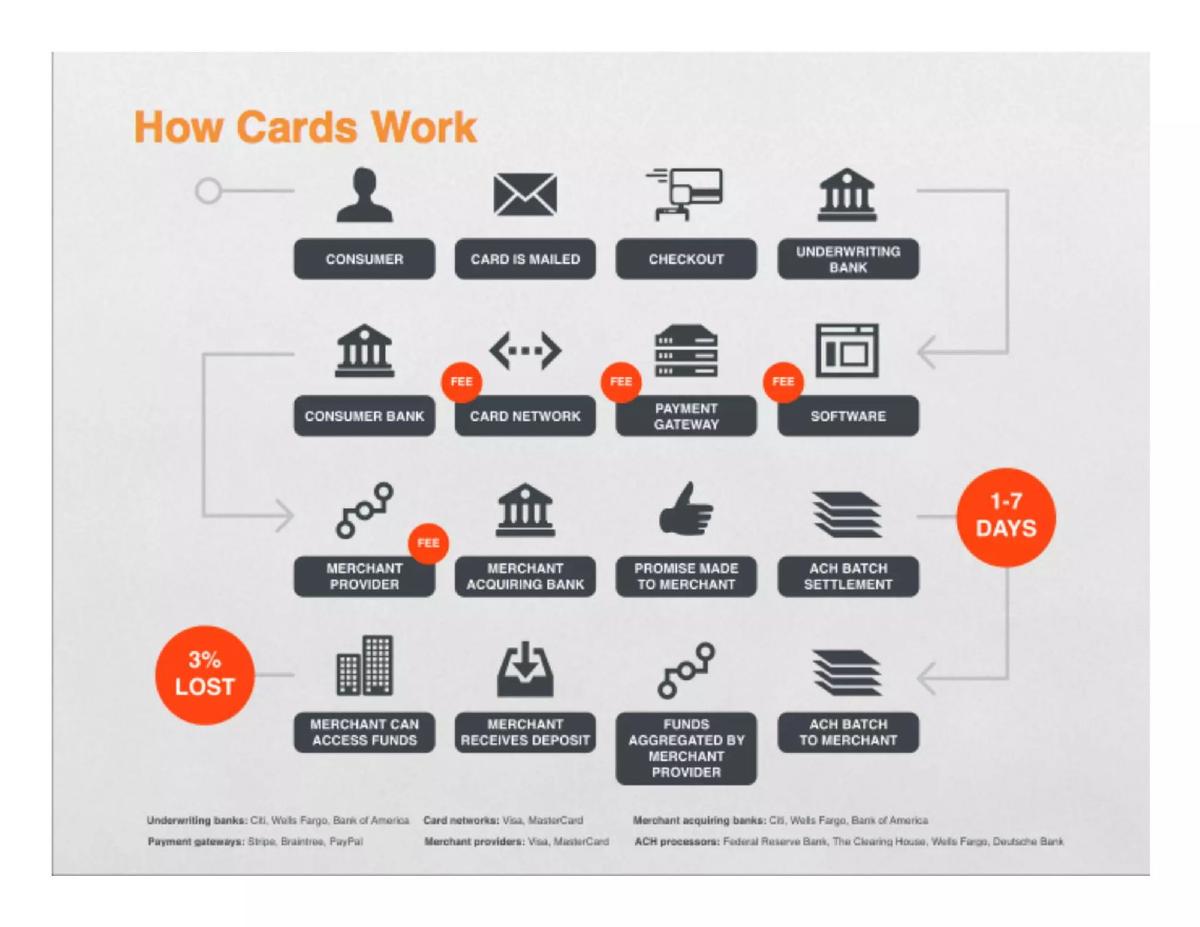
Dwolla doesn't start with a statistic; it starts with a diagram. The "How Cards Work" slide is a deliberately complex flowchart showing a dizzying array of middlemen: Consumer Bank, Issuing Bank, Card Network, Payment Gateway, Merchant Provider, Acquiring Bank. It's a visual representation of inefficiency and value extraction. For any founder or merchant who has ever looked at their processing statement and wondered where the money went, this slide is an instant "aha" moment. It visually screams, "This is broken."
The deck then dedicates two full slides to elaborating on the pain points, categorizing them brilliantly:
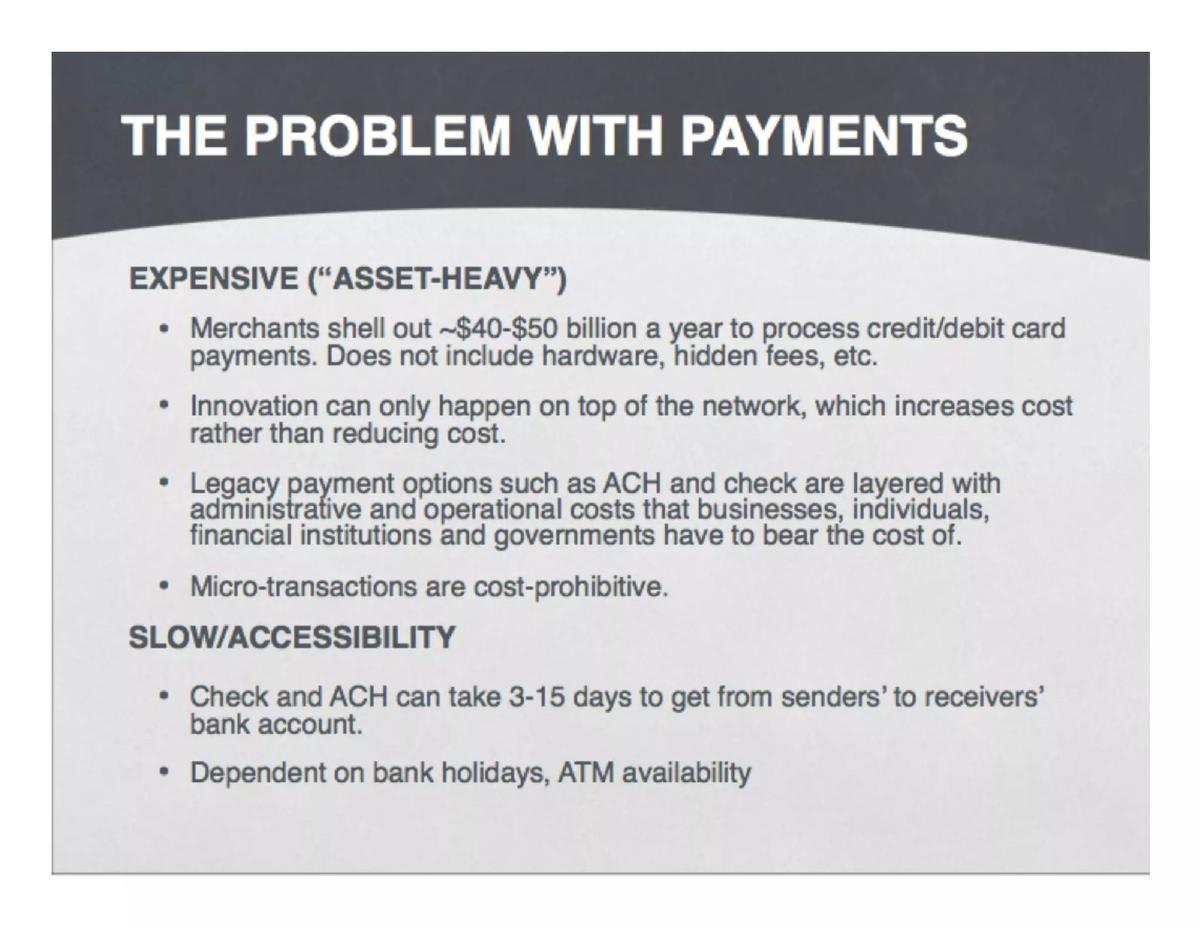
Expensive ("Asset-Heavy"): They put a hard number on the problem: $40-50 billion in annual fees for US merchants. They correctly point out that innovation on the old rails (like new gateways) often adds cost, and that micro-transactions are simply not viable. · Slow/Inaccessible: They contrast the instant gratification of the internet with the archaic, multi-day settlement times of ACH and the physical limitations of cash. · Fraud Heavy: This was a critical point. They highlight that card networks are fundamentally insecure, broadcasting the 16-digit number—the "key to the kingdom"—in every transaction. · Closed & Rigid: This is the appeal directly to the a16z-style, developer-first investment thesis. They argue there is no truly open, Web 2.0-compatible payment network. · Bank-Centric: A subtle but important jab, pointing out that the current system props up outdated and threatened bank revenue streams.
This comprehensive diagnosis of the problem is top-tier. It's multi-faceted, hitting on cost, speed, security, and developer access. It establishes Dwolla not just as a cheaper alternative, but a fundamentally superior one across every important vector.
The Solution: Elegant Simplicity
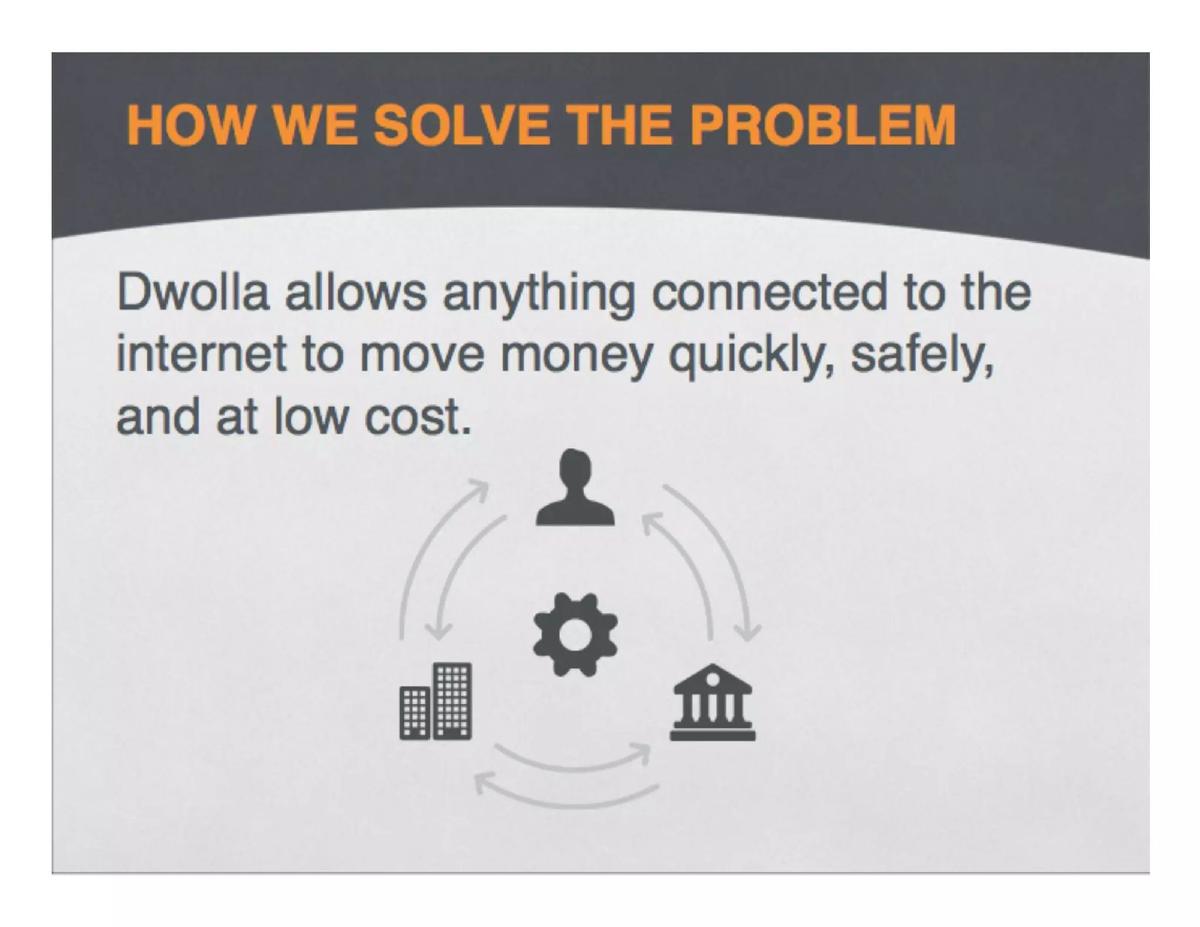
Just as they used a diagram to show the problem's complexity, they use one to show the solution's elegance. The "How Dwolla Works" slide is the perfect counterpoint. It shows a simple, three-step flow: Consumer -> Dwolla -> Bank. All the middlemen from the previous slide are gone. It's a powerful piece of visual storytelling. Critically, it introduces the term "FiSync: Real-Time Streaming Settlement." This isn't just a marketing name; it's the signal of a deep technical moat. Investors don't just see a payment app; they see new, proprietary infrastructure being built.
The deck then elaborates on how this new model solves the previously stated problems point-for-point:
Low Cost ("Asset-Light"): The business model is laid bare: $0.25 per transaction, and free for transactions under $10. This is a devastatingly simple and disruptive model compared to the 2-3% interchange fees. The 'free' tier is a brilliant Trojan horse to drive adoption and enable new use cases (the titular micro-transactions). · Fast/Accessible: Real-time movement of funds via FiSync. This leapfrogs not just cards, but the slow, batch-based ACH system. · Safer: Dwolla never discloses sensitive financial data, abstracting it away behind their network. This directly addresses the "16-digit problem." · Open-Loop & End-to-End: The magic words for a platform-focused VC. An API allows developers to build on top of the network, creating network effects and unforeseen applications. · Bank-Friendly: This is a sophisticated strategic move. Instead of just antagonizing banks, Dwolla offers them a life raft. FiSync is presented as a white-label product that banks can use to offer their own real-time payment services. It turns a potential adversary into a potential customer.
The Market: When a TAM Slide Is Just Right
Dwolla's market opportunity slide is a classic top-down Total Addressable Market (TAM) slide. Normally, these are viewed with skepticism, but for a company rebuilding fundamental financial infrastructure, it is the appropriate approach. The numbers are staggering: $40 trillion in ACH, $600 trillion in wire payments, $2 trillion on cards. The message isn't "we will capture 1% of this market." The message is, "The market is effectively infinite. The prize for rewiring how this value moves is one of the largest economic opportunities in history." That's the kind of scale that gets a top-tier VC's attention. They don't need a bottoms-up analysis to know that payments is a big enough pond to fish in.
The Team and The Ask: Founder-Market Fit on Display
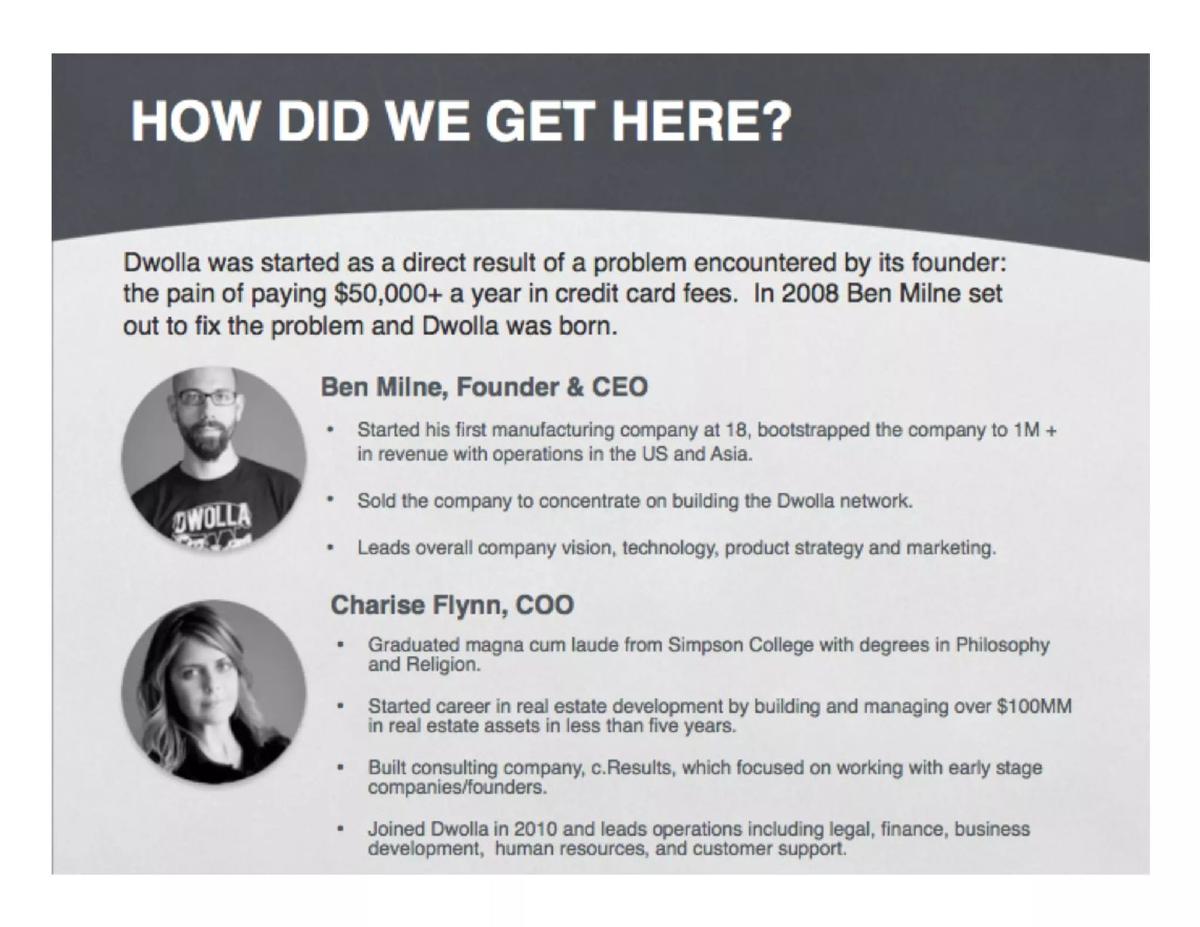
The deck wisely introduces the founding team early on, tethering the company's origin to a personal, visceral pain point. CEO Ben Milne didn't discover the problem through market research; he lived it, paying tens of thousands in fees at his previous company. This is the definition of founder-market fit and lends immense credibility to the mission. The inclusion of COO Charise Flynn, with a background in managing large-scale assets and operations, provides the necessary balance—the visionary paired with the operator. This is a classic founding team archetype that investors love to see.
There is no explicit "Ask" slide with a dollar amount. Instead, the deck uses a "2013 Hiring/Expansion Plan" slide as a proxy for the Use of Funds. It details planned hires across tech, product, BD, and support, and a geographic expansion to San Francisco. This is a smart way to frame the raise. It's not about funding losses; it's about investing in growth and scaling a team that has already found product-market fit (or so the narrative implies). It shows discipline and a clear plan for capital allocation.
What Worked and Why Investors Said Yes
Despite some notable gaps, this deck succeeded for several key reasons:
A Visionary Narrative: This wasn't a pitch for a feature; it was a pitch to build new financial rails. Dwolla was selling a paradigm shift, and VCs, especially firms like a16z, are looking to fund companies that can create and own new markets, not just compete in existing ones. · Pitch-Perfect Storytelling: The before-and-after diagrams of the payment flow are incredibly effective. They distill a complex industry problem and a novel solution into a format that anyone can grasp in seconds. This is storytelling at its finest. · A Credible Technical Moat: FiSync wasn't just marketing fluff. It represented a real, defensible technological advantage—a proprietary real-time gross settlement system. This signaled to investors that Dwolla wasn't just a pretty UI on top of the old, clunky ACH system; it was building something new from the ground up. · Disruptive Business Model: The flat 25-cent fee was simple, transparent, and radically cheaper than the competition. It was a pricing model designed for war, immediately highlighting the value proposition against the incumbents' percentage-based tolls. · Authentic Founder Story: Ben Milne's personal journey created an authentic and compelling 'why' behind the company. Investors bet on founders, and Milne's story was one of passion and deep domain experience born from personal frustration.
What Was Weak or Missing
By today's fundraising standards, this deck has some glaring omissions that would likely make it a 'no' for most VCs:
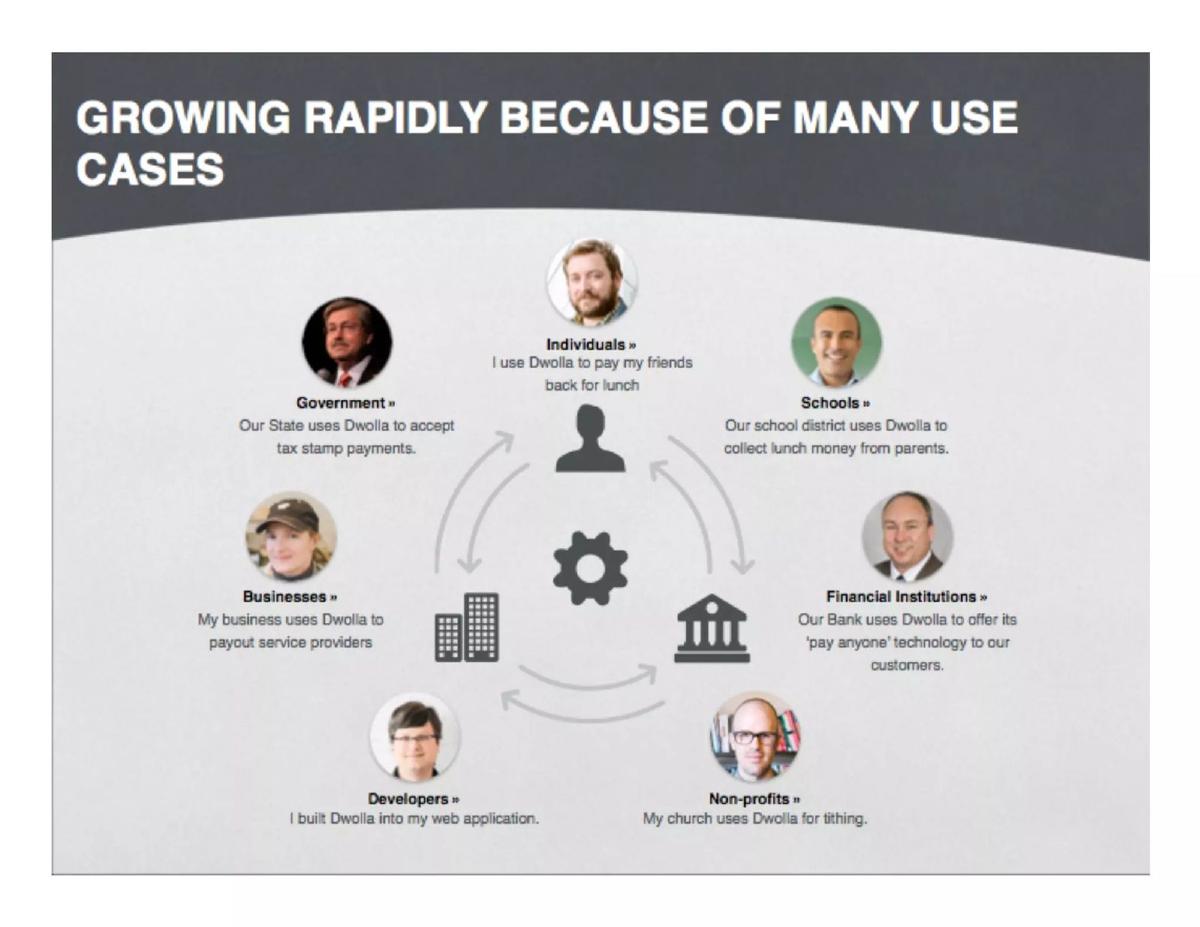
No Hard Traction Metrics: This is the biggest red flag. The deck uses qualitative phrases like "Growing Rapidly" but provides zero data. There are no charts for Total Payment Volume (TPV), Monthly Active Users (MAU), revenue growth, or customer acquisition cost (CAC). For a Series C, this absence is shocking and would be unacceptable in the current climate. · No Go-to-Market (GTM) Details: How exactly will Dwolla acquire customers (both consumers and businesses) at scale? The deck is all vision and product, with no concrete strategy for distribution. · No Competitive Landscape: The deck positions Dwolla against the abstract "old way" but fails to mention any direct competitors by name, such as PayPal or other emerging fintech players. While narratively strong, it lacks tactical awareness. · No Financial Projections: There are no forward-looking financial models, revenue forecasts, or detailed unit economics. The pitch rests entirely on the qualitative strength of the idea and the size of the market.
Lessons for Today's Founders
Master Visual Storytelling: Don't just tell, show. The 'How it Works vs. Our Way' diagram is a timeless technique. Simplify the complex and visually represent the value you create. · Sell Foundational Platforms: If possible, frame your company not as an application, but as the underlying infrastructure for a new ecosystem. VCs want to fund the railroad, not a single, fancy train car. · A Simple, Disruptive Price Is a Strategy: Your pricing model isn't just a number; it's a message. A simple, transparent, and fundamentally cheaper model can be your most powerful marketing tool and a signal of your disruptive intent. · Weaponize Your Origin Story: If you have an authentic connection to the problem you're solving, make it the heart of your pitch. It builds trust and demonstrates a level of commitment beyond a purely academic interest. · Develop a 'Frenemy' Map: Understand the ecosystem. Identify which incumbents you must destroy and which you can partner with. Dwolla's 'bank-friendly' angle was a sophisticated strategy that de-risked their path to market by turning a powerful potential enemy into a sales channel.
Epilogue: Where is Dwolla Now?
The anwser to 'where is Dwolla now?' is the most fascinating lesson of all. The consumer-facing payment network, the part of the business that seemed most prominent in the deck's early slides, is gone. Dwolla sunsetted its consumer application years ago.
Instead, Dwolla has become exactly what the most visionary parts of its pitch deck promised: a B2B, API-first payment infrastructure company. It is a leading platform for businesses to facilitate account-to-account (A2A) payments, powering fintech apps, SaaS platforms, marketplaces, and enterprise clients. The core anachronism here is that the future of the company wasn't the consumer-facing app, but the underlying 'FiSync' engine and open API. The vision of building new payment rails won out over the vision of being the next Venmo or PayPal.
This pivot is a powerful testament to the importance of finding your true business model. The consumer app was the Trojan horse that allowed Dwolla to build and battle-test its core infrastructure. Once that infrastructure was robust, the true, more profitable enterprise opportunity became clear. The 2013 deck, in retrospect, was a perfect prophecy of this outcome, even if the company itself had to go on a journey of discovery to realize it. They successfully built the railroad they promised, and now they sell tickets to other businesses who want to run their trains on it.
Frequently asked questions
- Why would an investor fund a Series C with almost no metrics in the deck?
- In 2013, the fundraising environment was different, and for certain types of companies, vision and narrative could outweigh traction. a16z, in particular, was known for making bold, thesis-driven bets on founders aiming to create new markets. Dwolla's pitch to build entirely new payment rails, combined with a strong founder story and a massive TAM, fit this mold perfectly. They were buying into the architectural vision, not the current P&L.
- What was 'FiSync' and why was it so important to the pitch?
- FiSync was Dwolla's proprietary technology for a real-time gross settlement (RTGS) system. It was the 'technical moat' of the pitch. While other P2P apps were often just layers on top of the slow, traditional ACH network, FiSync promised to be a fundamentally new, faster rail. This signaled to investors that Dwolla was a deep tech company building infrastructure, not just a consumer app, which implies a much larger and more defensible long-term business.
- Did Dwolla succeed in its original mission to replace credit cards?
- No, not in the way the deck envisioned. Credit cards are still the dominant form of consumer payment. However, Dwolla did succeed in building a powerful alternative for account-to-account (A2A) transfers. The company pivoted away from the consumer-facing product to focus on being an API-first platform that allows other businesses to integrate this A2A payment functionality, which was the core infrastructure part of their original vision.
- What happened to the '$0.25 per transaction' business model?
- While revolutionary at the time, Dwolla's pricing has since evolved. As they moved upmarket to serve larger enterprise clients with their B2B API product, they introduced tiered pricing and custom plans more suitable for high-volume business needs. The original simple, flat fee was a brilliant wedge to enter the market and signal disruption, but their current model reflects the maturity of their product and customer base.
- What is the biggest lesson from Dwolla's pivot away from a consumer product?
- The biggest lesson is that your initial product might just be the Trojan horse for your real business. Dwolla's consumer app allowed them to build, test, and prove their underlying payment infrastructure. They discovered that the true, scalable value was in selling that infrastructure to other businesses via an API, not in competing for consumers. Founders should be open to the idea that their most valuable asset might be the 'engine' they build, not the first 'car' they put it in.