Dub’s 15-slide deck is a masterclass in narrative-driven fintech pitching, prioritizing market sentiment and product vision over raw financial metrics. By framing the 'retail investor revolution' as a demand for integrated social and thematic investing, Dub positions itself as the first mover in U.S. copy-trading. The deck successfully identifies a gap between passive ETFs and high-risk self-directed trading, proposing a 'social investing marketplace' where users mirror creators. While the deck lacks traditional traction slides, unit economics, or a detailed team breakdown in the provided ima…
Key takeaways
- The deck positions the company as a 'first mover' pioneering copy-trading specifically for the U.S. market (Slide 7).
- Dub identifies a $100T asset management market that they intend to disrupt by 'reimagining' social investing (Slide 7).
- The product is framed as a marketplace connecting retail investors with 'crowdsourced investing talent' (Slide 5).
- Automation is a core feature, with Slide 4 showing 'Future trades made for you' and 'Rebalanced' notifications to solve the user's lack of stock-picking skill.
- The 'Marketplace Moat' is built on creators earning rewards for their followers' performance and building a public track record (Slide 6).
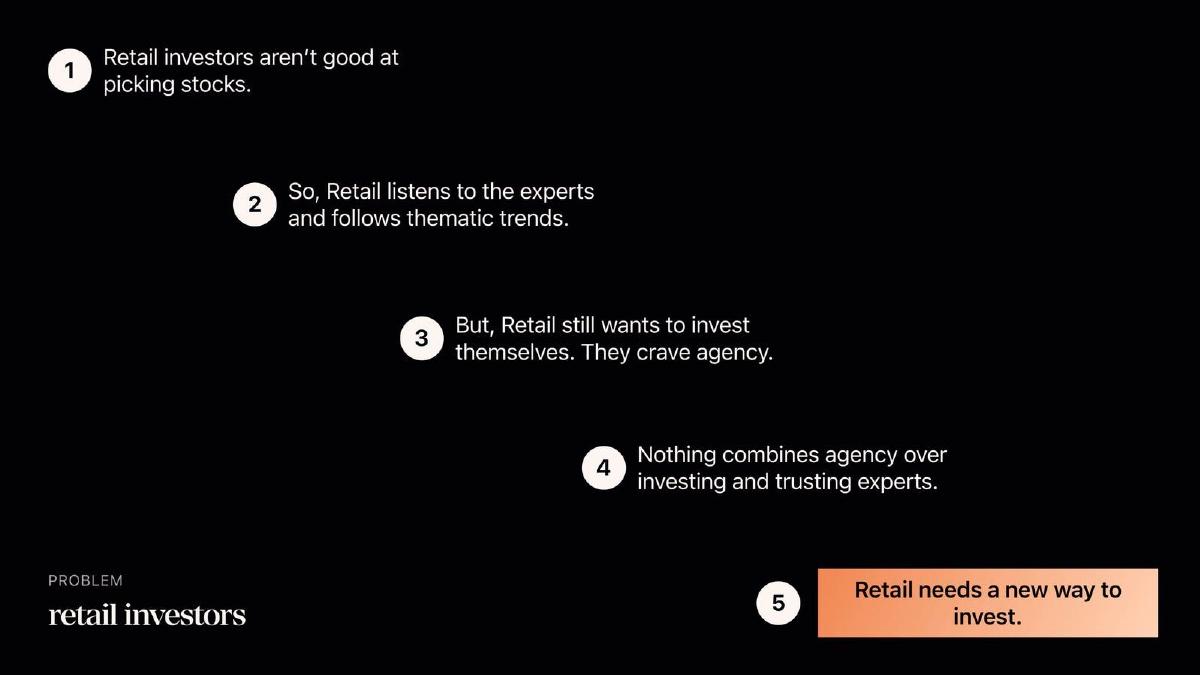
- The problem statement relies on the premise that retail investors crave agency but lack the skill to pick stocks effectively (Slide 2).
- Dub claims to be creating a 'new asset class' defined as 'individual investment wisdom' (Slide 7).
- The legal disclosure slide confirms the app is operated by DASTA Inc. and uses APEX Clearing Corporation for clearing services (Slide 8).
The Narrative: Turning Influencers into Fund Managers
Dub’s pitch deck for their $30M Series A is a study in market positioning. Rather than leading with a spreadsheet of user acquisition costs, the deck leads with a sociological observation: the retail investor revolution has changed how people want to interact with their money. As reported by Business Insider, this 2024 round was led by Tusk Venture Partners, and the deck reflects a strategy designed to appeal to investors who believe in the 'creator economy' applied to finance.
Slide 1: Title and Contact
The deck opens with a minimalist black slide featuring the logo and the tagline: "mirror any investor." It includes the name of founder Steven Wang and his contact information. The presence of "Strictly Confidential" in the corner is standard for Series A decks intended for a limited group of institutional VCs.
Slide 2: The Problem Statement
Slide 2 uses a stepped logic to define the market gap. It lists five points: 1. Retail investors aren't good at picking stocks. 2. They listen to experts and follow trends. 3. They still want agency. 4. Nothing combines agency with expert trust. 5. Retail needs a new way to invest. This slide is effective because it frames the solution not as a better brokerage, but as a psychological bridge between passive index funds and reckless day trading.
Slide 3: The Market Context
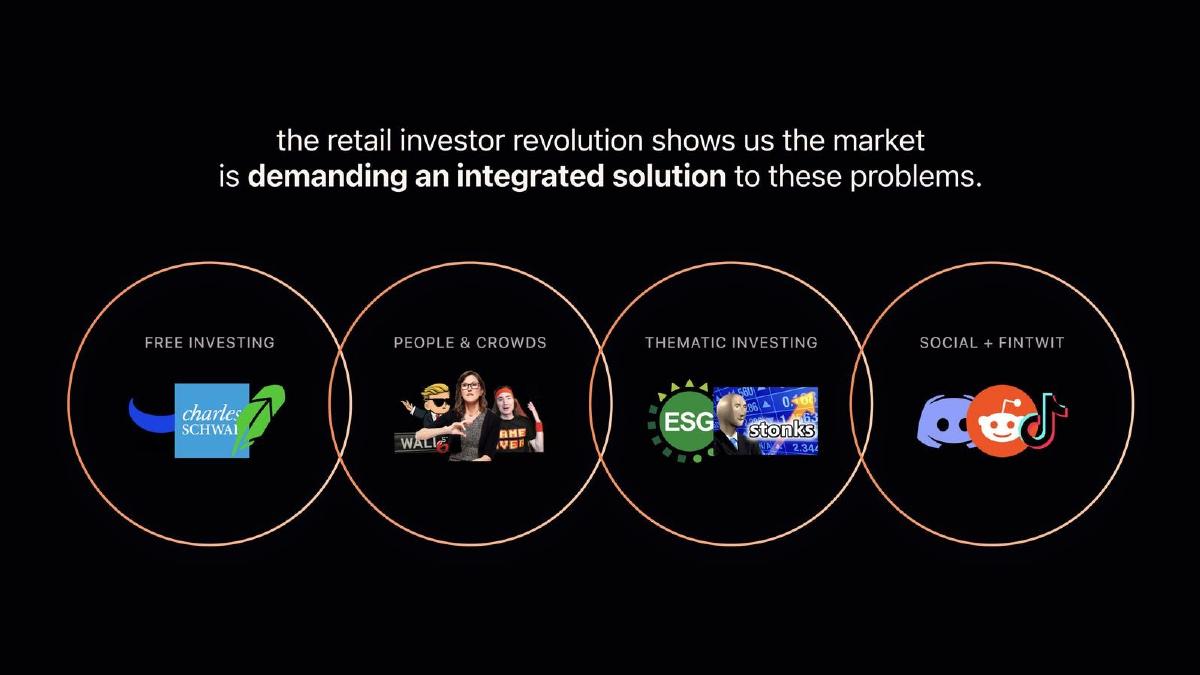
This slide uses four overlapping circles to show the convergence of trends: Free Investing (Schwab), People & Crowds (WallStreetBets/Cathie Wood), Thematic Investing (ESG/Stonks), and Social + Fintwit (Discord/Reddit/TikTok). The text claims the market is "demanding an integrated solution to these problems." By including logos of competitors and social platforms, Dub positions itself as the logical evolution of these fragmented behaviors.
Slide 4: How It Works (The Product)
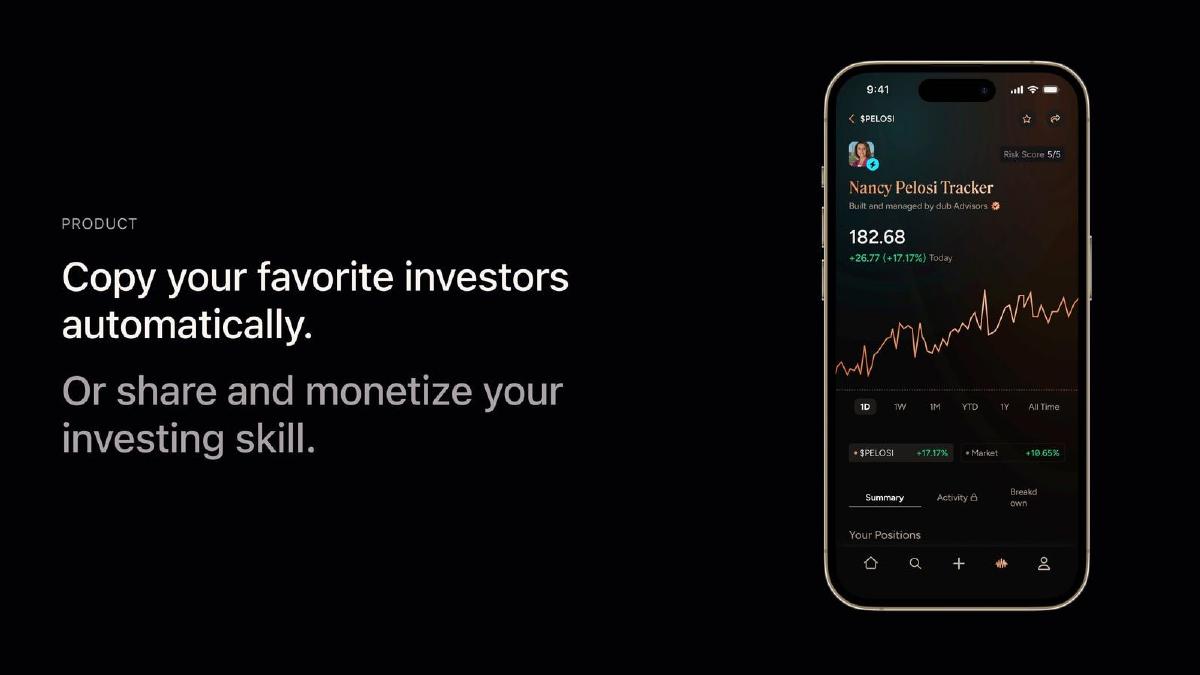
Slide 4 is the most information-dense, featuring four high-fidelity mobile app mockups. "Future trades made for you" shows a feed of creators like Joy Chen and Dean Spears with their "Copying Capital" listed. "Learn how Creators invest" shows a rebalancing log, explaining why a creator rotated out of consumer discretionary into semis. "Copy real Investors / Creators" shows a profile for Heeyun Chon with 50K subscribers and $120M in capital. "Discover novel investments" shows a leaderboard of returns and "Most Copies," featuring portfolios like "$PELOSI" and "$URANIUM." This slide demonstrates that the product is not just a trade execution tool, but a content platform.
Slide 5: The Marketplace Model
Slide 5 defines Dub as a "social investing marketplace." It uses a simple diagram showing Dub sitting between "retail investors" and "crowdsourced investing talent." The copy claims they are building the first such marketplace for retail investors, emphasizing that the best businesses in investing are those that connect capital to talent.
Slide 6: The Marketplace Moat
This slide focuses on the supply side of the marketplace—the creators. It lists three value propositions for creators: 1. Get rewarded for people who copy your portfolio. 2. Create portfolios to share ideas. 3. Build brand, credibility, and track record. This is the "moat" slide; by locking in the best talent with financial incentives and a public track record, Dub aims to make it difficult for competitors to lure users away.
Slide 7: The Investment Thesis
Slide 7 summarizes why Dub is the "consensus bet." It highlights five pillars: Unprecedented demand (active management inflows), 10x Better Product (creating a new asset class), First Mover (pioneering copy-trading in the US), Wisdom of the Crowds, and a World Class Team. It explicitly mentions the goal of reimagining the "$100T asset management market," providing the scale necessary for a $30M Series A.
Slide 8: Legal Disclosures
The final slide in the provided sequence is a dense legal disclosure. It identifies the parent company as DASTA Inc. and confirms the involvement of SEC-registered entities (dub Advisors, LLC) and FINRA-member broker-dealers (DASTA Financial, LLC). It also notes that clearing services are provided by APEX Clearing Corporation. For a fintech company, this slide is as important as the product slide, as it signals to investors that the regulatory hurdles—which are massive in copy-trading—have been addressed.
What Dub’s Deck Does Well
Clarity of Vision: The deck does not get bogged down in technical jargon about APIs or execution speeds. It stays focused on the user experience: following people you trust and having their trades mirrored in your account automatically.
Market Timing: By referencing the "retail investor revolution" and showing icons from Reddit and TikTok, the deck taps into the post-2020 zeitgeist where retail participation in markets reached all-time highs. It frames Dub as the professionalized version of what is already happening organically on social media.
Creator Incentives: Most social trading apps fail because they don't give the 'experts' a reason to stay. Dub explicitly addresses this by mentioning rewards and track-record building, which is essential for marketplace liquidity.
What is Missing from the Deck
Hard Metrics: The 15-slide deck (based on the 8 provided images) is notably light on traction. There are no charts showing Month-over-Month (MoM) user growth, Assets Under Management (AUM) growth, or retention rates. While the mockups show numbers like "$120M Capital," these appear to be placeholders for a future state (given the 2025 date on the same slide).
Unit Economics: There is no mention of Customer Acquisition Cost (CAC) or Lifetime Value (LTV). In a crowded fintech market, how Dub plans to acquire users cheaper than Robinhood or Public is a major question left unanswered in these slides.
Detailed Team Slide: While Slide 7 mentions a "World Class Team," the specific backgrounds of the founders and key hires are not detailed in the provided images. For a $30M round, investors usually require deep dives into the team's regulatory and engineering pedigree.
Founder's Guide: What to Copy
The 'Step-Logic' Problem Slide: Slide 2 is a perfect template for any founder trying to explain a complex market gap. By breaking the problem into a sequence of logical steps, you force the investor to agree with your premise before you even show the solution.
High-Fidelity Mockups: If your product is a consumer app, don't use wireframes. Dub uses high-quality renders that make the product feel finished and premium. This reduces 'execution risk' in the mind of the investor.
Regulatory Proactivity: If you are in a highly regulated space (Fintech, Healthtech, Insurtech), include your legal and clearing partners early. Showing that you are already working with APEX and have SEC-registered entities removes a massive 'red flag' for institutional VCs.
Frequently asked questions
- How does Dub plan to make money based on the deck?
- While the deck does not explicitly list a pricing table, Slide 6 mentions that creators 'get rewarded for people who copy your portfolio.' Publisher reports indicate a subscription-based model, but the deck focuses more on the marketplace mechanics of connecting capital to talent rather than specific fee structures or take rates.
- What is the primary 'problem' Dub is solving?
- According to Slide 2, the problem is that 'Retail investors aren't good at picking stocks,' yet they 'crave agency.' Current solutions force a choice between trusting experts (passive) or investing themselves (active). Dub aims to combine these by allowing users to choose which experts to follow actively.
- Does the deck show any real-world performance data?
- No. The app mockups on Slide 4 use dates like 'April 11, 2025' and names like '$PELOSI' or '$URANIUM,' suggesting these are illustrative examples of 'novel investments' rather than a report of actual historical fund performance or company growth metrics.
- Who is the target user for the Dub platform?
- The deck identifies two sides of its marketplace: 'retail investors' who want to mirror successful strategies, and 'crowdsourced investing talent' (creators) who want to build a brand, credibility, and a track record while being rewarded for their influence (Slides 5 and 6).
- What regulatory information is included in the pitch?
- Slide 8 provides extensive legal disclosures, noting that Dub Advisors, LLC is an SEC-registered investment adviser and DASTA Financial, LLC is a registered broker-dealer and member of FINRA and SIPC. This is a critical inclusion for a fintech raising a Series A.