AdVolve Media's pitch deck focuses on the Mirage Mirror, an interactive hardware solution designed to solve traditional advertising problems like lack of engagement and unverified impressions. By placing ads directly into mirrors in venues like stadiums and restaurants, the company claims to achieve significantly higher engagement rates than standard indoor promotions. The deck outlines a three-pronged business model: leasing hardware, selling ad space, and sharing revenue with venues. While the deck provides a clear financial trajectory showing growth from $270K in 2010 to a projected $13M i…
Key takeaways
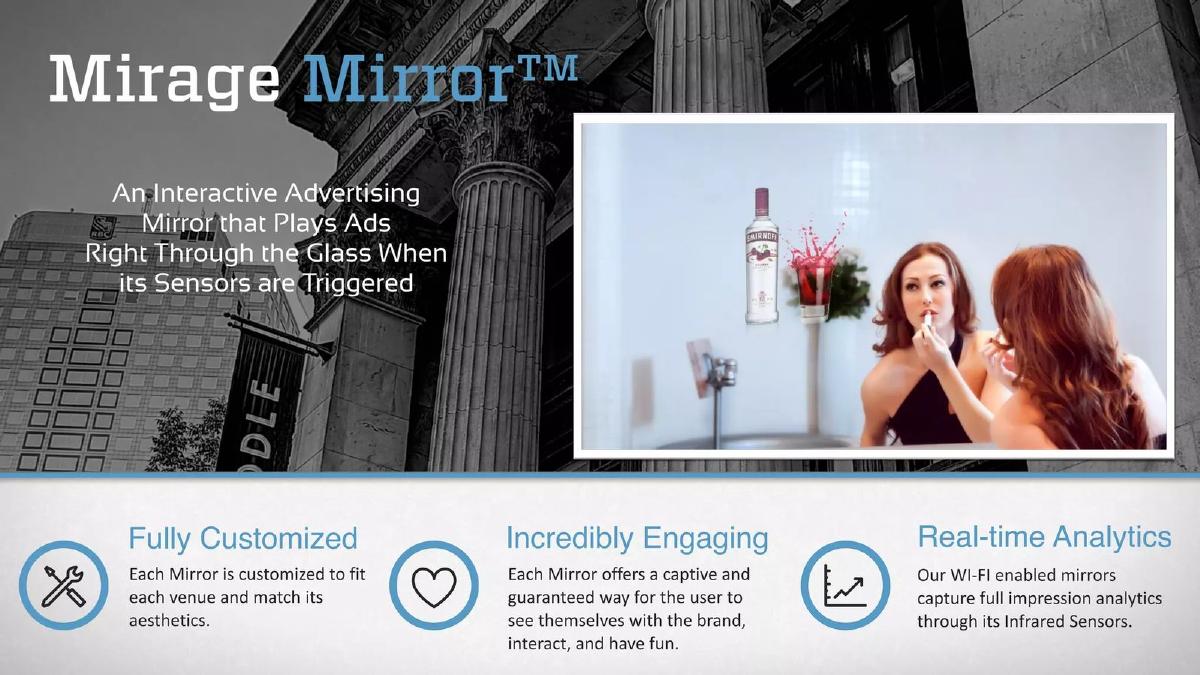
- The Mirage Mirror uses infrared sensors and Wi-Fi to play ads through glass when triggered by a user (Slide 5).
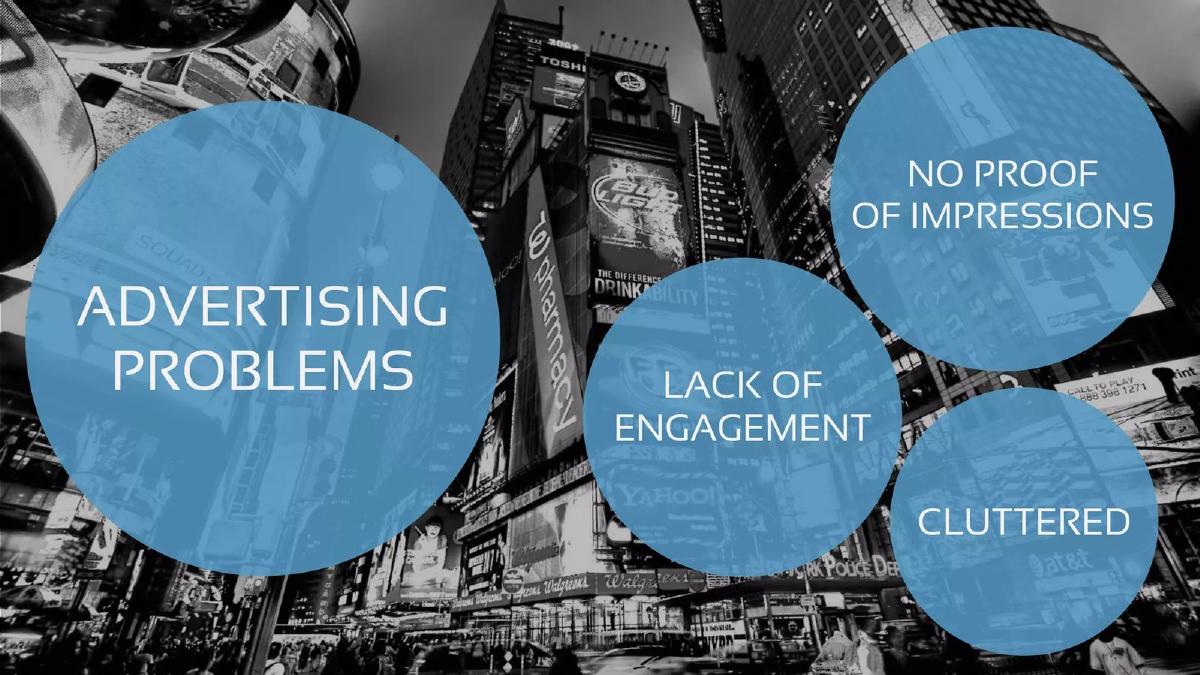
- AdVolve identifies four core industry problems: lack of engagement, no proof of impressions, clutter, and general advertising inefficiency (Slide 4).
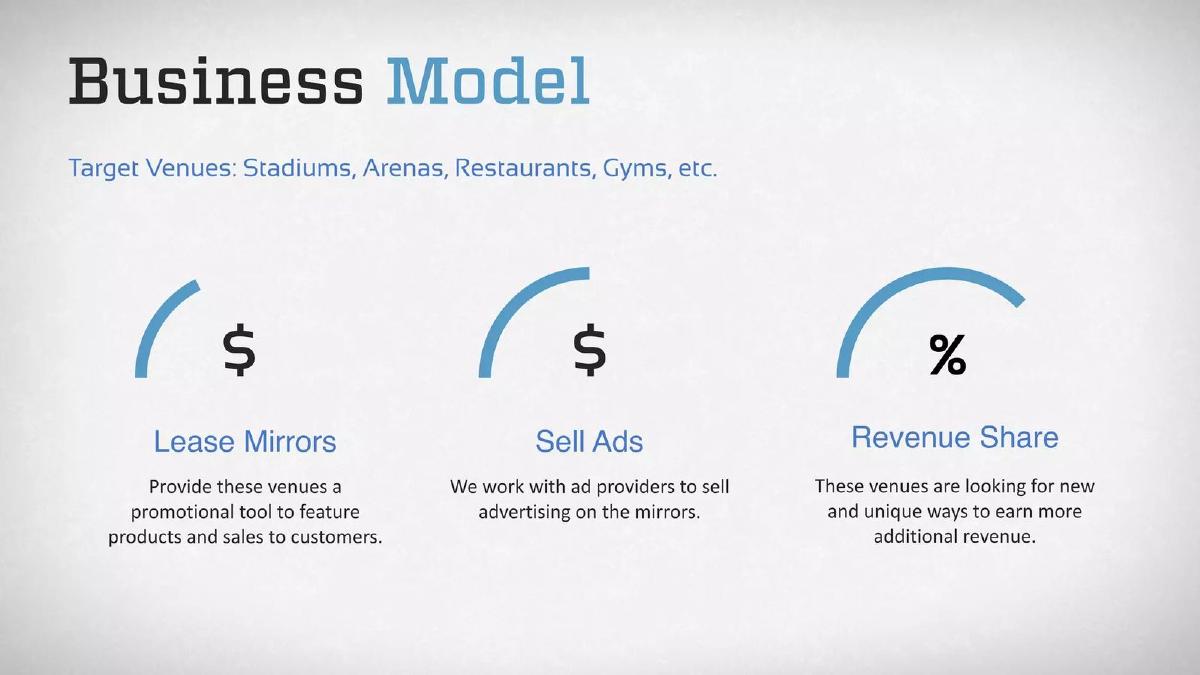
- The business model relies on three revenue streams: mirror leasing, ad sales, and revenue sharing with host venues (Slide 6).
- Case study data indicates engagement peaks as high as 62.5% at specific locations, though location names are redacted (Slide 7).
- The company claims a $30 billion addressable market across North America, targeting major hubs like New York, Los Angeles, and Toronto (Slide 14).
- Financial projections show a steep growth curve, aiming for $13M in revenue by 2014 from a $270K base in 2010 (Slide 19).
- The $1.5M equity investment is allocated primarily to Sales (40%) and Hardware Development (30%) (Slide 20).
- The deck includes a competitive landscape matrix claiming superiority over 'Indoor Digital Signage' in custom builds and social integration (Slide 16).
Executive Summary: The Mirage Mirror Concept
AdVolve Media's pitch deck introduces a hardware-centric approach to out-of-home (OOH) advertising. By turning standard mirrors in high-traffic restrooms and common areas into interactive displays, the company seeks to capture the 'captive audience' moment. The deck, published in 2019 but containing financial data up to 2014, outlines a transition from a hardware provider to a data-driven ad network. The following teardown examines the 21-slide presentation, noting where the narrative succeeds and where placeholders leave questions for potential investors.
Slides 1-3: Introduction and Branding
The deck opens with a generic cover slide (Slide 1) noting that text has been removed for privacy. Slide 2 serves as the formal title page for AdVolve Media, using the tagline "The Face of Facility Promotions & Marketing." The imagery features a woman using a mirror, immediately establishing the context of the product without needing a technical explanation. This is a strong visual hook that identifies the specific environment—restrooms and vanity areas—where the product operates.
Slide 4: The Problem Statement
Slide 4 identifies four 'Advertising Problems' using a bubble graphic over a black-and-white image of Times Square. The problems listed are: No Proof of Impressions , Lack of Engagement , Cluttered , and a general Advertising Problems header. By contrasting their solution against the chaos of Times Square, AdVolve positions itself as a way to cut through the noise. However, the slide is somewhat repetitive, as 'Cluttered' and 'Lack of Engagement' are often symptoms of the same issue.
Slide 5: The Solution - Mirage Mirror
The solution slide introduces the Mirage Mirror™ . It defines the product as an "Interactive Advertising Mirror that Plays Ads Right Through the Glass When its Sensors are Triggered." The slide highlights three key value propositions: Fully Customized (to fit venue aesthetics), Incredibly Engaging (guaranteed way for users to see themselves with the brand), and Real-time Analytics (via Wi-Fi and Infrared Sensors). The inclusion of a product photo showing a Smirnoff ad appearing next to a user's reflection provides a clear 'aha' moment for the reader.
Slide 6: The Business Model
AdVolve outlines a three-pillar revenue strategy on Slide 6. First, they Lease Mirrors to venues like stadiums and gyms. Second, they Sell Ads to third-party providers. Third, they offer a Revenue Share to the venues. This is a standard 'razor and blade' model adapted for ad-tech; the hardware creates the inventory, and the ad sales generate the recurring margin. The slide mentions target venues including stadiums, arenas, restaurants, and gyms, indicating a broad B2B2C approach.
Slides 7-8: Case Studies and Interstitial
Slide 7 presents 'Case Study Results' with a mountain-style bar chart. The engagement figures are impressive: 46%, 62.5%, 60%, 16%, and 30% across five locations. However, the locations are redacted, and the text below each says "Fill in study results," which detracts from the credibility of the data in this specific version of the deck. Slide 8 is an external advertisement for a pitch deck course, which is not part of the AdVolve business narrative.
Slides 9-10: Software and Future Roadmap
Slide 9 focuses on the 'Mirror Software,' showing a mobile and desktop dashboard. It lists features like an Online Real-time Dashboard , Third-Party Client Access , and Impression Data Reporting . This is a crucial slide because it moves the company from a hardware manufacturer to a platform play. Slide 10, 'Future Development,' uses a simple chevron timeline to list Smart Phone Integration , Live Social Media Boards , and Inventory Management APIs . This suggests the company intends to become more integrated with the broader digital advertising ecosystem.
Slides 11-13: Validation and Social Proof
Slide 11 compares Mirage Mirror to "Other Indoor Promotions Average." It claims a 6% average engagement for Mirage versus 1% for others. It also includes a chart for brand perception, though the data points are replaced with 'X%'. Slide 13, 'Our Clients Love Us,' is entirely composed of placeholders. It lists 'Joe Black' as the VP of Sales for 'X Company' three times with the quote "This is where your testimonial will go." While this version of the deck is a template, in a live pitch, these would need to be high-tier logos like the stadiums mentioned earlier.
Slides 14-16: Market Size and Competition
Slide 14 defines a $30 Billion Addressable Market in North America, highlighting five major cities. This is a 'top-down' market sizing which is generally less favored by investors than 'bottom-up' sizing, but it establishes the scale of the OOH ad market. Slide 15 lists 'Growth Partners' but again uses 'Pitch Deck Me' placeholders. Slide 16 is the 'Competitive Landscape' matrix. AdVolve claims to be the only player offering the full suite of Wi-Fi control, custom builds, real-time analytics, high conversion, and social integration. The competitors are anonymized, making it difficult to verify these claims.
Slides 17-18: Team and Advisors
Both the 'Our Team' (Slide 17) and 'Our Advisors' (Slide 18) slides are placeholders. They feature 'John Doe' with generic titles like Co-Founder, CEO, and CTO. For a hardware startup, the team's background in manufacturing, supply chain, and ad-sales is usually the most scrutinized part of the deck. The omission of real names here confirms this is a sanitized or template version of the original pitch.
Slides 19-21: Financials and The Ask
Slide 19, 'Financial Overview,' shows a strong historical and projected growth curve: $270K in 2010, $1.57M in 2011, $4.37M in 2012, $8.69M in 2013, and $13M in 2014. This 5-year view shows a company that has moved past the proof-of-concept stage. Slide 20 presents the Investment Sought: $1,500,000 Equity Investment . The allocation is clear: 40% Sales, 30% Hardware Development, 20% Software Development, and 10% Marketing. The deck concludes with a contact slide (Slide 21) and another course advertisement (Slide 22).
What Works Well in This Deck
The visual explanation of the product is excellent. By showing the mirror in action (Slide 5) and the dashboard (Slide 9), the founders bridge the gap between a physical object and a digital service. The business model slide (Slide 6) is also a highlight; it clearly explains how the company makes money and how it aligns interests with the venues. The financial slide (Slide 19) uses a simple, upward-trending graphic that is easy for an investor to digest quickly, providing a clear sense of the company's trajectory and scale.
What Is Missing or Needs Improvement
The most glaring issue is the lack of specific, verifiable data in this version of the deck. The use of 'Joe Black' and 'X%' placeholders (Slides 11, 13, 15, 17, 18) means the deck is currently a skeleton. To be effective, the 'Case Study' slide needs to name the venues—for example, specifying a specific NFL stadium or a national gym chain—to prove the hardware can survive high-volume public use. Furthermore, the competitive landscape (Slide 16) is too one-sided. Investors know that companies like Vengo or other digital signage firms exist; failing to name them and explain specific technical advantages makes the 'all checkmarks' matrix look unrealistic.
Founder's Takeaway: Lessons to Copy
Founders should emulate the way AdVolve defines the 'Problem.' They didn't just say "ads are bad"; they identified specific pain points like 'No Proof of Impressions' (Slide 4). This sets up their 'Real-time Analytics' solution perfectly. Additionally, the breakdown of the $1.5M ask (Slide 20) is a best practice. Instead of a vague "working capital" label, they assigned specific percentages to functional areas, which shows they have a plan for the capital. Finally, the use of a hybrid revenue model (leasing + ad sales) is a smart way to show multiple paths to profitability, reducing the perceived risk of the investment.
Conclusion
AdVolve Media presents a compelling case for a niche OOH advertising platform. The Mirage Mirror solves a specific problem—user attention—in a way that traditional digital signage cannot. While the template nature of this specific deck hides the team's strength and the actual client list, the underlying structure follows a logical progression from problem to solution to scale. For a $1.5M raise, the focus on sales and hardware development suggests a company ready to move from a regional pilot to a national network.
Frequently asked questions
- What is the core technology behind the Mirage Mirror?
- The Mirage Mirror is an interactive advertising display that uses infrared sensors to detect user presence. When triggered, it plays advertisements directly through the mirror glass. It is Wi-Fi enabled, allowing for real-time analytics and remote content management through a centralized software dashboard as shown on slide 9.
- How does AdVolve Media generate revenue?
- According to slide 6, the company employs a hybrid business model. They lease the physical mirrors to venues (stadiums, gyms, restaurants), sell advertising space on those mirrors to third-party brands, and offer a revenue-sharing model to incentivize venues to host the hardware.
- What are the primary use cases for the $1.5M investment?
- Slide 20 breaks down the $1,500,000 equity investment into four categories: 40% for Sales, 30% for Hardware Development, 20% for Software Development, and 10% for Marketing. This suggests a heavy focus on scaling the physical footprint and improving the core hardware product.
- What metrics does the company use to prove effectiveness?
- The company uses engagement and brand perception metrics. Slide 12 claims the Mirage Mirror achieves a 6% average engagement rate compared to approximately 1% for other indoor promotions. It also tracks 'appeal' and 'positive brand perception' through user surveys, though specific percentage figures for these are marked with 'X' placeholders.
- Who are the competitors mentioned in the deck?
- The competitive landscape on slide 16 is largely anonymized with 'Pitch Deck Me' placeholders. However, it explicitly lists 'Indoor Digital Signage' as a broad competitor, claiming that AdVolve differentiates itself through custom manufacturing, real-time analytics, and social media integration.