The Adobe × Macromedia acquisition deck is a masterclass in M&A communication, focusing on the synergy of 'Platforms' and 'Solutions.' By merging Adobe’s PDF dominance with Macromedia’s Flash ecosystem, the companies aimed to define the future of digital content across PCs, mobile devices, and enterprise servers. The deck outlines a $3.4 billion stock-for-stock deal with a fixed exchange ratio of 0.69 Adobe shares per Macromedia share. It emphasizes a combined financial profile of high gross margins (93% for both) and a strategic shift toward mobile and rich media. The presentation successful…
Key takeaways
- The transaction was a $3.4 billion stock-for-stock deal with a fixed exchange ratio of 0.69 Adobe shares for every Macromedia share (Slide 14).
- Both companies maintained identical gross margins of 93% at the time of the merger (Slide 15).
- The strategic core of the deal was the unification of Flash and PDF as 'Industry Defining Technology Platforms' (Slide 8).
- Adobe's revenue for the period ending 3/4/2005 was $1.716 billion, compared to Macromedia's $422 million (Slide 15).
- The deal was expected to be break-even to slightly accretive to earnings within the first 12 months on a non-GAAP basis (Slide 14).
- A $1 billion stock repurchase program was authorized to be executed after the close of the transaction (Slide 14).
- Leadership continuity was a priority, with Bruce Chizen remaining CEO and Stephen Elop becoming President of Worldwide Field Operations (Slide 17).
- The combined company targeted a massive partner ecosystem including Apple, Microsoft, Nokia, and Samsung (Slide 13).
Introduction: A Defining Moment in Creative Software
The 2005 acquisition of Macromedia by Adobe remains one of the most consequential mergers in the history of the software industry. Valued at $3.4 billion, this was not just a horizontal acquisition of a competitor; it was a vertical integration of the two most dominant standards of the early internet: the PDF and Flash. This pitch deck, dated April 18, 2005, served as the primary communication tool for investors, analysts, and stakeholders to understand why these two giants were better together.
Slides 1-3: Legal Foundations
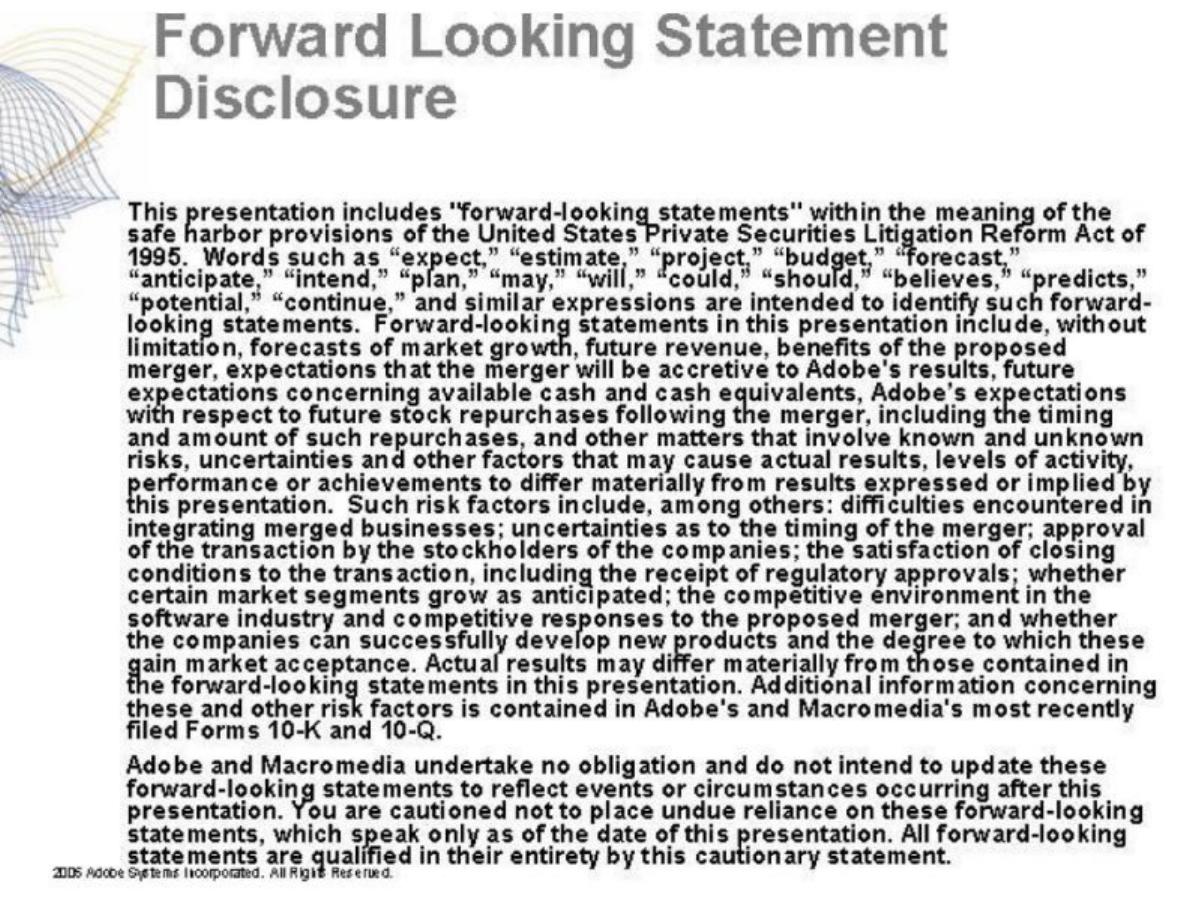
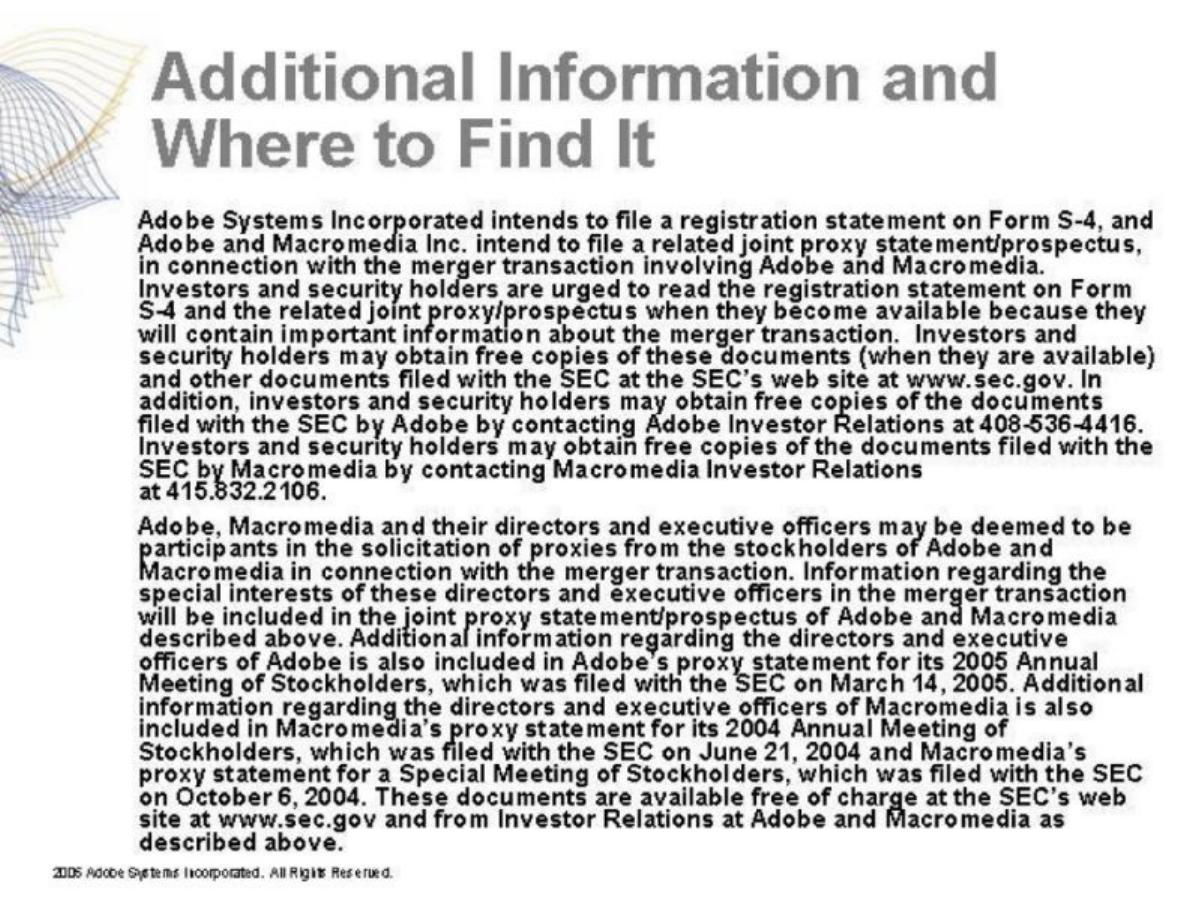
The deck opens with a standard title slide (Slide 1) and immediately moves into heavy legal disclosures. Slide 2 contains the 'Forward Looking Statement Disclosure,' a necessity for a multi-billion dollar public transaction. Slide 3, 'Additional Information and Where to Find It,' directs investors to the SEC filings (Form S-4) and proxy statements. These slides establish the formal, regulated nature of the transaction, reminding the audience that while the vision is creative, the execution is strictly governed by securities law.
Slides 4-5: The Vision and the 'Why'
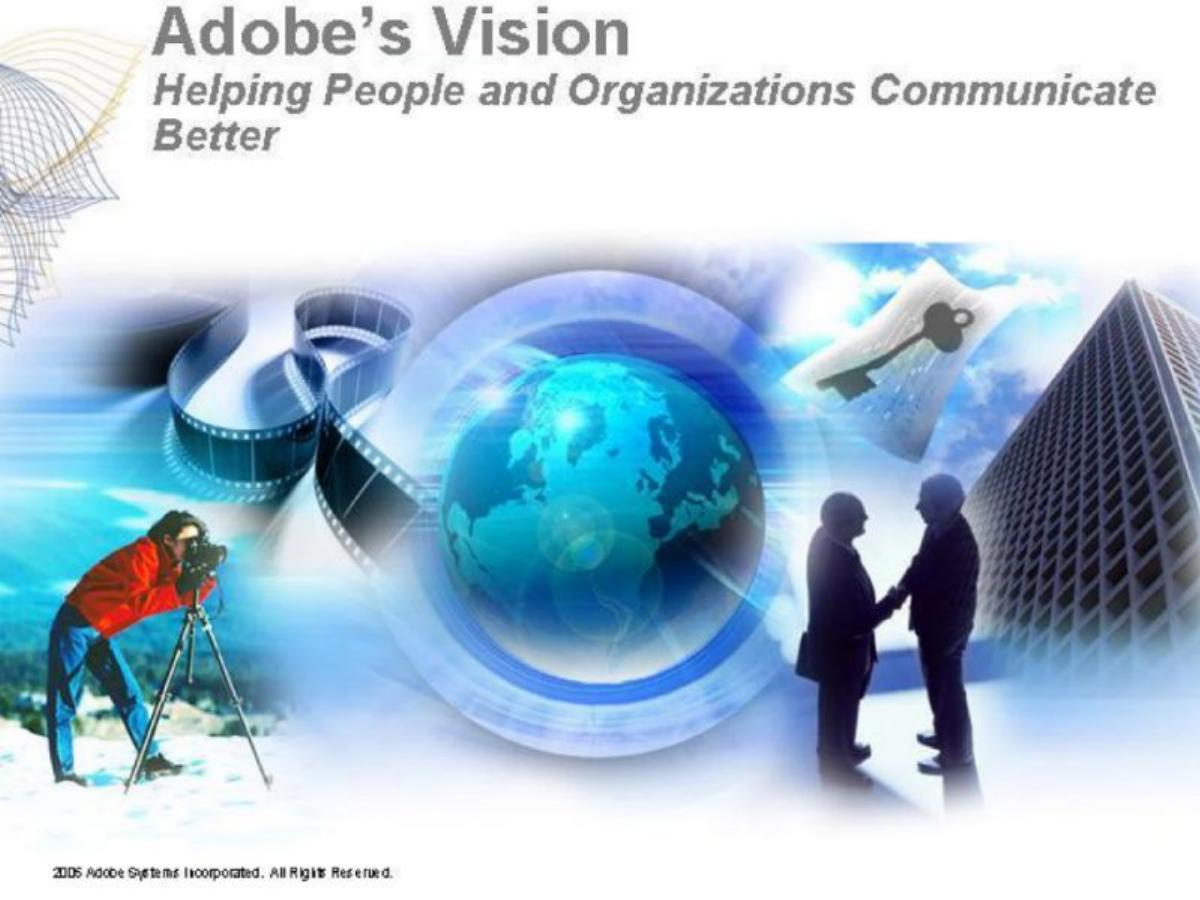
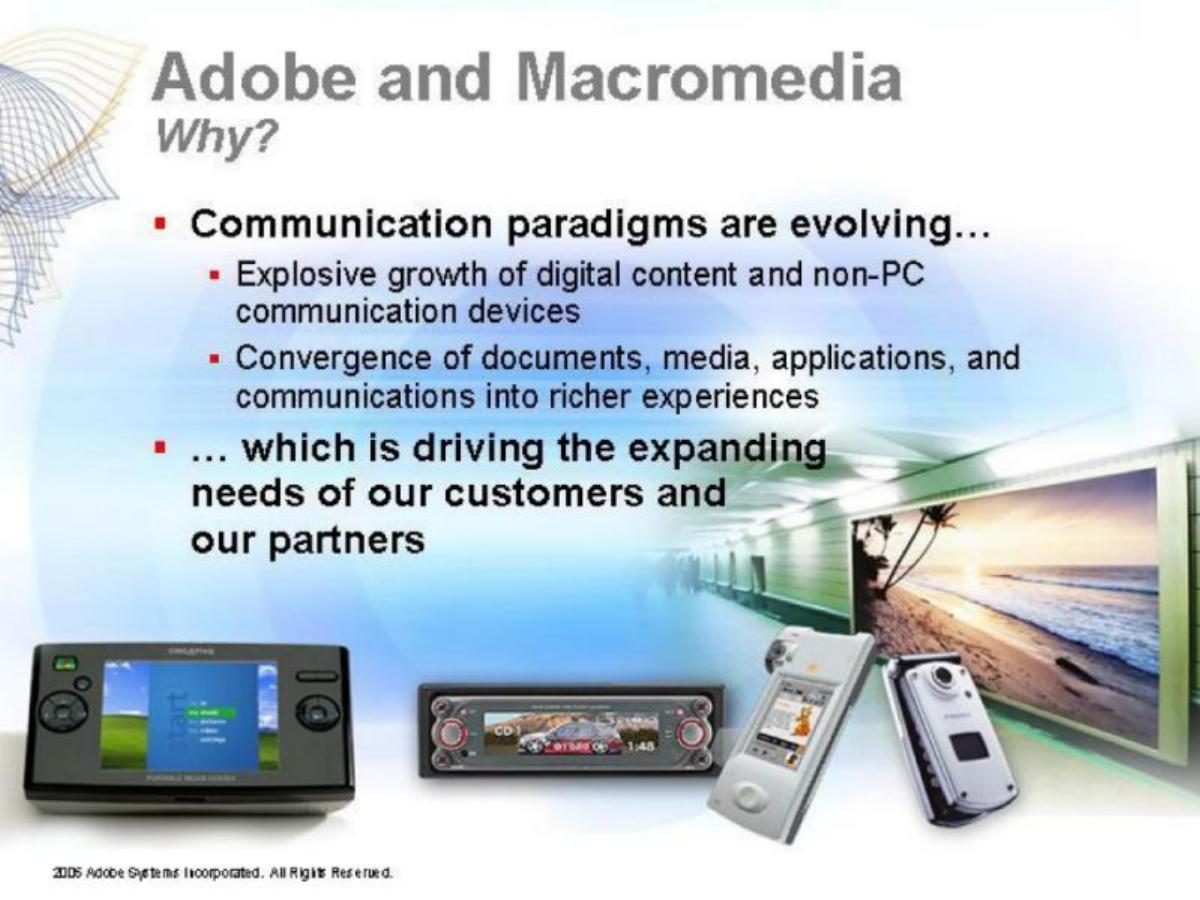
Slide 4 defines Adobe’s vision as 'Helping People and Organizations Communicate Better,' accompanied by a collage of photography, film, and global connectivity. This sets the stage for Slide 5, which addresses the 'Why?' of the deal. The core argument is that communication paradigms are evolving through the 'explosive growth of digital content and non-PC communication devices.' The slide explicitly mentions the convergence of documents, media, and applications—foreshadowing the mobile revolution that was just beginning in 2005.
Slides 6-7: The Convergence of Flash and PDF
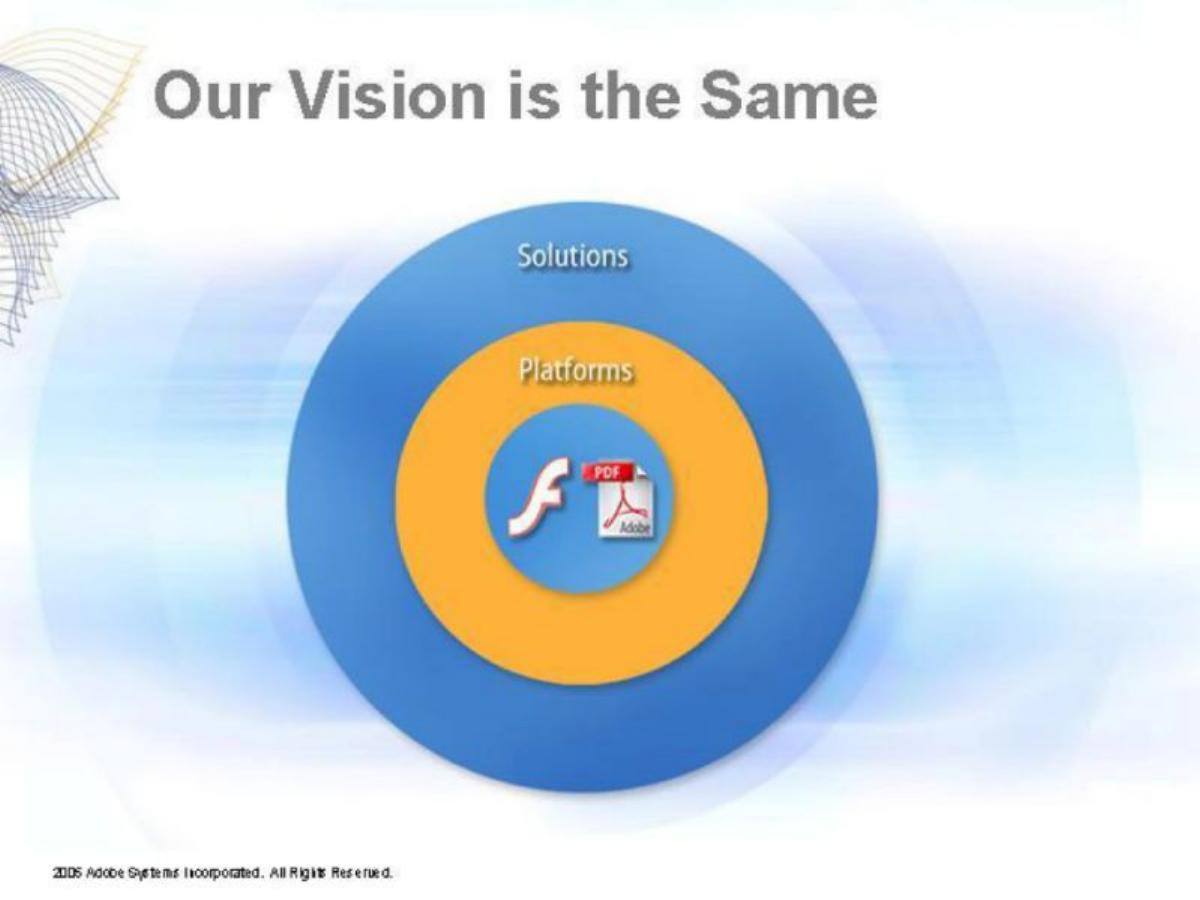
These two slides are visually identical in their core diagram but build in complexity. They present a 'Solutions' ring surrounding a 'Platforms' ring, at the center of which sit the Flash and PDF logos. Slide 7 expands this to show the ecosystem: browsers (IE, Firefox, Netscape), operating systems (Windows, Mac, Linux), and a variety of hardware including mobile phones, landlines, and game consoles (a PlayStation 2 is pictured). This is the 'moat' slide; it argues that by owning both standards, Adobe becomes the gatekeeper for content on every screen.
Slide 8: Strategic Rationale - The Product Matrix
This is arguably the most important slide for understanding the product synergy. It categorizes the combined portfolio into four segments: Creative Professional, Digital Imaging & Video, Enterprise, and Emerging Businesses. It shows how Macromedia’s tools (Dreamweaver, Flash, Flex, ColdFusion) slot perfectly alongside Adobe’s (Photoshop, After Effects, Premiere, Stock Photos). The bottom bar reinforces the message: Flash and PDF are the 'Industry Defining Technology Platforms' that support all these products.
Slides 9-12: Segmented Customer Benefits
Adobe breaks down the value proposition for four distinct groups. For the Creative Professional (Slide 9), the benefit is better integration and easier 'repurposing of content' across platforms. For Digital Imaging & Video (Slide 10), the focus is on an 'end-to-end video workflow' and the 'ubiquitous instant-on' nature of Flash video. For the Enterprise (Slide 11), the deck promises knowledge workers better collaboration tools and improved developer sets. Finally, Emerging Businesses (Slide 12) focuses on expanding the wireless ecosystem and enabling custom-branded services for mobile publishers.
Slide 13: The Combined Ecosystem
To prove market dominance, Slide 13 lists a 'Diverse Set of Customers and Partners.' The customer list spans hobbyists to government and telco verticals. The 'Partners' section is a 'who's who' of 2005 tech: Apple, Nokia, Microsoft, Dell, IBM, HP, Samsung, Sony, and Yahoo. This slide is designed to show that the combined entity is too integrated into the global tech stack to be ignored.
Slide 14: Transaction Summary
This slide provides the hard numbers of the deal. It confirms the $3.4 billion valuation and the stock-for-stock structure. Key details include a fixed exchange ratio of 0.69 Adobe shares for every Macromedia share and an 18% pro forma ownership for Macromedia stockholders. It also notes the expected closing in Fall 2005 and a $1 billion stock repurchase program authorized by the Adobe Board to offset dilution.
Slides 15-16: Financial and Operational Health
Slide 15 compares the income statements. Adobe’s revenue (ending 3/4/2005) was $1.716 billion with a 93% gross margin. Macromedia’s revenue (ending 12/31/2004) was $422 million, also with a 93% gross margin. This identical gross margin is a powerful indicator of business model alignment. Slide 16 highlights other metrics: Adobe had 4,016 employees and $1.467 billion in cash, while Macromedia had 1,417 employees and $341 million in cash. The combined entity would have over $1.8 billion in liquidity and a headcount of nearly 5,500.
Slide 17: Leadership
M&A deals often fail due to leadership friction. Slide 17 addresses this by naming names. Bruce Chizen (Adobe CEO) and Shantanu Narayen (Adobe President/COO) remained in their roles. Macromedia’s Rob Burgess joined the Board, and Stephen Elop (who later became CEO of Nokia) was named President of Worldwide Field Operations. This signaled a stable, integrated management plan.
Slide 18: Summary
The final slide reiterates the core themes: shared vision, industry-defining platforms, integrated solutions, and 'coming together from positions of financial strength.' It is a confident closing that emphasizes growth rather than cost-cutting or desperation.
What Adobe and Macromedia Did Right
Standardization Narrative: The deck successfully framed the merger as the unification of the internet's two most important standards (PDF and Flash). This made the deal feel inevitable rather than opportunistic. · Financial Alignment: Highlighting the identical 93% gross margins (Slide 15) was a brilliant move. it signaled to investors that the two companies operated with the same efficiency and business logic. · Visual Synergy: The use of the 'Platforms vs. Solutions' rings (Slides 6-7) provided a simple mental model for a very complex product integration. · Clear Leadership Path: By explicitly naming the future roles of executives from both companies (Slide 17), they mitigated concerns about post-merger integration and cultural clashes.
What Was Missing
Antitrust Acknowledgement: While Slide 14 mentions 'customary regulatory approvals,' the deck does not address the significant market share the combined company would hold in the creative software space, which was a major point of discussion at the time. · Specific Cost Synergies: Most M&A decks highlight 'synergies' (often a euphemism for layoffs). This deck focuses almost entirely on revenue and product growth, omitting specific details on how they would consolidate overlapping departments. · The 'HTML5' Risk: In hindsight, the deck's heavy reliance on Flash as an 'industry-defining platform' was its greatest vulnerability. There is no mention of open web standards that would eventually displace Flash.
What Other Founders Should Copy
The 'Why Now' Slide: Slide 5 is an excellent example of mapping a company's move to broader industry shifts (the rise of mobile and digital content). Founders should always link their 'Ask' to an unstoppable market trend. · The Partner Slide: Slide 13 uses logos effectively. If your startup has high-profile partners or customers, a single slide showing your integration into their ecosystem is more powerful than ten slides of text. · The Segmented Benefit Approach: Slides 9-12 show how to tailor a pitch to different stakeholders. Instead of a generic 'we are better,' they explained exactly how the deal helped the creative pro, the enterprise, and the mobile developer separately.
Frequently asked questions
- What was the valuation and structure of the Adobe-Macromedia deal?
- The acquisition was valued at $3.4 billion and structured as a stock-for-stock transaction. According to slide 14, the deal utilized a fixed exchange ratio where Macromedia stockholders received 0.69 shares of Adobe common stock for every share of Macromedia they owned, resulting in approximately 18% pro forma ownership for Macromedia stockholders.
- What were the primary strategic reasons for the merger?
- The deck highlights the convergence of documents, media, and applications into 'richer experiences' (Slide 5). By combining Adobe’s PDF and Macromedia’s Flash, the companies aimed to create a ubiquitous platform for digital content across multiple devices, specifically targeting the growth in non-PC communication devices like mobile phones and game consoles.
- How did the financial health of the two companies compare?
- Both companies were highly profitable with 93% gross margins. Slide 15 shows Adobe had $1.716 billion in revenue and $459 million in net income, while Macromedia had $422 million in revenue and $63 million in net income. Adobe also held significantly more cash: $1.467 billion compared to Macromedia’s $341 million (Slide 16).
- Who were the key leaders involved in the combined entity?
- Leadership was a blend of both firms. Bruce Chizen remained CEO of Adobe, and Shantanu Narayen remained President and COO. From Macromedia, Rob Burgess joined the Board of Directors, and Stephen Elop took the role of President of Worldwide Field Operations (Slide 17).
- What were the expected benefits for enterprise customers?
- For the enterprise, the merger promised better collaboration tools regardless of OS or hardware. Slide 11 notes that the combination would provide 'more complete solutions' by utilizing both PDF and Flash interfaces, improved developer tool sets, and leveraging Adobe’s established brand and go-to-market infrastructure.