Pendo’s Series B deck is a masterclass in growth-stage storytelling, securing $20M by proving they had built a repeatable, scalable machine. Instead of just selling a vision, the deck uses a 'knockout punch' of five data-heavy slides to demonstrate accelerating ARR, sales efficiency, and successful upmarket movement. By framing their solution as an integrated platform rather than a niche tool, Pendo established category leadership and a clear path to enterprise dominance.
Key takeaways
- Tell a multi-chapter metrics story by connecting top-line growth to sales capacity, cohort health, and rising average sale price.
- Weaponize customer ROI by using specific, quantifiable metrics from happy clients rather than making internal claims.
- Frame the problem in simple, human terms to make the market opportunity instantly relatable to any investor.
- Visualize your land-and-expand strategy to demonstrate how the product grows from a departmental tool to an enterprise system.
- Position as an integrated platform rather than a point solution to claim a larger, more strategic market category.
The Context: Hitting Escape Velocity in the Product Economy
In late 2016, the software world was deep into its transformation. The subscription economy was normalized, Agile development was the default, and the first whispers of 'product-led growth' (PLG) were emerging. It was no longer enough to just ship software; companies now lived and died by their ability to deliver continuous value, drive adoption, and retain users. Against this backdrop, Pendo, founded in 2013 by a team of product veterans, came to market for its Series B. They had raised $11M to date and were seeing explosive growth.
This deck secured a $20 million Series B round led by Spark Capital, with participation from existing investors. The presentation reviewed here is the 'overview' version, likely used in second or third meetings after an introduction. It's less about educating a novice and more about convincing a knowledgeable investor that Pendo had found product-market fit and built a repeatable, scalable go-to-market machine. It’s a case study in how to present a growth-stage company that has hit its stride.
Slide-by-Slide Analysis
The Hook: People, Trends, and a Simple Problem (Slides 2-4)
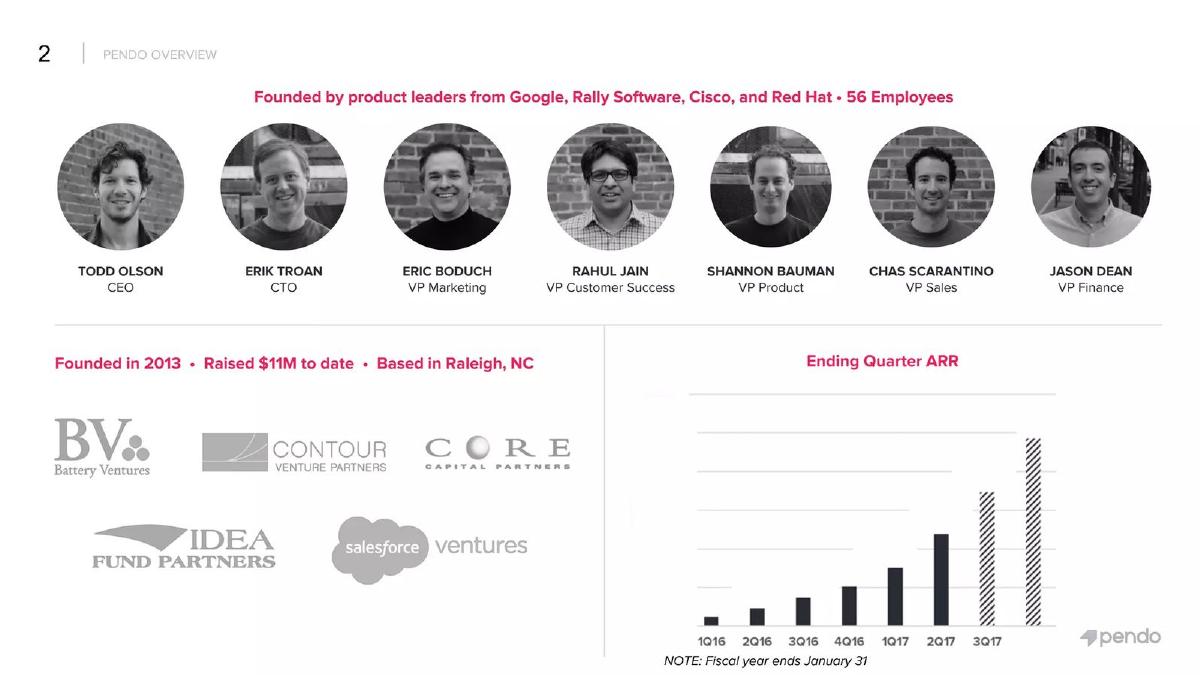
The deck opens with confidence. Slide 2 bypasses a lengthy intro and gets straight to the point: here's our all-star team from places you respect (Google, Rally, Cisco), here's our explosive ARR growth chart (even with redacted axes, the hockey stick is undeniable), and here are the basic facts. It immediately establishes credibility and signals that this is a company with momentum. This isn't a 'dream' deck; it's a 'reality' deck.
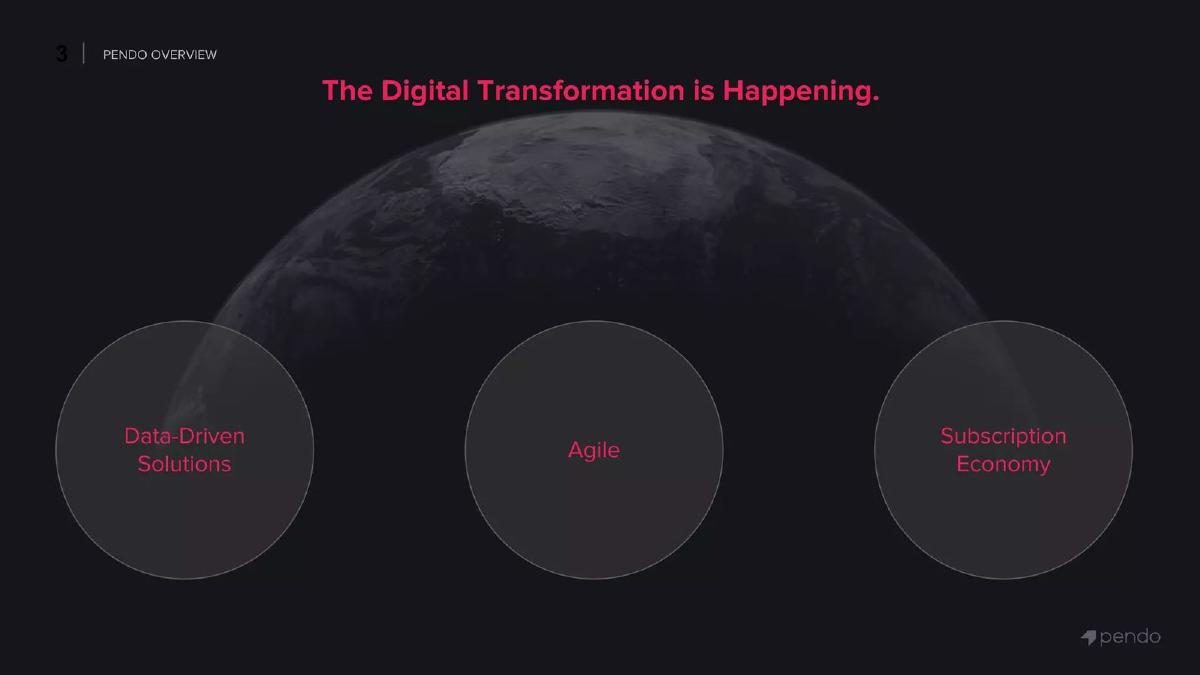
Slides 3 and 4 work together to frame the macro landscape and the core problem. The 'Digital Transformation' slide (Slide 3) with its three pillars—Agile, Data-Driven, Subscription Economy—is a simple way to align with an investor's worldview. It says, 'We are operating in the center of the biggest trends you're already investing in.' It’s context-setting, not thesis-defining.
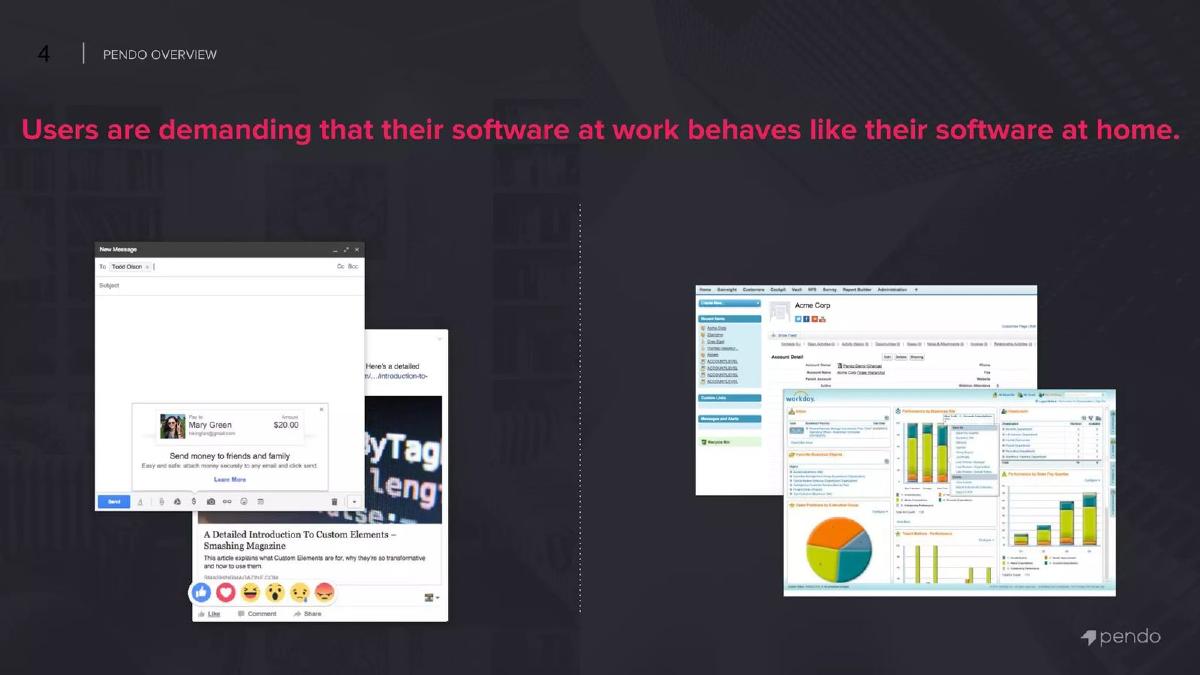
Users are demanding that their software at work behaves like their software at home.
This is a perfect problem statement. It's simple, universally relatable, and instantly understandable. Every investor has experienced clunky enterprise software and slick consumer apps. Pendo avoids jargon and technical complexity, instead grounding the entire company's purpose in a simple, human-centric insight. This tells an investor that the market for this problem is massive and implicitly understood by every employee at every company.
The Solution: An Integrated Platform Play (Slides 5-8)
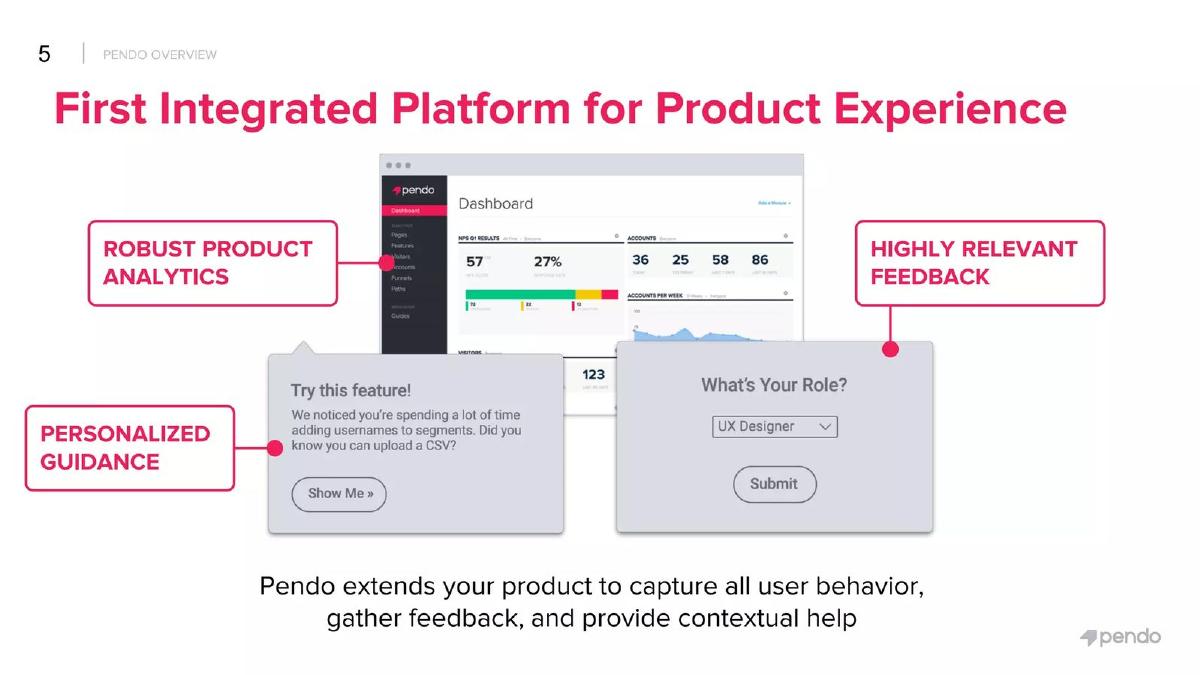
After a simple problem, Pendo presents an elegant solution on Slide 5: the 'First Integrated Platform for Product Experience.' The slide architecture—three overlapping circles for Analytics, Feedback, and Guidance—is crucial. The key word here is 'Integrated.' Pendo is explicitly positioning itself not as a better analytics tool or a better in-app messaging tool, but as the platform that unifies these disjointed functions. This is a classic strategy to differentiate from point solutions and claim a larger, more strategic category. It elevates the conversation from 'a tool for PMs' to 'a system for the business.'
Slide 6, 'The Foundation: Data,' provides the simple technical underpinning for this ambitious vision. A single JavaScript snippet captures every click and pageview, retroactively. This is a powerful technical and business differentiator. 'No-code,' 'retroactive,' and 'capture everything' are music to a buyer's ears, implying fast time-to-value and no missed insights. It de-risks the technical diligence and makes the platform's power seem almost magical.
Slide 7 reinforces the key strengths, hammering home the 'Fully Integrated Solution' point and highlighting the power of segmentation and targeted messaging. But it's Slide 8, 'Why Pendo?', that truly expands the vision. The wheel graphic showing value for Product, Customer Success, Marketing, Sales, UX, and Leadership is a brilliant piece of business storytelling. It visualizes the land-and-expand strategy, showing an investor exactly how Pendo can grow from a departmental tool into an enterprise-wide system of record. This slide justifies a higher average contract value (ACV) and a much larger total addressable market (TAM) than a simple product analytics tool ever could.
The Proof: Customer ROI and a Clear GTM (Slides 9-14)
Armed with a big vision, the deck pivots to proving it's actually happening. Slide 9 explicitly states the go-to-market motion: 'Land in Product / UX, Expand into Customer Success.' It’s simple, clear, and demonstrates a focused, repeatable strategy.
The next slides provide the social proof. Rather than just a logo wall (which comes later), Pendo uses two full slides (10 and 12) for mini case studies. The Infor slide signals enterprise readiness ('Standard across HCM Suite,' 'Negotiating Enterprise-wide Deal'). This tells investors Pendo can land massive accounts. The Henry Schein slide provides the killer ROI metric:
“...as a result of improvements we made we raised our NPS by 53 points in 6 months”
This is gold. A specific, quantifiable, and dramatic business outcome, directly attributed to the product by a happy customer. It transforms Pendo from a 'nice-to-have' analytics tool into a 'must-have' driver of customer satisfaction and retention. After this powerful proof, the redacted logo slide (13) serves as reinforcement.
Finally, Slide 14, 'Go to market,' summarizes the sales engine with surgical precision: Direct, inside sales team targeting B2B product managers, with a per-product MAU-based pricing model. In less than 25 words, it answers every fundamental GTM question an investor has, projecting an image of a well-understood and well-executed sales process.
The 'Knockout Punch': Traction, Traction, Traction (Slides 15-19)
If the deck up to this point was the setup, this section is the knockout. Pendo unleashes five consecutive slides of hard, quantitative proof that the machine is working and accelerating. This is what a great growth-stage deck does.
Slide 15: Net New ARR Growth. The quintessential hockey stick. Even with no Y-axis, the accelerating quarterly growth is undeniable. This is the single most important slide for a Series B and Pendo nails it. · Slide 16: Sales Quota Capacity. A more nuanced and impressive slide. It shows that the sales team's capacity to sell is actually outstripping their already aggressive goals. This de-risks future growth, telling investors 'if you give us money to hire more reps, we have a proven system to make them productive.' · Slide 17: Cohort Trending. This slide, while hard to read in this format, demonstrates net dollar retention. It shows that customers don't just stay; they spend more over time. This is the foundation of a healthy, efficient SaaS business model. It proves the product is sticky and that the 'expand' part of 'land-and-expand' is real. · Slide 18: New ASPs Trending Up. This chart shows that the average sales price is increasing quarter over quarter. It's direct evidence supporting the narrative of moving upmarket and selling more strategic, larger deals. · Slide 19: Moving Up Market to Serve Enterprise Customers. This bar chart visualizes the change in customer mix, showing a growing percentage of revenue coming from higher-value accounts. It's the final piece of evidence that Pendo is successfully executing its enterprise strategy.
Together, these five slides form an unbreakable narrative: 'We are growing fast, our growth is efficient and profitable at the unit level, and we are successfully moving into the larger, more lucrative enterprise market.' It's a masterclass in telling a story with data.
The Future: Vision and The Ask (Slides 20-23)
The final section of the deck looks forward. The TAM slide (20), though redacted, uses a standard and credible bottom-up build, starting with sample customers and extrapolating out. The competitive analysis (21) is a standard feature grid. While these slides can often feel weak, in the context of the overwhelming traction C-suite, it serves its purpose: to show they’ve done their homework and have a defensible position, even if the slide format is basic.
The roadmap (22) signals continued ambition, laying out plans for future product development. It assures investors that the team isn't resting on its laurels and has a vision to further expand the platform. Finally, the 'ask' on Slide 23 is clear: '$15M Series B' to pour fuel on the fire that the previous slides proved was burning bright. The redacted forecast would show how this capital translates into continued hyper-growth. The deck closes with a simple summary slide (24) reinforcing the four key pillars: Team, Growth, Customers, and Product.
Founder Lessons: What to Steal from Pendo
Tell a Multi-Chapter Metrics Story: Don't just show an ARR chart. Pendo created a narrative arc with its data. They showed top-line growth (Net New ARR), then proved its health (Cohorts), its scalability (Sales Capacity), and its strategic direction (Rising ASPs, Enterprise Mix). Connect your metrics to tell a complete story of a healthy, scalable business. · Weaponize Customer ROI: A single, powerful quote with a hard metric (like Henry Schein's '53 point NPS increase') is more valuable than ten slides of your own claims. Actively solicit this data from your champion customers and make it the star of your deck. · Frame the Problem in Human Terms: 'Work software should feel like home software' is a billion-dollar problem statement disguised as a simple observation. Find the simple, relatable truth behind the complex problem your product solves. · Visualize Your Land-and-Expand Strategy: Pendo's 'Why Pendo?' wheel graphic (Slide 8) is a powerful tool. It shows investors how you'll maximize the value of each customer you acquire. If your product has multi-departmental value, show it, don't just say it. · Lead with Confidence: The deck starts with a team slide that includes an ARR chart. This projects extreme confidence. If you have stellar metrics, don't bury the lede. Put your strongest proof point front and center. · Position as an 'Integrated Platform': If you operate in a crowded market of point solutions, the best way to stand out is to move up a level. By branding as an 'integrated platform,' Pendo changed the conversation, increased its perceived value, and created a category it could own.
Conclusion: Promise Made, Promise Kept
The Pendo Series B deck is a testament to the power of execution. The promise was simple: give us capital, and we will continue executing on this incredible engine we’ve built. Pendo delivered. Today, the company is a dominant force in the product experience category, valued at $2.6 billion in its 2021 funding round. They have executed flawlessly on the 'move upmarket' strategy, serve a who's who of enterprise clients, and have expanded their platform through both internal development and strategic acquisitions (like Receptive for feedback management and Mind the Product for community).
This deck is an artifact from a pivotal moment when Pendo proved it had moved beyond mere product-market fit and had built a truly scalable, repeatable, and profitable growth machine. For any founder approaching a growth-stage round, it's a blueprint for how to use data not just as evidence, but as the core of the narrative itself.
Frequently asked questions
- What was the single most effective slide in this deck?
- Slide 15, 'Net New ARR Growth.' For a Series B, top-line growth acceleration is the name of the game. This classic hockey stick chart, even with redacted axes, communicates one thing: explosive momentum. It's the foundation upon which the entire credibility of the deck is built.
- This deck seems light on the product itself. Why did that work?
- This is a growth-stage 'overview' deck, not a seed-stage 'first look' deck. By Series B, and with these metrics, investors assume the product works. The risk has shifted from 'can they build it?' to 'can they sell it and scale?'. The deck rightly focuses 80% of its energy on proving the go-to-market engine is world-class.
- How defensible was Pendo's moat at this stage? The competitive slide is weak.
- The competitive feature-grid slide is indeed the weakest part of the deck. However, their true moat was implicitly argued elsewhere: the 'capture everything, retroactively' data layer (Slide 6). This technical choice created a data asset no competitor could easily replicate. A customer's entire user history was instantly available from the moment of installation, creating high switching costs and a uniquely powerful dataset.
- The deck highlights a 'Land and Expand' model. How did they prove the 'Expand' part?
- Primarily through the 'Cohort Trending' slide (Slide 17). This slide demonstrates positive net dollar retention, meaning the revenue from a given cohort of customers increases over time. This is hard proof that customers are not only staying but also buying more seats, adopting more features, or adding Pendo to more products—the 'expand' motion in action.
- What can a founder raising a Seed or Series A learn from this Series B deck?
- While you won't have the same traction slides, you can adopt the storytelling principles. First, frame the problem in a simple, human way. Second, position your solution as a strategic platform, not just a feature. Third, even with early customers, hunt for those quantitative ROI stories ('we increased X by Y%'). Finally, have a crystal-clear slide on your target customer and go-to-market hypothesis, even if it's not yet proven at scale.
- Where is Pendo now compared to the vision in this deck?
- Pendo has largely executed on and exceeded the vision laid out here. They successfully moved upmarket to become an enterprise-first company, as promised in Slides 18 and 19. They expanded the platform well beyond the initial three circles, acquiring companies to bolster their offerings and launching a 'Product Cloud' vision. The company is a clear market leader, valued in the billions, and is widely expected to be a future IPO candidate. The deck was a credible preview of a dominant company in the making.