Peertopier presents a dual-sided marketplace solution designed to streamline the leisure boating experience. By targeting both boat owners and marine service providers, the company aims to digitize service history, billing, and vessel sales. The deck relies heavily on top-down market statistics, citing 15.8 million registered boats in the U.S. and a $16 billion spend on marine services. While the product vision includes a mobile invoicing system and a digital service record that transfers upon sale, the deck lacks critical investor information. There is no mention of the founding team, no spe…
Key takeaways
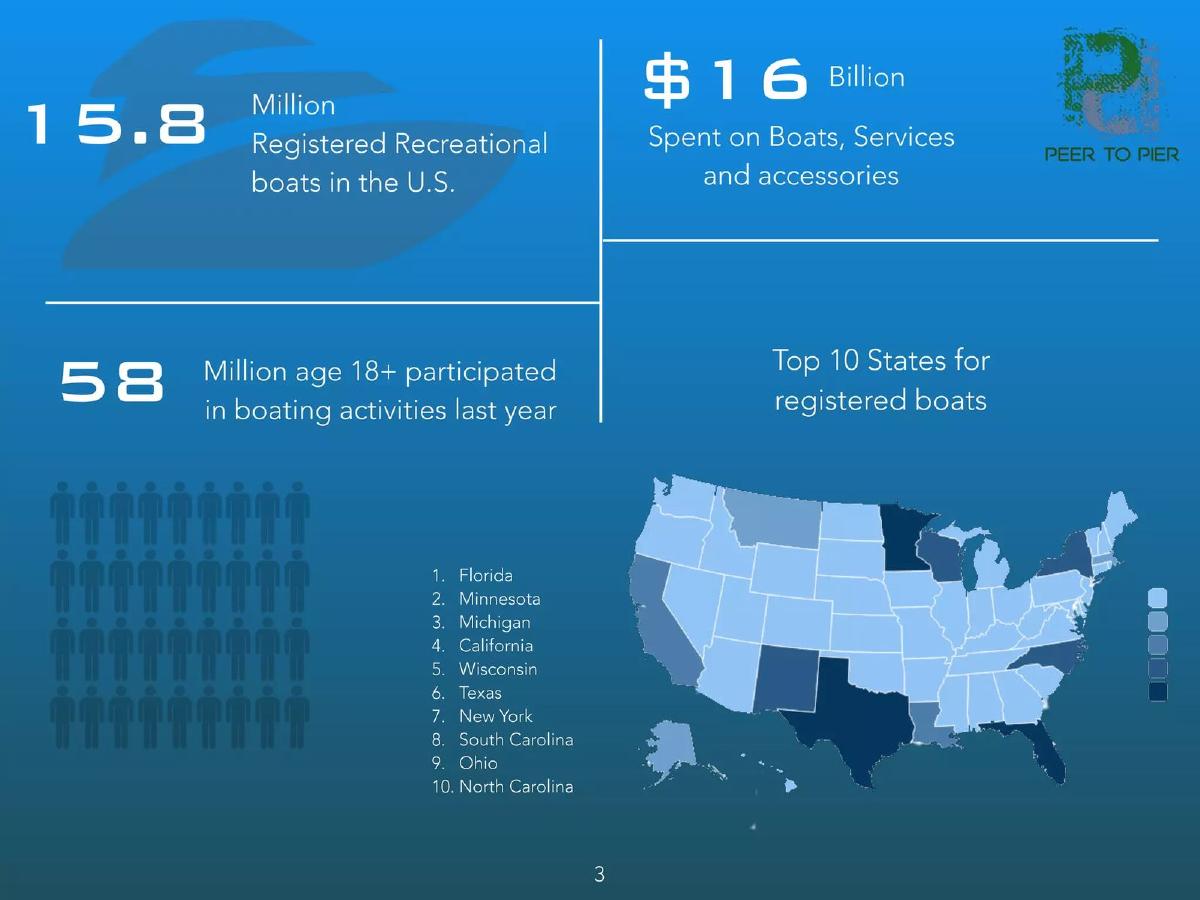
- The U.S. market contains 15.8 million registered recreational boats, with 58 million adults participating in boating activities annually (Slide 2).
- Total annual spending on boats, services, and accessories is estimated at $16 billion (Slide 2).
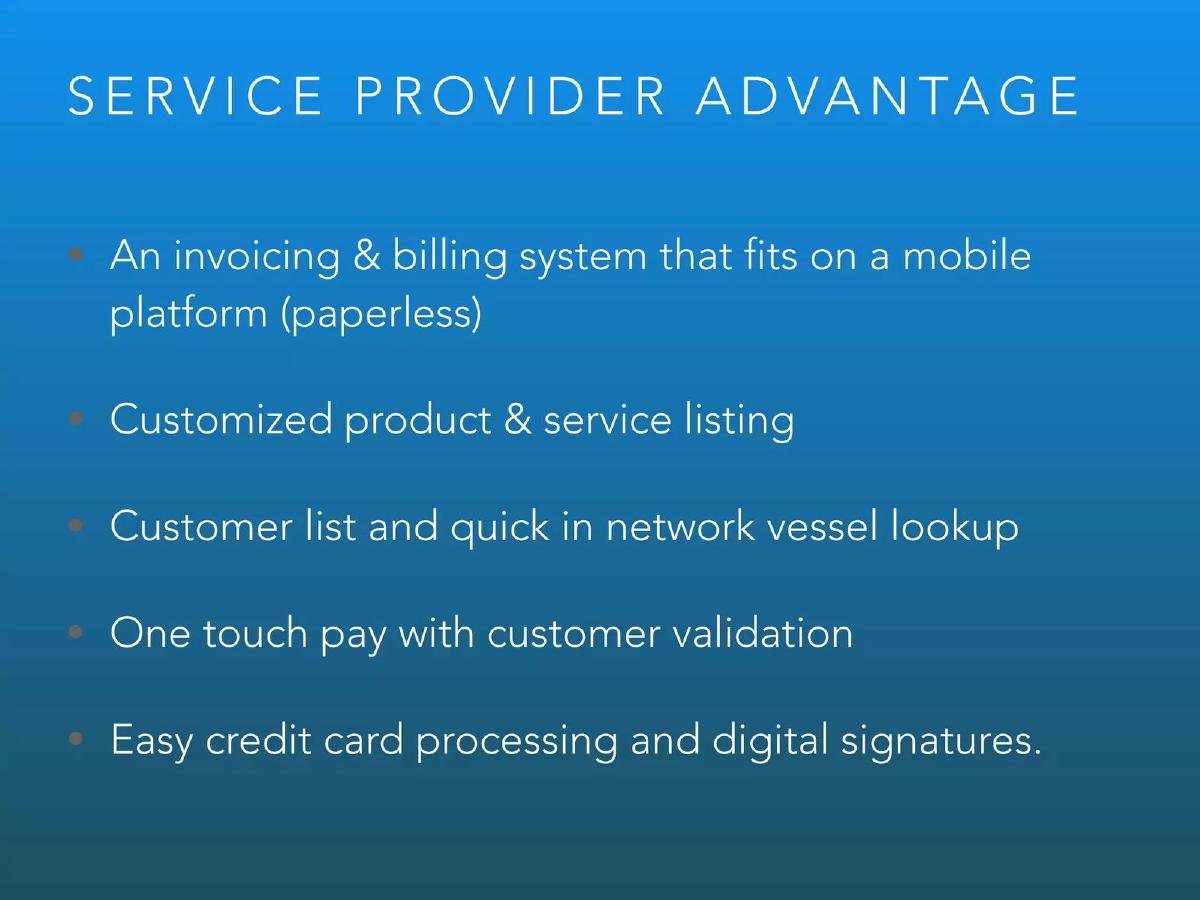
- The platform offers service providers a mobile-first invoicing and billing system, including digital signatures and credit card processing (Slide 3).
- A key product feature is the transfer of digital service records to new owners when a vessel is sold through the platform's ad system (Slide 4).
- The company identifies 13 million boats as being in their 'optimal customer range' within the U.S. (Slide 5).
- Peertopier projects that capturing 5% of the service provider market with basic memberships would generate $2,913,240 in annual gross revenue (Slide 5).
- The deck identifies 97,108 registered marine industry providers and 3,851 marinas as potential B2B targets (Slide 5).
- Funding is intended to cover the final 6-8 weeks of software development, sales force training, and hardware integration for chip-in-card standards (Slide 6).
Executive Summary: The Digitization of the Dock
Peertopier is positioning itself as the 'Leisure Boating Companion,' a title that encompasses both a consumer-facing utility and a B2B SaaS tool for marine professionals. The deck focuses on the massive scale of the U.S. boating market and the inefficiencies inherent in traditional boat maintenance and sales. By creating a digital thread that follows a vessel from service to sale, Peertopier aims to capture data that the deck claims will be 'invaluable for the marine industry.'
Slide 1: Title and Positioning
The cover slide establishes the brand as 'Peer-to-Pier' (a play on P2P networking) and defines the target audience: 'For Boaters and Marine Service providers.' The imagery of a family on a motorboat against a mountainous backdrop suggests a focus on the recreational, lifestyle aspect of the industry rather than commercial shipping. The logo uses a textured, green 'P' icon, which is consistent throughout the deck.
Slide 2: Market Scale and Geography
This slide provides the macro-economic justification for the business. It cites 15.8 million registered recreational boats in the U.S. and 58 million participants in boating activities. The financial weight of the industry is pegged at $16 billion spent on boats, services, and accessories. A map of the U.S. highlights the top 10 states for registered boats, with Florida, Minnesota, and Michigan taking the top three spots. This geographic data is useful for investors to understand where the initial sales force (mentioned in Slide 6) would likely be deployed.
Slide 3: Service Provider Advantage
Peertopier shifts focus to the B2B value proposition here. The slide lists five key features designed to entice service providers to join the platform:
An invoicing and billing system that is mobile and paperless. · Customized product and service listings. · A customer list with 'quick in-network vessel lookup.' · One-touch pay with customer validation. · Credit card processing and digital signatures.
This suggests that Peertopier is competing with general mobile payment processors (like Square) by offering industry-specific features like vessel lookups.
Slide 4: Product Interface and Data Transfer
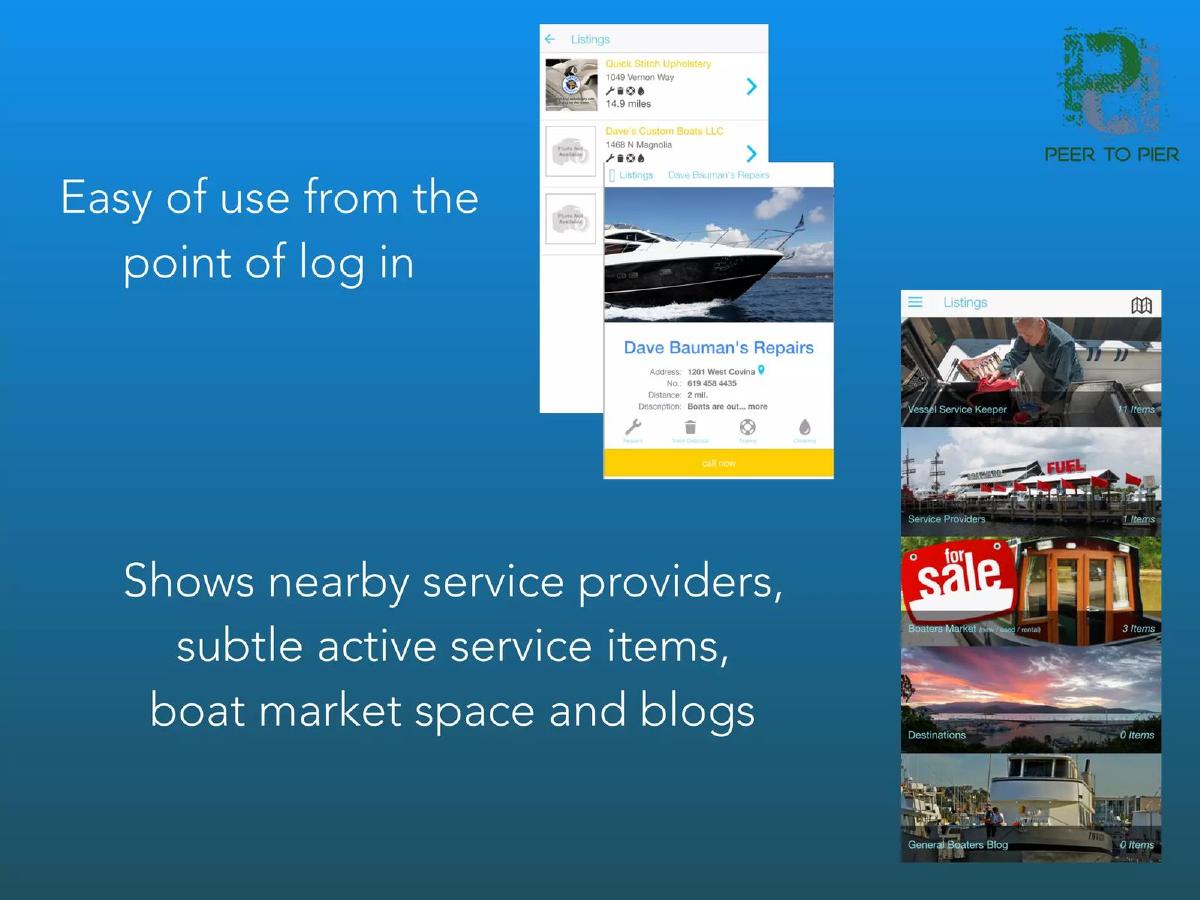
This slide provides the only visual evidence of the app's UI. It shows a 'Service Notifications' screen with checklists for tasks like 'Engine / oil filter change' and 'Drive oil change.' A second screen shows a marketplace for used boats, featuring a 1994 Trojan F-36 for $34,000. The most compelling claim on this slide is that 'When a vessel is sold through the ad system the records are transferred to the new owner.' This creates a 'Carfax-like' value proposition for the boating world, which historically suffers from fragmented maintenance records.
Slide 5: Market Potential and Revenue Projections
The company outlines its expansion strategy, starting with the U.S., Canada, and Mexico. It narrows the 15.8 million boats down to 13 million boats in the 'optimal customer range.' The slide uses a '5% market share' logic to project outcomes: 650,000 registered boats and $2,913,240 in annual gross revenue from service provider memberships. It also notes the existence of 3,851 marinas and 1,766 boat yards, providing a clear census of the B2B sales targets. The slide concludes by mentioning the value of data for targeted ads and future product development.
Slide 6: Use of Funds
The final slide, titled 'How We Will Invest,' outlines the immediate roadmap. The company is 6-8 weeks away from completing software development and testing. Funds are also earmarked for 'Sales & Marketing,' 'Sales force training,' and 'initial salaries.' Interestingly, it mentions 'Updated hardware integration to comply with emerging chip in card standards,' which suggests the company may be providing physical point-of-sale (POS) hardware to marinas or service vans.
What Works in the Peertopier Deck
Specific Industry Data: The deck does a good job of quantifying the 'un-digitized' opportunity. By listing the exact number of marinas and boat yards in the U.S., the founders show they have done the legwork to understand their B2B sales funnel. The geographic breakdown of the top 10 states also provides a logical starting point for a go-to-market strategy.
The 'Digital Thread' Concept: The idea of transferring service records to a new owner is a strong 'sticky' feature. It incentivizes boat owners to use the platform to maintain their vessel's resale value and encourages buyers to stay within the Peertopier ecosystem once they take ownership.
What Is Missing from the Peertopier Deck
The Team: This is the most glaring omission. In early-stage startups, investors are primarily betting on the founders. Without a team slide, there is no way to know if the founders have experience in marine services, software development, or scaling marketplaces.
The Ask: While Slide 6 explains how they will spend the money, it never says how much money they need. A standard pitch deck should clearly state the funding goal (e.g., 'Raising $500k for 18 months of runway').
Competitive Landscape: The deck operates as if Peertopier is the only solution in the market. It fails to address existing marine management software or general-purpose mobile invoicing tools that service providers might already be using. A 'Competitor Matrix' slide is needed to show why Peertopier is the superior choice for a boat mechanic or a marina manager.
Unit Economics: While the deck mentions a 'basic membership,' it does not specify the price point. To reach the projected $2.9 million in revenue from a 5% market share of 97,108 providers (which is roughly 4,855 providers), the membership would need to cost approximately $600 per year. Investors would want to see if this price point is realistic for a small independent boat mechanic.
Founder Takeaways: What to Copy and What to Avoid
Copy the 'Optimal Range' Logic: Instead of just claiming the entire 15.8 million boat market, the founders narrowed it down to 13 million 'optimal' customers. This shows a level of realism that investors appreciate—acknowledging that not every boat (such as very old vessels or simple canoes) is a fit for the platform.
Avoid the '5% Market Share' Trap: Slide 5 relies on the 'if we just get 5% of the market' trope. Professional investors generally dislike this approach because it ignores the actual cost of acquisition (CAC) and the logistical difficulty of reaching those customers. It is better to show a bottom-up build: 'We will target 50 marinas in Florida, which will lead to X users and Y revenue.'
Include a Roadmap: The mention of '6-8 weeks' of remaining development is a good way to show that the company is close to a milestone. Founders should always include a timeline that shows what the investment will actually buy in terms of time and product readiness.
Final Note: This deck feels like a 'teaser' rather than a full investor presentation. It succeeds in identifying a large, fragmented market but fails to prove that this specific team has the right solution or the necessary capital requirements to win it.
Frequently asked questions
- What is the primary problem Peertopier is solving?
- Peertopier addresses the fragmentation and lack of digitization in the marine service industry. By providing a mobile invoicing and billing system for providers and a digital service history for owners, it aims to replace paper-based systems. The deck specifically mentions that service records can be transferred to new owners, solving the problem of lost maintenance data during vessel resale.
- How does Peertopier plan to generate revenue?
- The deck suggests a membership-based model for service providers. Slide 5 calculates a potential gross revenue of $2,913,240 based on a 5% market share of service providers paying for a 'basic membership.' Additionally, the mention of an 'ad system' for selling vessels and 'targeted ads' based on gathered data suggests secondary advertising revenue streams.
- What is the current stage of the product?
- According to Slide 6, the product is in the final stages of development. The company states there are '6-8 weeks remaining of additional software development and testing.' They are also looking to integrate hardware to comply with modern credit card chip standards, indicating the software is nearing a commercial launch phase.
- Who are the target customers for this platform?
- The platform targets two distinct groups: recreational boat owners and marine service providers. The B2B side includes 3,851 marinas, 1,766 boat yards, and over 97,000 registered service providers. The B2C side targets the 15.8 million registered boat owners in the U.S., specifically focusing on 13 million boats in their 'optimal range.'
- What critical information is missing from the Peertopier deck?
- The deck is missing several standard investor components. Most notably, there is no 'Team' slide to verify founder expertise. It also lacks a specific 'Ask' (the dollar amount being raised), a detailed 'Competition' slide, and a 'Financial Projections' slide beyond a single hypothetical revenue figure. There is also no mention of existing traction or pilot programs.