Alcatraz AI’s 16-slide deck for their $25M Series A is a masterclass in technical credibility and market positioning. By highlighting a founder who led Apple’s FaceID team, the company immediately bypasses the 'can they build it?' hurdle. The deck focuses heavily on the 'how'—specifically how they solve the privacy and integration nightmares that typically plague facial recognition in the enterprise. With a Total Addressable Market (TAM) of $70B and a clear 'Past vs. Present' narrative, the deck successfully frames physical security as an industry ripe for an AI-driven overhaul. While it lack…
Key takeaways
- The 'Founder-Product Fit' is exceptionally strong, noting on Slide 15 that the President & Founder led the FaceID team at Apple.
- The deck addresses the primary industry objection—privacy—by explicitly stating on Slide 7 that they operate without the need for PII (Personally Identifiable Information).
- Market size is framed through high-growth sub-sectors, including a 30% CAGR for Smart Locks and 19% for Biometrics on Slide 11.
- Technical interoperability is prioritized on Slide 9, showing compatibility with Wiegand, OSDP, and ONVIF protocols.
- The product, 'The Rock,' is positioned as an edge device that converts visual data into a 'fused hash,' ensuring no pictures are stored (Slide 7).
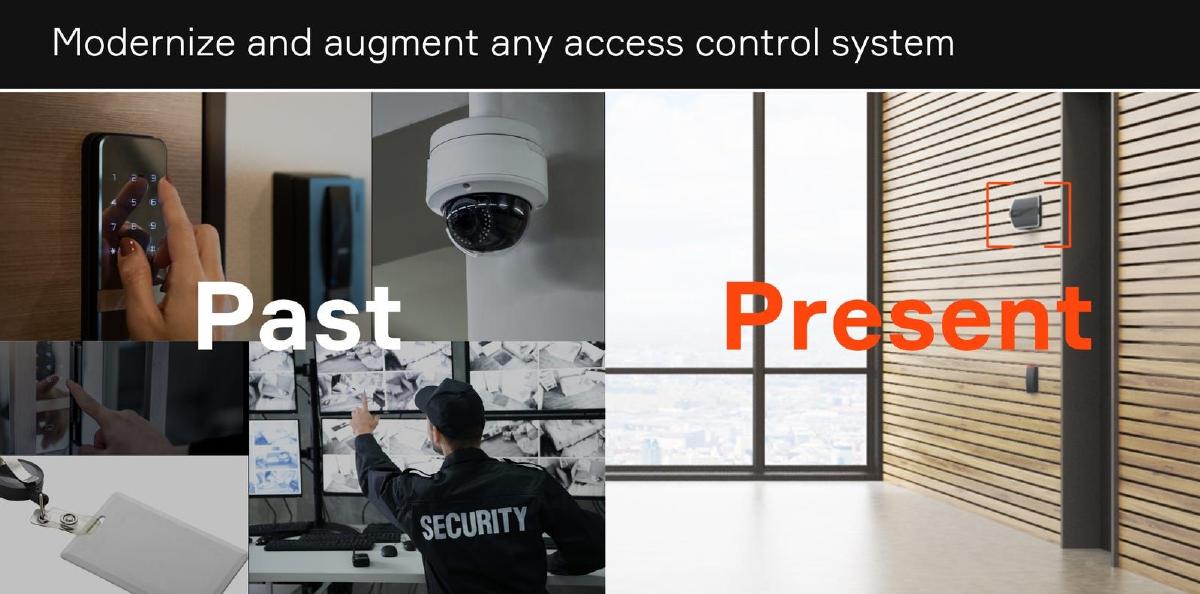
- The deck uses a 'Past vs. Present' visual on Slide 5 to contrast clunky badge/camera systems with their streamlined hardware.
- Enterprise validation is provided via a case study of a 'Large financial institution' that chose them over competitors in a 'bake off' (Slide 13).
- The leadership team features deep industry roots from Johnson Controls, HID, and Stanley Security, signaling strong go-to-market capabilities (Slide 15).
The Vision: Autonomous Access Control
Slide 1: Title and Vision
The deck opens with a high-contrast image of a modern office hallway, immediately grounding the technology in its physical environment. The logo is clean, and the subtitle "Autonomous access control" sets the stage. The vision statement is explicit: "Revolutionize the access control experience using the unique power of the human face." This slide establishes Alcatraz AI as a hardware-plus-software play, specifically targeting the enterprise security market. The footer notes this is an "Investor Overview - 2022," which aligns with the lead-up to their reported 2024 funding.
Slide 2: The Thesis Statement
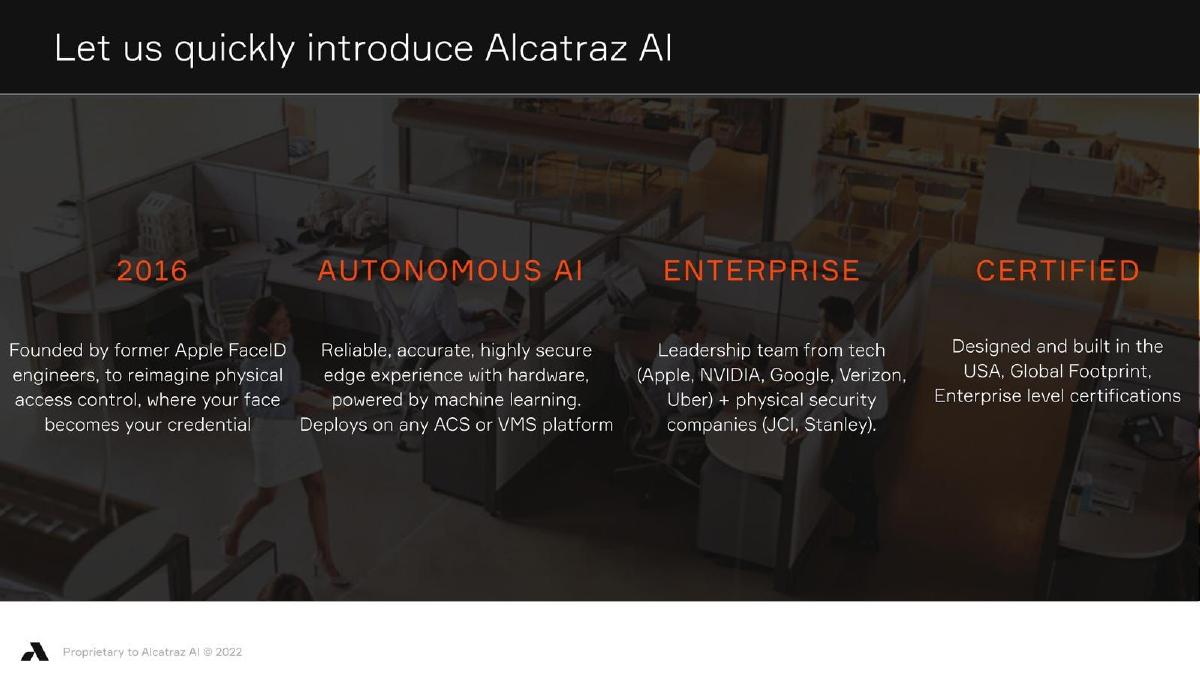
This slide serves as a quick executive summary. It breaks the company down into four pillars: 2016 (founding year), Autonomous AI (the tech), Enterprise (the target and team experience), and Certified (compliance). Key details here include the mention of former Apple FaceID engineers and the ability to deploy on "any ACS or VMS platform," which addresses the common fear of vendor lock-in or expensive infrastructure overhauls.
Slide 5: The Market Shift (Past vs. Present)
Slide 5 uses a classic "Before and After" visual. On the left ("Past"), we see a montage of keypad entries, security guards monitoring dozens of screens, and physical lanyards. On the right ("Present"), a single, sleek device—referred to elsewhere as "The Rock"—is mounted on a wall in a minimalist office. This visual narrative suggests that Alcatraz AI isn't just a new tool, but a replacement for a fragmented and labor-intensive legacy system.
Slide 7: The Privacy Solution
For any facial recognition company, privacy is the biggest hurdle to a deal. Slide 7, titled "How we do privacy sets us apart," is perhaps the most important technical slide in the deck. It details the "Inside the Rock" vs. "Outside the Rock" data flow. It explains that 3D and infrared images are converted to a "fused hash" at the edge. Crucially, it states: "Purge all visual data. No employee names or pictures are stored." By claiming that "Only data that comes out of the Rock is a badge number," Alcatraz AI positions itself as a privacy-safe alternative to traditional biometric databases.
Slide 9: Technical Interoperability
Enterprise sales live or die by integration. Slide 9 shows a flow chart of how the Alcatraz Rock sits between existing badge/Bluetooth readers and the Video Monitoring System (VMS). It lists industry-standard protocols: Wiegand, OSDP, ONVIF, and POE+ . This slide is designed to reassure a Chief Security Officer (CSO) that installing this hardware won't require ripping out their existing wiring or software. It also highlights certifications like FCC, CE, UL, ISO 27001, CCPA, and GDPR , which are mandatory for global enterprise contracts.
Slide 11: Market Size and Growth
The market slide provides a massive $70B TAM and an $11B SAM . More interesting than the big numbers are the specific CAGR (Compound Annual Growth Rate) figures provided. Alcatraz points to Biometrics (19% CAGR) and Smart Locks (30% CAGR) as the tailwinds driving their growth. This suggests they are positioning themselves at the intersection of two of the fastest-growing niches in the security industry.
Slide 13: Enterprise Validation (Case Study)
Without naming the client, Slide 13 describes a case study with a "Large financial institution." This is a strategic choice; financial institutions have the strictest security and privacy requirements. The slide mentions that Alcatraz was in a "bake off" with other biometric companies and won because they passed "extreme due diligence." This provides social proof that the technology is robust enough for the world's most sensitive environments.
Slide 15: The Team
The team slide is a "who's who" of the security and tech world. Vince Gaydarzhiev (President & Founder) is the star here, having led the FaceID team at Apple and worked on Tesla's Model S at NVIDIA. The rest of the leadership team brings "adult supervision" from legacy giants: Tina D’Agostin (CEO) from Johnson Controls, Greg Sarrail (SVP Sales) from HID/Assa Abloy, and Blaine Frederick (VP Product) from Stanley Security. This combination of Silicon Valley innovation and deep industry connections is a powerful signal to investors.
What Works in This Deck
The Privacy-First Narrative: By dedicating a full slide (Slide 7) to how they avoid storing PII, Alcatraz AI proactively answers the first question every enterprise buyer and VC will ask. The technical explanation of "fused hashes" at the edge is credible and necessary.
Founder-Product Fit: You cannot find a better founder for a facial recognition startup than the person who led the FaceID team at Apple. The deck leans into this pedigree heavily, which instantly validates the technical feasibility of the product.
Ecosystem Integration: The deck doesn't pretend Alcatraz exists in a vacuum. By showing exactly how it plugs into Wiegand and OSDP systems (Slide 9), they demonstrate a deep understanding of how physical security is actually deployed in the real world.
What Is Missing
Revenue and Traction Metrics: While the case study is a good start, the deck is missing hard numbers. There is no mention of Annual Recurring Revenue (ARR), the number of units deployed, or the current sales pipeline. For a Series A, investors usually expect to see a "Traction" slide with a clear growth curve.
Unit Economics: As a hardware-enabled AI company, the margins are critical. The deck does not explain the pricing model (e.g., is it a one-time hardware sale plus a SaaS subscription?) or the Cost of Goods Sold (COGS). Investors would want to know if this scales like a software company or a traditional hardware manufacturer.
The Ask: The provided slides do not include a formal "Ask" slide detailing how much capital is being raised and how it will be allocated (e.g., 40% R&D, 40% Sales, 20% Ops). While this may have been in a separate document or a later version, its absence here leaves the narrative unfinished.
What a Founder Should Copy
The 'Past vs. Present' Visual: Slide 5 is an excellent example of how to show, rather than tell, the value of a product. It makes the old way of doing things look cluttered and obsolete without being insulting to the industry.
The Protocol Checklist: If you are building an enterprise hardware product, copy Slide 9. Listing the specific protocols (ONVIF, OSDP) and certifications (ISO, GDPR) at the bottom of a technical flow chart builds immediate trust with technical reviewers.
The 'Bake Off' Case Study: Mentioning that you won a competitive evaluation ("bake off") against established players is a high-signal way to demonstrate product superiority. It tells investors that your product has already been battle-tested against the competition.
Frequently asked questions
- What is Alcatraz AI's core product?
- The core product is 'The Rock,' an autonomous access control device. As shown on Slide 7 and Slide 9, it is a hardware-enabled AI sensor that replaces or augments traditional badge readers. It uses 3D sensing and infrared technology to authenticate users at the edge, meaning it processes data locally rather than in a centralized database.
- How does Alcatraz AI handle facial recognition privacy concerns?
- Privacy is a central pillar of their pitch. Slide 7 explains that the device purges all visual data and does not store employee names or pictures. Instead, it converts 3D and infrared images into a 'fused hash' at the edge. The only data that leaves the device is a badge number, allowing it to comply with GDPR and CCPA.
- What is the market opportunity for biometric access control?
- According to Slide 11, the Total Addressable Market (TAM) is $70B, with a Serviceable Addressable Market (SAM) of $11B. The deck highlights that while the general access control market is growing at an 8.7% CAGR, specific segments like Smart Locks (30%) and Biometrics (19%) are growing much faster.
- Who are the key people behind Alcatraz AI?
- The team is a mix of Big Tech and legacy security veterans. Slide 15 highlights Founder Vince Gaydarzhiev, who led Apple's FaceID team. The executive suite includes veterans from Johnson Controls (CEO Tina D’Agostin), HID (SVP Greg Sarrail), and Verizon (COO Chris Kennedy), providing a balance of innovation and enterprise sales experience.
- Does the deck mention specific financial metrics or the funding ask?
- No. The provided slides focus on the vision, technology, market, and team. There are no slides detailing current Annual Recurring Revenue (ARR), burn rate, or the specific dollar amount being raised in this round, though external reports confirm a $25M Series A.