Cove.Tool’s Seed deck is a study in clear problem-solution mapping for a technical industry. The narrative centers on the fragmentation of the building design process, where a 'web of consultants' and specialized software create weeks of delays. By positioning their 'Intelligent Building Design Platform' as a single automated tool that reduces analysis time from 80 hours to 15 minutes, the deck makes the value proposition immediate and undeniable. While the version of the deck available for review has redacted its specific financial figures, the structure of the traction slides—showing a clea…
Key takeaways
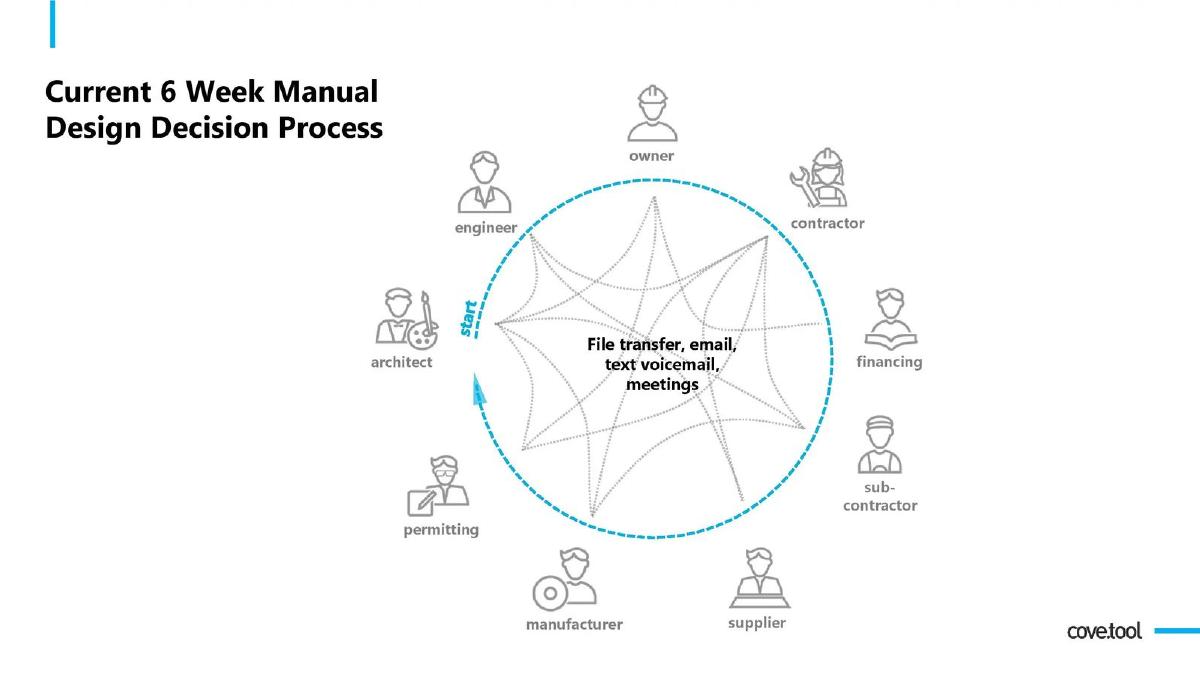
- The deck identifies a fragmented ecosystem of ten distinct stakeholders, from owners to sub-contractors, all hindered by manual communication (Slide 2).
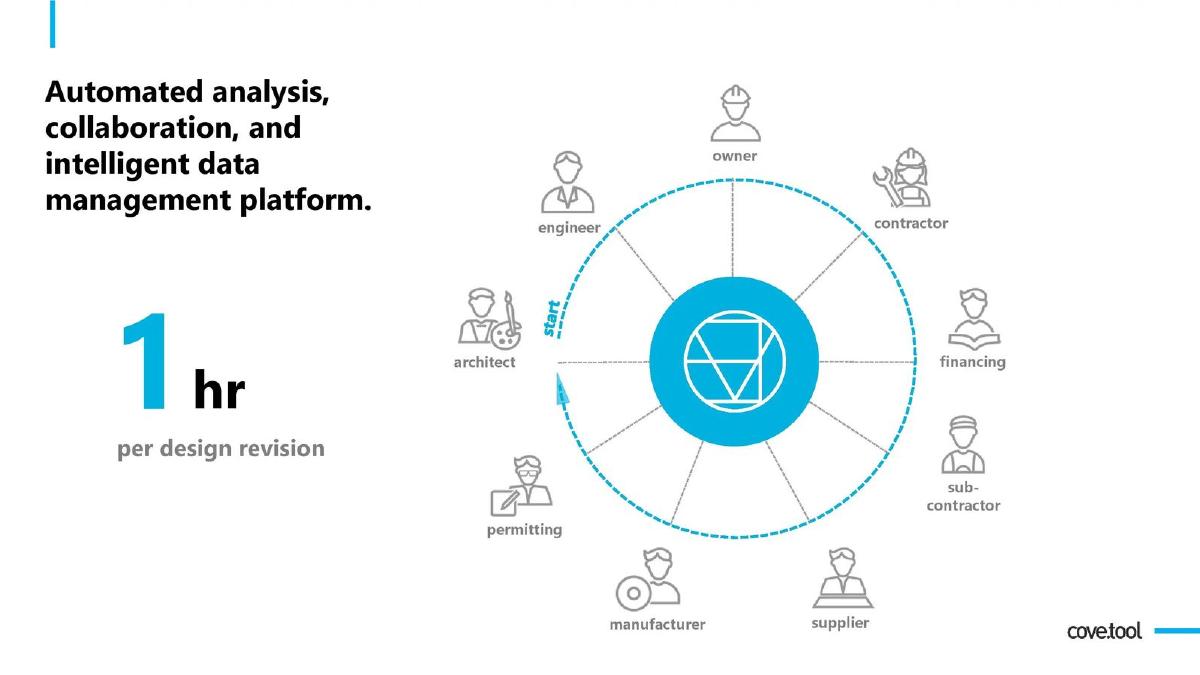
- A powerful 'Before vs. After' comparison highlights a reduction in analysis time from 80 hours to just 15 minutes (Slide 3).
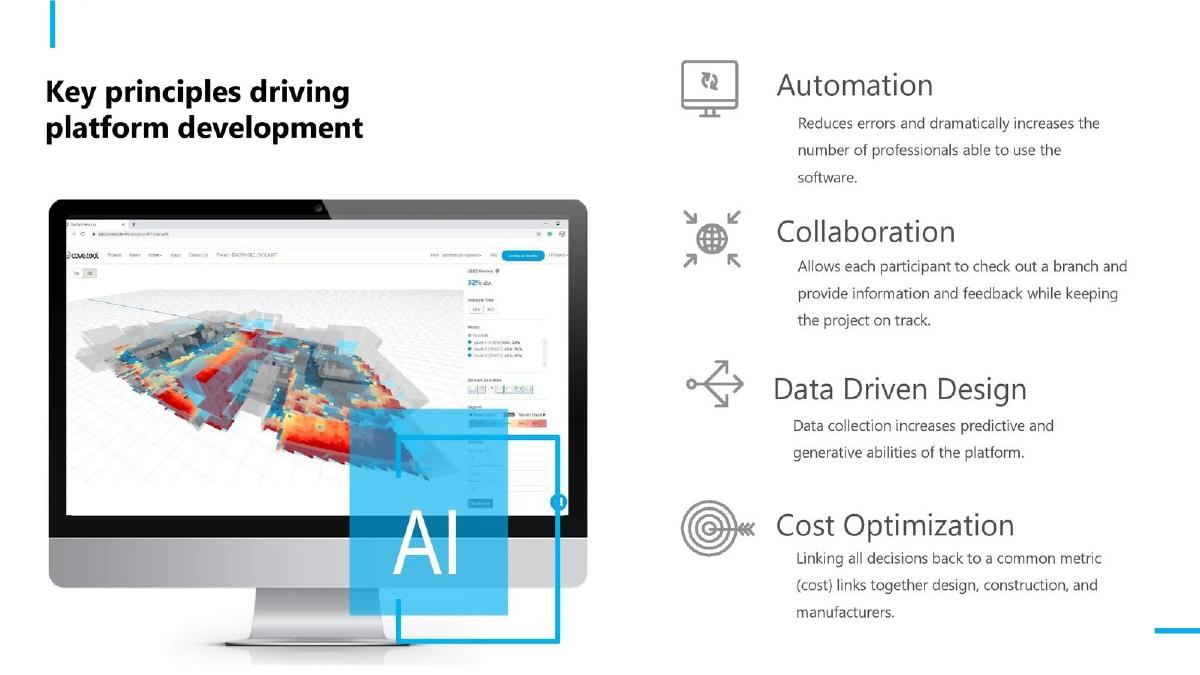
- The platform is built on four pillars: Automation, Collaboration, Data-Driven Design, and Cost Optimization (Slide 4).
- The product utilizes AI to increase predictive and generative abilities, as shown in the platform interface preview (Slide 4).
- Traction is demonstrated through a consistent month-over-month and year-over-year ARR growth chart spanning 2019 to 2020 (Slide 5).
- The business model shows strong operating leverage, with gross margins scaling from under 20% to nearly 90% as fixed costs are amortized (Slide 6).
- The company sets a massive long-term target of $1.2B in ARR within a 5-year timeframe (Slide 7).
- The deck lacks a team slide, a specific funding ask, and a detailed breakdown of the competitive landscape in the provided selection.
The Intelligent Building Design Platform
Cove.Tool enters the market with a pitch deck that focuses heavily on the friction inherent in the Architecture, Engineering, and Construction (AEC) industry. The deck is visually clean, utilizing a consistent blue and grey palette that mirrors the technical nature of their product. By focusing on the 'Intelligent Building Design Platform' as a category-defining solution, the founders set the stage for a high-scale SaaS play in a traditionally slow-moving sector.
Slide 1: Title and Positioning
The opening slide is minimalist, featuring the Cove.Tool logo and the tagline 'Intelligent Building Design Platform.' The background image of a 3D building model immediately contextualizes the sector. It establishes the brand as a modern, tech-forward solution for the built environment. There are no distracting sub-bullets here; the focus is entirely on the identity of the platform.
Slide 2: The Fragmented Ecosystem
Slide 2 is a masterclass in visualizing a 'messy' problem. It depicts a circular 'chain' of stakeholders including the owner, engineer, contractor, financing, sub-contractor, supplier, manufacturer, permitting, and architect. The center of the circle is a web of dotted lines labeled 'File transfer, email, text, voicemail, meetings.' The headline, 'Any break in the chain causes delays driving up costs,' perfectly encapsulates the pain point. It highlights that the current process is not just slow, but fragile. By listing the specific concerns of each stakeholder (e.g., 'Energy Code' for engineers, 'Value Engineering' for contractors), Cove.Tool demonstrates a deep understanding of their multi-sided market.
Slide 3: The Efficiency Gap
This slide presents the core value proposition through a 'Before vs. After' comparison. On the left, we see a complex web of 'Many tools to do 1 iteration by consultants,' citing a time requirement of 40 to 80 hours per analysis type. On the right, the Cove.Tool logo is positioned as a 'Single automated tool' that does everything in just 15 minutes. This 160x to 320x improvement in speed is the kind of 'hair on fire' solution that venture capitalists look for. It transforms a specialized, consultant-heavy task into a democratized, automated process.
Slide 4: Platform Principles and AI Integration
Slide 4 breaks down how the platform actually works, focusing on four pillars: Automation, Collaboration, Data-Driven Design, and Cost Optimization. A key detail here is the mention of 'checking out a branch,' a concept borrowed from software development (Git), which suggests a sophisticated approach to version control in building design. The slide also features a screenshot of the platform interface with a prominent 'AI' overlay, noting that data collection increases the 'predictive and generative abilities' of the platform. This positions Cove.Tool not just as a calculator, but as an intelligent partner in the design process.
Slide 5: ARR Growth Trajectory
The traction slide shows a bar chart of ARR (Billed and Booked) from January 2019 through December 2020. Although the specific dollar amounts are redacted, the visual trend is a classic 'up and to the right' hockey stick. The inclusion of both billed and booked revenue provides transparency into the sales cycle and suggests a strong pipeline. The slide highlights 'YoY Growth' and 'MoM Growth' as the primary KPIs, signaling to investors that the company is in a high-growth phase.
Slide 6: Operating Leverage and Margins
Perhaps the most compelling financial slide is Slide 6, which tracks Gross Margins. The chart shows margins starting below 20% in early 2019 and climbing steadily to nearly 90% by mid-2020. The headline, 'Increasing Gross Margins with Fixed Cost amortized over more revenue,' is a clear signal of a scalable software business. It proves that as the company grows, it becomes significantly more profitable, a key requirement for a successful Seed-stage venture investment.
Slide 7: The $1.2B Vision
The final slide in this selection moves from the 'what' and 'how' to the 'why.' It sets a bold five-year target: touching every building from design to construction and generating $1.2B in ARR. By explicitly linking this financial milestone to 'bending the curve on climate change,' Cove.Tool appeals to the growing segment of ESG (Environmental, Social, and Governance) and climate-tech investors. It frames the company’s success as a win for the planet, providing a powerful emotional hook to close the pitch.
What Works in This Deck
The most successful element of the Cove.Tool deck is its ability to quantify the 'pain.' In many enterprise SaaS decks, the problem is described in vague terms like 'inefficiency' or 'lack of visibility.' Cove.Tool puts a specific number on it: 80 hours vs. 15 minutes. This makes the ROI calculation for a potential customer incredibly simple.
Furthermore, the deck does an excellent job of showing, not just telling, the transition from a service-heavy model to a product-heavy model. The gross margin expansion slide is the empirical proof of this transition. It reassures investors that they are funding a software company with high margins, not a tech-enabled consultancy.
What is Missing
While the narrative flow is strong, several standard pitch deck components are missing from this curated selection:
Team Slide: There is no information regarding the founders' backgrounds. In the AEC space, domain expertise is critical, and investors would want to see if the team has deep roots in architecture or engineering. · Competitive Landscape: The deck mentions 'expensive specialized software' but does not name competitors. A 'Magic Quadrant' or feature comparison table would help define their moat. · The Ask: The deck does not specify how much capital is being raised or how it will be deployed (e.g., hiring, R&D, sales expansion). · Unit Economics: While gross margins are shown, Customer Acquisition Cost (CAC) and Lifetime Value (LTV) are absent, which are vital for assessing the sustainability of the growth shown on Slide 5.
Founder Takeaways
Founders in technical or legacy industries should study how Cove.Tool maps out their ecosystem. By identifying every stakeholder in the 'chain' (Slide 2), they show that they understand the complex web of permissions and incentives that can kill a sale. If your product requires buy-in from multiple departments, you must show that you know who those people are and what they care about.
Additionally, the use of 'redacted' but visually accurate charts for Seed rounds is a smart way to share a deck broadly while protecting sensitive data. The shape of the curve often matters more than the starting number to an initial screener; it proves the engine is working. Finally, always link your massive financial goal to a broader mission. Cove.Tool’s $1.2B ARR goal feels more attainable and inspiring because it is tied to the global necessity of fighting climate change.
Frequently asked questions
- What problem is Cove.Tool solving in the construction industry?
- Cove.Tool addresses the 'break in the chain' of communication and data generation among architects, engineers, contractors, and owners. Currently, specialized software requires a web of consultants and weeks of manual work to generate necessary data, leading to delays and increased costs. Cove.Tool automates this process into a single platform.
- How does the platform improve efficiency for design teams?
- According to the deck, traditional methods take 40 to 80 hours per analysis type. Cove.Tool’s automated platform performs all required analyses in 15 minutes. This represents a massive reduction in labor costs and allows for more design iterations in a shorter timeframe.
- What are the core technical pillars of the Cove.Tool platform?
- The platform is built on four key principles: Automation (reducing errors and expanding the user base), Collaboration (allowing participants to 'check out a branch' of a project), Data-Driven Design (using AI for predictive abilities), and Cost Optimization (linking all design decisions to a common cost metric).
- What does the deck reveal about the company's financial health?
- While specific numbers are redacted in this version, the charts show high-growth ARR and a significant expansion in gross margins. The margin profile is particularly impressive, moving from a low starting point to approximately 90%, suggesting a highly scalable SaaS model with low marginal costs.
- What is the long-term vision presented in the pitch?
- Cove.Tool aims to 'touch every building' from design to construction. Their five-year goal is to reach $1.2 billion in Annual Recurring Revenue (ARR). They frame this financial goal as a means to 'bend the curve on climate change,' suggesting their tool optimizes for energy efficiency.