The Coursmos deck is a product of the mid-2010s EdTech boom, positioning itself as the 'world’s first micro-learning platform.' It leans heavily on social proof and rapid-fire growth metrics to justify its existence in a crowded market. Between January and October 2014, the platform scaled from 30 to 10,000 courses, a feat it uses to highlight its efficiency compared to incumbents like Coursera and Udemy. Most striking is the deck's lack of a traditional business model slide in the provided selection, replaced instead by a highly specific exit strategy targeting five global conglomerates. Whi…
Key takeaways
- The platform claims a massive growth trajectory, increasing its user base from 100 to 350,000 in eight months (Slide 5).
- Coursmos uses a unique 'Funding / courses' metric to argue it is more efficient than Coursera, spending only $70 per course compared to Coursera's $170,000 (Slide 6).
- The deck identifies a 96% failure or dissatisfaction rate in traditional MOOCs, citing 'long, boring courses' as the primary pain point (Slide 3).
- A 'Charity Project' called Step To Your Dream is integrated directly into the solution, using a request-response model for children's education (Slide 4).
- The startup includes direct, named quotes from Andreessen Horowitz and Redpoint Ventures to signal high-tier VC interest (Slide 7).
- The exit strategy is unusually explicit, naming five specific potential acquirers including Pearson and McGraw Hill, with a 2-3 year timeline (Slide 8).
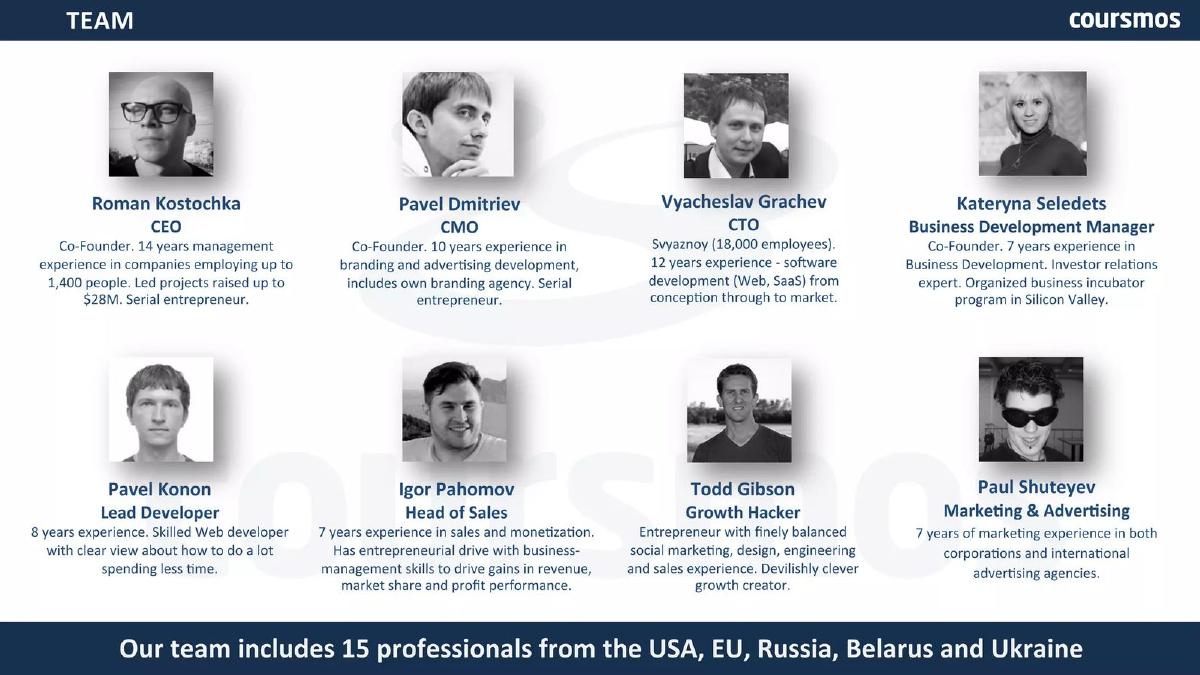
- The deck lacks a dedicated team slide, unit economics, or a specific 'Ask' for the current round in the provided slides.
- Traction is further supported by 830,000 pageviews and 45,000 individual lessons as of October 2014 (Slide 5).
Introduction: The Micro-Learning Pivot
Coursmos entered the market during a period of 'MOOC fatigue.' While platforms like Coursera were raising tens of millions, completion rates were notoriously low. This deck, consisting of 31 slides (8 of which are analyzed here), attempts to position 'micro-learning' as the antidote to the 'long, boring courses' that dominated the early 2010s. The visual style is clean, utilizing a dark blue and white palette that feels professional yet modern for its era.
Slide 1: Title and Tagline
The cover slide is minimalist, featuring the Coursmos logo—a stylized '8' or infinity symbol—and the tagline: "The world’s first micro-learning platform." This is a bold claim of category leadership. By defining a new category (micro-learning) rather than competing directly in the 'online education' category, Coursmos attempts to own the narrative from the first second.
Slide 2: Press and Social Proof
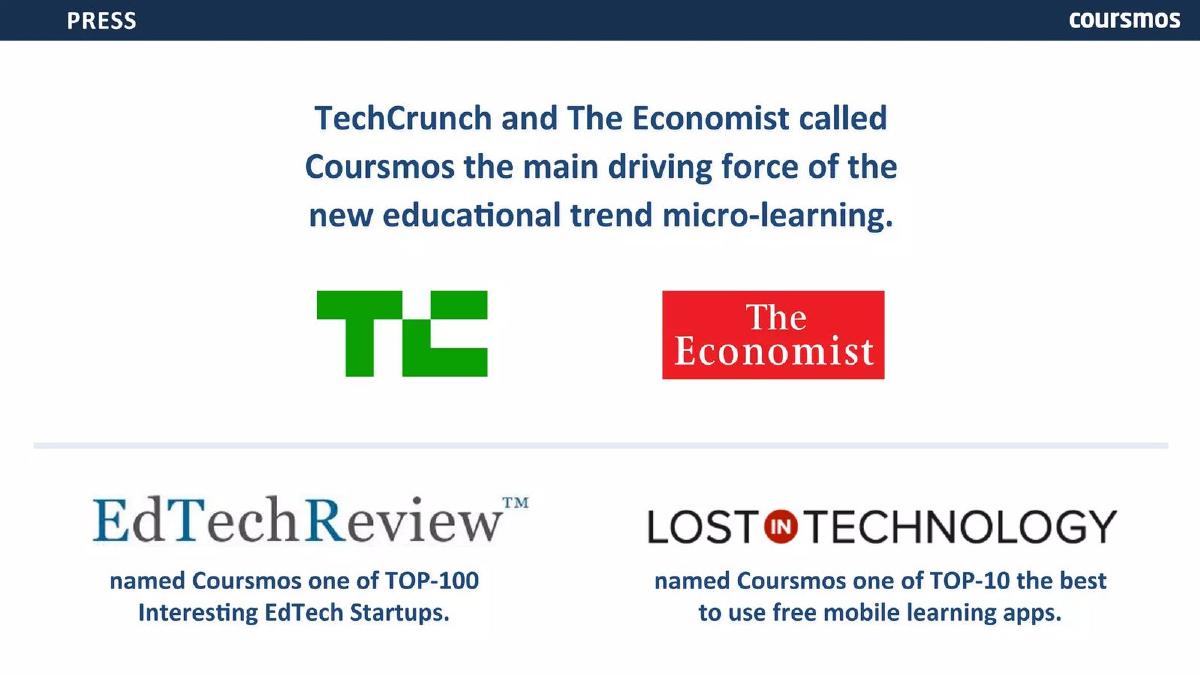
Slide 2 is a 'Press' slide, which is often placed later in decks but here serves as immediate validation. It quotes TechCrunch and The Economist as calling Coursmos the "main driving force" of the micro-learning trend. It also mentions being named one of the "TOP-100 Interesting EdTech Startups" by EdTechReview and a "TOP-10 best to use free mobile learning app" by Lost In Technology. This heavy reliance on third-party validation suggests the founders wanted to establish credibility before diving into the metrics.
Slide 3: The 96% Problem
The 'Problem' slide uses a high-impact visual of a man asleep at his laptop. A large red circle contains the figure "96%" . While the slide doesn't explicitly define this metric in the text, it is standard industry shorthand for MOOC dropout rates. The slide lists four 'Why?' factors: long courses, lack of time, MOOCs not providing the specific knowledge students want, and a lack of student involvement in content creation. This sets the stage for a solution that is short, mobile-friendly, and user-driven.
Slide 4: The Charity Project
Interestingly, the 'Solution' slide focuses on a 'Charity Project' called Step To Your Dream . The mission is to create a bridge between those seeking knowledge and those providing it. The process involves asking children two questions: "What is your dream?" and "What do you want to learn to make your dream come true?" Instructors then answer these requests. While noble, placing a charity project as a core 'Solution' slide is an unusual choice for a venture pitch, as it doesn't immediately explain the commercial product's mechanics.
Slide 5: Explosive Traction Metrics
This is the 'meat' of the deck. Slide 5 displays two hockey-stick growth charts for 2014. The number of courses grew from 30 to 10,000 in 10 months (Jan-Oct). The number of users grew from 100 to 350,000 in 8 months (Mar-Oct). The slide also lists 4,000 instructors , 45,000 lessons , 450,000 sessions , and 830,000 pageviews . These are impressive top-of-funnel numbers that demonstrate significant market fit or, at the very least, highly effective user acquisition.
Slide 6: Competitive Efficiency
Slide 6 features a table comparing Coursmos to Coursera, Udemy, and YouTube. The standout metric is "Funding / courses." It claims Coursera has $85M in funding for 500 courses ($170,000 per course), while Coursmos has $0.68M in funding for 10,200 courses ($70 per course). This is a clever, if slightly manipulative, way to show capital efficiency. It positions Coursmos at the intersection of structured 'Online Learning Platforms' and 'User Generated Content,' arguing they have the scale of the latter with the intent of the former.
Slide 7: Investor Sentiment
Rather than a standard 'Investors' slide showing logos of current backers, Slide 7 shows 'comments' from tier-one VCs who are tracking the company. Gregg Alpert from Pearson notes that "bite sized content" is interesting. Bart Dessaint from Andreessen Horowitz is quoted saying, "We’d love to be reconsidered after you’ve put this round of funding to work." Alex Clayton from Redpoint Ventures says he will "continue to track the company." This is a 'soft' traction slide designed to create FOMO (Fear Of Missing Out) by showing that the biggest names in the valley are watching.
Slide 8: The Exit Strategy
The final slide in this selection is a blunt 'Exit Strategy' slide. It explicitly states: "Coursmos exit strategy: acquisition in 2-3 years." It provides a table of five potential acquirers (Pearson, McGraw Hill, Benesse, The Washington Post Company, and Apollo Group) along with their market caps and revenue stats. It also includes CB Insights charts showing the rise in EdTech financing and M&A deals through H1 2014. This slide is a clear signal to investors that the founders are not looking to build a 100-year company, but rather a high-growth feature set for a larger conglomerate.
What Works in This Deck
The traction slide (Slide 5) is the strongest element. The growth from 100 to 350,000 users in less than a year is the kind of data that stops an investor from flipping to the next deck. By providing specific numbers for instructors (4,000) and lessons (45,000), they prove that the platform isn't just a landing page, but a functioning ecosystem.
The efficiency argument (Slide 6) is also highly effective. By creating a custom metric (Funding per Course), they turn their lack of capital into a competitive advantage. It paints the incumbents as bloated and slow, while Coursmos is lean and scalable. This narrative is very attractive to Seed and Series A investors who want to see how their dollars will be stretched.
What is Missing
The most glaring omission in these eight slides is the Business Model . While we see how they get users and how they might exit, there is no mention of how they actually make money. Is it a subscription? A take-rate on course sales? Ad-supported? Without this, the traction numbers are 'vanity metrics' that don't necessarily lead to a sustainable business.
Additionally, there is no Team Slide in this selection. In early-stage EdTech, the pedigree of the founders (pedagogical background vs. technical background) is critical. Finally, the 'Ask' is missing. We know they want an exit in 2-3 years, but we don't know how much capital they are raising now or what the specific milestones for that capital are.
Founder's Takeaway
Founders should study how Coursmos uses social proof . Even without a check from Andreessen Horowitz, they managed to use a 'rejection' (the request to be reconsidered later) as a badge of honor. It tells other investors that the company has already cleared the first hurdle of getting a meeting with the world's top VCs.
However, be cautious with the explicit exit strategy . While some investors appreciate the honesty, others may see a '2-3 year acquisition' goal as a lack of ambition. If you use this approach, ensure your traction metrics are as strong as Coursmos' were to prove that you are actually an attractive target for the companies you've listed.
Focus on efficiency: If you are underfunded compared to competitors, find a metric that makes your 'lean' status look like a feature, not a bug. · Leverage 'Soft' interest: If a big VC passes but asks for updates, ask if you can use their interest as a signal in your deck. · Define the Category: Don't just be 'another EdTech startup.' Be the 'first' of a specific sub-category, as Coursmos did with micro-learning.
Frequently asked questions
- What is the core problem Coursmos aims to solve?
- According to Slide 3, the problem is the inefficiency of Massive Open Online Courses (MOOCs). The deck claims a 96% figure (likely referring to dropout rates or dissatisfaction) caused by courses being too long and boring. It argues that students lack time and motivation for traditional formats and are excluded from the content creation process.
- How does Coursmos differentiate itself from YouTube or Udemy?
- Slide 6 positions Coursmos as the middle ground between 'Online Learning Platforms' (like Coursera/Udemy) and 'User Generated Content' (like YouTube). It specifically uses a 'Funding per Course' metric to show it produces content far more cheaply than academic platforms while maintaining a more structured educational focus than generic video sites.
- What kind of traction did the company have at the time of the deck?
- The traction is significant for an early-stage startup. Slide 5 shows that in 2014, the number of courses grew from 30 in January to 10,000 in October. User growth was even faster, jumping from 100 in March to 350,000 by October, supported by 450,000 sessions and 830,000 pageviews.
- Is there a social impact component to the business?
- Yes, Slide 4 introduces 'Step To Your Dream,' a charity project described as a 'unique bridge' between knowledge seekers and providers. It allows children to ask what they need to learn to achieve their dreams, and instructors pick these requests to answer with expertise, providing a feedback loop between the platform and youth foundations.
- Who are the potential buyers identified in the exit strategy?
- Slide 8 lists five specific targets: Pearson (UK), McGraw Hill (US), Benesse (Japan), The Washington Post Company (US), and Apollo Group (US). The slide includes their market caps and the percentage of their revenue derived from education to justify why they would be interested in an acquisition.