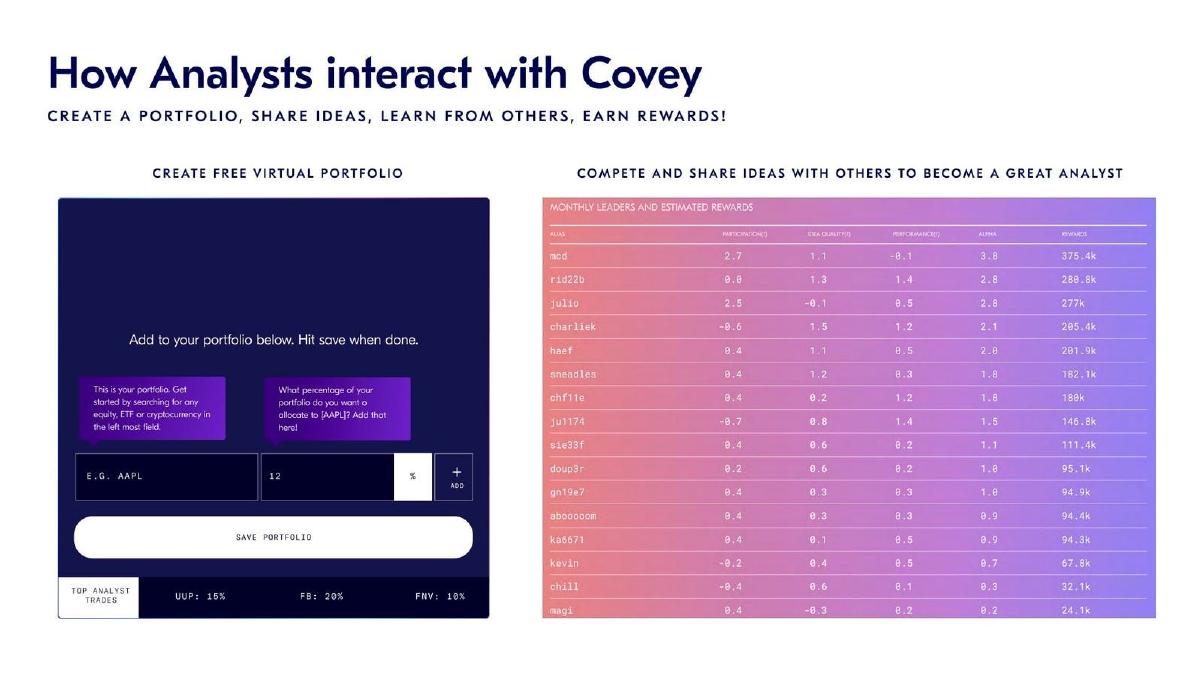
Covey’s 13-slide Seed deck focuses on the structural failure of active asset management and the rise of retail analysts. By leveraging blockchain to create immutable track records, Covey aims to build a meritocratic investment community where the best analysts are rewarded with crypto and copy-trading opportunities. The deck successfully highlights early traction, including over 1,000 applicants and $20k in rewards distributed within 10 months of their AA1 launch. While the deck is visually polished and presents a clear vision of becoming the 'Shopify for Asset Management,' it lacks a dedicat…
Key takeaways
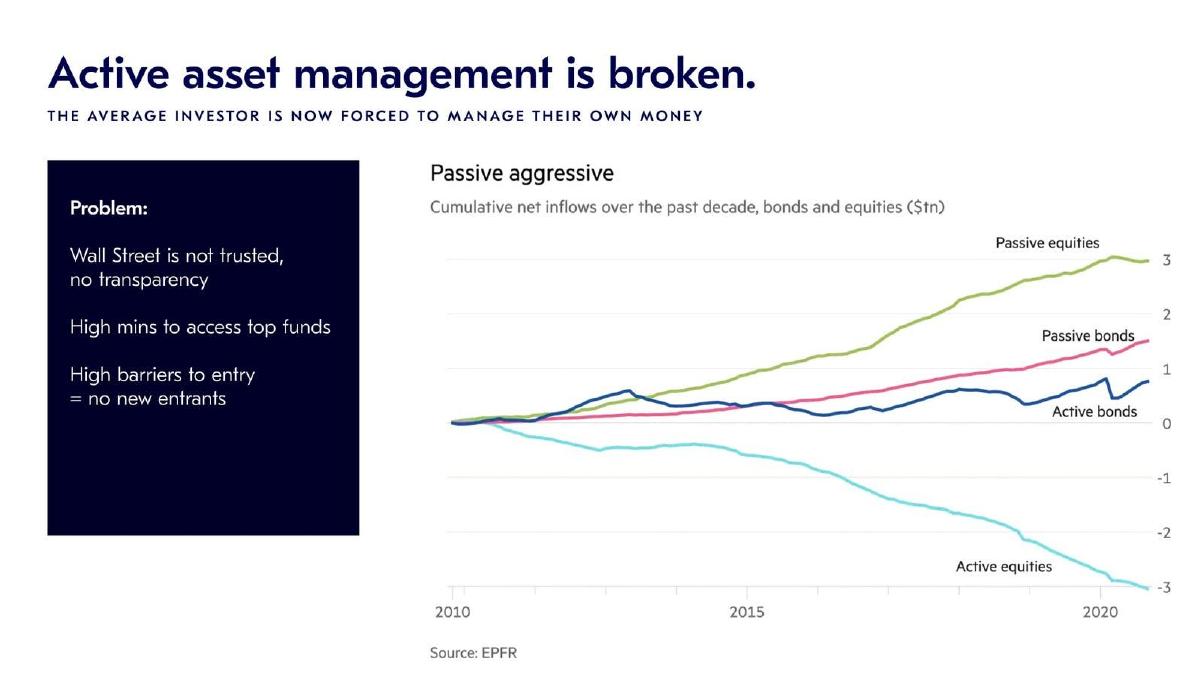
- The deck identifies a massive outflow from active equities, citing a negative $3 trillion trend since 2010 on Slide 2.
- Covey positions itself as an investment community powered by the 'smartest analysts in the world' on Slide 3.
- Early traction is quantified on Slide 4, showing a January 2021 launch and over 1,000 applicants by the time of the deck's creation.
- The platform uses blockchain to provide 'Immutable Track Records,' solving the transparency issue in Wall Street (Slide 2 and 5).
- Monetization is split into three phases: Data Sales ($300M), Copy Trading ($3T AUM), and a 'Shopify for Asset Management' model ($10T+ AUM) on Slide 6.
- The 'Alpha Algo' is a central component, intended to find and reward the best managers based on merit rather than pedigree (Slide 5).
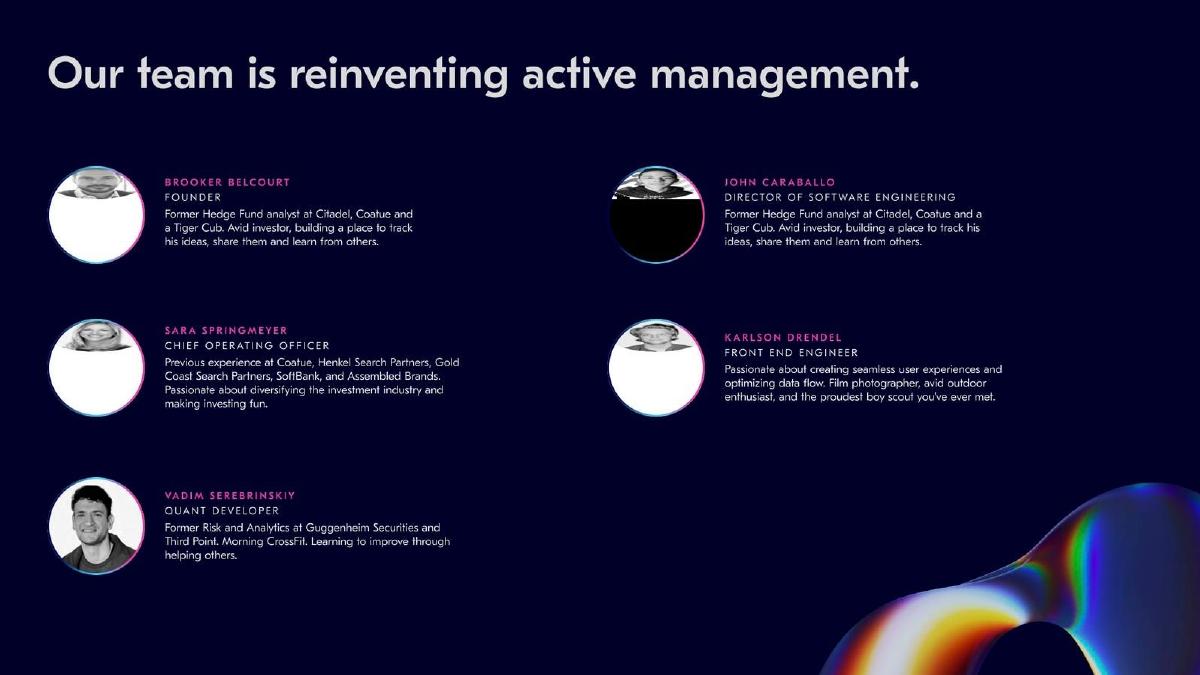
- The deck omits a team slide, leaving the founders' backgrounds and technical expertise to be verified externally.
- There is no explicit 'Ask' slide detailing how the $2.5M reported by Business Insider will be allocated.
The Vision: Decentralizing the Hedge Fund
Covey’s pitch deck is a masterclass in identifying a macro-trend—the death of active management—and positioning a technology-driven solution to capture the resulting vacuum. As reported by Business Insider, the company raised $2.5M in 2022 to execute this vision. The deck is concise, spanning 13 slides, though several are transitional or repetitive. It focuses heavily on the 'why' and the 'what,' leaving the 'who' and the 'how much' for the due diligence phase.
Slide 1: Title and Branding
The cover slide is minimalist, featuring a stylized 'C' logo with a gradient sunburst effect. It establishes a modern, fintech-forward aesthetic. There is no tagline here, just the company name and the label 'Fundraising Presentation.' While clean, it misses an opportunity to immediately define the value proposition.
Slide 2: The Macro Problem
Slide 2, titled 'Active asset management is broken,' uses a stark line graph from EPFR to show the divergence between passive and active investing. The data is compelling: since 2010, active equities have seen cumulative net outflows approaching negative $3 trillion, while passive equities have climbed to positive $3 trillion. The slide lists three specific pain points: Wall Street is not trusted (no transparency), high minimums to access top funds, and high barriers to entry for new entrants. This sets the stage for a disruptive entrant that can solve for trust and accessibility.
Slide 3: The Mission Statement
This is a transition slide that defines Covey as 'an investment community open to all, powered by the smartest analysts in the world.' It is a bold claim that shifts the focus from the problem to the community-led solution. The visual language remains consistent with the cover, using organic, iridescent shapes.
Slide 4: Traction and Discovery
Slide 4 provides a timeline of achievements. It notes a January 2021 launch of 'Immutable Track Records' and a September 2021 'AA1 Launch' where they began rewarding analysts with monthly crypto. The metrics are specific: 'Over 1K Applicants' and '$20k in rewards earned over 10 months.' Most importantly, the slide claims a discovery: 'Performance Persistence' exists for retail analysts just as it does in professional hedge funds. This is a crucial validator; if the 'smartest analysts' don't actually exist in the retail space, the platform has no product to sell.
Slide 5: The Analyst Value Proposition
Slide 5 explains 'Why Analysts love us' using a Venn diagram of three pillars: Token Rewards, Track Record, and Access to Manage. The 'Track Record' is described as having 50 metrics and being 'Immutable, Transparent, Auditable.' The 'Access to Manage' refers to copy-trading apps and fund formation. The sidebar notes that the community owns the 'Alpha Algo' to find the best managers, emphasizing a meritocratic system where 'Investors only copy the best.'
Slide 6: Market Opportunity and Monetization
This slide outlines three distinct revenue and AUM (Assets Under Management) opportunities. First, 'Sell Data' to recruiters and hedge funds ($300 million revenue potential). Second, 'Copy Trading' for top analysts ($3 trillion AUM potential). Third, the 'Shopify for Asset Management' model ($10 trillion+ AUM potential), which includes crowdsourced ETFs and fund formation. By framing the end-state as a platform for others to build businesses, Covey elevates itself from a simple social network to a foundational infrastructure play.
Slide 7-13: Conclusion and Repetition
The remaining slides in the provided sequence include a 'Thank You' slide (Slide 7) and several others that repeat the branding or provide minor variations of the core message. Notably, the text provided for slides 8 through 13 suggests a continuation of the visual theme rather than new data-heavy slides. The absence of a team slide or a financial ask slide in this sequence is a significant omission for a fundraising deck.
What Works in the Covey Deck
Strong Macro Context: By starting with the $3 trillion outflow from active management, Covey makes the case that the current system is failing. Investors love a 'why now' story, and the shift from active to passive is one of the biggest stories in finance over the last decade.
Quantified Traction: The mention of 1,000 applicants and $20k in distributed rewards (Slide 4) proves that the platform isn't just a concept. It shows that there is a supply side (analysts) willing to participate for crypto rewards and the chance to build a verified track record.
The 'Shopify' Analogy: Comparing a complex fintech product to a well-understood success story like Shopify (Slide 6) helps investors quickly grasp the platform's potential scale. It moves the conversation from 'we are a social network' to 'we are the infrastructure for the next generation of money managers.'
What is Missing
The Team Slide: In a Seed round, the team is often more important than the product. The provided slides do not list the founders, their backgrounds in finance or blockchain, or their previous exits. For a platform claiming to use an 'Alpha Algo' to disrupt Wall Street, the pedigree of the builders is a critical missing piece.
The Ask: While we know from publisher reports that they raised $2.5M, the deck itself does not state how much they are looking for or how they plan to spend the capital. A standard Seed deck should include a slide detailing the use of funds (e.g., 50% engineering, 30% marketing, 20% legal/compliance).
Regulatory and Compliance Strategy: Operating a 'copy trading' and 'fund formation' platform involves significant regulatory hurdles (SEC, FINRA). The deck mentions 'Fund Formation' and 'Crowdsourced ETFs' but does not address how they will navigate the legal complexities of asset management. This is a major red flag for fintech investors that needs to be addressed early.
Unit Economics: While the market sizes are listed in the trillions, there is no mention of how Covey actually makes money on a per-user or per-trade basis. Is it a SaaS fee? A percentage of AUM? A performance fee? The monetization slide (Slide 6) lists 'Data Vendors' and 'AUM' but lacks a specific business model breakdown.
Founder's Playbook: Lessons to Copy
Use Immutable Proof: If your product relies on trust, show how you automate that trust. Covey’s use of blockchain for 'Immutable Track Records' is a perfect example of using technology to solve a specific industry pain point (lack of transparency in Wall Street).
Focus on the Supply Side First: In marketplace businesses, the supply side is often the hardest to bootstrap. Covey focused its early traction on attracting analysts (the supply) before trying to sell to investors (the demand). Proving that you can attract talent is a strong signal to VCs.
Visual Consistency: The deck is visually cohesive. The use of a consistent color palette and high-quality abstract imagery makes the company feel 'premium.' In fintech, where you are asking people to trust you with the future of money, professional design is not optional.
Cite Academic or Data-Driven 'Discoveries': Slide 4 mentions 'Performance Persistence.' By framing their internal data as a 'discovery' that mirrors professional fund behavior, they add a layer of scientific legitimacy to their community-driven model. Founders should look for these 'aha' moments in their data to anchor their pitch.
Frequently asked questions
- What is the core problem Covey is solving?
- According to Slide 2, active asset management is 'broken' because Wall Street lacks transparency, has high minimums for top funds, and maintains high barriers to entry that prevent new entrants. This has led to a massive shift toward passive investing, which Covey aims to reverse by democratizing access to high-performing analysts.
- How does Covey reward its analysts?
- Slide 4 and 5 indicate that analysts earn monthly crypto rewards based on their performance. The deck notes that $20k in rewards were earned over a 10-month period following the September 2021 AA1 launch. Additionally, top analysts gain 'Access to Manage' through copy-trading apps and fund formation.
- What does 'Shopify for Asset Management' mean in this context?
- On Slide 6, this is described as the largest market opportunity ($10 trillion+). It involves providing the infrastructure for crowdsourced ETFs, subscription funds, social investing, and fund formation, allowing individual analysts to run their own investment vehicles as easily as a merchant opens a Shopify store.
- What role does blockchain play in the platform?
- Blockchain is used to create 'Immutable Track Records' (Slide 4). This ensures that an analyst's performance history is transparent, auditable, and cannot be manipulated, addressing the 'no transparency' problem cited on Slide 2.
- Is there evidence of market demand in the deck?
- Slide 4 highlights that since their January 2021 launch, they have seen over 1,000 applicants. They also claim to have discovered 'Performance Persistence' among retail analysts, suggesting that top-tier talent exists outside of traditional hedge funds and mutual funds.