Posh, a North American consumer app and events marketplace, successfully raised a $22M Series A in 2024 using a 12-slide deck that balances emotional mission-driven storytelling with aggressive marketplace growth data. The deck frames the problem as a loss of human connection, specifically citing Gen Z loneliness, before transitioning into concrete proof of utility. By showcasing diverse community organizers—ranging from dating podcasts to college rave promoters—Posh demonstrates a versatile platform capable of generating significant revenue. Key metrics include $95M in organizer earnings and…
Key takeaways
- The deck uses a mission-driven hook, framing the business as a solution to Gen Z loneliness on Slide 3.
- Posh highlights three distinct community archetypes on Slide 5 to prove the platform's versatility across different niches.
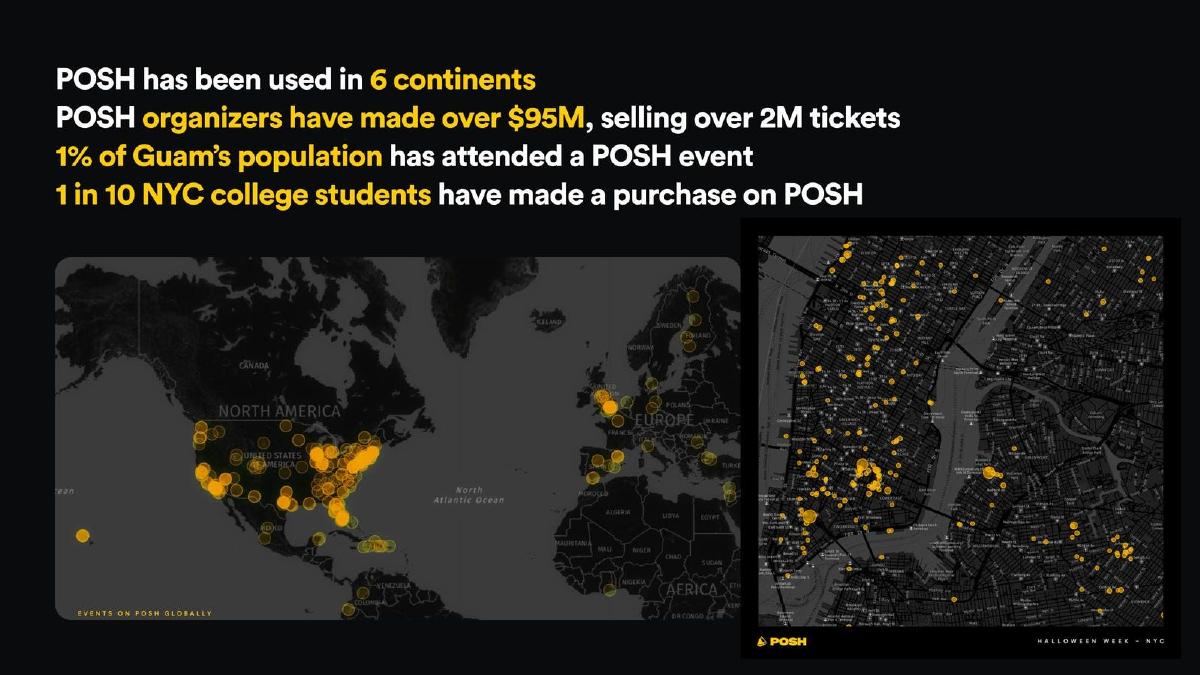
- Global reach is established on Slide 7, noting presence on 6 continents and over 2M tickets sold.
- Hyper-local density is a core proof point, with Slide 7 claiming 1 in 10 NYC college students have made a purchase.
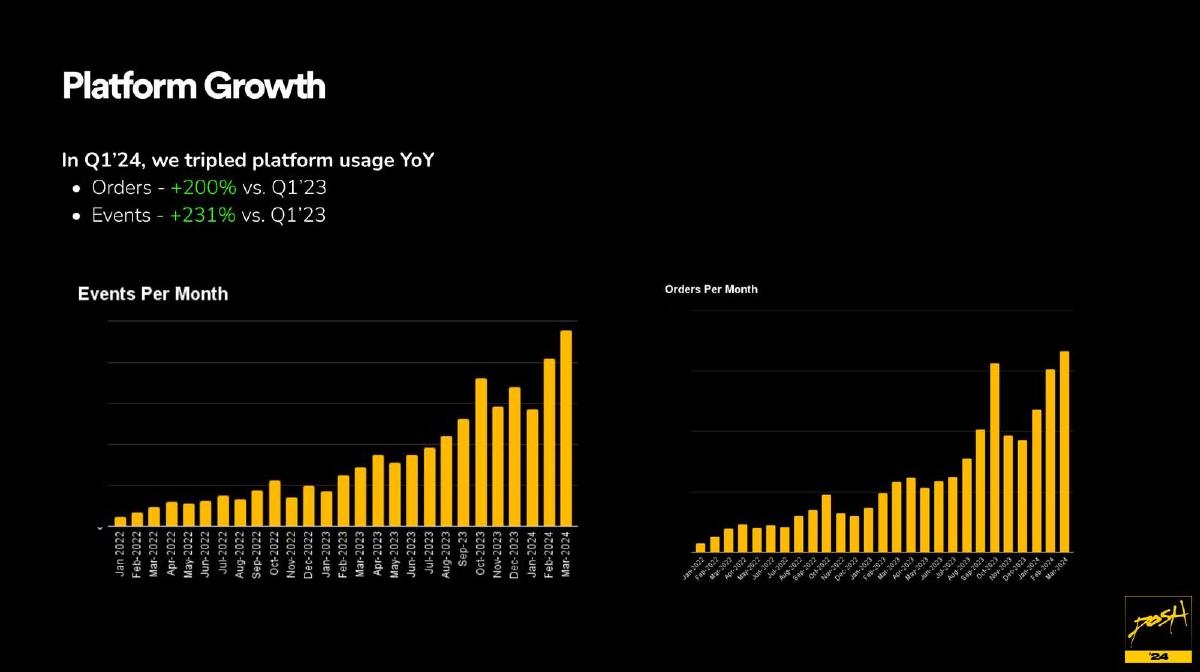
- Marketplace orders grew by 1733% compared to Q1 2023, as shown on Slide 9.
- The deck omits a traditional 'Ask' slide, unit economics, and a detailed competitor landscape.
- Slide 9 reveals that marketplace order contribution stands at 9.7%, indicating the platform is successfully transitioning from a tool to a discovery engine.
- The founders are introduced early on Slide 2, establishing credibility before diving into the problem statement.
The Mission-Driven Marketplace: Posh's $22M Series A Teardown
Posh entered the 2024 fundraising market with a clear narrative: the world is lonely, and technology should be the cure, not the cause. As reported by Business Insider, the company raised $22M in a Series A round to expand its consumer app and events marketplace. The 12-slide deck they used is a masterclass in balancing high-level social mission with the cold, hard growth metrics required to close a mid-stage venture round.
Slide 1: Title and Vision
The opening slide is minimalist, featuring the Posh logo and the tagline: "connecting the world through social experiences." It establishes the brand identity immediately—black background, bold yellow accents—and positions the company as a global connector rather than just a ticketing utility. The footer notes this is the "2024 Venture Deck - Posh Group Inc."
Slide 2: The Team
Posh chooses to introduce its founders immediately on Slide 2. While the provided text doesn't list their specific backgrounds, placing the team slide at the front is a common tactic for founders who have either achieved significant early traction or have previous exits that establish immediate credibility with investors.
Slide 3 & 4: The Loneliness Epidemic
Slide 3 serves as the "Problem" slide. It features a person scrolling on a phone in the dark with the text "Human connection is lost." It includes a poignant quote: "Generation Z is the loneliest generation the world has seen." Slide 4 follows up with the "Solution" statement, claiming Posh is "helping the world bring back meaningful human connection." This emotional hook is designed to make the investment feel significant beyond just financial returns.
Slide 5: Community Case Studies
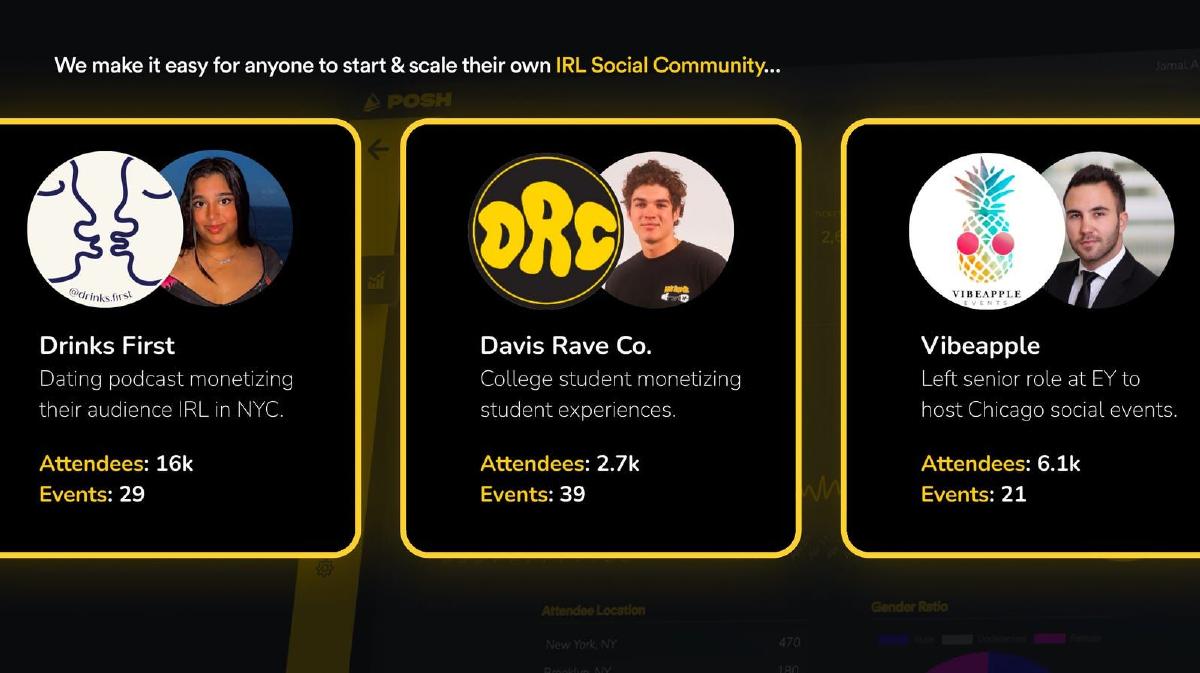
This is one of the most effective slides in the deck. Instead of talking about "users" in the abstract, Posh highlights three specific organizers to show the platform's versatility:
Drinks First: A dating podcast in NYC with 16k attendees over 29 events. · Davis Rave Co.: A college student monetizing student experiences with 2.7k attendees over 39 events. · Vibeapple: A former EY professional hosting Chicago social events with 6.1k attendees over 21 events.
By showing these diverse use cases, Posh proves that their tools work for different niches and geographic markets.
Slide 6: Product Interface
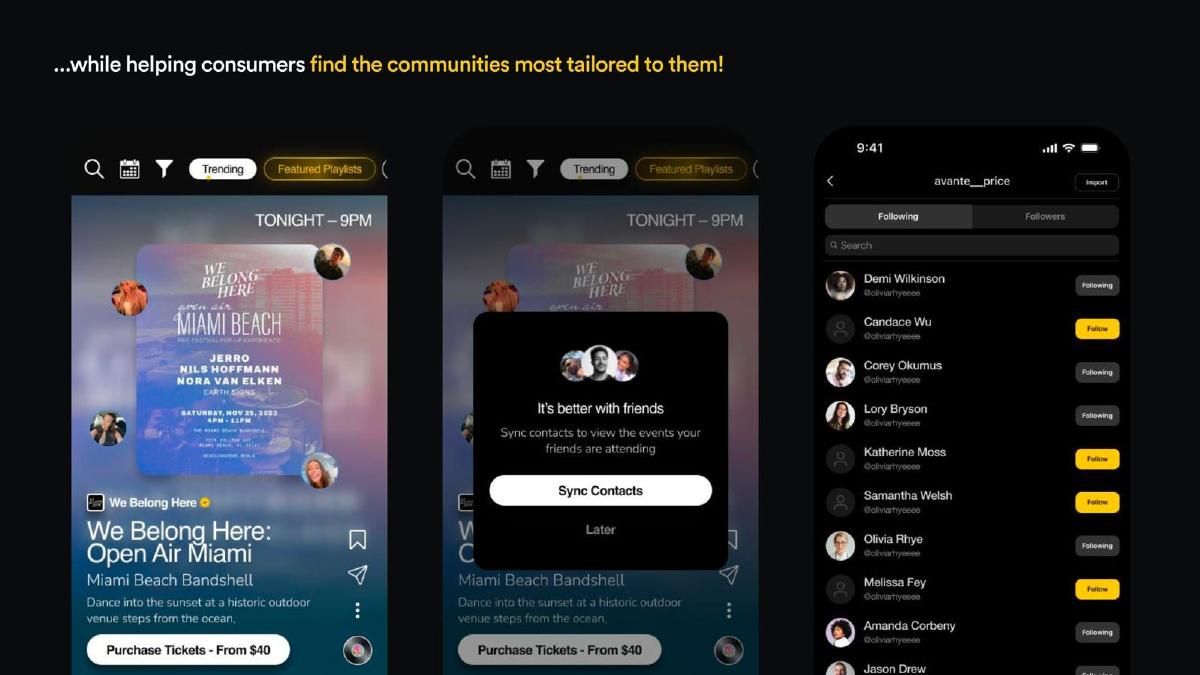
Slide 6 focuses on the consumer experience. It states Posh is "helping consumers find the communities most tailored to them" and displays screenshots of the mobile app. This reinforces the transition from a back-end organizer tool to a front-end discovery marketplace.
Slide 7: Global Scale and Local Density
Slide 7 is the "Traction" powerhouse. It lists four massive claims:
POSH has been used in 6 continents. · POSH organizers have made over $95M, selling over 2M tickets. · 1% of Guam’s population has attended a POSH event. · 1 in 10 NYC college students have made a purchase on POSH.
The inclusion of Guam and NYC college students is a clever way to show "density." In social apps, total numbers matter less than the percentage of a specific community you control. If you can capture 10% of NYC students, you have a repeatable playbook for other cities.
Slide 8 & 9: Marketplace Growth Metrics
Slide 8 and 9 dive into the data. Slide 9, titled "Platform Growth - Marketplace," is the most critical for a Series A. It shows two bar charts: Marketplace GMV Per Month and Marketplace Orders Per Month. The key highlights are:
Marketplace Orders: +1733% vs. Q1’23. · Marketplace Order Contribution: 9.7%.
The 9.7% contribution metric is vital. It tells investors that Posh isn't just a tool organizers bring their own fans to; Posh's own marketplace is now responsible for nearly 10% of the sales, proving the discovery engine is working.
Slide 10 & 11: The Future and The Close
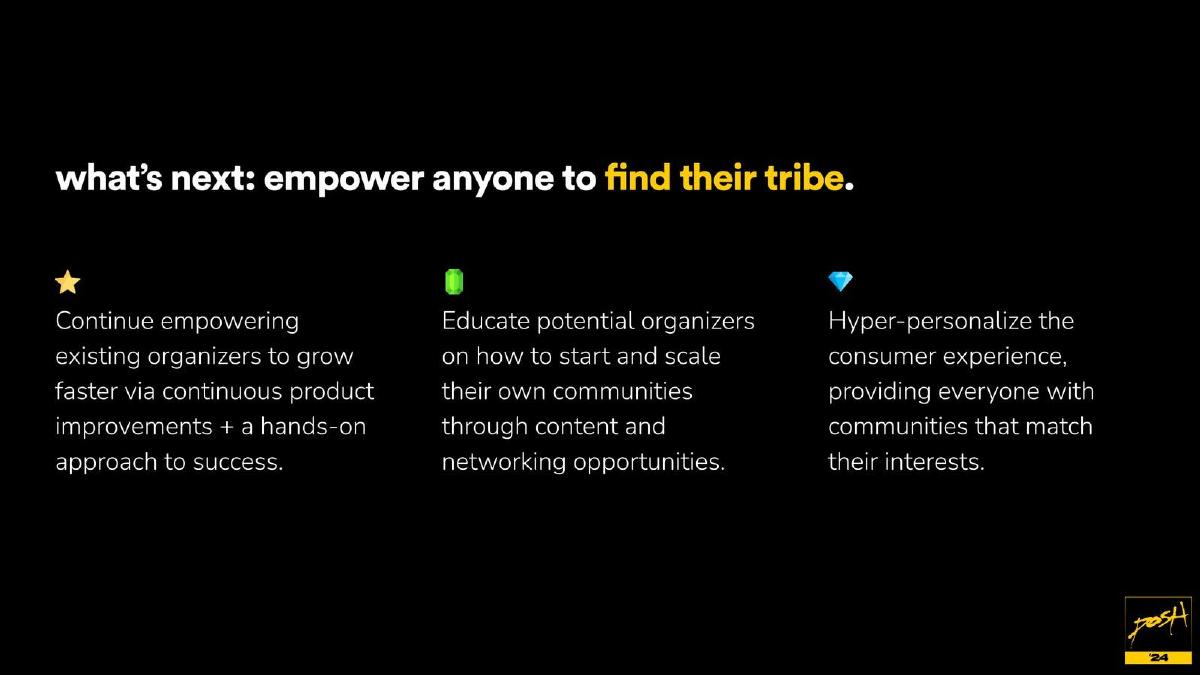
Slide 10 looks forward, aiming to "empower anyone to find their tribe." Slide 11 returns to the emotional core with a high-energy photo of a crowd and the text "Let’s end loneliness." This brings the narrative full circle, reminding investors of the scale of the problem they are solving. Slide 12 is a standard contact/thank you slide.
What Works in the Posh Deck
Density as a Proxy for Success: Most startups brag about total users. Posh brags about 1 in 10 NYC students. This is much more impressive to a Series A investor because it suggests the product has "viral loops" or "network effects" within a specific, high-value demographic.
Organizer Diversity: By showing a podcast, a college student, and a corporate professional, they demonstrate that the TAM (Total Addressable Market) isn't just professional concert promoters. They are capturing the "long tail" of social organizers.
Visual Consistency: The deck is high-contrast and visually striking. It feels like a consumer brand, not a B2B SaaS company. This helps sell the "lifestyle" and "community" aspect of the business.
What is Missing from the Posh Deck
The Financial Ask: The deck does not state how much they are raising or the terms. While common in leaked decks, a founder should always have a version that clearly outlines the use of funds.
Unit Economics: There is no mention of CAC (Customer Acquisition Cost) or LTV (Lifetime Value). For a consumer marketplace, investors eventually want to know if the cost of acquiring a ticket buyer is lower than the commission earned over that buyer's lifetime.
Competitive Landscape: Posh operates in a crowded space with Eventbrite, Luma, Partiful, and Resident Advisor. The deck makes no mention of how they differentiate technically or economically from these incumbents.
Founder Takeaways
Use 'Micro-Traction' to prove 'Macro-Potential': If your total numbers aren't in the millions yet, find a small pond where you are the big fish. Posh's mention of Guam is a perfect example of using a small, contained market to prove that your product can achieve near-total penetration.
Highlight the 'Supply Side' Success: In a marketplace, the supply side (organizers) is usually the hardest to move. By showing that organizers have made $95M, Posh makes a compelling case that their platform is a primary income source for their users, which leads to high retention.
Bridge the Gap Between Tool and Network: Posh started as a tool for organizers to sell tickets. The 1733% growth in marketplace orders proves they are successfully becoming a network where users go to discover things. If you are building a tool-based startup, you must show the path to becoming a network to command a venture-scale valuation.
Frequently asked questions
- What is Posh's primary business model based on the deck?
- While the deck does not explicitly detail fee structures, it describes Posh as an 'events marketplace' on Slide 9. It highlights that organizers have made over $95M selling 2M tickets (Slide 7), and the growth of 'Marketplace Orders' suggests the company generates value by facilitating ticket sales and event discovery through its mobile app.
- How does Posh demonstrate product-market fit?
- Posh uses 'density metrics' rather than just total user counts. Slide 7 states that 1% of Guam's population has attended an event and 10% of NYC college students have made a purchase. This proves the app can achieve critical mass in specific demographics and geographies, which is vital for social marketplaces.
- Who are the target organizers for the Posh platform?
- Slide 5 showcases three specific examples: a dating podcast (Drinks First) with 16k attendees, a college student (Davis Rave Co.) with 2.7k attendees, and a former corporate professional (Vibeapple) with 6.1k attendees. This suggests they target 'micro-influencers' and community leaders rather than just large-scale professional event production companies.
- What significant growth metrics did Posh share?
- The most striking metric is on Slide 9, which shows a 1733% increase in marketplace orders compared to Q1 2023. Additionally, Slide 7 notes that the platform has facilitated over $95M in total organizer earnings and sold over 2 million tickets globally.
- What is missing from the Posh Series A deck?
- The deck is light on financial specifics. It lacks a slide on unit economics (CAC/LTV), a detailed breakdown of the $22M fundraise 'Ask,' a competitive analysis against incumbents like Eventbrite or Luma, and a clear roadmap of how the new capital will be deployed beyond the vague 'empower anyone to find their tribe' on Slide 10.