Portkey.ai’s pitch deck is a masterclass in technical product positioning within a crowded market. By identifying as the 'complete LLMOps stack' (Slide 6), the company addresses the acute pain points of developers moving from AI prototypes to production environments. The deck effectively utilizes technical proof points, such as semantic caching that makes calls '20x faster' (Slide 4), to demonstrate immediate ROI. While the deck leans heavily on product features and technical integration, it successfully communicates a vision of an interoperable AI future where Portkey acts as the essential g…
Key takeaways
- The deck positions Portkey as a unified gateway for over 20+ LLM providers, reducing switching costs for enterprises (Slide 4).
- A core value proposition is performance optimization, specifically claiming that semantic caching can make 35% of calls 20x faster (Slide 4).
- The 'Challenges' slide identifies five specific enterprise hurdles: visibility, provider lock-in, landscape evolution, experimentation effort, and security risks (Slide 2).
- Portkey emphasizes ease of adoption with a code-centric 'Integrate in a minute' slide, showcasing a simple configuration object (Slide 7).
- The platform includes an 'Experimentation' suite that uses Elo ratings to compare model performance, providing a quantitative framework for AI quality (Slide 5).
- Reliability is addressed through automatic fallbacks, ensuring that if one model fails, the system switches to a functioning alternative (Slide 4).
- The deck omits traditional business metrics like current revenue, customer logos, or a detailed team slide in the provided sequence, focusing instead on technical capability.
- The publisher reports a $3M Seed round raised in 2024, indicating high demand for infrastructure tools in the North American AI sector.
The Infrastructure of the AI Revolution
Portkey.ai entered the market at a pivotal moment. As the initial hype of generative AI transitioned into the hard work of enterprise implementation, developers realized that calling an API was the easy part. The difficulty lies in the 'Ops'—monitoring, reliability, and cost control. Portkey’s deck, which helped secure a $3M Seed round in 2024, focuses almost entirely on solving these technical friction points. It is a lean, product-focused presentation that speaks the language of the engineer rather than the MBA.
Slide 1: The Value Proposition
The title slide is minimalist, establishing the brand and its core mission: 'Launch production-ready apps with the LLMOps stack for monitoring, model management, and more.' By using the term 'LLMOps,' Portkey aligns itself with the established DevOps and MLOps categories, signaling to investors that they are building a necessary category-defining tool for the new AI stack.
Slide 2: The Five Pillars of Friction
Slide 2, titled 'Challenges,' is the most important strategic slide in the deck. It identifies five specific pain points: low visibility (cost/accuracy/latency), high switching costs between providers, the rapidly evolving landscape, the effort required for experimentation, and security risks. This slide sets the stage for the rest of the deck to act as a point-by-point solution to these problems. It validates the need for a middleware layer in the AI ecosystem.
Slide 3: Transitioning to the Product
Slide 3 is a simple 'Platform Tour' transition. In a 14-slide deck, using a full slide for a transition is a bold choice, but it serves to reset the viewer's focus from the 'Problem' to the 'Solution.' It signals that the following slides will be a deep dive into the actual interface and capabilities of the software.
Slide 4: The LLM Gateway and Performance Metrics
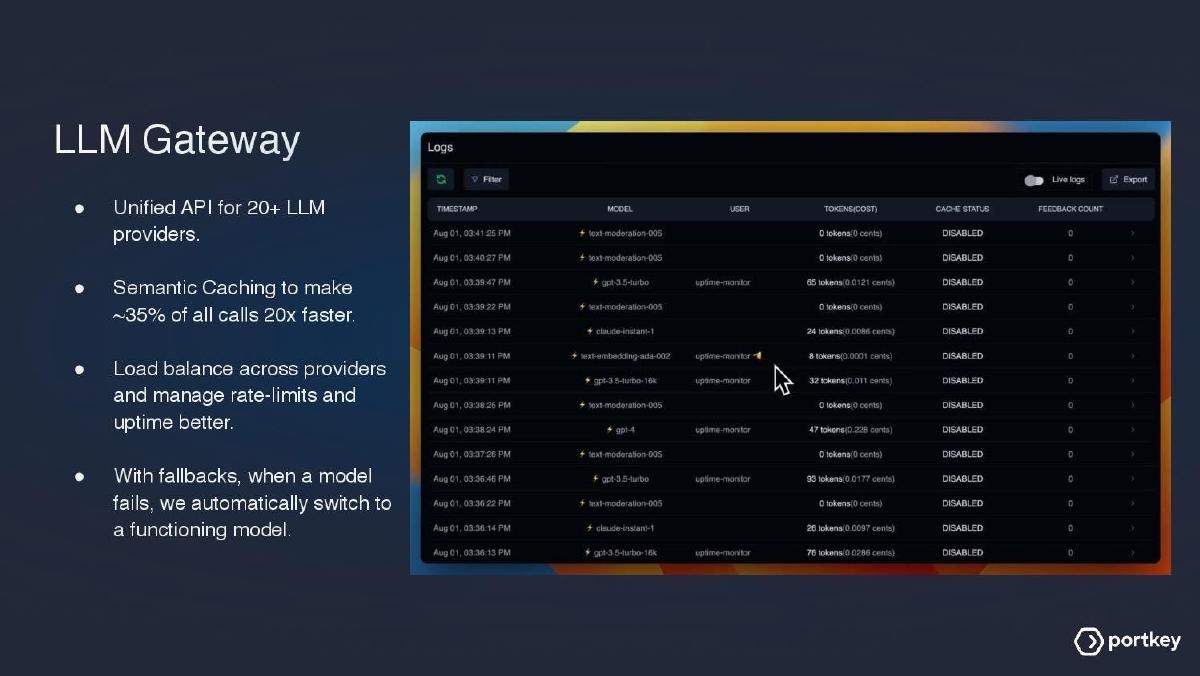
Slide 4 introduces the 'LLM Gateway.' This is the heart of the product. The slide is dense with technical value: a unified API for 20+ providers, load balancing, and automatic fallbacks. However, the standout metric is the claim regarding 'Semantic Caching,' which reportedly makes '~35% of all calls 20x faster.' This is a tangible, quantifiable benefit that appeals to both the developer (speed) and the CFO (cost reduction). The inclusion of a 'Logs' dashboard screenshot provides visual proof that the product is real and functional.
Slide 5: Quantitative Experimentation
Slide 5 focuses on 'Experimentation.' In the world of LLMs, 'quality' is often subjective. Portkey attempts to quantify this by showing 'Model Elo Rating Diff' charts. This is a clever borrowing from the world of chess and competitive gaming to provide a metric for model performance. The slide also lists key partners/integrations like OpenAI, Anthropic, and Cohere, reinforcing Portkey’s position as the central hub of the ecosystem.
Slide 6: Defining the Category
Slide 6 is a summary statement: 'Portkey is your complete LLMOps stack.' It uses a rocket emoji and bold text to drive home the point that this isn't just a single tool, but a comprehensive platform. This is a classic 'land and expand' strategy—starting with a gateway and moving into the entire lifecycle of AI application development.
Slide 7: The 'Aha' Moment for Developers
Slide 7, 'Integrate in a minute.. ..with everything,' is the closing technical argument. By showing a concise code snippet, Portkey demonstrates that the barrier to entry is extremely low. The logos on the right (Node.js, Python, LangChain, etc.) show that they have built the necessary connectors to fit into any existing developer workflow. This slide addresses the 'high testing & switching costs' mentioned in Slide 2 by showing how easy it is to actually switch.
What Portkey.ai Does Exceptionally Well
The Portkey deck succeeds because it identifies a 'hair-on-fire' problem for a very specific, high-growth audience: developers building with LLMs. It doesn't waste time explaining what AI is; it assumes the audience knows the market is huge and focuses entirely on why the current way of building is broken. The use of specific metrics (20x faster, 20+ providers) gives the claims weight. Furthermore, the visual design is consistent with modern developer tools—dark, sleek, and data-heavy—which builds immediate subconscious trust with the intended user base.
What is Missing from the Deck
While the technical narrative is strong, the provided slides are missing several traditional venture capital components. There is no 'Market Size' (TAM/SAM/SOM) slide, which is usually expected in a Seed round to justify the potential for a billion-dollar outcome. There is also no 'Team' slide in this sequence, which is often the most important factor in a Seed investment. Finally, there is no 'Ask' slide detailing how the $3M will be spent or what milestones the company intends to hit next. These omissions suggest that either the deck relied heavily on the founders' previous reputations or that these slides were removed for the public version of the teardown.
Founder Takeaways: The Power of the Middleware Layer
Founders should look at Slide 2 and Slide 4 as a template for 'Problem/Solution' alignment. If you are building infrastructure, you must prove two things: that the current infrastructure is painful to use, and that your solution is objectively better (faster, cheaper, or more reliable). Portkey does this by focusing on 'Semantic Caching' and 'Unified APIs.' Another takeaway is the importance of 'Developer Experience' (DX). Slide 7’s code snippet is more persuasive to a technical investor than ten slides of marketing fluff. If your product is for developers, show the code early and often.
Frequently asked questions
- What specific problem does Portkey.ai solve?
- Portkey.ai addresses the 'production gap' in generative AI. While building a demo is easy, Slide 2 highlights that maintaining visibility over cost, accuracy, and latency, along with managing multiple providers and security compliance, is difficult. Portkey provides the infrastructure to manage these operational challenges through a unified API and monitoring stack.
- How does Portkey improve AI performance and cost?
- According to Slide 4, Portkey uses 'Semantic Caching' to make approximately 35% of all LLM calls 20x faster. By caching similar queries rather than just identical ones, the platform reduces the number of expensive and slow calls made to providers like OpenAI or Anthropic, directly impacting both latency and the bottom line.
- Is Portkey compatible with multiple AI models?
- Yes. Slide 4 explicitly states that Portkey offers a 'Unified API for 20+ LLM providers.' Slide 5 further illustrates this by showing logos for OpenAI, Cohere, AI21 Labs, Aleph Alpha, and Anthropic, emphasizing that the platform is designed to prevent vendor lock-in and allow for easy model switching.
- How does the platform handle model failures?
- Portkey includes a 'fallback' mechanism. As described on Slide 4, the system automatically switches to a functioning model if the primary model fails. This is a critical feature for production-ready applications that require high uptime and cannot afford to be dependent on a single provider's availability.
- What does the 'Experimentation' feature actually do?
- Slide 5 shows that the experimentation suite allows developers to test different prompts and models, perform 'dark testing' across providers, and collect feedback to create datasets. It uses a 'Model Elo Rating' system to provide a comparative score of model quality, helping teams choose the best model for their specific use case.