PostHog’s 18-slide Series B deck from 2021 is a study in developer-centric fundraising. Eschewing the typical corporate aesthetic for pixel art and raw community metrics, the company successfully raised $15M. The deck leans heavily on the 'open source' advantage, highlighting a 50% retention rate for technical users and a community of 6,500 developers built with less than $25,000 in marketing spend. Rather than focusing on immediate revenue, the narrative emphasizes 'commoditizing' existing tools and scaling through inbound demand. While it lacks a traditional team slide or detailed financial…
Key takeaways
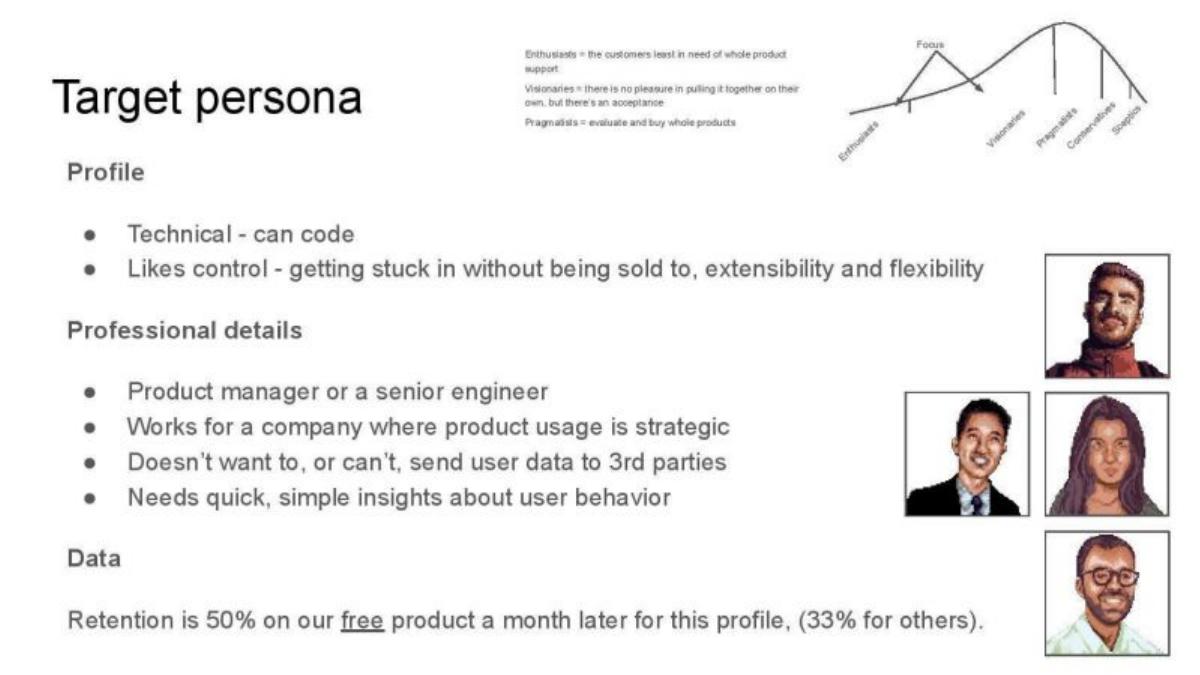
- The target persona is strictly technical, with a 50% one-month retention rate for users who can code compared to 33% for others (Slide 3).
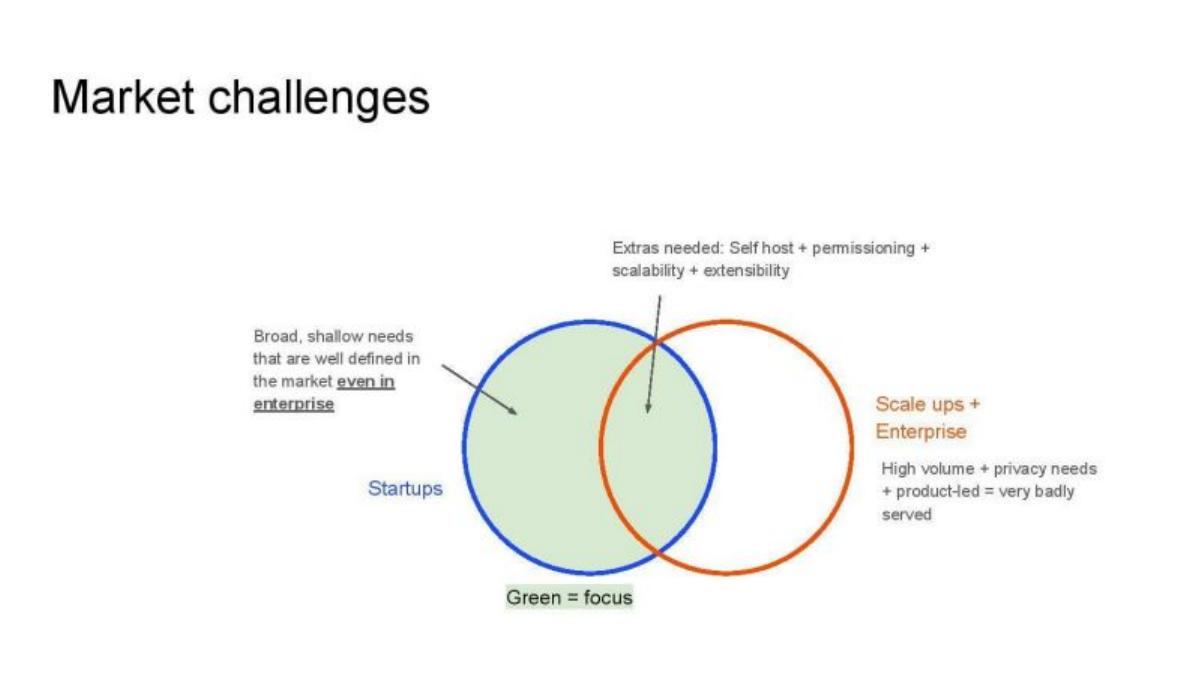
- PostHog identifies a gap in the market where scale-ups and enterprises with high volume and privacy needs are 'very badly served' (Slide 5).
- The product strategy involves building core features like feature flags and session recording while integrating with external tools like GitHub and CRMs (Slide 8).
- Growth is driven by community rather than sales, with ~6,500 developers across Slack, GitHub, and Twitter (Slide 12).
- Marketing efficiency is a core highlight, claiming the community was built with less than $25,000 in total marketing spend (Slide 12).
- Inbound demand saw a massive spike following the enablement of ClickHouse in late 2020 (Slide 13).
- The go-to-market strategy prioritizes developer evangelism and 'merch' over traditional outbound sales (Slide 15).
- The long-term vision is to achieve 'whole product status' with open source to commoditize existing paid tools (Slide 17).
The Developer-First Aesthetic: PostHog's Series B Narrative
PostHog’s Series B deck is a masterclass in authenticity. In an industry where Series B decks usually transition into polished, corporate presentations filled with CAC/LTV ratios and sales hiring plans, PostHog doubled down on its roots. The deck is characterized by pixel art, raw screenshots, and a heavy emphasis on community metrics over financial ones. This teardown explores how they used a developer-centric narrative to raise $15M in 2021.
Slides 1-2: Setting the Technical Tone
The Title Slide (Slide 1) features a pixel-art collage of servers, mice, gears, and code windows. There is no tagline, only the PostHog logo in the bottom left. This immediately signals that the presentation is not for a generalist audience; it is for those who understand the 'plumbing' of the internet.
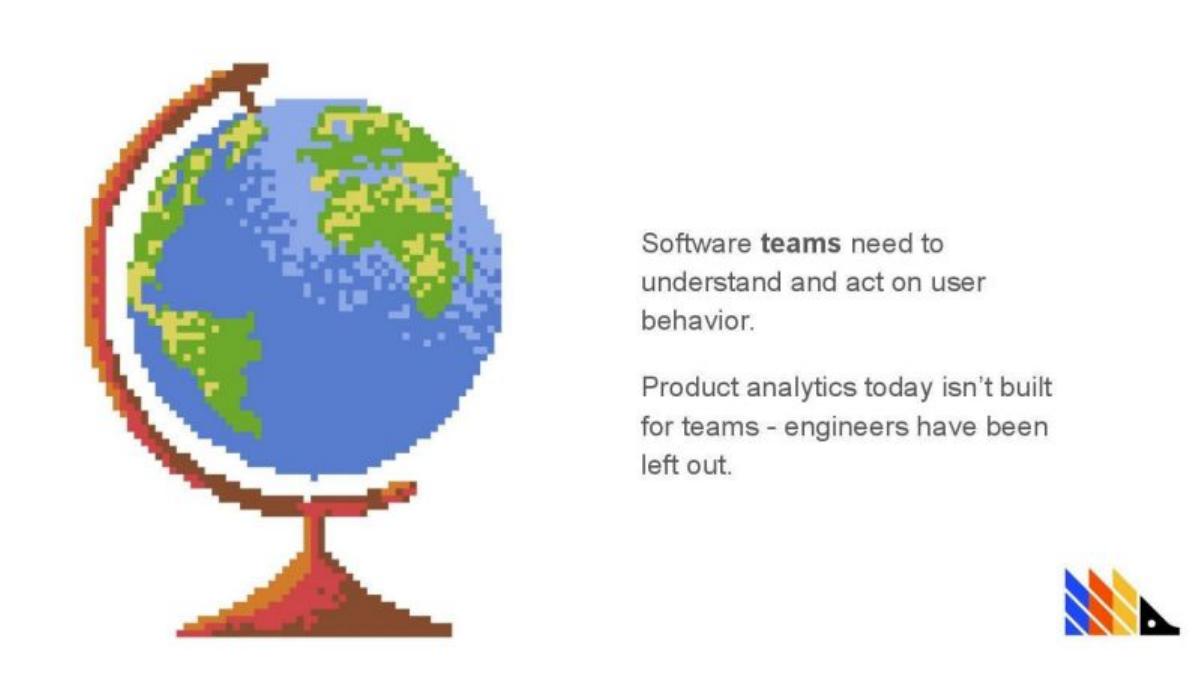
Slide 2 introduces the core problem: 'Software teams need to understand and act on user behavior.' Crucially, it identifies the specific gap: 'Product analytics today isn’t built for teams - engineers have been left out.' By framing the problem as an exclusion of engineers, PostHog justifies its existence as a technical platform rather than a marketing tool.
Slides 3-5: Defining the Visionary Persona
Slide 3 is one of the most important slides in the deck. It defines the 'Target persona' as someone who is 'Technical - can code' and 'Likes control.' The data point at the bottom is the clincher: 'Retention is 50% on our free product a month later for this profile, (33% for others).' This proves that the product has found a specific niche where it is significantly more 'sticky' than the market average.
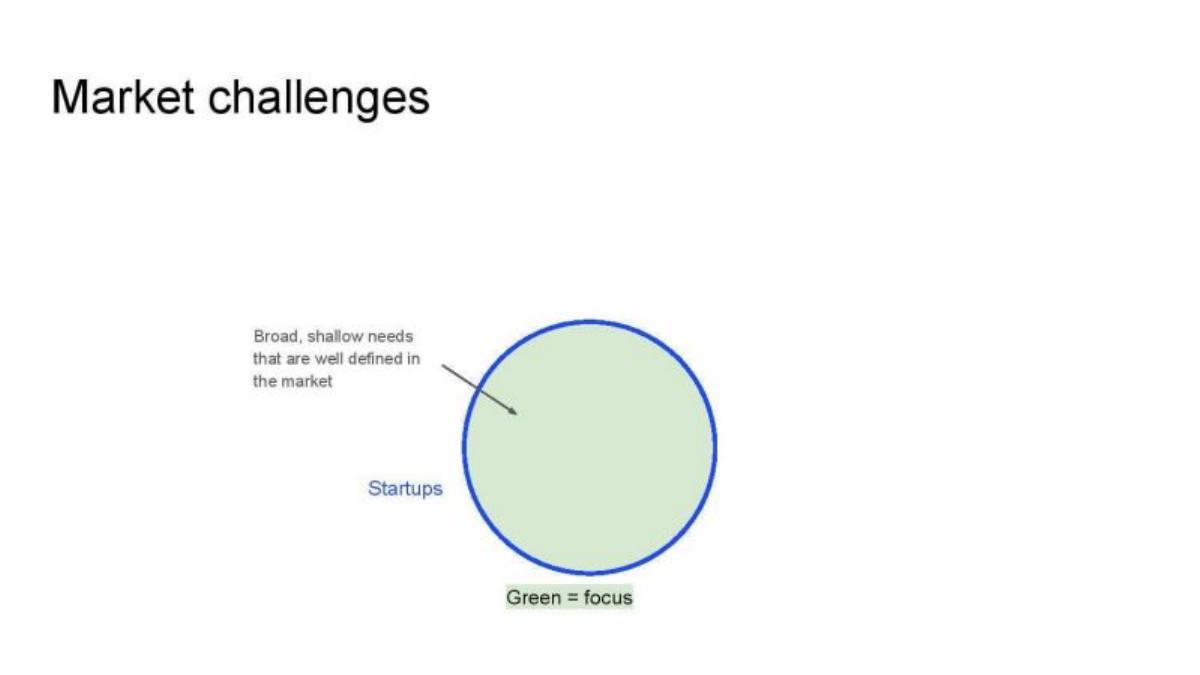
Slides 4 and 5 use Venn diagrams to explain 'Market challenges.' They show a focus on 'Startups' but point toward an overlap with 'Scale ups + Enterprise.' The deck claims that high-volume, privacy-conscious, product-led companies are 'very badly served.' This sets the stage for PostHog to move up-market by solving for 'Self host + permissioning + scalability + extensibility'—features that legacy SaaS analytics tools often struggle to provide in a developer-friendly way.
Slides 6-8: The Product and Roadmap
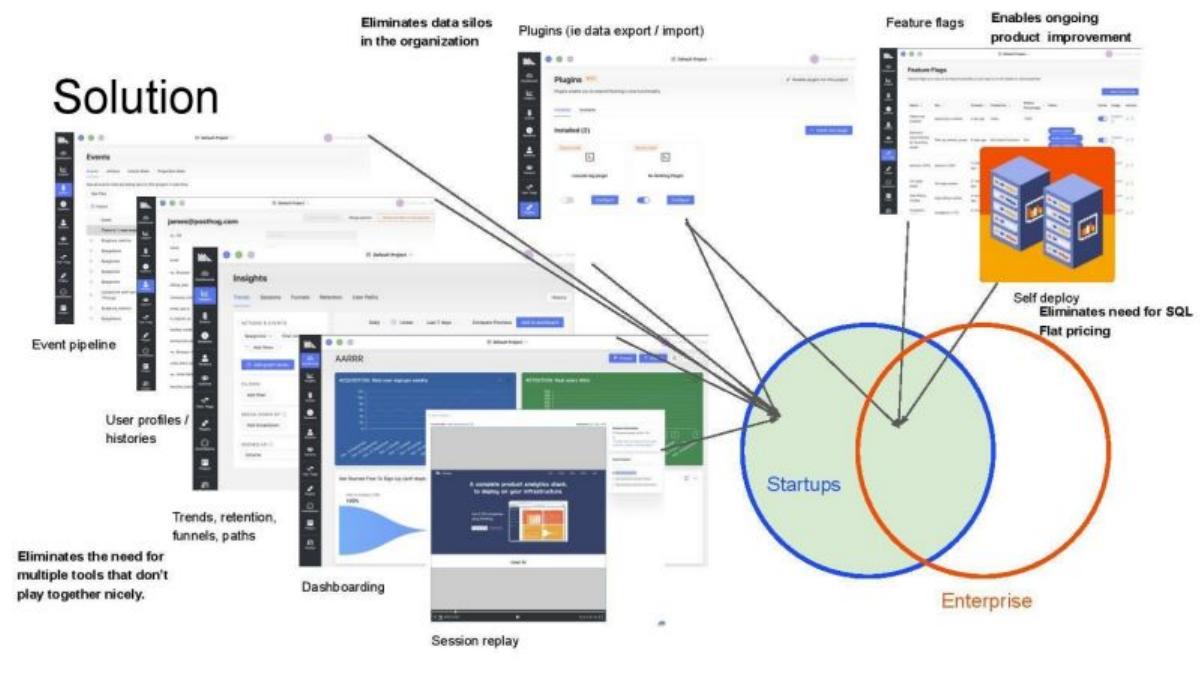
Slide 6 is a 'Solution' overview that connects product features to the market segments defined earlier. It highlights that for startups, they offer an event pipeline, user profiles, and trends. For the enterprise segment, they add 'Self deploy,' 'Eliminates need for SQL,' and 'Flat pricing.' This slide effectively communicates that the product is a multi-tool, not just a single-feature utility.
The Roadmap (Slides 7-8) is refreshingly transparent. Slide 7 lists high-level goals for 2021, such as 'Establish growth engineering function' and 'Enhance catalogue of plugins.' Slide 8 provides a detailed grid of what they will 'Ignore,' 'Build,' or 'Integrate.' For example, they explicitly state they will 'Ignore' design mockups while 'Building' feature flags and split testing. This level of detail shows a team that is disciplined about its product scope.
Slides 9-11: The Traction Curves
PostHog uses three consecutive slides to show different angles of growth. Slide 9 ('Deployments') shows a steady upward curve of thousands of companies. Slide 10 ('The rate of growth is increasing') uses a deployments-per-month metric to show acceleration. Slide 11 ('Usage is exponential') shows a massive vertical spike in 'Monthly events' on their cloud platform. By showing deployments first and usage second, they demonstrate that not only are people installing the software, but those who install it are using it at an increasing scale.
Slide 12: The Efficiency of Open Source
This slide provides the strongest evidence for their business model. PostHog claims a community of ~6,500 developers and ~100 contributors . The most striking figure is the claim that this was achieved with ' For a Series B investor, this suggests an incredibly low Customer Acquisition Cost (CAC) and a powerful organic growth engine that can be poured into with fresh capital.
Slides 13-14: Inbound Demand and Social Proof
Slide 13 shows a chart of inbound demand with a specific inflection point: 'Clickhouse enabled' in late 2020. This connects a technical engineering decision directly to a business outcome, reinforcing the 'engineer-led' narrative. Slide 14 is a 'wall of love' featuring raw testimonials from Slack, Twitter, and customer calls. Quotes like 'We can’t survive without posthog' and 'I think I am in love with posthog lmao' provide the emotional validation to back up the hard data on previous slides.
Slides 15-17: Go-to-Market and The Future
Slide 15 outlines a non-traditional GTM strategy. Instead of 'hiring 10 AEs,' they focus on 'Developer evangelism,' 'merch,' and 'Easy contributions.' They acknowledge they are 'getting swamped with paid enquiries,' which is the best possible problem to have when asking for Series B funding. Slide 16 and Slide 17 wrap up the vision. They argue that as product-led growth becomes mainstream, every team will need a clear view of user behavior. Their strategy is to 'commoditize the range of existing tools' with their open-source offering, effectively undercutting the pricing power of incumbents like Mixpanel or Amplitude.
What PostHog Does Well
1. Persona Specificity: They don't try to be everything to everyone. They explicitly state that their product is for people who can code. This clarity helps investors understand exactly who the customer is and why they would choose PostHog over a more 'user-friendly' but less flexible competitor.
2. Technical Milestones as Business Drivers: By highlighting the ClickHouse integration, they prove that their engineering team understands how to build infrastructure that unlocks market demand. This is rare in pitch decks, which usually treat the 'product' as a black box.
3. Extreme Capital Efficiency: The mention of 1. Traditional Team Slide: There is no slide introducing the founders or the core team. While their YC pedigree and GitHub contributor count likely mitigated this, it is a standard component that most founders should include to build personal credibility.
2. Detailed Financials: The deck is heavy on 'usage' and 'deployments' but light on Revenue, ARR, or Net Revenue Retention (NRR). While they mention 'paid enquiries,' the lack of hard revenue data suggests this was a 'growth-first' round where the valuation was driven by adoption metrics rather than a multiple of current earnings.
3. Competitive Landscape: Aside from a brief mention of Mixpanel in a testimonial, there is no formal competitive matrix. PostHog relies on the investor knowing the space well enough to recognize how an open-source, self-hosted option differs from the standard SaaS incumbents.
Founder's Playbook: What to Copy
Use 'The Wall of Love': Slide 14 is incredibly effective because the testimonials feel real. They aren't polished logos; they are screenshots of Slack messages and tweets. If you have a passionate user base, show their raw enthusiasm.
Focus on 'Visionary' Retention: If your product has a specific segment that uses it 2x more than others, highlight that data (as seen on Slide 3). It shows you have found Product-Market Fit in a specific niche, which is more believable than claiming broad appeal.
The 'Ignore' List: Including what you are not doing (Slide 8) is a sign of maturity. It tells investors that you have a strategy and the discipline to stick to it, rather than chasing every possible feature request.
Frequently asked questions
- Why does the deck use pixel art instead of professional photography?
- PostHog is an open-source tool built for developers. The pixel art aesthetic signals that the company is 'by developers, for developers.' It aligns with their target persona—technical users who value authenticity and control over polished corporate sales pitches. This branding reinforces their position as a community-driven alternative to legacy enterprise analytics software.
- How does PostHog justify its focus on startups over enterprise in a Series B deck?
- Slide 5 and 6 show that PostHog views startups as their initial focus to build a 'whole product.' However, they explicitly identify that enterprises have 'high volume + privacy needs' that are currently underserved. By winning the 'visionary' engineers at startups first, they create a bottom-up adoption path into larger organizations that require self-hosting and extensibility.
- What is the significance of the ClickHouse mention on Slide 13?
- ClickHouse is a high-performance database. By enabling it, PostHog allowed users to handle much larger data volumes. The chart on Slide 13 shows that this technical milestone was the direct catalyst for a massive spike in inbound demand, proving to investors that their technical infrastructure choices directly drive business growth.
- Is the lack of a team slide a red flag for a Series B company?
- In most cases, yes. However, PostHog was a Y Combinator graduate (W20) with a highly visible open-source presence. By the Series B, the 'team' is effectively the 100+ contributors mentioned on Slide 12. For a developer-led company, the strength of the external contributor community can be more persuasive than a list of internal executive hires.
- What does 'commoditize the range of existing tools' mean in their strategy?
- On Slide 17, PostHog states they want to use their open-source product to make standard features (like heatmaps or funnels) free and ubiquitous. Their business model relies on providing a 'complementary paid product' for advanced needs, while the free version disrupts incumbents by offering their paid features for free, thus capturing the market.