Zio Studios, a Bogota-based production house, utilized this deck to transition from a service-based business model to an original IP studio under the 'Brainz Games' brand. By leveraging 12 years of experience producing content for global brands like Coca-Cola and Sony Music, the company argued that low production costs in Colombia combined with a 'transmedia' approach—launching stories across games, comics, and video—would mitigate the inherent risks of the entertainment industry. The deck is light on financial projections and team bios but heavy on visual proof of concept, showcasing five di…
Key takeaways
- The company successfully raised $1.3 million in 2011 for their Series A round (Catalogue facts).
- Zio Studios highlights a staff of 70+ people based in Bogota, Colombia, emphasizing regional leadership in 3D animation (Slide 2).
- The deck explicitly states a pivot from 12 years of 'Work For Hire' to creating original intellectual property (Slide 2).
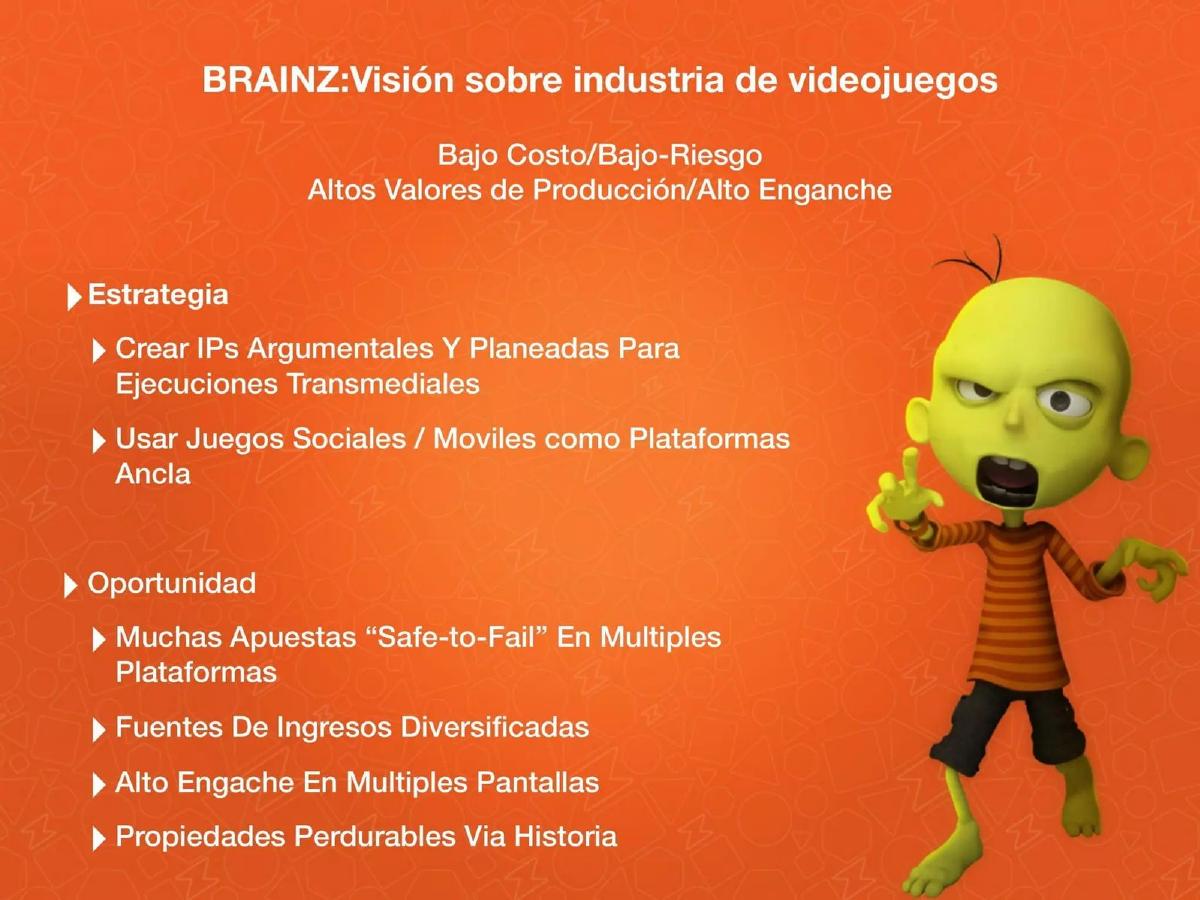
- They define their strategy as 'Safe-to-Fail' by launching multiple bets across various platforms to diversify revenue (Slide 5).
- The 'Brainz Games' brand was established specifically to house their video game and transmedia efforts (Slide 6).
- The pipeline includes five specific titles: Social Street Soccer, Vampire Season, Gone South, Toyz, and Legendary Warrior (Slide 7).
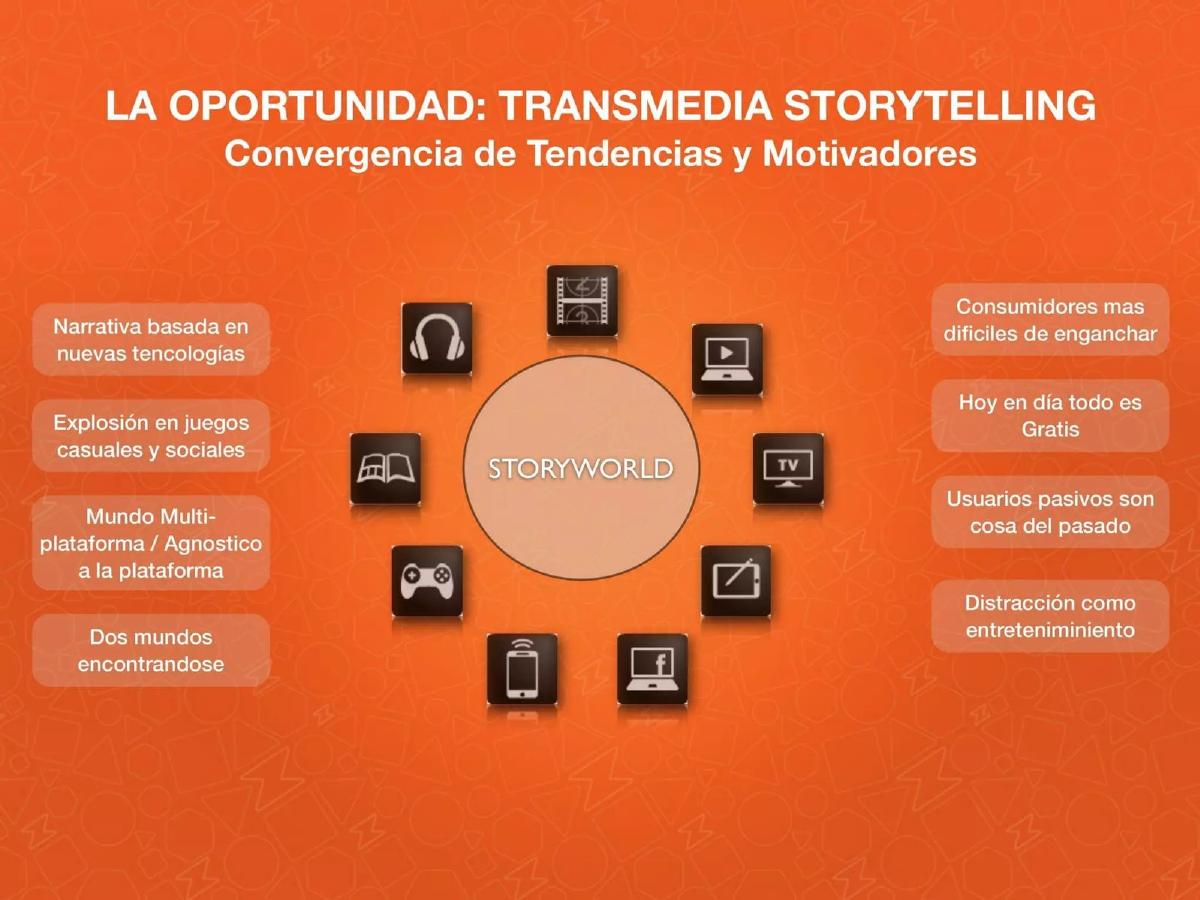
- Transmedia is defined as the convergence of storyworlds across mobile, social games, TV, and books (Slide 4).
- The deck lacks a dedicated team slide, financial projections, or a specific breakdown of the use of funds (Omissions).
Introduction: The Transmedia Pivot
Zio Studios' 2011 pitch deck is a classic example of a service-to-product transition. Based in Bogota, Colombia, the studio spent over a decade building a reputation as a high-quality animation and post-production house for global giants. This deck represents the moment they decided to stop selling hours and start building equity through original Intellectual Property (IP). The $1.3 million raised (noted as $1.5M in the deck text) was intended to fuel this new direction under the 'Brainz Games' moniker.
Slides 1-2: History and Foundation
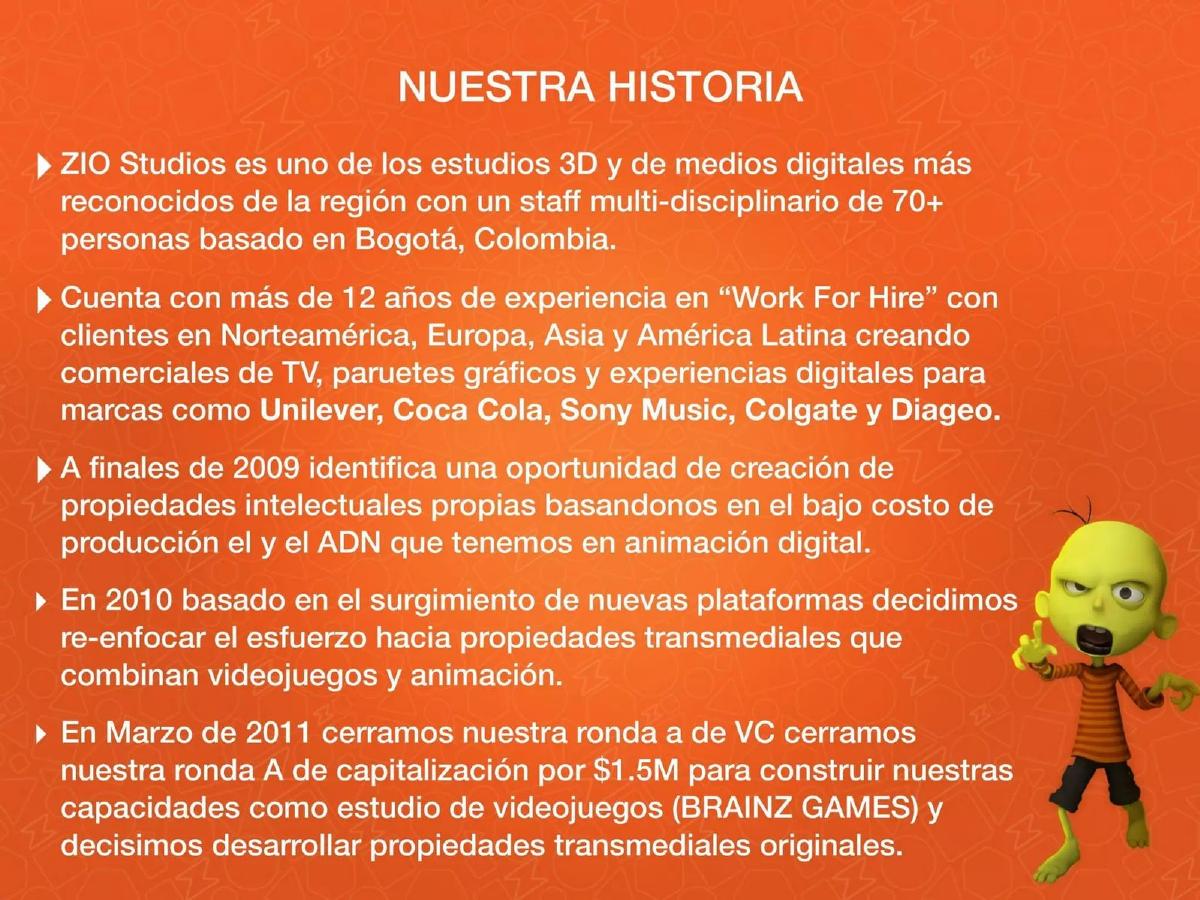
The deck opens with a simple branding slide followed by Nuestra Historia (Our History) on Slide 2. This is a high-density information slide that establishes immediate credibility. It notes that Zio Studios is one of the most recognized 3D studios in the region with a multi-disciplinary staff of 70+ people . Crucially, it highlights 12 years of 'Work For Hire' experience for tier-one brands including Unilever, Coca-Cola, Sony Music, Colgate, and Diageo . This establishes that the team isn't a group of amateurs; they are seasoned professionals who have already delivered for the world's most demanding clients. The slide concludes by stating that in March 2011, they closed a $1.5M round to build their game studio, Brainz Games .
Slides 3-4: The Transmedia Opportunity
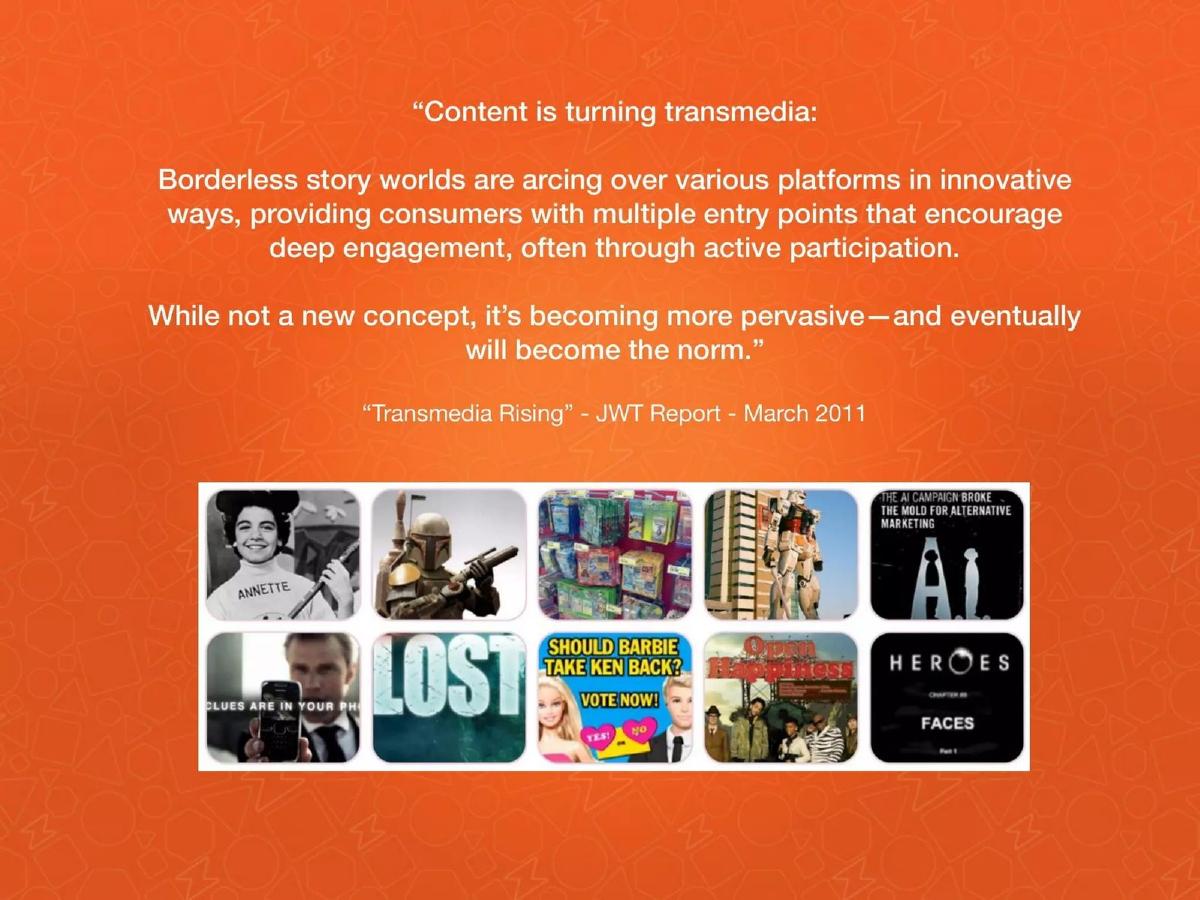
Slide 3 uses a quote from a JWT Report (March 2011) to validate the market trend: 'Content is turning transmedia.' By citing an external authority, Zio Studios justifies their shift in focus. Slide 4, titled La Oportunidad: Transmedia Storytelling , visualizes their strategy. They place a 'Storyworld' at the center of a wheel containing icons for mobile, tablets, TV, books, and consoles. The text on the right side of Slide 4 identifies the pain points they are solving: consumers are harder to engage, everything is 'free' today, and passive users are a thing of the past. Their solution is 'distraction as entertainment' through multi-platform convergence.
Slide 5: The Brainz Vision and Strategy
Slide 5 outlines the core business logic of the new venture. The vision is defined as Bajo Costo/Bajo-Riesgo (Low Cost/Low Risk) paired with Altos Valores de Producción/Alto Enganche (High Production Value/High Engagement). This is the 'arbitrage' play of using Colombian labor costs to produce world-class assets. Their strategy involves creating IPs planned for transmedia execution from the start, using social and mobile games as 'anchor platforms.' The most interesting bullet point here is the 'Safe-to-Fail' approach—making many bets across multiple platforms to ensure diversified revenue streams. This is a direct appeal to investors who are often wary of the 'hit-driven' nature of the gaming and film industries.
Slides 6-7: Brand and Pipeline
Slide 6 introduces the Brainz Games logo, signaling a distinct brand identity for their gaming arm. Slide 7, Nuestro Pipeline , is a visual gallery of five projects currently in development: Social Street Soccer, Vampire Season, Gone South, Toyz, and Legendary Warrior . Showing a full pipeline rather than a single game reinforces the 'many bets' strategy mentioned earlier. It proves the studio has the bandwidth to handle multiple creative directions simultaneously.
Slides 8-11: Deep Dives into Lead IPs
The deck then spends four slides providing visual proof of concept for two specific titles. Slides 8 and 9 focus on Vampire Season , showing high-quality character art and a link to a trailer video. The art style is polished and professional, which is vital for an animation-led pitch. Slides 10 and 11 focus on Gone South . Slide 11 is particularly effective as it shows the transmedia strategy in action: the same IP is presented as a 'Social Game' (with a screenshot of a city-builder style interface) and a 'Comic Book / Motion Comic.' This demonstrates that the 'Storyworld' concept from Slide 4 isn't just theory—they are actively building assets that work across different media formats.
Slide 12: Contact and Leadership
The final slide is a digital business card for Alejandro González, CEO & Studio Director . It includes his contact information, LinkedIn, and Facebook links. While it provides a face to the company, it is the only mention of leadership in the entire deck. There is no slide detailing the backgrounds of other key executives or the creative leads responsible for the 70+ person staff.
What Works in This Deck
Proven Track Record: By leading with their 12-year history and a list of massive corporate clients, Zio Studios removes the 'execution risk' that plagues many early-stage creative startups. Investors know they can deliver high-quality work because they've already done it for Coca-Cola.
Strategic Arbitrage: The deck clearly communicates the advantage of being based in Bogota. They are pitching a 'Low Cost/High Production Value' model that is very attractive to Series A investors looking for capital efficiency.
Visual Storytelling: As an animation studio, the deck's design and the quality of the game art (specifically for Vampire Season and Gone South) do the heavy lifting. The 'show, don't tell' approach works well here; the art looks like it belongs on a professional console or mobile storefront.
Market Timing: In 2011, 'transmedia' was a significant buzzword. By aligning their existing skills with a trending market concept, they made their pivot feel inevitable rather than desperate.
What Is Missing from This Deck
The Team Slide: This is the most glaring omission. While the CEO is listed at the end, a 70-person studio needs to showcase its key department heads (Art Director, Lead Developer, Head of Production). Investors in the creative space invest in talent as much as IP.
Financials and Projections: There are no mentions of current revenue from the 'Work For Hire' side, nor are there projections for how the new IPs will monetize. While they mention 'diversified revenue,' they don't explain if this is through ads, in-app purchases, or licensing.
Unit Economics: For a gaming pitch, metrics like Customer Acquisition Cost (CAC) or Lifetime Value (LTV) are usually expected. Even if the games weren't live yet, a slide on their monetization strategy for 'Social Street Soccer' or 'Vampire Season' would have added weight to the business case.
The Ask: The deck mentions they closed a round in March 2011, but it doesn't state what they are looking for next or how the $1.3M will be allocated across the five pipeline projects. A 'Use of Funds' slide is a standard requirement that is absent here.
What a Founder Should Copy
The 'Anchor Platform' Strategy: If you are building a multi-product company, copy the way Zio Studios defines their 'anchor platforms' (Slide 5). It shows you have a plan for where the audience starts and how they migrate to other parts of your ecosystem.
Pipeline Visualization: Slide 7 is a great way to show breadth. If you have multiple products in development, showing them as a 'pipeline' rather than a single list makes the company feel like a 'studio' rather than a 'one-hit-wonder' project.
External Validation: Using a quote from a reputable industry report (Slide 3) to frame the 'Problem/Opportunity' section is a highly effective way to build a narrative that your company is part of a larger, unstoppable trend.
Regional Advantage: If you are operating in a lower-cost geography, make that a feature, not a footnote. Zio Studios leaned into their Bogota base as a way to offer 'Low Risk' to investors, which is a smart framing for a creative venture.
Final Thoughts
Zio Studios' deck is a transition document. It bridges the gap between a successful service business and an ambitious IP creator. While it lacks the rigorous financial data and team breakdowns found in modern SaaS decks, its strength lies in its visual proof and the clear strategic logic of the 'transmedia' pivot. It successfully argues that the company has the tools, the talent, and the cost structure to compete globally, which was enough to secure their $1.3 million Series A.
Frequently asked questions
- What is the primary business model shift described in the deck?
- Zio Studios outlines a transition from a 'Work For Hire' service model, which they operated for 12 years, to an original IP model. Slide 2 explains that they identified an opportunity to create their own intellectual property by leveraging the low production costs in Colombia and their existing expertise in 3D animation and digital media.
- How does Zio Studios define 'Transmedia'?
- According to Slide 3 and 4, transmedia involves 'borderless story worlds' that arc over various platforms. Their model places a 'Storyworld' at the center, surrounded by entry points like mobile apps, social games, TV, books, and tablets, allowing for deep consumer engagement through active participation rather than passive consumption.
- What specific games or IPs are mentioned in the pipeline?
- Slide 7 lists five projects: Social Street Soccer, Vampire Season, Gone South, Toyz, and Legendary Warrior. The deck provides deeper visual dives into 'Vampire Season' (Slide 8-9) and 'Gone South' (Slide 10-11), the latter of which is shown as both a social game and a motion comic.
- What is the 'Safe-to-Fail' strategy mentioned on Slide 5?
- The 'Safe-to-Fail' strategy involves making 'many bets' across multiple platforms. By diversifying their revenue sources and using social/mobile games as 'anchor platforms,' they aim to create enduring properties through storytelling while minimizing the risk associated with any single high-budget production.
- Does the deck include a clear 'Ask' or financial roadmap?
- No. The deck mentions that they closed a $1.5M round in March 2011 on Slide 2, but it does not provide a specific 'Ask' for a new round, nor does it include revenue targets, burn rate, or a detailed breakdown of how the $1.3M (or $1.5M) would be spent over time.