Postmates’ 2011 pitch deck, dated April 2011, presents a vision for 'insanely personal local delivery' that extends far beyond food. The 13-slide presentation identifies a $72 billion US courier market, highlighting a $10 billion 'long tail' shared among 12,000 small companies. The deck is notable for its early focus on logistics infrastructure, featuring a 'Real-Time Logistics Platform' and a four-stage market expansion playbook. While it lacks a specific financial 'Ask' slide or detailed unit economics, it successfully leverages early traction in San Francisco—citing 20 committed courier co…
Key takeaways
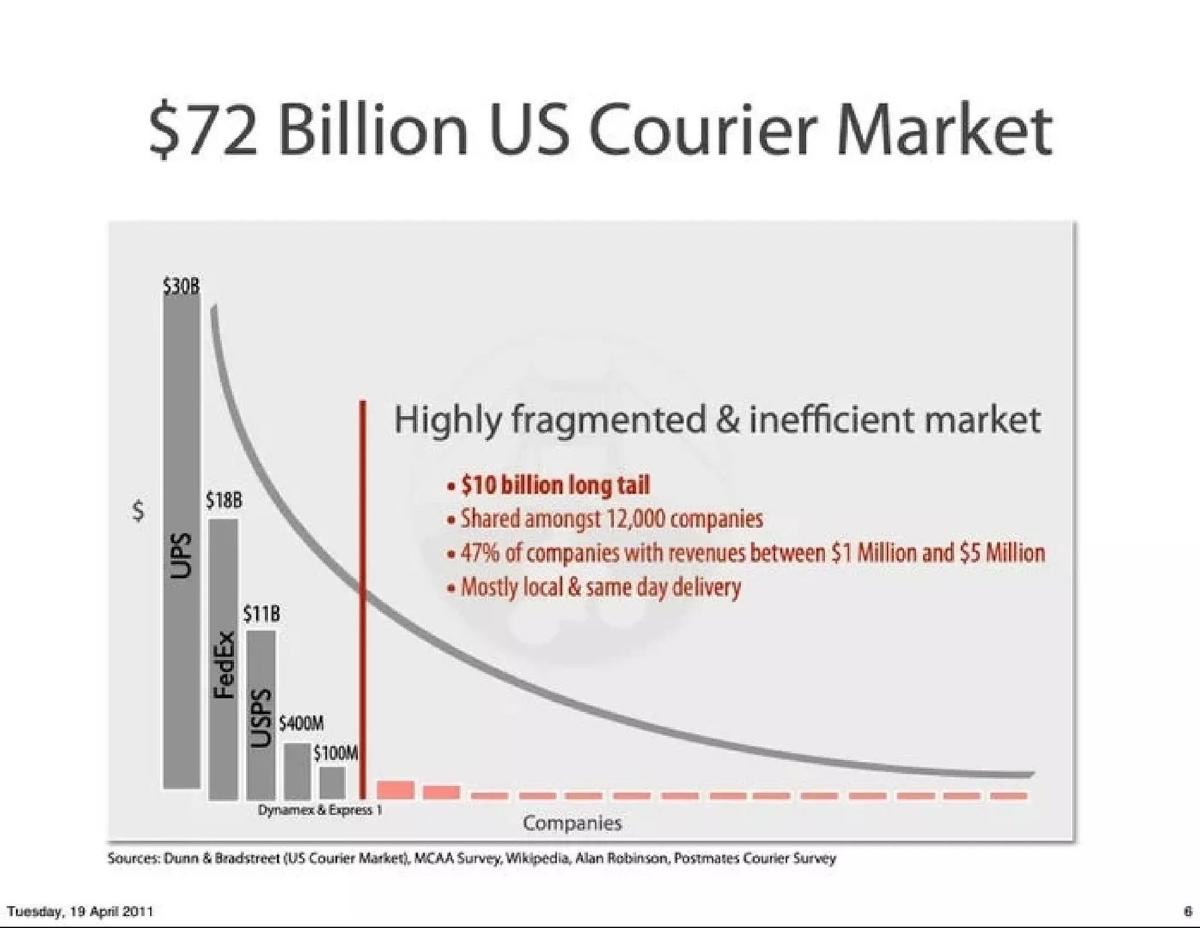
- The deck identifies a highly fragmented $72 billion US courier market with a $10 billion long tail (Slide 6).
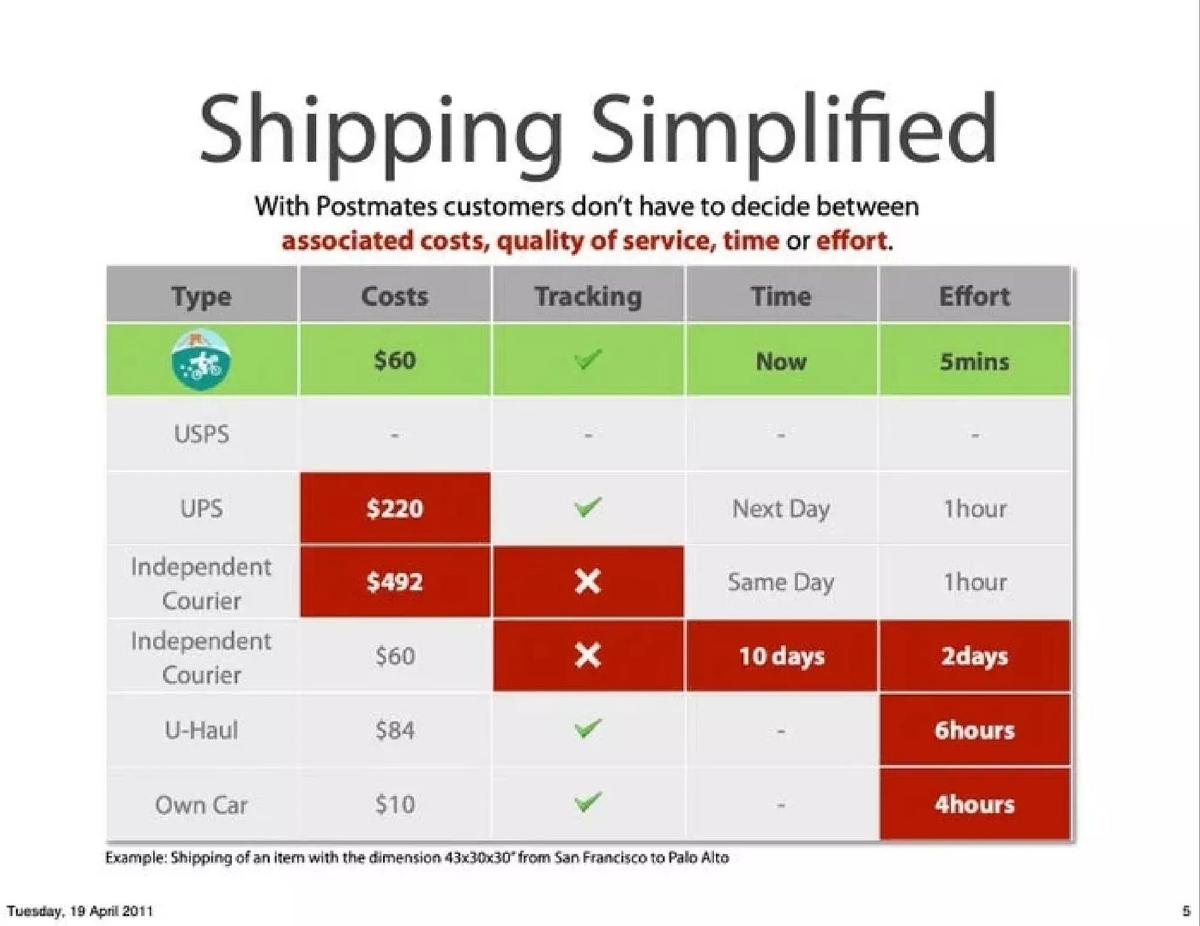
- Postmates positioned itself against traditional shipping like UPS, claiming a cost of $60 vs $220 for a specific 43x30x30 inch item (Slide 5).
- The founding team included experience from Yelp and Huddle, with early backing from AngelPad (Slide 2).
- Traction at the time included 20 courier companies committed and trials running in San Francisco (Slide 8).
- The business model relies on transaction fees for shipments and platform services like dispatch and insurance (Slide 10).
- The expansion strategy follows a four-step process: Market Discovery, Market Trial, Market Expansion, and Market Lock (Slide 9).
- The deck lists over 30 potential delivery categories, including auto parts, medical delivery, and architects (Slide 7).
- The technology stack was built on Python, Tornado Web, MySQL, MongoDB, Java, and Hadoop (Slide 11).
The 2011 Postmates Pitch Deck: A Logistics-First Approach
The April 2011 pitch deck for Postmates is a relic from the early days of the 'on-demand' economy. At just 13 slides, it is concise, focused, and surprisingly light on the food-delivery branding that would later define the company. Instead, the deck presents Postmates as a sophisticated logistics platform designed to disrupt the fragmented courier industry. The following teardown examines how the founders framed a complex operational challenge as a scalable technology opportunity.
Slide 1: Title Slide
The deck opens with the original Postmates logo: a caped courier on a bicycle against a San Francisco backdrop. The tagline is 'Insanely personal local delivery,' with a parenthetical addition '(that doesn't suck).' This sets a tone of disruption and customer-centricity. The slide is dated April 2011 and identifies Bastian Lehmann as the Founder & CEO. It is a clean, minimalist start that immediately establishes the geographic focus (San Francisco) and the core service.
Slide 2: Team & Company
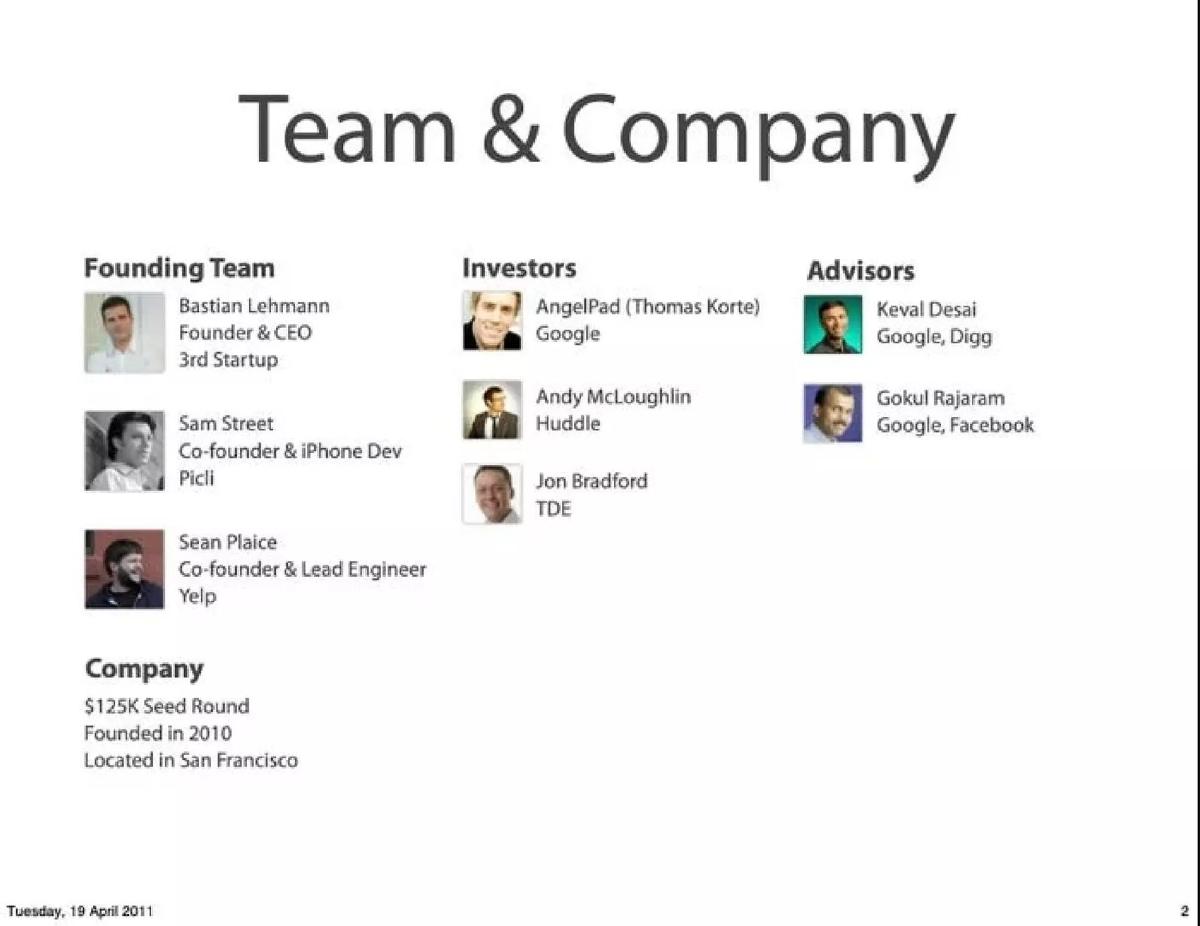
Postmates places its team slide early, which is a common tactic for seed-stage startups where the founders' pedigree is the primary asset. The slide lists Bastian Lehmann (3rd startup), Sam Street (iPhone Dev), and Sean Plaice (Lead Engineer from Yelp). The 'Company' section notes a $125K Seed Round already raised in 2010. The inclusion of high-profile advisors from Google, Facebook, and Digg, along with investors from AngelPad, provides immediate social proof. This slide tells investors that the team has both the technical chops and the professional network to execute a difficult logistics play.
Slides 3-4: The Problem and the Demo
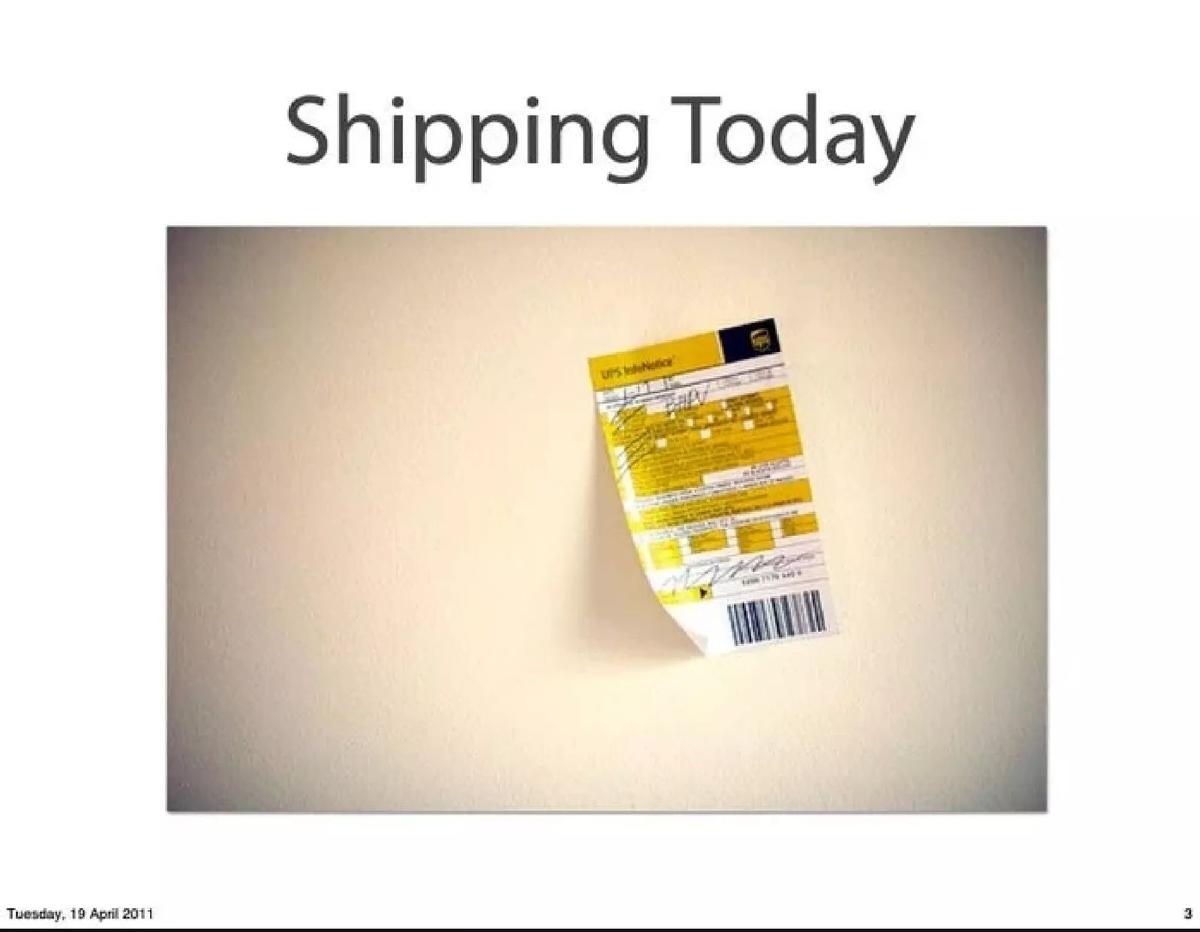
Slide 3, titled 'Shipping Today,' features a single image of a UPS 'missed delivery' notice stuck to a wall. This is a powerful, visceral representation of the 'problem'—the frustration of traditional shipping. Slide 4 follows up with links to two Vimeo demos (password protected at the time). By showing the failure of the status quo and then pointing to a working solution, the deck moves quickly from pain point to product.
Slide 5: Shipping Simplified
This is the core value proposition slide. It uses a comparison table to show how Postmates stacks up against USPS, UPS, Independent Couriers, U-Haul, and using one's 'Own Car.' For a specific example—shipping a 43x30x30 inch item from San Francisco to Palo Alto—Postmates claims a cost of $60 with 'Now' delivery and only 5 minutes of effort. In contrast, UPS is listed at $220 with 'Next Day' delivery and 1 hour of effort. This slide is critical because it quantifies the efficiency gains Postmates promises to deliver.
Slide 6: Market Opportunity
Slide 6 identifies a '$72 Billion US Courier Market.' The chart shows a 'Highly fragmented & inefficient market' dominated by UPS, FedEx, and USPS, but with a '$10 billion long tail' shared among 12,000 small companies. The deck notes that 47% of these companies have revenues between $1 million and $5 million. This is a classic 'aggregation' play: Postmates isn't just competing with UPS; it is aiming to organize the thousands of small, local players that currently handle same-day delivery.
Slide 7: Why stop with one market?
This slide is a dense list of over 30 potential delivery categories. While 'Food delivery' is at the top, the list includes everything from 'Auto parts' and 'Medical delivery' to 'Architects' and 'P2P shipping.' This demonstrates the founders' ambition. They didn't see Postmates as a food app; they saw it as the logistics infrastructure for all local commerce. Highlighting 'Groceries' and 'Retail stores' in green suggests these were the immediate priorities after the initial launch.
Slide 8: Traction
The traction slide uses icons to show progress: 20 courier companies committed, the first businesses committed for shipping, and trials running in San Francisco. It also mentions that 80 additional couriers are ready to expand the trial and that scouting has started in New York. This slide proves that the concept isn't just theoretical—there is real-world momentum and a supply-side (couriers) willing to join the platform.
Slide 9: The Expansion Playbook
Titled 'Market Lock,' this slide explains the four-stage process for entering a new city. 1. Market Discovery: Filtering leads from Yelp and Google. 2. Market Trial: Hiring a manager and signing up 50 businesses. 3. Market Expansion: Leveraging network effects to reach 500+ deliveries per day. 4. Market Lock: Blocking competitors and moving to the next market. This systematic approach is designed to reassure investors that the business is repeatable and scalable.
Slide 10: Business Model
The business model is split into 'Shipping Services' and 'Platform Services.' Revenue comes from transaction fees on shipments, item insurance, and premium delivery fees for weekends/holidays. On the platform side, they suggest facilitating transactions for couriers (fuel, auto services) and providing liability insurance. This indicates a multi-faceted revenue strategy that goes beyond a simple delivery fee.
Slide 11: Tech Architecture
This slide provides a high-level overview of the 'Postmates Real-Time Logistics Platform.' It lists the tech stack: Python, Tornado Web, MySQL, MongoDB, Java, and Hadoop. It shows how mobile apps, partner APIs, and courier services all feed into the central logistics engine. For a technical investor, this slide validates that the platform is built on modern, scalable infrastructure capable of handling real-time dispatching.
Slides 12-13: Summary and Contact
The deck concludes with a summary slide reiterating four points: disrupting a huge market, clear value proposition, current trial in San Francisco, and the right team. The final slide returns to the title graphic with contact information. Notably, there is no 'Ask' slide in this version of the deck, which suggests it may have been used for introductory meetings or that the specific terms were handled in a separate document.
What Works in This Deck
The Postmates deck excels at identifying a specific, massive inefficiency in a legacy industry. By focusing on the 'long tail' of 12,000 courier companies, the founders presented a way to capture value without having to immediately go head-to-head with the infrastructure of FedEx or UPS. The comparison table on Slide 5 is particularly effective because it translates abstract 'efficiency' into concrete dollars and minutes saved for the customer. Furthermore, the 'Market Lock' slide (Slide 9) provides a clear roadmap for growth, which is often a missing piece in early-stage decks.
What Is Missing
The most glaring omission is a dedicated 'Ask' slide. A fundraising deck should typically state how much capital is being raised, the valuation (or at least the stage), and how the funds will be allocated. Additionally, the deck lacks unit economics. While it mentions a $60 delivery fee, it doesn't explain the margin—how much goes to the courier, how much to insurance, and how much Postmates keeps. Finally, there is no 'Competition' slide addressing other tech startups. In 2011, the 'Uber for X' wave was just beginning, and investors would have wanted to know how Postmates planned to defend against other well-funded entrants in the space.
What a Founder Should Copy
Founders should emulate the way Postmates used a single image (the UPS notice on Slide 3) to define the problem. It is much more effective than a bulleted list of complaints. The 'Market Lock' expansion playbook is also a great template for any business that requires local operations; it shows that the founders have thought through the 'cold start' problem of entering a new territory. Lastly, the use of a 'Tech Architecture' slide (Slide 11) is a smart way to signal that the company is a technology platform first and a service company second, which is vital for achieving a high valuation multiple.
Conclusion The 2011 Postmates deck is a masterclass in framing. It takes a messy, operationally intensive business—local delivery—and presents it as a clean, scalable software problem. By focusing on the fragmentation of the existing market and the clear cost-savings of their platform, the founders built a compelling case for why the world needed a new logistics layer. While it lacks some of the financial detail expected in modern decks, its clarity of vision and early evidence of traction make it a landmark example of a successful seed-stage pitch.
Frequently asked questions
- What was Postmates' original value proposition?
- In 2011, Postmates focused on 'insanely personal local delivery' with a goal to simplify shipping. Slide 5 shows they aimed to beat competitors like UPS and independent couriers on cost, tracking, time, and effort. For a large item, they claimed to offer 'Now' delivery for $60, compared to 'Next Day' for $220 via UPS, significantly reducing the customer's effort from hours to five minutes.
- How did Postmates plan to scale to new cities?
- Slide 9 outlines a four-stage 'Market Lock' process. It begins with 'Market Discovery' (filtering leads from Yelp/Google), moves to 'Market Trial' (signing 50 businesses and 20 courier companies), then 'Market Expansion' (reaching 500+ deliveries/day), and finally 'Market Lock' (blocking competitors and starting discovery in neighboring markets). This systematic approach suggested a repeatable playbook for urban logistics.
- What did the early Postmates team look like?
- The founding team consisted of Bastian Lehmann (CEO, 3rd startup), Sam Street (iPhone Dev, formerly of Picli), and Sean Plaice (Lead Engineer, formerly of Yelp). According to Slide 2, they had already raised a $125K seed round in 2010 and were advised by veterans from Google, Facebook, and Digg, giving them significant technical and industry credibility.
- What markets did Postmates target beyond food?
- While Postmates is now synonymous with food, Slide 7 shows a massive list of targets. These included auto parts, medical and drug delivery, flower shops, furniture, legal documents for lawyers, and even blueprints for architects. They viewed themselves as a general logistics layer for the 'long tail' of local commerce rather than a niche food delivery app.
- What is missing from the Postmates 2011 deck?
- The deck is missing a clear 'Ask' slide detailing how much money they were seeking in this specific round. It also lacks a 'Competition' slide that addresses other emerging tech startups, focusing instead on traditional couriers. Furthermore, there are no detailed unit economics or financial projections showing how the $60 delivery fee would be split between the courier and the platform.