PQShield’s Series A deck is a high-signal, low-noise presentation that prioritizes technical authority over traditional business metrics. With only 9 slides, the deck focuses on the existential threat quantum computing poses to current encryption standards like RSA and Elliptic Curve cryptography. By positioning the team as the primary architects of the new NIST standards, the company establishes an immediate competitive moat. While the deck lacks a business model, financial projections, or a specific funding ask, it successfully leverages the 'Oxford spinout' brand and a roster of world-clas…
Key takeaways
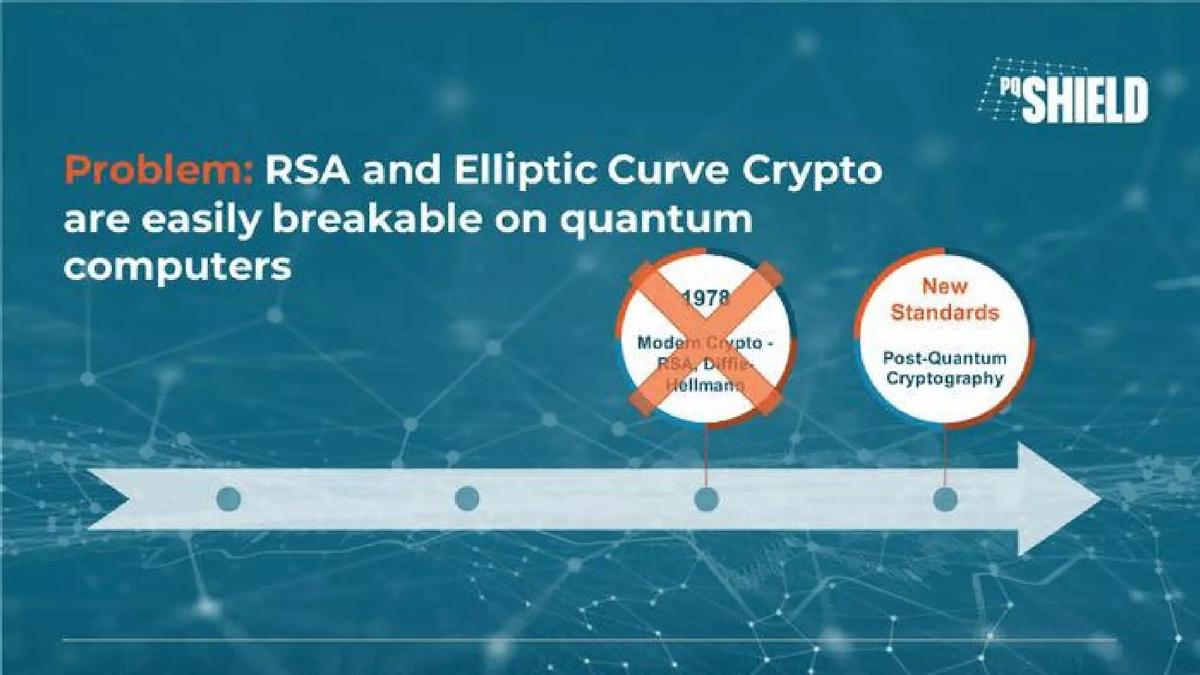
- The deck identifies a specific technical deadline: the transition from legacy RSA/Diffie-Hellman to Post-Quantum Cryptography (Slide 4).
- PQShield positions itself as a standard-setter, not just a vendor, by highlighting team members who are NIST semi-finalists (Slide 7).
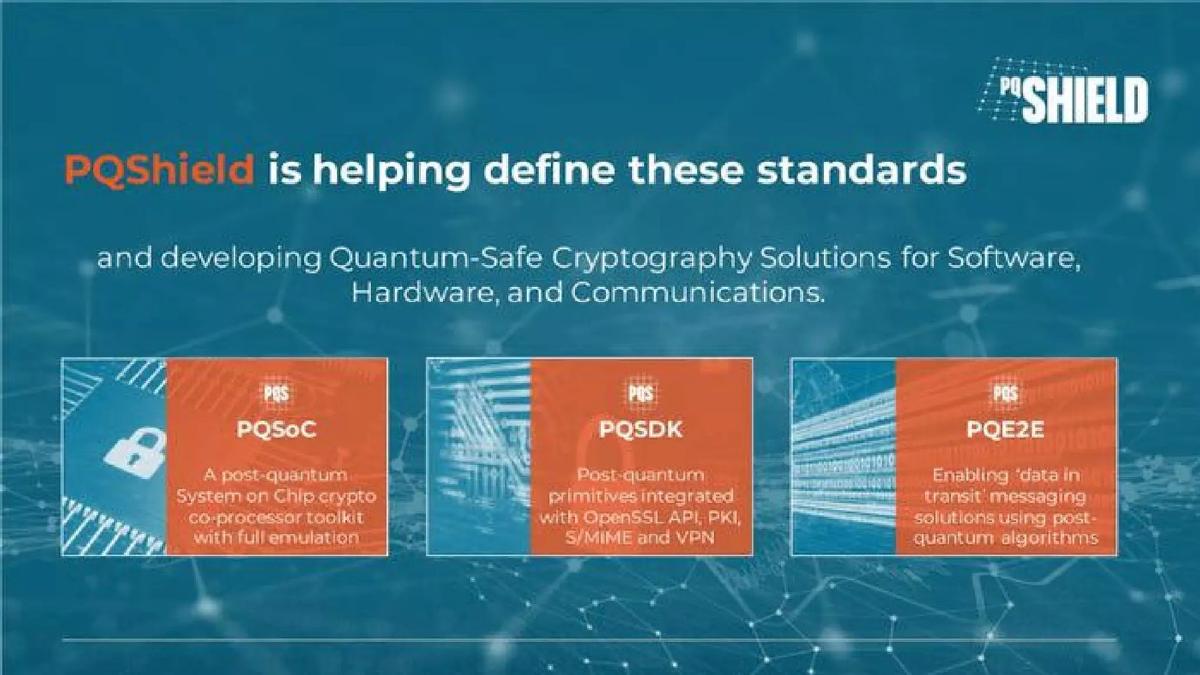
- The product suite is divided into three clear categories: PQSoC for hardware, PQSDK for software, and PQE2E for communications (Slide 6).
- Academic pedigree is the central theme, with the University of Oxford logo prominently displayed alongside the CEO's credentials (Slide 7).
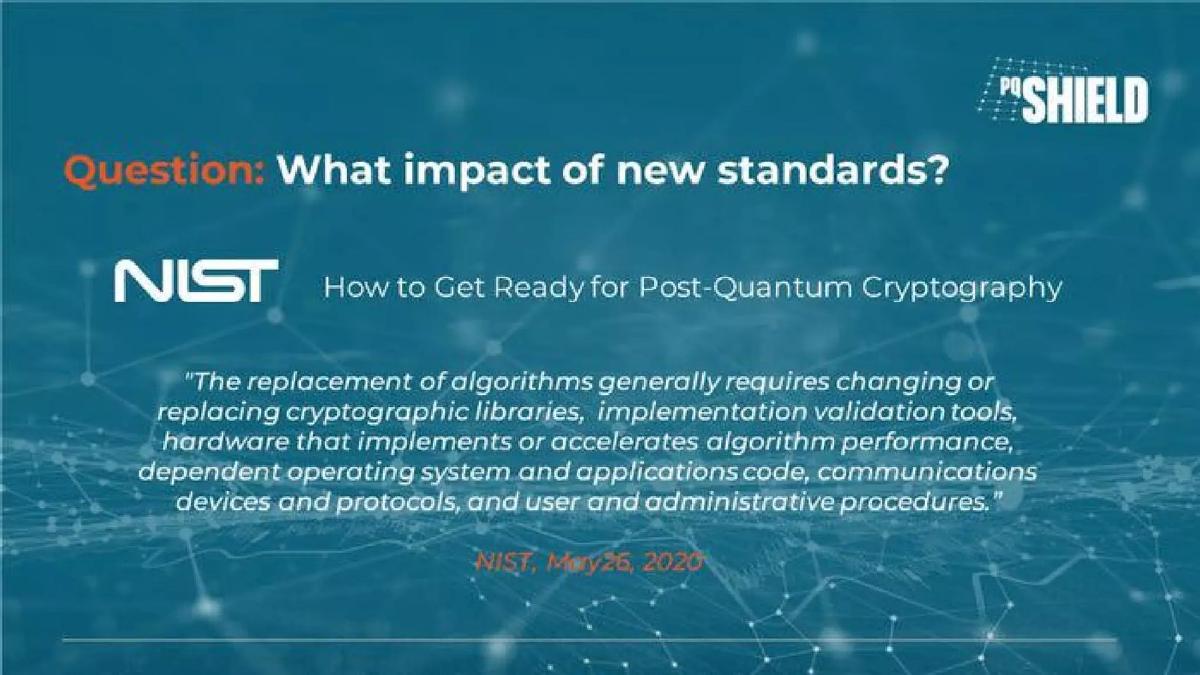
- The company cites a May 26, 2020, NIST directive to emphasize the urgency of replacing cryptographic libraries and hardware (Slide 5).
- The team includes a 'thought leader' who authored 8 NIST submissions and an expert with 100+ patents in cryptography (Slide 8).
- There is a total absence of revenue figures, customer names, or market size estimations within the 9 slides.
- The deck concludes with a bold mission statement rather than a financial 'ask' or use-of-funds slide (Slide 9).
The Deep-Tech Authority Play
PQShield’s Series A deck is a departure from the typical SaaS pitch. There are no charts showing Month-over-Month growth, no CAC/LTV calculations, and no competitive quadrants. Instead, this 9-slide deck is a clinical argument for the necessity of a new cryptographic standard and a showcase of the only team qualified to build it. The company raised $26.9 million in 2018 (and subsequent rounds) based on the strength of its academic IP and its proximity to the NIST standardization process.
Slides 1-3: The Historical Context
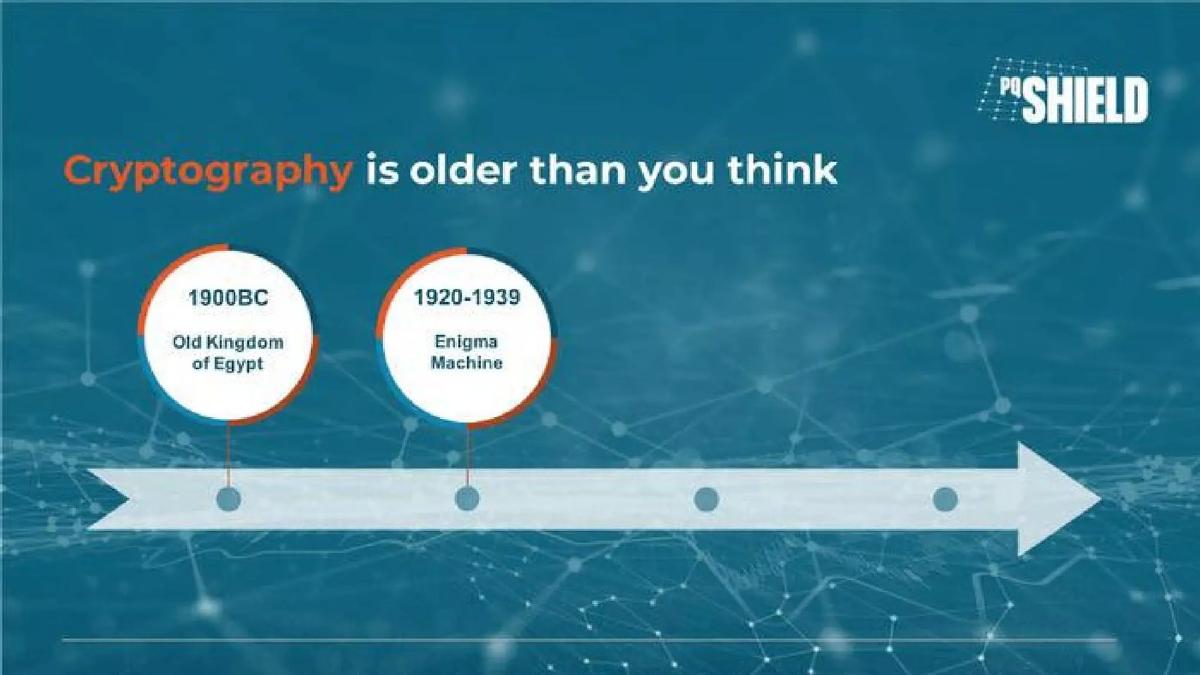
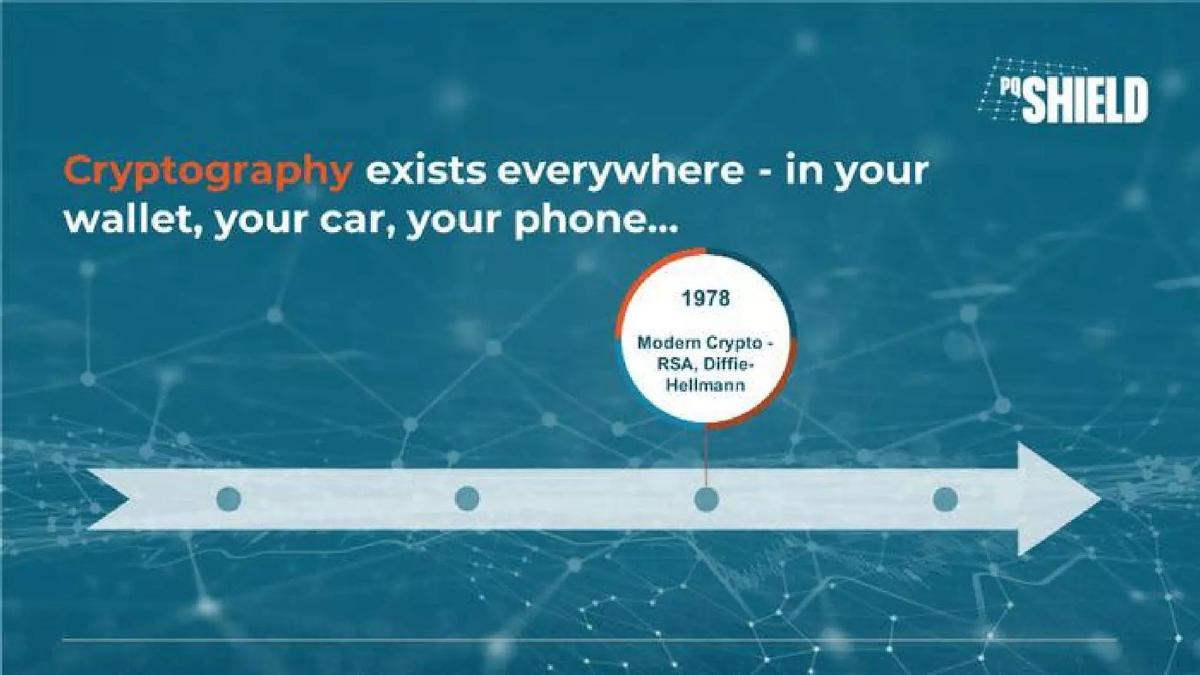
The deck opens with a minimalist title slide ( Slide 1 ) featuring Dr. Ali El Kaafarani, CEO and Founder. The background imagery of a neural or data network sets a technical tone immediately. Slide 2 and Slide 3 use a timeline to contextualize cryptography. By citing the Old Kingdom of Egypt (1900 BC) and the Enigma Machine (1920-1939), the deck frames cryptography as a fundamental human requirement that evolves in distinct epochs. Slide 3 marks the current epoch, starting in 1978 with RSA and Diffie-Hellman, which the deck notes exists 'everywhere - in your wallet, your car, your phone.'
Slides 4-5: The Quantum Threat and Regulatory Mandate
Slide 4 introduces the core problem: 'RSA and Elliptic Curve Crypto are easily breakable on quantum computers.' The slide visually crosses out the 1978 'Modern Crypto' era, signaling its obsolescence. This is a high-stakes problem slide; it doesn't just claim a better way of doing things, it claims the current way is dead. Slide 5 reinforces this with a quote from NIST dated May 26, 2020. The quote outlines the massive scope of the required change, including replacing cryptographic libraries, hardware, operating systems, and administrative procedures. This slide serves as the 'Why Now?'—the global regulatory body is signaling a mandatory transition.
Slide 6: The Product Suite
PQShield breaks its offering into three distinct pillars on Slide 6 . This is the only slide that addresses 'what' they actually sell. PQSoC is described as a 'post-quantum System on Chip crypto co-processor toolkit with full emulation,' targeting hardware manufacturers. PQSDK offers 'post-quantum primitives integrated with OpenSSL API, PKI, S/MIME and VPN,' targeting software developers. Finally, PQE2E focuses on 'data in transit' messaging solutions. By covering hardware, software, and communications, PQShield positions itself as a full-stack provider for the post-quantum era.
Slides 7-8: The Academic Moat
The 'Team' section is the heart of this deck. Slide 7 , titled 'The best technical team,' features eight specialists. The slide highlights their specific roles in the NIST process, using labels like 'NIST Submitters' and 'NIST semi-finalist.' The affiliations are prestigious: University of Oxford, ARM, Cloudflare, IBM Zurich, and ENS Paris. Slide 8 doubles down on this with 'The best academic credentials,' featuring Prof. Chris Peikert, Dr. Peter Schawbe, and Prof. Liquun Chen. The slide notes Chen’s 100+ patents and 25 years at HP Labs. This is a clear signal to investors that the company has cornered the market on the specific talent required to solve this problem.
Slide 9: The Vision
The deck concludes on Slide 9 with a simple, bold statement: 'PQShield will deliver the new global cryptography standard.' There is no 'Ask' slide, no 'Use of Funds,' and no 'Roadmap.' The deck assumes that if the investor believes in the team and the problem, the financial details will be handled in the data room.
What Works in the PQShield Deck
1. Extreme Focus on Authority: In deep-tech, the team is the product. By highlighting their direct involvement in the NIST standardization process, PQShield makes it clear that they aren't just following the new rules—they are writing them. This creates an enormous perceived moat.
2. Clear Problem/Solution Mapping: The timeline approach (Slides 2-4) is an effective way to explain a complex technical shift to non-expert investors. It makes the transition to post-quantum cryptography feel like an inevitable historical progression rather than a niche technical upgrade.
3. Comprehensive Product Range: Slide 6 shows that they aren't just a research shop. By having specific products for SoC (hardware) and SDK (software), they demonstrate a path to commercialization across multiple massive industries (IoT, mobile, server infrastructure).
What is Missing from the PQShield Deck
1. Business Model and Pricing: There is no mention of how PQShield intends to make money. Are these one-time IP licenses? Per-device royalties? Subscription-based SDK access? For a Series A, this is a significant omission that would usually be a red flag for less specialized companies.
2. Market Size (TAM/SAM/SOM): The deck assumes the investor already knows that the market for 'all encryption' is massive. However, failing to quantify the specific segments they are targeting (e.g., the automotive SoC market vs. the VPN software market) leaves the scale of the opportunity to the investor's imagination.
3. Competitive Landscape: PQShield acts as if they are the only players in the space. While their NIST credentials are impressive, there are other firms and large incumbents (like IBM or Intel) also working on quantum-resistant standards. A slide addressing why their specific lattice-based approach is superior to competitors would have strengthened the case.
4. Financial Ask and Roadmap: The deck lacks a 'The Ask' slide. Investors typically want to know how much is being raised, what milestones that capital will hit, and what the hiring plan looks like over the next 18-24 months.
What a Founder Should Copy
1. The 'Standard-Setter' Positioning: If your startup is involved in regulatory or industry bodies that define your sector, lead with that. Being a 'NIST Submitter' is a more powerful validator than any early customer testimonial for a deep-tech company.
2. Minimalist Design for Technical Topics: Cryptography is dense. PQShield kept their slides incredibly clean, using simple graphics and limited text. This prevents the investor from getting bogged down in the math and keeps them focused on the business implications.
3. Leveraging Institutional Brand: The prominent use of the University of Oxford logo and the academic titles of every team member (Dr., Prof., Eng.) builds immediate trust. If your team has elite credentials, do not be modest—put them front and center.
Final Analysis
PQShield’s deck is a 'Trust Us' pitch. It relies entirely on the premise that a massive technical shift is coming and that this specific group of Oxford-linked researchers are the only ones who can navigate it. While it breaks almost every rule of a 'standard' pitch deck—omitting revenue, competition, and the ask—it succeeds because it perfectly aligns with the expectations of deep-tech Series A investors who prioritize IP and talent above all else. It is a reminder that for certain high-barrier-to-entry sectors, a 9-slide masterclass in authority can be more effective than a 20-slide deck full of speculative projections.
Frequently asked questions
- Why is there no business model or revenue slide in this deck?
- For deep-tech companies like PQShield, the value lies in IP and being first-to-market with standardized solutions for a global problem. Investors in this $26.9M Series A were likely betting on the team’s ability to capture the mandatory transition to post-quantum standards, where the market is effectively 'everyone using encryption.' The deck focuses on proving they own the best IP rather than showing early-stage sales.
- How does the deck handle the 'Problem' slide differently than most startups?
- Instead of focusing on user pain points or market inefficiencies, PQShield uses a historical timeline (Slides 2-4) to show that current encryption (RSA) is a 40-year-old technology that is fundamentally broken by quantum advancement. It frames the problem as a systemic failure of global infrastructure, making the solution appear mandatory rather than optional.
- What is the significance of the NIST mentions throughout the deck?
- NIST (National Institute of Standards and Technology) sets the cryptographic standards for the US government and, by extension, the global tech industry. By showing that their team members are 'NIST Submitters' and 'Semi-finalists' (Slide 7), PQShield proves they are not just reacting to the market—they are building the rules the market must follow.
- Is the 9-slide format enough for a Series A?
- Generally, no. However, for a highly technical spinout, a short deck often serves as a 'teaser' for a much deeper due diligence process involving technical white papers. The brevity suggests confidence in their academic moat. Founders should note that this works best when the team has 'unrivalled domain expertise' as stated in their catalogue description.
- What are the three main products PQShield pitched?
- According to Slide 6, the products are PQSoC (a System on Chip crypto co-processor toolkit), PQSDK (software primitives integrated with OpenSSL and VPNs), and PQE2E (end-to-end messaging solutions). This covers the full stack from hardware to end-user applications, showing a comprehensive approach to the quantum threat.