Postmoda’s 8-slide seed deck is a study in brevity and high-impact social proof. Rather than getting bogged down in complex logistics, the deck centers on a single, powerful traction figure: $53.1 million generated for retailers from 3.1 million items (Slide 4). The company positions itself as an AI-driven solution to a $100 billion write-off problem in fashion e-commerce (Slide 2). By combining a clear five-step operational workflow (Slide 5) with a founder profile that includes a CNN Hero designation and backing from the founders of Airbnb and Coinbase (Slide 7), Postmoda successfully navig…
Key takeaways
- The deck identifies a massive $100B annual write-off problem in fashion returns, citing Coresight Research (Slide 2).
- Postmoda claims a significant average return processing cost of 66% of MSRP for brands (Slide 2).
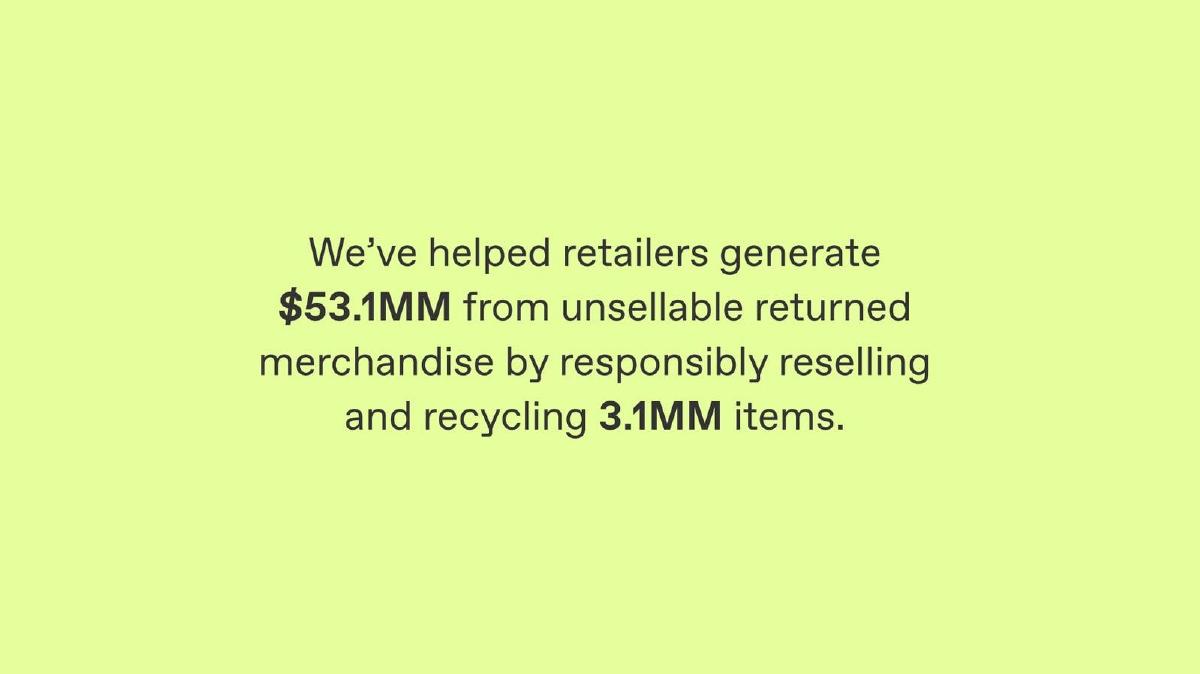
- A single 'big number' slide anchors the deck, claiming $53.1MM generated for retailers across 3.1MM items (Slide 4).
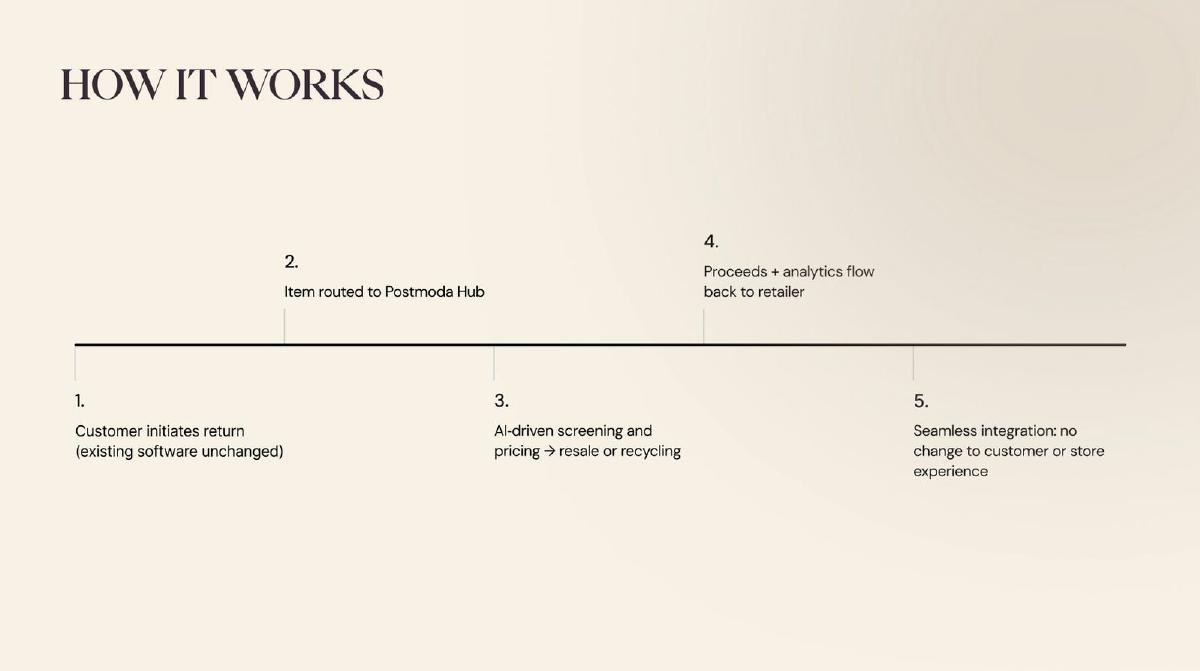
- The operational model is simplified into a five-step timeline, emphasizing that existing retailer software remains unchanged (Slide 5).
- The solution is positioned as a four-fold benefit: profitability, sustainability, customer acquisition, and insights (Slide 3).
- Founder Adarsh Alphons leverages extreme social proof, including CNN Heroes and Fast Company accolades (Slide 7).
- The deck lists high-tier institutional investors including Slow Ventures, Foundation Capital, and Ludlow Ventures (Slide 7).
- Postmoda highlights backing from founders of unicorn companies like Airbnb, Coinbase, and Opendoor (Slide 7).
The 8-Slide Traction Play
Postmoda’s deck is an exercise in minimalism. In an industry as complex as reverse logistics and e-commerce fashion, it is easy to get lost in the weeds of warehouse management systems and shipping costs. Postmoda avoids this by focusing on three things: the size of the waste, the proof of their success, and the quality of the people backing them. According to publisher reports, this deck helped secure $200,000 in 2023 for their North American operations.
Slide 1: Title and Vision
The cover slide is clean, featuring the Postmoda logo and the tagline: "Unlocking revenue and profitability using AI." It immediately establishes the two most important themes for a B2B retail solution: making money and using modern technology to do it. The background uses a muted, grainy gradient that feels aligned with modern fashion branding, signaling they understand the aesthetic of their target clients.
Slide 2: The $100 Billion Problem
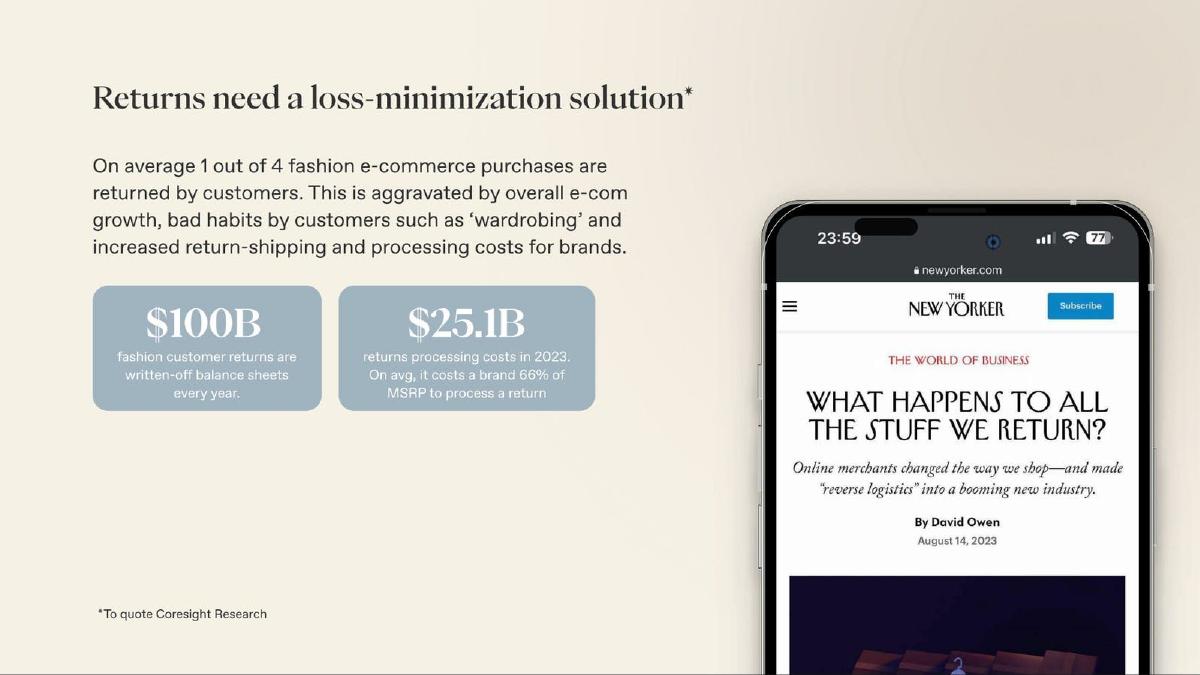
Slide 2 sets the stakes. It states that "1 out of 4 fashion e-commerce purchases are returned by customers." This is attributed to 'wardrobing' (buying to wear once and return) and rising shipping costs. The slide highlights two massive figures: "$100B fashion customer returns are written-off balance sheets every year" and "$25.1B returns processing costs in 2023." Crucially, it notes that it costs a brand "66% of MSRP to process a return." This slide effectively turns a logistical headache into a massive financial leak that must be plugged.
Slide 3: The Value Proposition
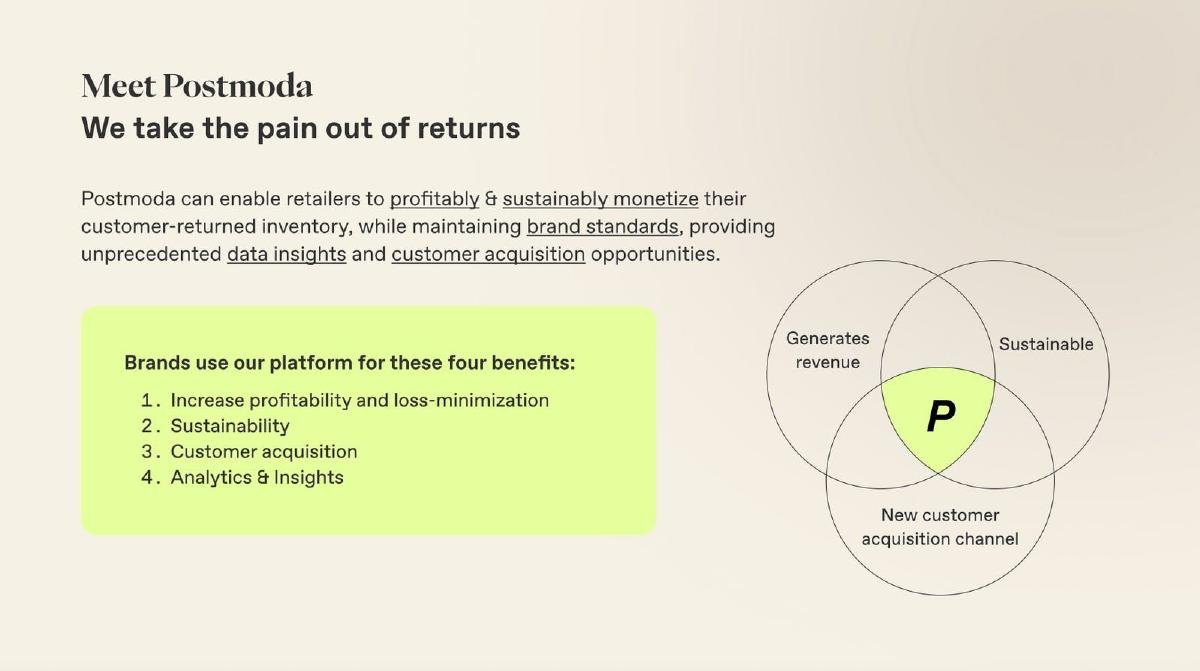
Slide 3 introduces the solution. It claims Postmoda enables retailers to "profitably & sustainably monetize their customer-returned inventory." The slide uses a Venn diagram to show Postmoda sitting at the intersection of generating revenue, sustainability, and new customer acquisition. They list four specific benefits for brands: Increase profitability, Sustainability, Customer acquisition, and Analytics & Insights. This slide transitions the deck from 'here is a problem' to 'here is how we fix it for the brand's bottom line.'
Slide 4: The 'Big Number' Traction Slide
This is the most important slide in the deck. It contains a single sentence on a bright lime-green background: "We’ve helped retailers generate $53.1MM from unsellable returned merchandise by responsibly reselling and recycling 3.1MM items." By leading with a $53 million figure, Postmoda proves their model works at scale. This isn't a theoretical pilot; it is a functioning engine that has handled millions of units. For a seed-stage investor, this number reduces the 'execution risk' significantly.
Slide 5: The Operational Workflow
Slide 5, titled "HOW IT WORKS," uses a simple linear timeline to explain a complex process. The five steps are: 1. Customer initiates return (software unchanged), 2. Item routed to Postmoda Hub, 3. AI-driven screening and pricing, 4. Proceeds + analytics flow back to retailer, and 5. Seamless integration. The most important note here is "existing software unchanged" and "no change to customer or store experience." This addresses the retailer's biggest fear: technical friction and integration costs.
Slide 6: Impact for Retailers
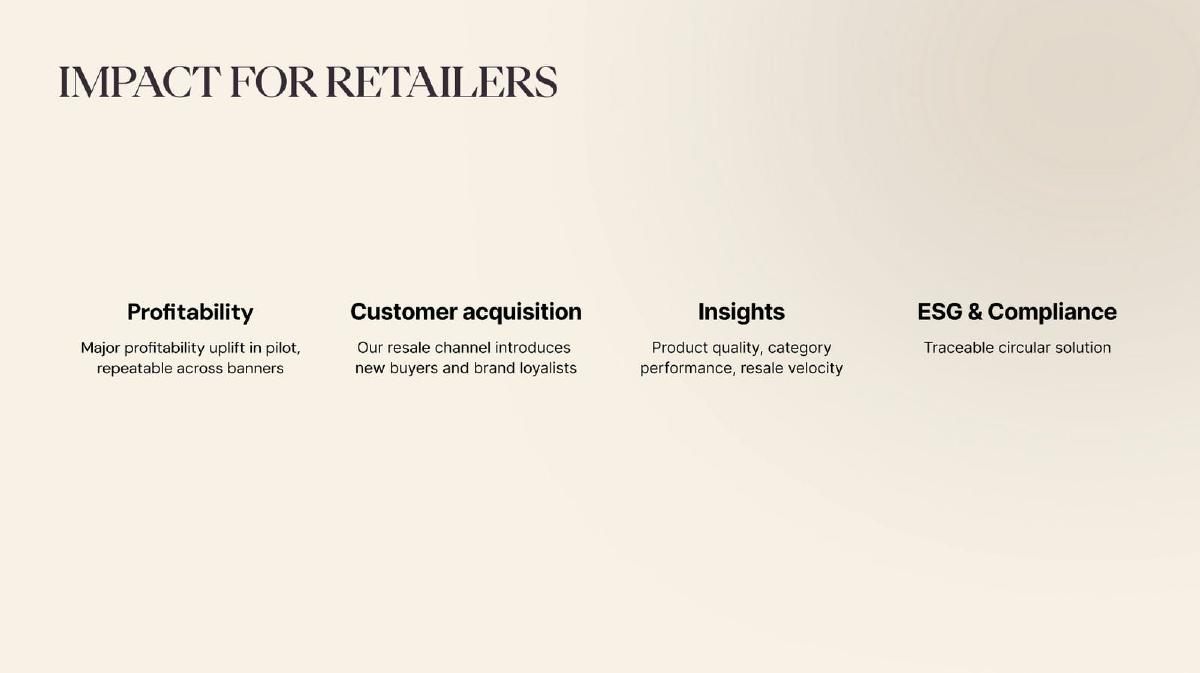
Slide 6 reiterates the benefits but adds a layer of 'why now.' It lists Profitability (citing a 'major profitability uplift in pilot'), Customer Acquisition (new buyers and brand loyalists), Insights (product quality and resale velocity), and ESG & Compliance (traceable circular solution). This slide is designed to appeal to different stakeholders within a retail organization, from the CFO to the Head of Sustainability.
Slide 7: Founder and Institutional Backing
Slide 7 is a 'flex' slide. It features founder Adarsh Alphons , described as a "Columbia University-trained economist, a CNN Hero, a 40 Under 40 in Global Art Business." It mentions he previously founded ProjectArt, the nation's largest art school. The right side of the slide lists institutional investors: Slow Ventures, Foundation Capital, Plug & Play Ventures, Ludlow Ventures, Long Journey Ventures, and Shrug Capital. Below that, it claims backing from the founders of Airbnb, Coinbase, HQ, Casper, and Opendoor. This level of social proof is rare for a $200k seed round and suggests the round may have been a small top-off or a very early strategic entry for these names.
Slide 8: Contact
The final slide is just the URL: postmoda.com . It maintains the minimalist aesthetic of the rest of the deck.
What Postmoda Does Well
The deck excels at quantifying the pain . By citing the 66% MSRP processing cost, they make the problem feel urgent and expensive. Most founders describe problems qualitatively; Postmoda describes them in dollars and cents. This makes the ROI calculation for a potential customer (and investor) much easier.
The traction slide (Slide 4) is a masterclass in focus. Many decks bury their best metrics in a sea of charts. Postmoda puts their $53.1MM figure on a high-contrast background with no other distractions. It forces the reader to acknowledge the scale they have already achieved.
Finally, the social proof is overwhelming. When a founder can list the creators of Airbnb and Coinbase as backers alongside top-tier VCs like Slow Ventures and Foundation Capital, the 'team' slide becomes a 'trust' slide. It signals to new investors that the due diligence has already been done by some of the best in the business.
What is Missing from the Deck
Despite its strengths, the deck is missing several components that are usually standard in a seed round. There is no competitive landscape . Companies like Trove, Archive, and various 3PLs operate in the resale and returns space. Postmoda does not explain how its AI-driven screening is superior to these existing players.
There are no financial projections . While the $53MM figure is impressive, the deck does not state Postmoda's take rate or net revenue. Generating $53MM for retailers is different from generating $53MM in revenue for Postmoda. Investors would typically want to see the path to $100MM in ARR, which is absent here.
The lack of an 'Ask' slide is also notable. The deck doesn't specify how much they are raising (though we know from publisher reports it was $200,000) or what the milestones for the next 18 months are. This suggests the deck might have been used as a 'teaser' to get a meeting rather than a full diligence document.
Lessons for Founders
Lead with your strongest foot. If you have moved 3 million items, that is your story. Don't hide your biggest achievement on slide 12. Postmoda makes it the centerpiece of the presentation.
Simplify the complex. Reverse logistics involves warehouses, shipping labels, labor, and software integrations. Postmoda boiled this down to a 5-step line that promises 'no change' to the retailer's existing systems. Founders should always look for ways to reduce the perceived 'effort' of adopting their solution.
Leverage every ounce of social proof. If you have an accolade like 'CNN Hero' or a high-profile angel investor, use it. In the early stages, investors are betting on the person. Postmoda’s Slide 7 makes it very difficult to bet against Adarsh Alphons given his history and the caliber of people who have already written him checks.
Frequently asked questions
- How does Postmoda justify its market opportunity?
- Postmoda uses Slide 2 to frame the problem through two specific figures: $100 billion in fashion returns written off annually and $25.1 billion in processing costs for 2023. By citing that it costs brands 66% of MSRP to process a return, they establish a clear financial pain point that their 'loss-minimization solution' addresses directly.
- What is the core technology behind Postmoda?
- The deck is light on technical specifics but repeatedly mentions 'AI-driven screening and pricing' (Slide 5) and 'Unlocking revenue... using AI' (Slide 1). The value proposition is that this AI automates the decision-making process for whether an item should be resold or recycled, which is the primary bottleneck in reverse logistics.
- Who are the key investors mentioned in the deck?
- Postmoda displays a high-pedigree investor list on Slide 7, including Slow Ventures, Foundation Capital, Plug & Play Ventures, Ludlow Ventures, Long Journey Ventures, and Shrug Capital. They also claim backing from the founders of Airbnb, Coinbase, HQ, Casper, and Opendoor, which provides significant credibility for a seed-stage round.
- What traction does the company demonstrate?
- The company demonstrates massive scale for a seed-stage startup, claiming on Slide 4 to have helped retailers generate $53.1 million from 3.1 million items. This suggests the company had already moved past the pilot phase and achieved significant throughput before this specific deck was used for the 2023 raise.
- What is missing from the Postmoda pitch deck?
- The deck is missing several standard elements: a detailed competitive analysis, a breakdown of unit economics (take rate, margins), a multi-year financial forecast, and a specific 'Ask' slide detailing how the $200,000 would be spent. It relies almost entirely on past performance and founder pedigree to sell the vision.