PingTank positioned itself as the 'Ultimate Expression Engine' during a period of rapid growth for mobile messaging. The deck leans heavily on its integration with Facebook Messenger, which at the time of the deck's creation had 500 million monthly active users. The product strategy is split between a utility app for Messenger and a standalone social platform. While the deck provides a clear roadmap and a percentage-based use of funds, it lacks specific financial projections and a defined 'Ask' amount. The revenue model is predicated on three streams: celebrity branded animations, brand spons…
Key takeaways
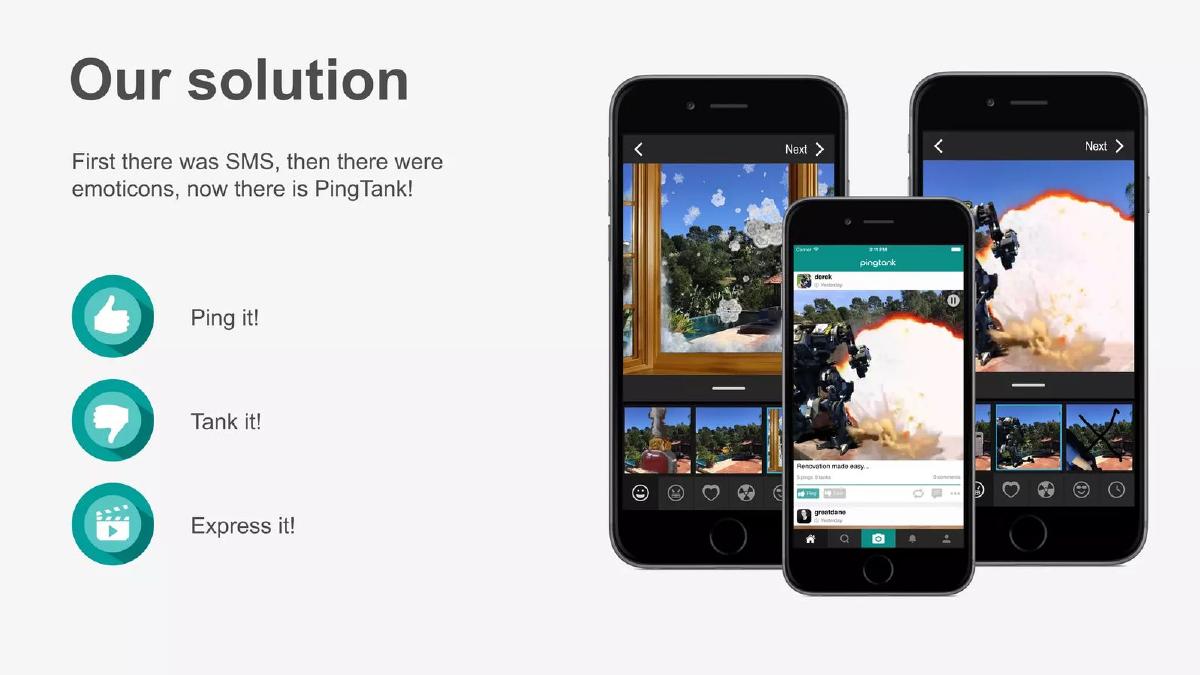
- The company defines its value proposition as an 'Expression Engine' for social media users seeking dynamic self-expression (Slide 2).
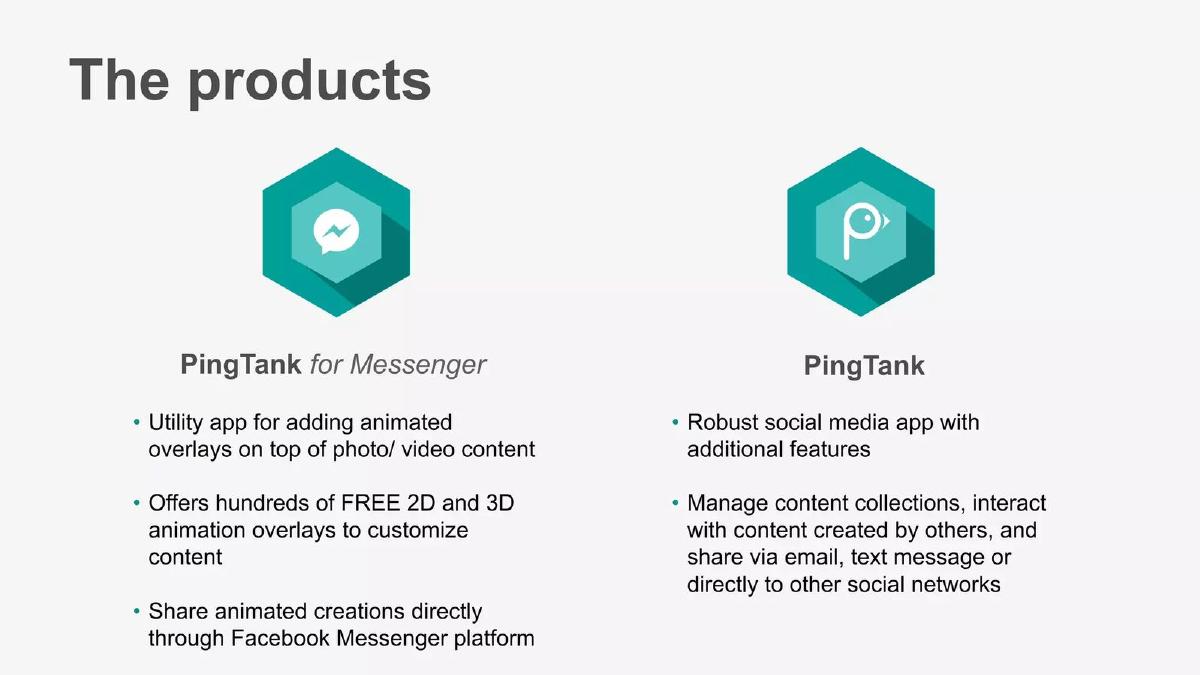
- PingTank pursued a dual-product strategy, offering both a utility app for Facebook Messenger and a standalone social media app (Slide 3).
- The roadmap highlights a significant milestone in March 2015: an announcement at the F8 Conference and a release to 500 million Messenger users (Slide 4).
- Market sizing is based on broad mobile statistics, citing 3+ billion unique mobile users and 2.078 billion active social media accounts (Slide 5).
- The monetization strategy relies on revenue sharing from celebrity and user-generated animations, alongside brand sponsorships (Slide 6).
- The founding team consists of Derek Myska (CTO), Jeremy Greene (CEO), and Lars Halvor Jensen (President/CFO), though no professional backgrounds are listed (Slide 7).
- The 'Use of Funds' slide provides a percentage breakdown—40% for New Hires, 30% for Product Development, 18% for Operational Costs, and 12% for Marketing—but omits the total capital being raised (Slide 8).
- The deck lacks a dedicated competition slide, failing to address how it differentiates from native sticker and GIF features in major messaging apps.
Introduction
PingTank's investor deck presents a vision for a social media 'Expression Engine' that capitalizes on the shift toward visual and animated communication. By leveraging a high-profile integration with Facebook Messenger, the company sought to solve the problem of static social media interactions. This teardown examines the eight slides provided to understand the company's product-market fit, its reliance on platform partnerships, and its proposed path to monetization.
Slide 1: Title Slide
The deck opens with a minimalist title slide featuring the PingTank logo—a stylized 'P' that incorporates a bird-like eye and beak. The tagline, 'The Ultimate Expression Engine!' , immediately establishes the company's focus on creative tools and user communication. The branding is clean, using a dark slate and white color palette that suggests a modern, tech-focused aesthetic.
Slide 2: The Problem
Slide 2, titled 'What is the problem?' , identifies two primary pain points. First, it claims social media users are 'craving a dynamic, interactive platform' for 'total freedom of self expression.' Second, it notes that brands and companies are seeking new ways to engage audiences. The slide concludes that the entire social media space requires a 'user expression overhaul.' While these points are broad, they set the stage for a solution centered on rich media and brand integration.
Slide 3: The Products
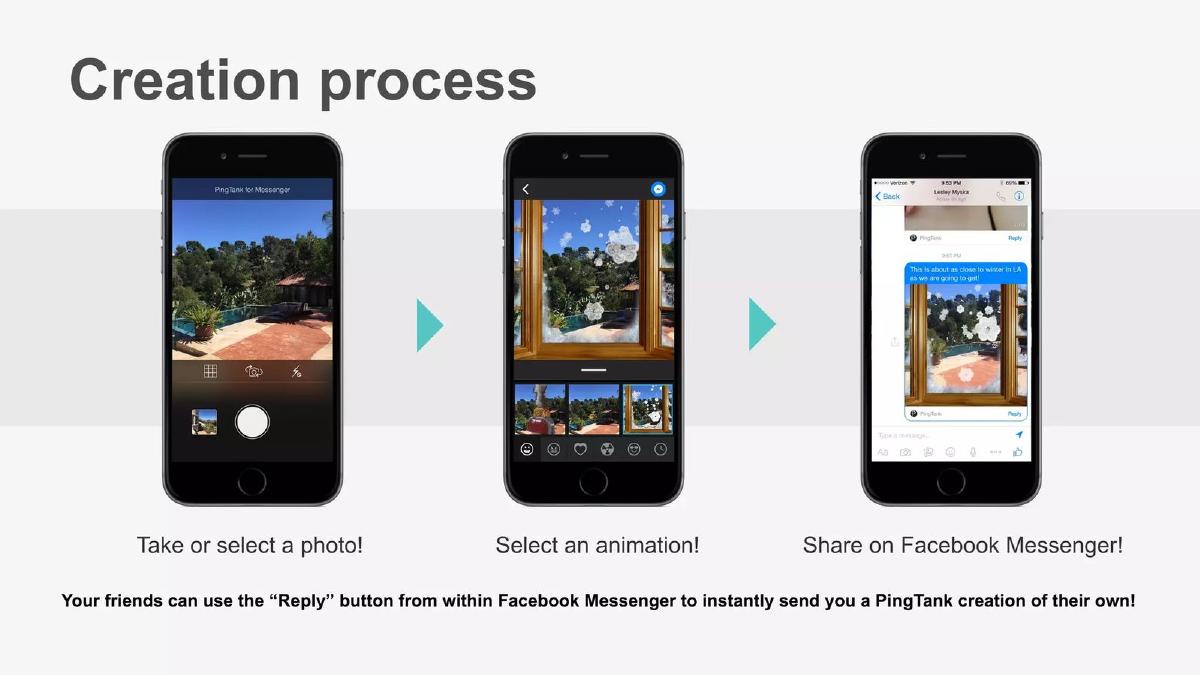
This slide introduces a two-pronged product strategy. PingTank for Messenger is described as a utility app for adding animated overlays (2D and 3D) to photos and videos, with direct sharing to Facebook Messenger. The second product, simply titled PingTank , is described as a 'robust social media app' with features for managing content collections and interacting with other users' creations. This dual approach suggests the company wanted to use Messenger as an acquisition channel while building its own destination platform.
Slide 4: Project Roadmap
The roadmap provides a timeline from February 2015 to October 2015. Key milestones include:
February 2015: iOS beta release in Europe. · March 2015: Global release via the F8 Conference to 500 million monthly active users. · May 2015: Introduction of in-app purchases. · July 2015: Release of version 2.0 with video support and an SDK for user-generated animations. · October 2015: Release of version 3.0 featuring gamification.
The inclusion of the F8 Conference is a significant credibility marker, indicating a formal partnership or recognition by Facebook.
Slide 5: The Market
Slide 5 focuses on the scale of the opportunity. It highlights that Facebook Messenger has over 500 million monthly active users , with 300 million of those users already sending 'no-text based content' like stickers and images. The slide also provides global context: 3+ billion unique mobile users, 2.078 billion active social media accounts, and a breakdown of mobile OS share (53.2% Android vs. 43.1% iOS). The data effectively argues that the behavior PingTank facilitates is already mainstream.
Slide 6: Revenue Model
Titled 'How we will make money,' this slide outlines three revenue streams:
Revenue share from celebrity branded animations: Suggesting a marketplace for high-profile digital goods. · Brand sponsored animation revenue: A B2B play for advertising and engagement. · Revenue share from user generated animations: A creator economy model where users can monetize their own designs.
The model is entirely dependent on the volume of transactions and the success of the SDK mentioned in the roadmap.
Slide 7: Our Team
The team slide introduces three key figures: Derek Myska (Co-founder / CTO) , Jeremy Greene (Co-founder / CEO) , and Lars Halvor Jensen (President / CFO) . While the slide includes photos and titles, it notably lacks any biographical information, past company successes, or educational background. In a seed or Series A deck, the absence of 'why this team' evidence is a significant omission.
Slide 8: Use of Funds
The final slide in this set details how the raised capital will be spent. The allocation is as follows:
40% New Hires: Developers, systems administrators, animators, and support. · 30% Product Development: Server space, hardware, and software. · 18% Operational Costs: Office space and utilities. · 12% Marketing: PR, advertising, and events.
While the percentages are clear, the slide does not state the total amount of funding sought, which is a critical piece of information for any investor pitch.
What Works Well
The deck excels at highlighting its strategic distribution channel . By centering the pitch on the Facebook Messenger integration and the F8 Conference announcement, PingTank demonstrates that it has solved the 'cold start' problem that plagues most new social apps. The roadmap is also well-structured, showing a clear progression from a simple utility to a more complex, gamified social platform.
The revenue model is diversified. By targeting celebrities, brands, and individual creators, the company shows it isn't relying solely on one type of customer. This multi-faceted approach to monetization is common in successful digital asset marketplaces.
What Is Missing
The most glaring omission is a Competition Slide . In 2015, the market for stickers, GIFs, and photo filters was becoming highly saturated with players like Giphy, Bitmoji, and Snapchat. PingTank fails to explain how its 2D and 3D overlays are defensible or superior to native features being built by the platforms themselves.
The Team Slide is also weak. Investors back people as much as ideas, and providing only names and photos without context or track records makes it difficult to assess the team's ability to execute on a complex roadmap involving SDKs and global scaling.
Finally, the financials are absent . There are no projections for user growth, expected ARPU (Average Revenue Per User), or even a basic 'Ask' for the current round. Percentages for the use of funds are meaningless without a total dollar figure.
Founder Takeaways
Leverage platform partnerships: If your startup has a unique integration with a major platform (like Facebook, Slack, or Salesforce), make that a central pillar of your pitch. It validates your technology and your distribution strategy.
Be specific about the 'Ask': Never leave an investor guessing how much money you need. A 'Use of Funds' slide must include the total amount being raised to give context to the percentage breakdowns.
Sell the team's pedigree: If you have a team slide, use it to highlight relevant experience. Mentioning previous exits, roles at major tech companies, or specific technical expertise is crucial for building trust.
Address platform risk: When your business model relies heavily on another company's ecosystem (like Messenger), you must address the risk of that platform changing its rules or building competing features. Acknowledging this and showing a path to independence (as PingTank did with its standalone app) is a good start, but it needs more depth.
Frequently asked questions
- What is PingTank's core product?
- PingTank offers two primary products. The first is a utility app designed specifically for Facebook Messenger that allows users to add 2D and 3D animated overlays to photos and videos. The second is a standalone social media app that includes content management, social interaction features, and sharing capabilities across multiple networks including email and text.
- How does PingTank plan to generate revenue?
- The business model is built on three pillars: revenue sharing from celebrity-branded animations, revenue from brand-sponsored animations, and a revenue-sharing model for user-generated animations. This suggests a marketplace approach where creators and brands can monetize digital assets within the PingTank ecosystem.
- What was the significance of the F8 Conference for PingTank?
- According to the project roadmap on Slide 4, PingTank for Messenger was announced at the F8 Conference in March 2015. This event served as the global launchpad for the app, providing immediate access to Facebook Messenger's user base, which was stated to be over 500 million monthly active users at that time.
- How much money was PingTank raising in this deck?
- The deck does not state a specific dollar amount for the fundraise. Slide 8, titled 'Use of Funds,' only provides a percentage-based allocation of capital. While it shows that 40% of the funds would go toward new hires, the lack of a total 'Ask' makes it difficult to assess the scale of the round.
- What market data does the deck use to justify the opportunity?
- The deck uses top-down market data, citing 3+ billion unique mobile users and over 2 billion active social media accounts. More specifically, it notes that 300 million Messenger users (out of 500 million) were already sending non-text content like images and stickers, identifying this as the core target audience.