Pinshape’s 17-slide deck is a masterclass in visual positioning, using the 'X for Y' strategy to define itself as the 'iTunes for 3D Printing.' The narrative focuses on solving the 'lack of quality' in the early 3D printing market by connecting professional designers with consumers. The deck relies heavily on high-fidelity product categories—ranging from jewelry to character models—to prove the platform's value. However, the presentation is light on hard data. There are no slides detailing current revenue, user growth rates, or a specific capital ask. It functions more as a high-level vision…
Key takeaways
- The company uses a strong anchor metaphor, calling itself the 'iTunes for 3D Printing' on slide 1.
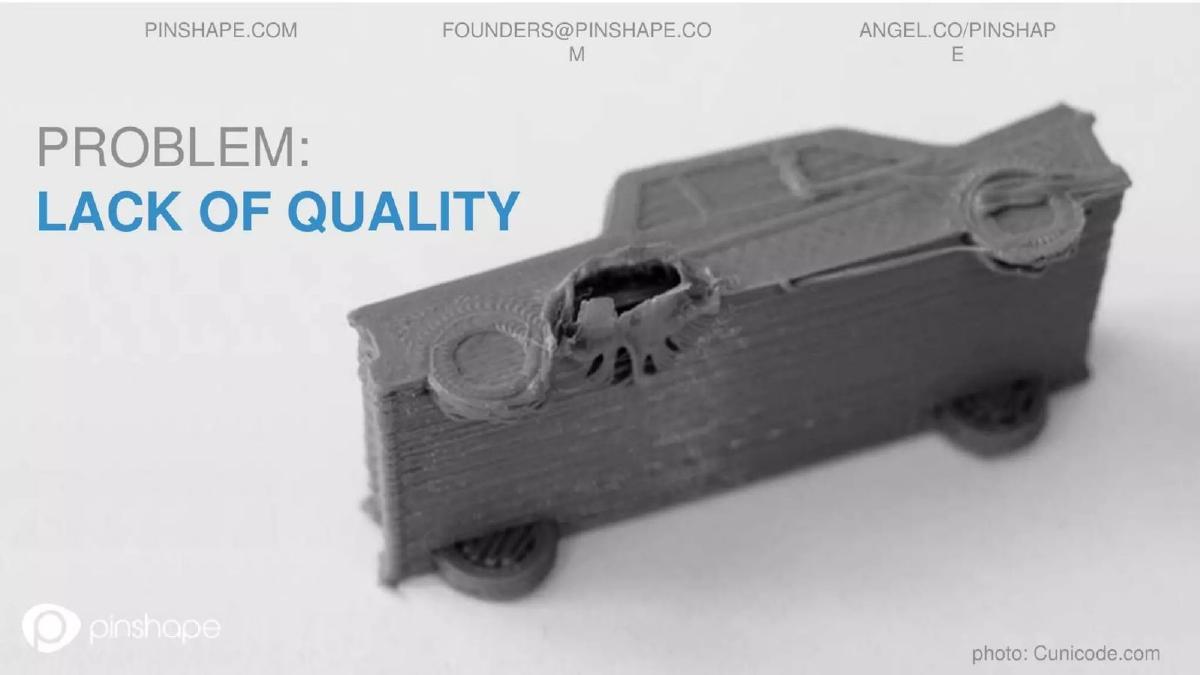
- The core problem identified is a 'Lack of Quality' in existing 3D prints, illustrated by a failed car model on slide 3.
- Pinshape offers a dual-sided marketplace value proposition, helping designers monetize and customers access 35 different materials (slide 6).
- The deck showcases six distinct product categories—Home & Decor, Jewelry, Art, Toys, Tools, and Characters—to demonstrate platform versatility (slides 7-12).
- Market projections cite a leap from $643M in 2011 to a $16B market by 2017, representing 47% YOY growth (slide 13).
- The team slide highlights a mix of corporate experience (Deloitte) and industry-specific expertise (MakerBot) on slide 15.
- A high-profile testimonial from Adam Ross (Legacy Effects) serves as the primary social proof on slide 16.
- The deck completely omits a 'The Ask' slide, leaving investors without a specific funding target or use-of-funds breakdown.
Introduction: The iTunes for 3D Printing
Pinshape’s pitch deck is a product of its time, capturing the peak optimism of the consumer 3D printing movement. The 17-slide presentation is visually driven, leaning heavily on the quality of the objects that can be produced through its platform. By branding itself as the iTunes for 3D Printing on the very first slide, Pinshape immediately communicates its role as a content aggregator and marketplace in a hardware-heavy industry.
The Hook and The Problem
Slide 1: Title Slide The deck opens with a clean logo and the definitive tagline: "iTunes for 3D Printing." This is a classic 'X for Y' positioning strategy. It tells the investor that Pinshape isn't building the hardware (the iPod); they are building the ecosystem that makes the hardware useful (the store).
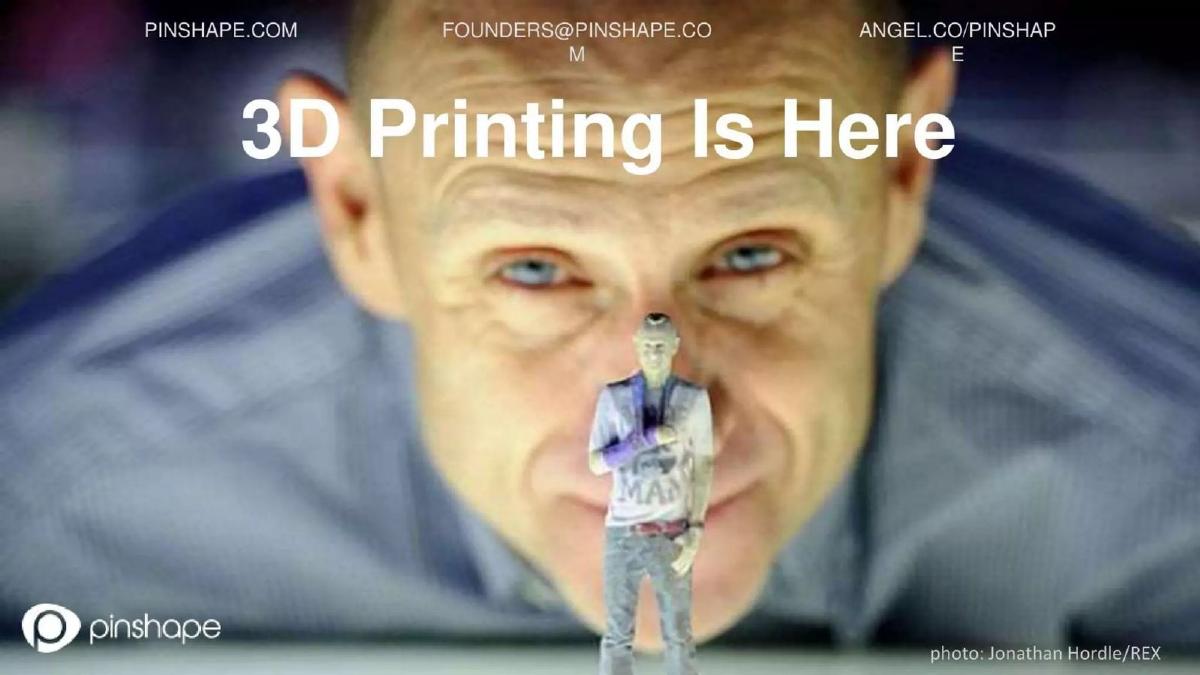
Slide 2: Context A full-bleed image with the text "3D Printing Is Here" serves to ground the investor in the current reality. It’s a transition slide meant to build excitement for the sector before diving into the specific friction points.
Slide 3: The Problem Pinshape identifies a single, visceral problem: LACK OF QUALITY . They use a photo of a failed, stringy 3D print of a car to illustrate the point. In 2012, 3D printing was notorious for high failure rates and low-resolution results. By anchoring the problem in quality, Pinshape sets itself up as the curator that solves the 'garbage in, garbage out' issue of the early maker movement.
The Solution and Marketplace Dynamics
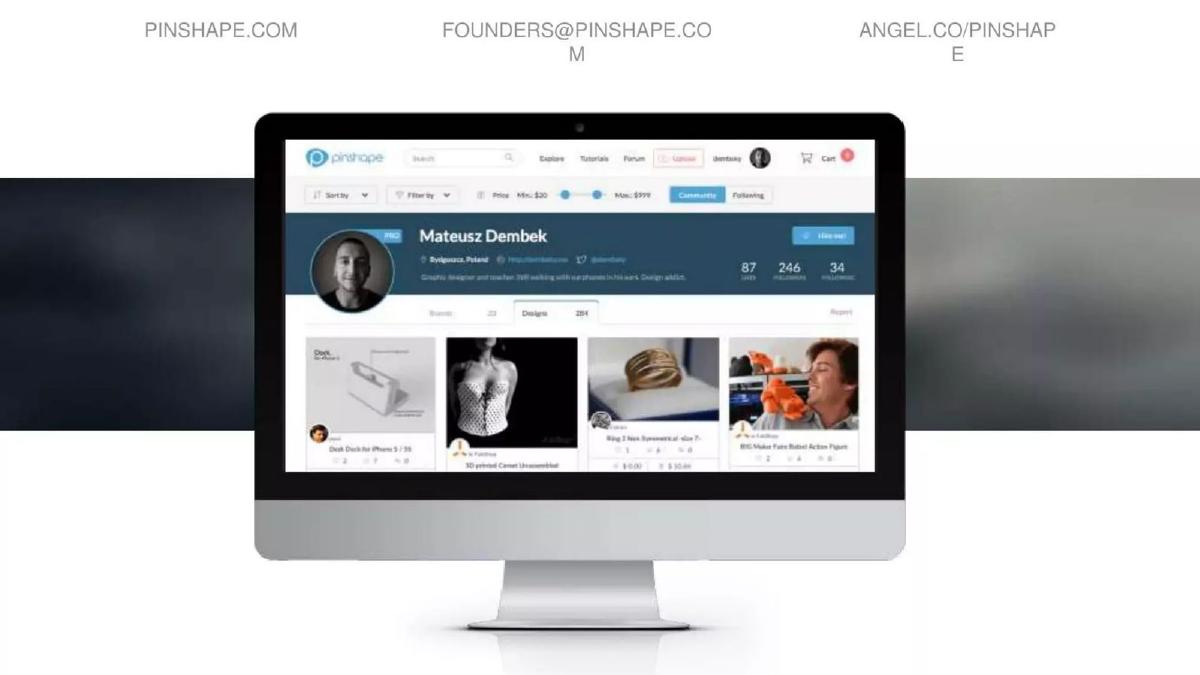
Slide 4: Product Interface This slide shows a high-resolution mockup of the Pinshape platform on an iMac. It highlights a designer profile (Mateusz Dembek), showing follower counts and a gallery of designs. This reinforces the 'community' aspect mentioned in their self-description.
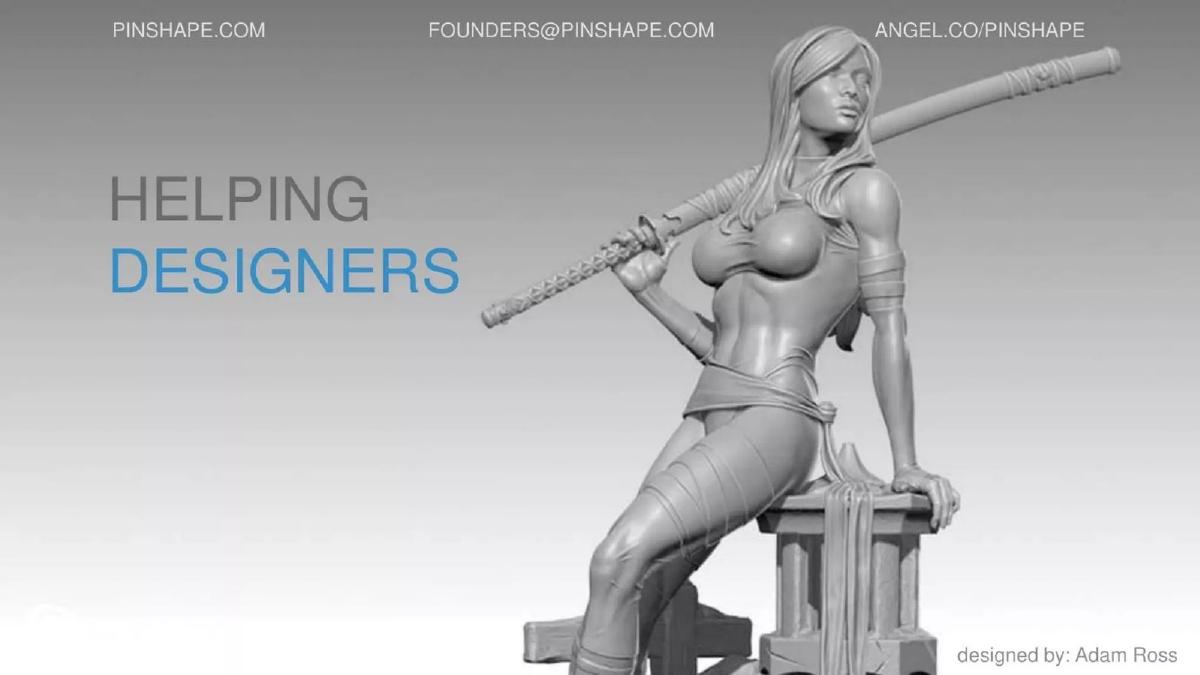
Slide 5: Helping Designers A large, detailed render of a character model by Adam Ross is shown. The text is minimal: "HELPING DESIGNERS." The implication is that Pinshape provides a professional-grade showcase for creators to monetize their work, which was a significant gap in the market at the time.
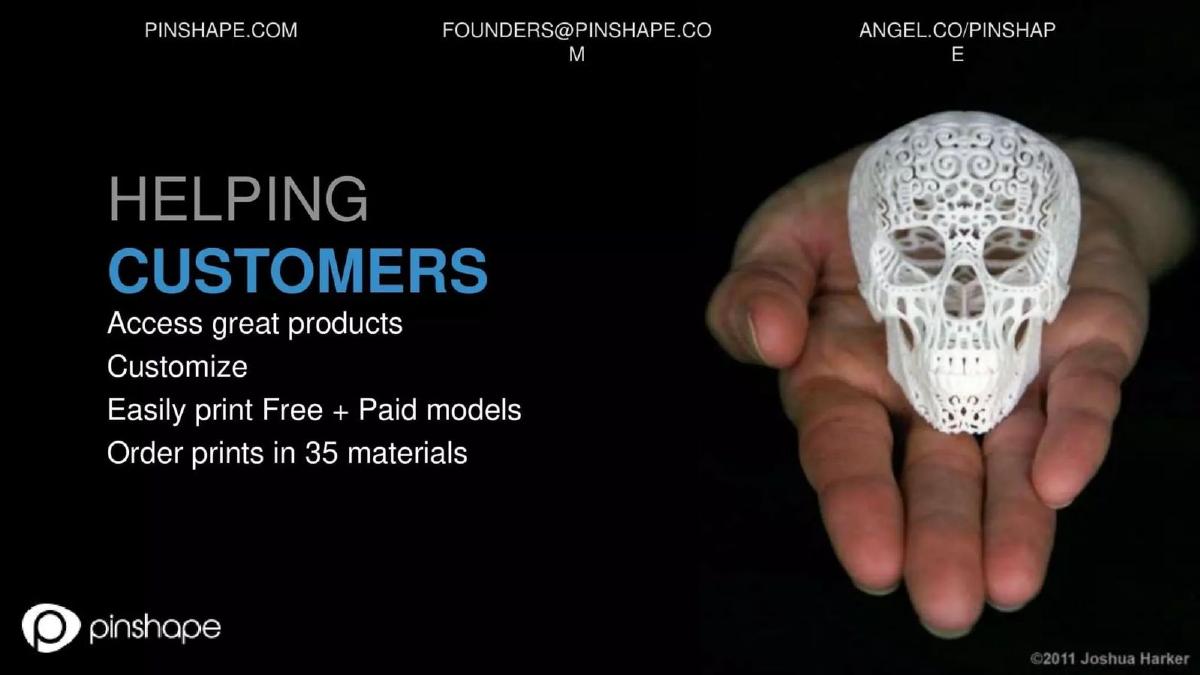
Slide 6: Helping Customers This slide lists the core value propositions for the buyer: access to products, customization, easy printing of free and paid models, and the ability to order prints in 35 materials . This is a crucial detail—it suggests that Pinshape isn't just for people who own printers, but also acts as a gateway to professional printing services.
Vertical Deep Dives
Slides 7 through 12: Category Showcases The deck spends a significant amount of time (six slides) walking through specific use cases: Home & Decor, Jewelry & Fashion, Art, Toys, Tools & Gadgets, and Characters . Each slide features a high-quality, professional design. This serves two purposes: it proves the platform can handle diverse file types and it expands the Total Addressable Market (TAM) in the investor's mind by showing that 3D printing isn't just for plastic trinkets.
Slide 8 (Jewelry): Shows a complex interlocking ring, highlighting precision. · Slide 10 (Toys): Shows a mechanical gear-driven car, highlighting functional assemblies. · Slide 11 (Tools): Shows a wall-mounted cable organizer, highlighting utilitarian value.
Market Opportunity and Competition
Slide 13: Exploding Market Pinshape provides the 'Why Now' data. They cite a jump from $643M in 2011 to $16B in 2017 . They also note a 47% YOY growth rate and a projection of 1 million printers sold by 2017. While these numbers were industry standard projections at the time, they provide the necessary scale for a venture-backed play.
Slide 14: Competition The deck acknowledges the landscape by displaying logos for Amazon, Authentise, Sculpteo, and Exocortex . Curiously, the slide lacks a comparison matrix or a 'why we win' bullet list. It relies on the previous slides' emphasis on 'Quality' and 'Community' to imply their competitive advantage.
The Team and Social Proof
Slide 15: Team The team slide is strong on credentials but light on bios. Lucas Matheson (CEO) and Nick Schwinghamer (COO) both hold MBAs, with backgrounds at Deloitte and Eleven Engineering. Andre Yanes (CTO) is listed as the engineering lead. The standout is Eric Raymond , noted as a 'Former MakerBot' employee, which gives the team immediate 'insider' status in the 3D printing world.
Slide 16: Testimonial Social proof is delivered via a quote from Adam Ross , a designer associated with high-profile projects like Iron Man 3 and Wolverine . He states, "Pinshape is the future of 3D printing." For a marketplace, having 'power users' or 'star creators' early on is a vital signal of supply-side health.
Slide 17: Conclusion The final slide repeats the logo and tagline, adding a row of press logos including TechCrunch, CBC News, and Inside 3DP . It’s a standard 'thank you' slide that reinforces the brand one last time.
What Works in This Deck
The visual storytelling is the deck's greatest strength. By showing, rather than just telling, the quality of the designs available on the platform, Pinshape overcomes the biggest skepticism of the era: that 3D printing was a hobby for making useless plastic junk. The 'iTunes' analogy is also incredibly effective. It simplifies a complex technical marketplace into a business model that every investor already understands (content + hardware ecosystem).
The inclusion of a former MakerBot employee on the team slide is a masterstroke of 'borrowed credibility.' In a nascent industry, having someone from the market leader on your founding team reduces the perceived risk of technical or industry-specific execution errors.
What Is Missing
The most glaring omission is The Ask . There is no slide indicating how much capital is being raised, what the milestones for the next 18 months are, or how the founders plan to allocate the funds. This makes the deck feel more like a general company overview than a fundraising document.
Furthermore, there is a complete lack of Traction Metrics . While the deck was likely used for a Seed round where early numbers might be thin, investors still look for signs of life: number of registered designers, number of files uploaded, or early transaction volume. Without these, the deck relies entirely on market potential rather than proven execution.
Finally, the Unit Economics are absent. How does Pinshape make money? Is it a flat fee per print? A percentage of the file sale? A subscription for designers? While 'iTunes' implies a transaction cut, a marketplace deck should explicitly outline the take rate and the cost of customer acquisition (CAC) versus lifetime value (LTV), even if those numbers are just early estimates.
What a Founder Should Copy
Founders should emulate Pinshape's use of High-Fidelity Imagery . If your product is about 'quality,' your deck must reflect that quality. The renders and photos used in slides 7-12 are professional and aspirational, which helps justify a venture-scale valuation.
The Anchor Metaphor is another excellent takeaway. If you are building in a new or confusing space, find a 'Gold Standard' company in a different industry and use the 'We are the [Famous Company] for [New Industry]' formula. It saves you three slides of explanation and gets the investor focused on the 'how' rather than the 'what.'
Lastly, the Problem Identification on slide 3 is a great example of using a single, powerful image to define a pain point. Instead of a list of five minor problems, they chose one major hurdle (Quality) and owned the solution to it. This creates a much tighter narrative thread throughout the rest of the presentation.
Company: Pinshape · Sector: 3D Printing Marketplace · Stage: Seed · Year: 2012 · Slides: 17 · Outcome: 500 Startups-backed; later acquired by Formlabs · HQ: Vancouver, Canada
Frequently asked questions
- What is Pinshape's primary business model according to the deck?
- Pinshape positions itself as a marketplace connecting 3D designers with consumers. According to slide 6, they facilitate the printing of both free and paid models, allowing customers to order prints in 35 different materials. The 'iTunes' comparison suggests a transaction-based revenue model where they take a cut of digital file sales or physical print orders.
- How does Pinshape differentiate itself from competitors like Amazon or Sculpteo?
- While slide 14 lists competitors like Amazon, Authentise, and Sculpteo, the deck differentiates Pinshape through its focus on 'Quality' (slide 3) and designer support (slide 5). By positioning as a curated community rather than just a service bureau or general retailer, they aim to be the central hub for high-end 3D creative content.
- What market data does the deck provide to justify the investment?
- Slide 13 provides the primary market justification, claiming the 3D printing market will grow from $643 million in 2011 to $16 billion by 2017. They also project that 1 million printers will be sold by 2017, growing at a 47% year-over-year rate. This suggests a rapidly expanding hardware base that requires a software and content layer.
- Does the deck include a clear financial ask?
- No. The deck is notably missing a slide detailing how much money the company is looking to raise, the valuation, or how the funds will be allocated. This is a significant omission for a seed-stage pitch deck, as it forces the investor to ask for the most basic deal terms separately.
- What kind of expertise does the founding team bring?
- The team (slide 15) features a balanced mix of business and technical skills. CEO Lucas Matheson brings a CFA/MBA background with Deloitte experience, while Eric Raymond provides direct industry relevance as a former employee of MakerBot, one of the most recognizable names in desktop 3D printing at the time.