Sverve's 16-slide deck from 2012 captures the early transition of influencer marketing from celebrity endorsements to scalable marketplaces. The deck relies heavily on high-impact visuals and large-font metrics rather than dense prose. It identifies a clear market inefficiency: while 50% of purchasing decisions are driven by word of mouth (Slide 2), brands lack the tools to manage campaigns beyond top-tier celebrities like Kim Kardashian (Slide 3). With 350 businesses already on board (Slide 9) and a 250% growth in ad spend over four months (Slide 13), the deck presents a compelling case for…
Key takeaways
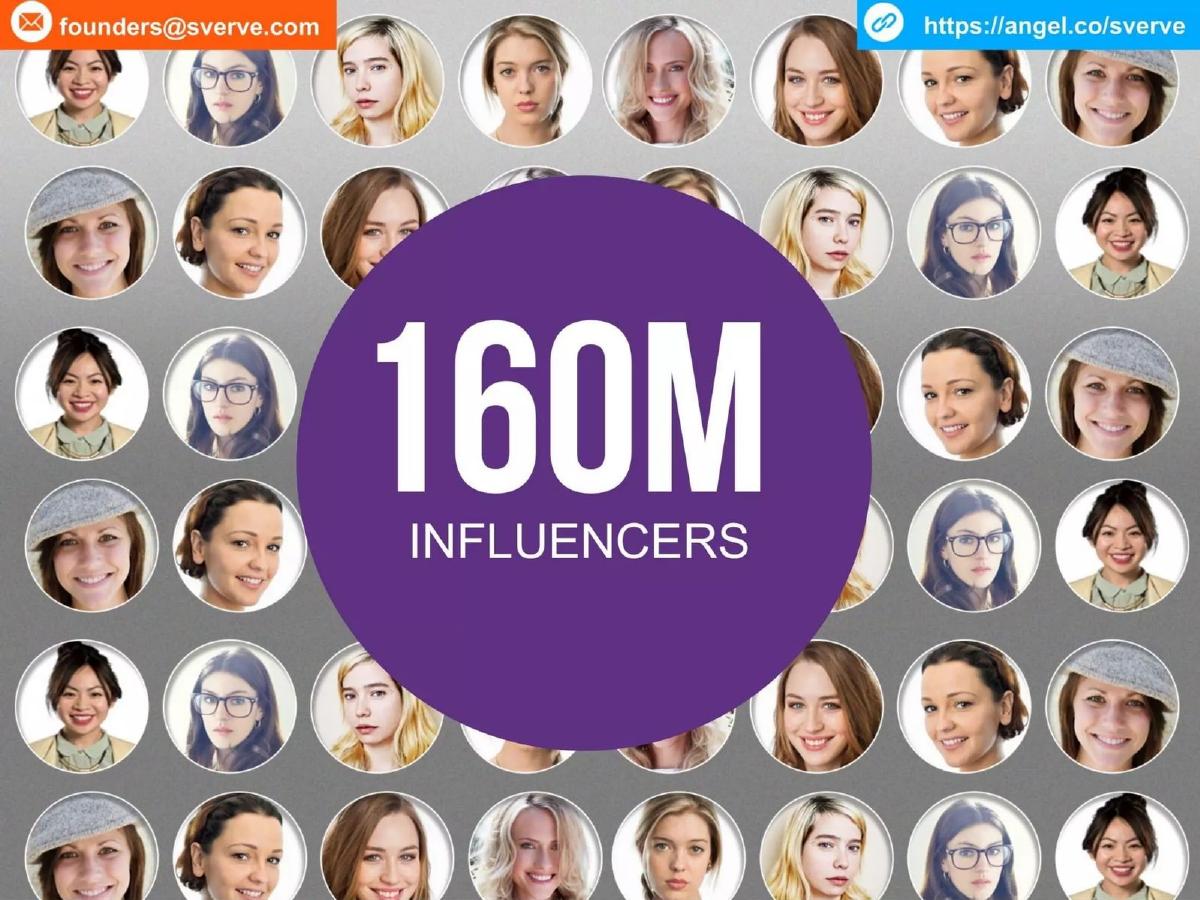
- The deck uses a 'Big Number' strategy, highlighting 160 million potential influencers on Slide 5 to establish market scale.
- It effectively contrasts celebrity reach (Slide 3) against the difficulty of finding and managing smaller influencers (Slide 6 and 7).
- Traction is demonstrated through a logo cloud of 350 businesses, including brands like Le Tote and Mega (Slide 9).
- Specific campaign outcomes are shared, such as reaching an audience of 327,000 for eduPad (Slide 10).
- Financial growth is shown via a bar chart indicating ad spend grew from $8,500 in March to $20,000 in June (Slide 13).
- The team slide emphasizes serial entrepreneurship, noting the CEO is on his 4th startup and the CTO is on his 2nd (Slide 14).
- The 'Ask' is clearly defined as $750,000 for sales and development, despite the company eventually raising $1.6M (Slide 16).
- The deck lacks a formal business model or unit economics slide, focusing instead on volume and growth metrics.
Introduction: The Dawn of the Influencer Marketplace
In 2012, the term 'influencer' was largely synonymous with 'celebrity.' Sverve’s pitch deck arrived at a pivotal moment when brands were beginning to realize that the 'middle class' of the internet—bloggers and social media enthusiasts—held significant untapped value. This teardown examines the 16-slide deck that helped Sverve secure $1.6 million in seed funding, nearly double their original $750,000 target.
Slides 1-2: The Hook and the Macro Trend
Slide 1 serves as a clear, high-contrast title page. It defines the company immediately: 'Sverve is an influencer marketplace enabling word of mouth marketing on social media.' There is no ambiguity here. By using a blue-on-dark-background aesthetic, they establish a professional, tech-forward tone.
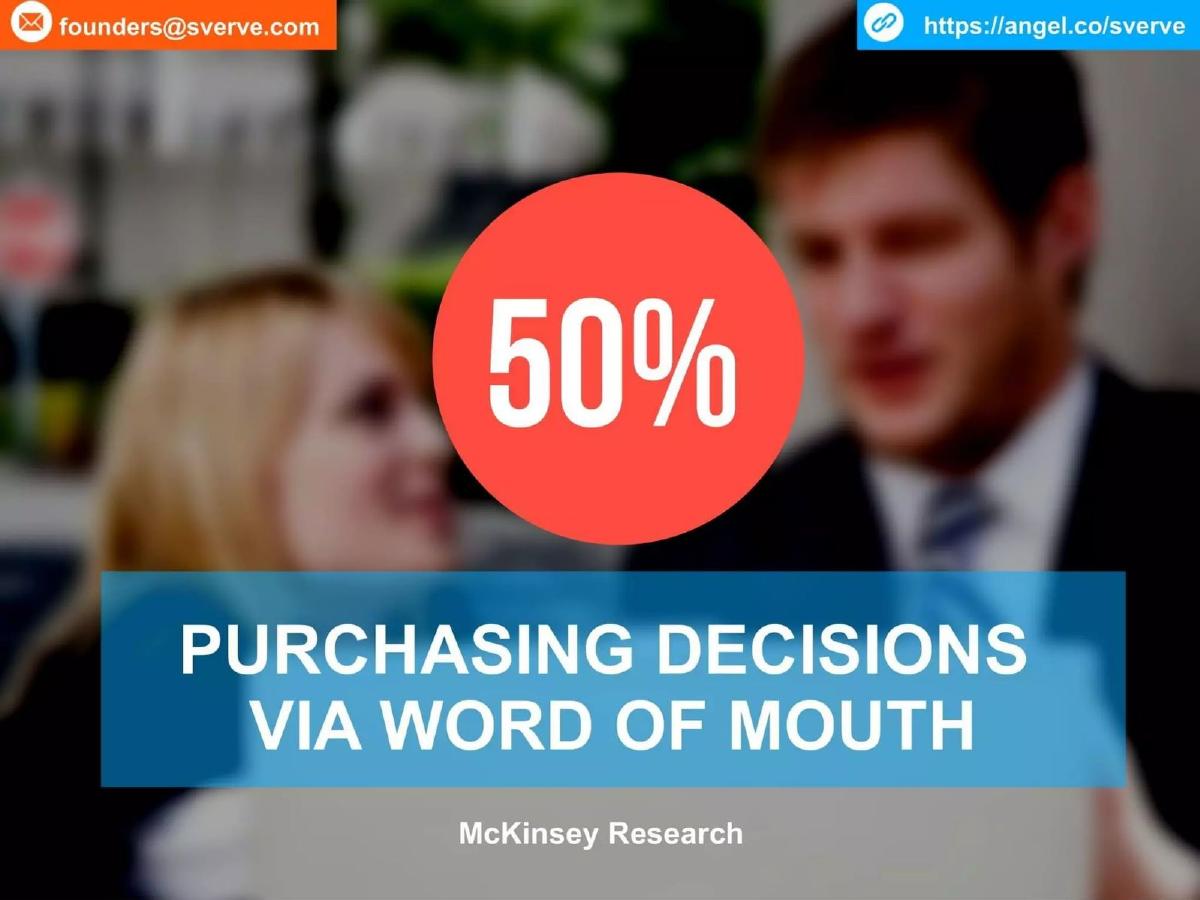
Slide 2 introduces the 'Why Now?' factor. Citing McKinsey Research, the slide features a massive '50%' figure, stating that half of all purchasing decisions are made via word of mouth. This anchors the pitch in a massive, validated market behavior rather than a niche tech trend. It justifies the existence of the company before the product is even shown.
Slides 3-5: Market Scale and the Celebrity Trap
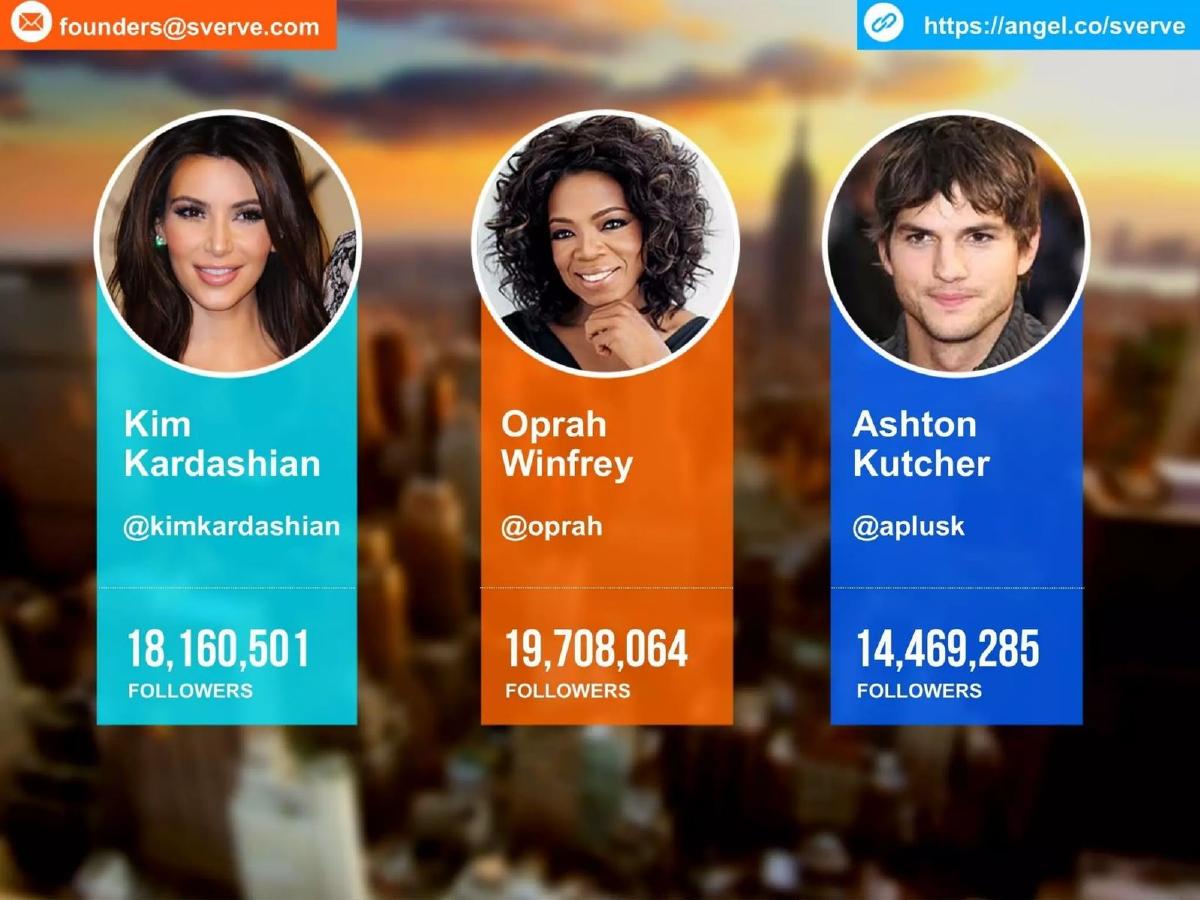
Slide 3 uses recognizable faces—Kim Kardashian, Oprah Winfrey, and Ashton Kutcher—to illustrate the current state of influencer marketing. By listing their follower counts (ranging from 14.4M to 19.7M), the deck acknowledges the power of the 'head' of the market. However, Slide 4 , which shows money underwater, and Slide 5 , which highlights '160M Influencers,' suggest that the real opportunity lies in the long tail. The transition from three celebrities to 160 million potential influencers effectively visualizes the scale of the 'middle market' Sverve intends to capture.
Slides 6-8: The Problem and the Solution
Slide 6 and Slide 7 define the friction points. The deck argues that there is 'no easy way to find influencers' and that brands 'lack tools to manage campaigns.' The imagery—a blurred woman at a laptop and a wall of messy post-it notes—emotionally resonates with the administrative headache of manual outreach. Slide 8 presents the antidote: a four-step process (Create a Campaign, Influencers Apply, Quick Engagement, Results). This simplifies a complex marketplace interaction into a linear, manageable workflow.
Slides 9-11: Traction and Case Studies
Slide 9 is a classic 'social proof' slide. It features a red box with '350 Businesses' surrounded by logos like Le Tote, Flightpath, and eduPad. For a seed-stage company in 2012, having 350 paying or active business users was a significant milestone. Slide 10 and Slide 11 go deeper into results. They highlight that eduPad reached an audience of 327,000 and Flightpath generated $4,125 in profit. Providing specific dollar amounts and reach figures transforms the pitch from theoretical to empirical.
Slides 12-13: Supply Growth and Revenue Velocity
Slide 12 shows that the marketplace supply is growing, noting '6000 Influencers' are now on the platform. This demonstrates that Sverve can attract both sides of the marketplace. Slide 13 is perhaps the most important slide for an investor: the growth chart. It shows a '250% Growth in Ad Spend' from March ($8,500) to June ($20,000). While the absolute numbers are small, the month-over-month trajectory is steep and consistent, which is exactly what seed investors look for to justify a larger round.
Slides 14-16: The Team and The Ask
Slide 14 introduces the team. Rohit Vashisht (CEO) is highlighted as a 4th-time founder, and Vikas Gupta (CTO) as a 2nd-time founder. This 'serial entrepreneur' status significantly de-risks the investment. The slide also includes logos of prestigious former employers and clients like IBM, BlackRock, and Consumer Reports. Slide 15 notes that $620K has been 'Raised So Far,' showing existing investor confidence. Finally, Slide 16 sets the target at $750,000 to expand the sales team for PR firms and the dev team for product build-out.
What Works in This Deck
Visual Hierarchy: The deck is incredibly easy to scan. The founders used large fonts for their most important metrics (350 Businesses, 6000 Influencers, 250% Growth). An investor could flip through this in 30 seconds and understand the entire value proposition and traction status.
Focus on ROI: By including a slide that explicitly mentions 'Profit' (Slide 11), Sverve moves away from 'vanity metrics' like likes or shares and focuses on what actually matters to the businesses paying for the platform.
Market Positioning: The deck does a great job of contrasting the 'Celebrity' world with the 'Marketplace' world. It makes the case that the celebrity model is not scalable for most businesses, whereas a marketplace of 160M influencers is.
What is Missing
Business Model/Unit Economics: The deck never explains how Sverve makes money. Do they take a percentage of the ad spend? Is there a SaaS subscription fee for the management tools? While the growth in ad spend is shown, the take-rate is omitted.
Competitive Landscape: There is no mention of other influencer platforms or how Sverve differs from emerging social media management tools of that era. Investors usually want to see how a startup plans to defend its position.
Product Deep Dive: While the process is summarized in four icons on Slide 8, there are no actual screenshots of the platform. This leaves the investor wondering about the quality of the user interface and the robustness of the 'management tools' mentioned.
What a Founder Should Copy
The 'Big Number' Slide: If you have traction, don't bury it in a bullet point. Use an entire slide for a single, impressive number like Sverve did on Slides 9 and 12. It forces the investor to stop and acknowledge the achievement.
The Serial Founder Highlight: If you have started companies before, even if they weren't billion-dollar exits, frame it as '4th Startup' or '2nd Startup.' It signals that you have already made the 'rookie' mistakes on someone else's dime.
Clear Use of Funds: Slide 16 doesn't just ask for money; it tells the investor exactly what that money buys (Sales team for PR firms, Dev team for product). This shows a level of operational planning that gives investors confidence that the capital won't be wasted.
Conclusion
Sverve’s deck is a product of its time, leaning heavily on the 'Word of Mouth' narrative that dominated early 2010s marketing discussions. However, its structural clarity and emphasis on growth metrics remain timeless. By focusing on the scalability of the 'middle-tier' influencer, Sverve successfully carved out a space in a market that was previously dominated by high-cost celebrity endorsements. The fact that they raised $1.6M against a $750K ask is a testament to the power of a clear, traction-heavy narrative.
Frequently asked questions
- What was the primary problem Sverve aimed to solve?
- Sverve identified that while word-of-mouth marketing is highly effective, brands lacked the tools to discover and manage influencers at scale. Slide 6 and 7 explicitly state there is 'no easy way to find influencers' and a 'lack of tools to manage campaigns,' positioning Sverve as the centralized marketplace solution for these operational hurdles.
- How did Sverve demonstrate early product-market fit?
- The deck uses Slide 9 to show that 350 businesses were already using the platform. They followed this with specific case studies on Slides 10 and 11, showing an audience reach of 327,000 for eduPad and a $4,125 profit for Flightpath, providing concrete evidence that the platform delivered measurable ROI for early adopters.
- What was the growth trajectory shown in the deck?
- Slide 13 displays a 250% growth in ad spend over a four-month period. Starting at $8,500 in March, the spend increased to $13,500 in April, $17,000 in May, and peaked at $20,000 in June. This visual representation of increasing platform utility was likely a key factor in their successful seed round.
- Who were the key members of the founding team?
- The team featured Rohit Vashisht (CEO), a fourth-time founder with a background in product management and sales, and Vikas Gupta (CTO), a second-time founder and 'hacker.' The slide also lists advisors and team members with experience at BlackRock, IBM, and WebMD, lending significant professional credibility to the early-stage venture.
- How much did Sverve actually raise compared to their pitch?
- Slide 16 explicitly asks for a 'Target Investment of $750K.' However, catalogue data indicates the company successfully raised $1,600,000 in 2012. This suggests the deck was effective enough to generate oversubscription, allowing the founders to take on more capital than initially requested to accelerate their roadmap.