Sweep’s 14-slide deck is a study in narrative-driven fundraising for a Series B round. Rather than bogging the reader down in granular unit economics or exhaustive competitive matrices, the deck focuses on the 'agentic era' of enterprise software. By positioning their platform as the first agentic workspace for GTM (Go-To-Market) systems, Sweep addresses a specific pain point: the inability of traditional CRM setups to keep pace with AI-driven business speeds. The deck leans heavily on the founders' previous exit to Wix and a strong testimonial from Brex to establish credibility. While it lac…
Key takeaways
- The deck positions Sweep as the 'first agentic workspace for GTM systems' on Slide 1, claiming a new category in enterprise software.
- Slide 2 defines the problem broadly: AI moves faster than the teams and systems currently supporting enterprise workflows.
- Visual complexity is used as a rhetorical device on Slide 4 to show the mess of business systems metadata that Sweep aims to organize.
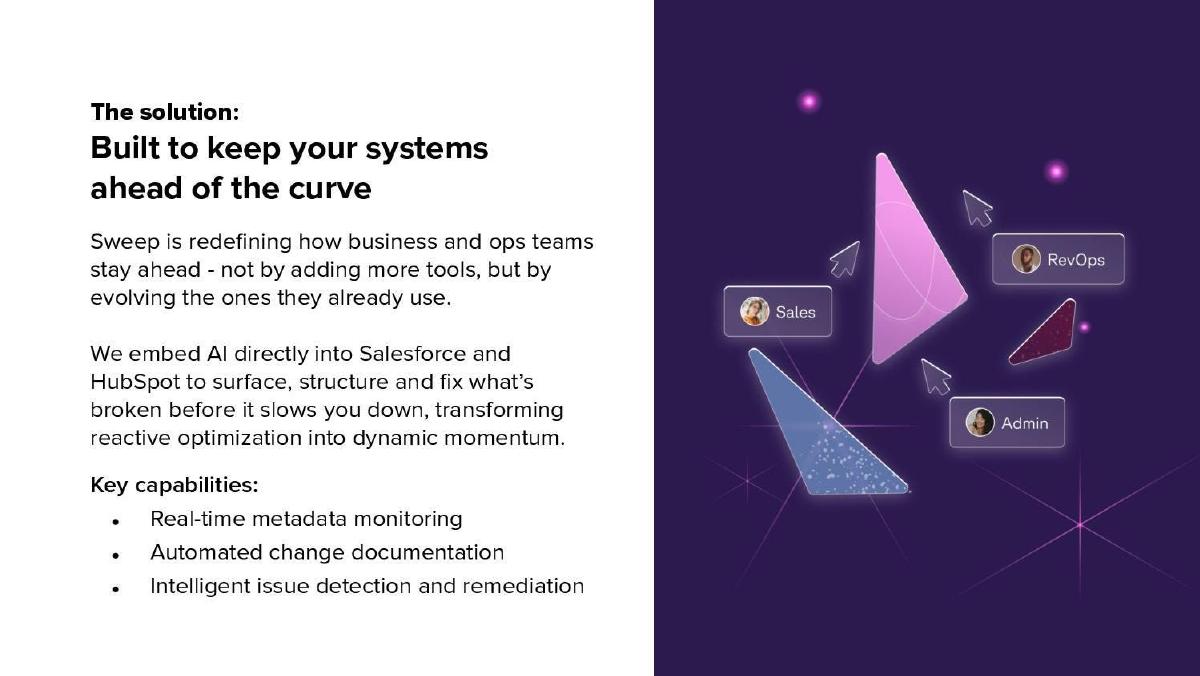
- The product transition is framed as moving from 'reactive optimization' to 'adaptive momentum' on Slide 5.
- Social proof is anchored by a specific quote from Dylan Hughes at Brex on Slide 6, highlighting Sweep's role in cross-functional collaboration.
- Founder pedigree is a central pillar, noting on Slide 7 that Ido Gaver and Eran Kirshenboim previously sold flok.com to Wix in 2017.
- The company discloses a total headcount of 40 across three global offices (TLV, NYC, Lisbon) on Slide 7.
- Top-tier venture backing from Bessemer Venture Partners and Insight Partners is prominently displayed on the final slide.
The High-Level Narrative of the Agentic Era
Sweep’s Series B deck is a masterclass in minimalist, high-concept storytelling. In an era where enterprise software is being redefined by artificial intelligence, Sweep chooses not to compete on features, but on a new category: the agentic workspace. According to publisher reports from Business Insider, this deck helped secure $22.5M in 2024. The deck’s primary goal is to convince investors that the current Go-To-Market (GTM) infrastructure is fundamentally broken because it cannot keep pace with the speed of AI.
Slide 1: The Category Stake
The deck opens with a bold claim: "The first agentic workspace for GTM systems." By using the word "first," Sweep is attempting to claim a new category. In venture capital, being the first in a category is often more valuable than being the best in an existing one. The branding is clean, utilizing a dark purple palette and celestial imagery that suggests a 'north star' or a new horizon for enterprise tech.
Slide 2-3: The Macro Problem and Philosophy
Slide 2 states the problem simply: "AI moves fast, leaving teams and systems behind." This is a classic 'why now' slide. It suggests that the bottleneck in modern business isn't the AI itself, but the legacy systems (like Salesforce or HubSpot) that are too rigid to adapt. Slide 3 follows up with the solution's core values: "Clarity, agility, and adaptability." These are abstract terms, but in a Series B deck, they serve to align the investor with the company’s mission before diving into the 'how.'
Slide 4: The Visual Representation of Chaos
Slide 4 is one of the few slides with significant visual detail. It shows a sprawling, complex ERD (Entity Relationship Diagram) of a typical enterprise CRM. Labels like "Order Product," "Contract," "Campaign," and "Opportunity" are visible, connected by a dizzying array of lines. The text overlay, "Sweep turns business systems metadata...", sets up the technical value proposition. It acknowledges that enterprise data is a mess and positions Sweep as the layer that makes sense of it.
Slide 5: The Product Shift
Slide 5 provides a conceptual look at the product. It features a UI mock-up with a Salesforce logo and a chat interface that says "Ask anything..." The headline, "Where agents move from reactive optimization to adaptive momentum," is the core of their 'agentic' thesis. It implies that Sweep isn't just a chatbot; it's a system that proactively manages the workflow, moving from fixing things that are broken to creating forward motion.
Slide 6: Enterprise Validation
Social proof is critical at the Series B stage. Sweep includes a detailed quote from Dylan Hughes, GTM Business Systems Lead at Brex. The testimonial is specific, noting that Sweep "surface[s] friction points before they become bottlenecks" and has elevated their team to a "strategic driver of growth." Using a high-growth unicorn like Brex as a lead case study provides immediate credibility to the platform's scalability.
Slide 7: The Founder Pedigree
For many investors, this is the most important slide in the deck. It details the history of Ido Gaver (CEO) and Eran Kirshenboim (CTO). The fact that they co-founded flok.com in 2009 and sold it to Wix in 2017 is a massive de-risking signal. It tells investors that these founders know how to build, scale, and exit a CRM-adjacent business. The slide also notes a total headcount of 40 and a global presence in TLV, NYC, and Lisbon, indicating a mature, distributed operation.
Slide 8-14: The Omissions and the Partners
The remaining slides (8-14) are not explicitly detailed in the provided text beyond the company name, but the final slide prominently features their "Partners": Bessemer Venture Partners and Insight Partners. These are two of the most prestigious names in enterprise SaaS investing. Their presence on the deck acts as a final stamp of approval.
What Works in the Sweep Deck
1. Narrative over Numbers: While most Series B decks are heavy on spreadsheets, Sweep leans into a narrative shift. They are selling a future where AI agents run the GTM stack. This allows them to command a valuation based on future potential rather than just a multiple of current ARR.
2. Founder-Market Fit: The deck makes a direct link between the founders' past experience at flok and the problem they are solving at Sweep. This "operators solving their own problems" story is a favorite among VCs.
3. Visual Metaphor: The use of the complex metadata map on Slide 4 is an excellent way to communicate a technical problem to a non-technical audience. It visually demonstrates the 'pain' of the customer without requiring the investor to read a white paper.
What is Missing from the Sweep Deck
1. Unit Economics: There is no mention of CAC (Customer Acquisition Cost), LTV (Lifetime Value), or payback periods. For a $22.5M raise, these are usually mandatory. Their absence suggests this deck was used as a high-level teaser or that the round was pre-empted by insiders who already had the data.
2. The 'Ask': The deck does not state how much money they are looking for or what they plan to do with it. While we know from Business Insider that they raised $22.5M, a standard pitch deck usually includes a slide detailing the use of proceeds (e.g., 50% R&D, 30% Sales, 20% Marketing).
3. Competitive Landscape: The deck assumes a vacuum. It doesn't mention how Sweep differs from Salesforce’s own Einstein AI or other emerging agentic AI startups. In a crowded market, a competitive matrix is usually helpful for positioning.
Lessons for Founders
If you are a second-time founder with a successful exit under your belt, you can afford to be more visionary and less tactical in your deck. Sweep proves that if you have the right pedigree and the right lead investors (Bessemer/Insight), you can raise significant capital by defining a new category. However, for first-time founders, the lack of metrics seen here would be a red flag. The takeaway is to lead with your strongest asset: if it’s your track record, put it front and center; if it’s your growth, lead with the charts.
Frequently asked questions
- What is an 'agentic workspace' as defined in this deck?
- While the deck doesn't provide a technical definition, it frames the 'agentic workspace' on Slide 1 and Slide 5 as a system where AI agents move beyond reactive tasks to 'adaptive momentum.' In the context of GTM systems, this implies a platform that proactively manages and optimizes metadata and workflows within CRMs like Salesforce or HubSpot rather than just recording data.
- How does Sweep use social proof to validate its Series B?
- Sweep uses a high-impact testimonial from Brex’s GTM Business Systems Lead on Slide 6. The quote specifically mentions that Sweep elevated their systems team from a 'support function' to a 'strategic driver of growth.' This shifts the value proposition from a cost-saving tool to a revenue-generating asset, which is critical for enterprise software valuations.
- Why are there no financial metrics in the slides?
- For a Series B, the absence of ARR or NRR is unusual but often indicates a 'narrative' or 'pre-emptive' round. Given the founders' history (Slide 7) and the backing of Bessemer and Insight, the investors likely had access to a separate data room. The deck itself is designed to sell the vision of the 'agentic era' rather than the current balance sheet.
- What is the significance of the metadata visualization on Slide 4?
- Slide 4 shows a chaotic web of interconnected tables (Account, Opportunity, Campaign, etc.). This serves as a 'visual empathy' slide. It reminds the investor of how bloated and unmanageable enterprise CRM schemas have become, setting the stage for Sweep to be the solution that 'turns business systems metadata' into something actionable.
- Who are the founders and what is their track record?
- As detailed on Slide 7, the founders are Ido Gaver (CEO) and Eran Kirshenboim (CTO). They are 'longtime friends' who previously co-founded flok, a CRM for small businesses, in 2009. They successfully sold that company to Wix.com in 2017, providing them with the 'second-time founder' status that significantly lowers perceived risk for VCs.