Switchboard’s 12-slide Series A deck is a masterclass in leveraging founder authority and early-stage momentum. Raising $25 million in 2022, the company focused on the 'post-pandemic' shift toward hybrid work, positioning itself as the next evolution beyond simple video conferencing tools like Zoom. The deck is light on traditional financial metrics—omitting revenue, churn, and detailed unit economics—but heavy on social proof and market timing. By highlighting 1,200 new teams joined within the first week of launch with $0 spent on marketing, the narrative successfully shifted from 'can this…
Key takeaways
- The deck leads with founder Amir Ashkenazi's track record of 1 IPO, 3 acquisitions, and $1.1B in exits on Slide 1.
- It defines the problem as current tools being 'just communication tools' that lack the ability to 'do anything together' on Slide 2.
- The solution highlights three core pillars: all apps, side-by-side collaboration, and permanent rooms on Slide 3.
- Market data on Slide 4 projects the North America Team Collaboration Software Market reaching $40.79B by 2028.
- Traction is demonstrated by 1,200 new teams joining within the first week of launch with $0 paid marketing on Slide 5.
- The deck leans on social proof from high-profile users like Chris Messina and Product Hunt rankings (#1 Product of the Day) on Slides 5 and 6.
- The deck omits a formal 'Ask' slide, financial projections, and a detailed breakdown of the internal team beyond the CEO.
- The presentation uses a minimalist aesthetic with high-contrast visuals to simulate the product experience.
The Momentum Play: Switchboard’s $25M Series A Teardown
Switchboard entered the market at a pivotal moment in 2022. As the initial 'Zoom fatigue' set in, the enterprise software sector was looking for the 'what's next' of remote work. The following teardown analyzes the 12-slide deck that secured a $25 million Series A, as reported by Business Insider. The deck is a masterclass in using founder pedigree and viral momentum to bypass the need for deep financial disclosures in a pitch.
Slide 1: The Power of the 'Super Founder'
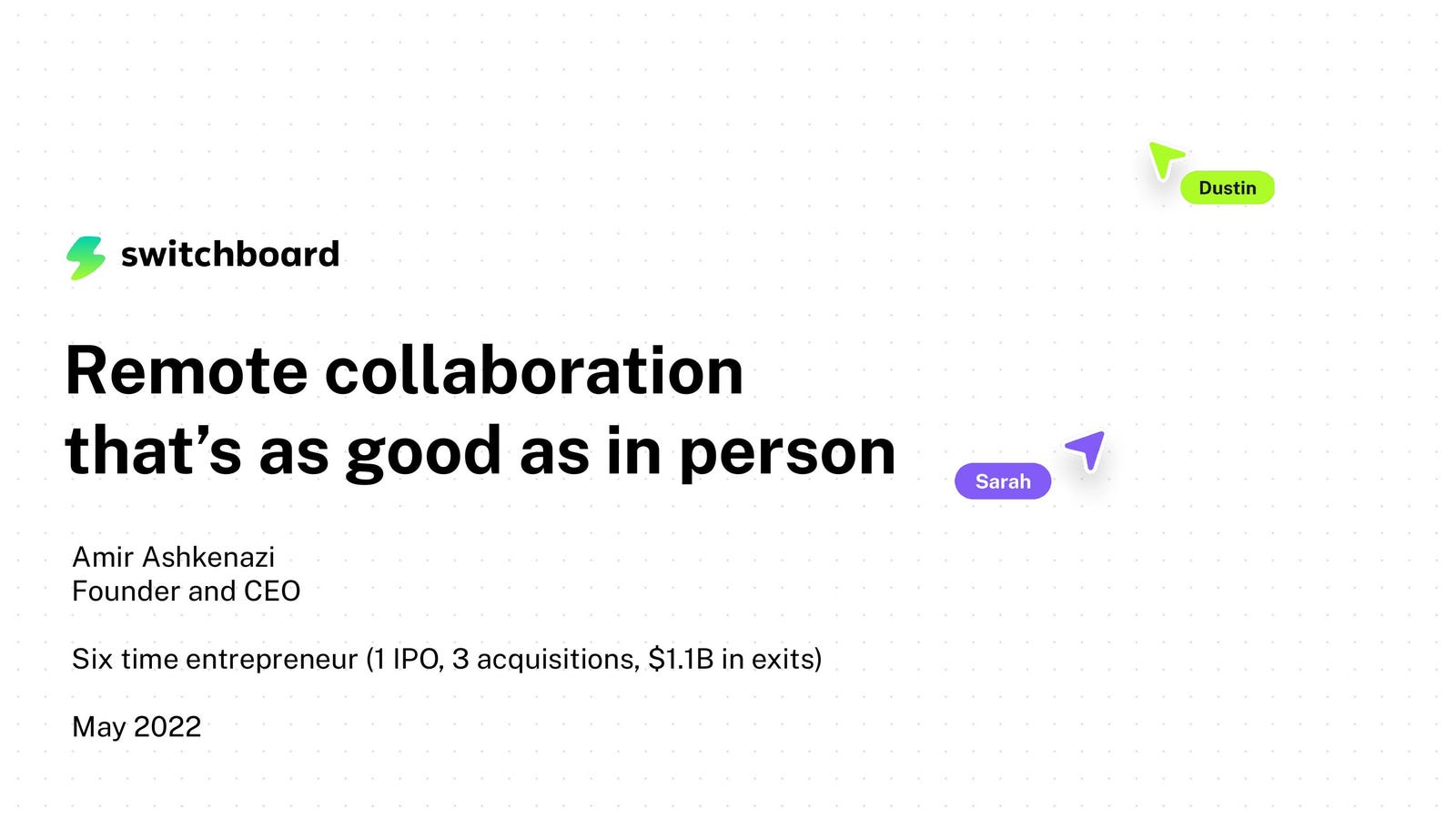
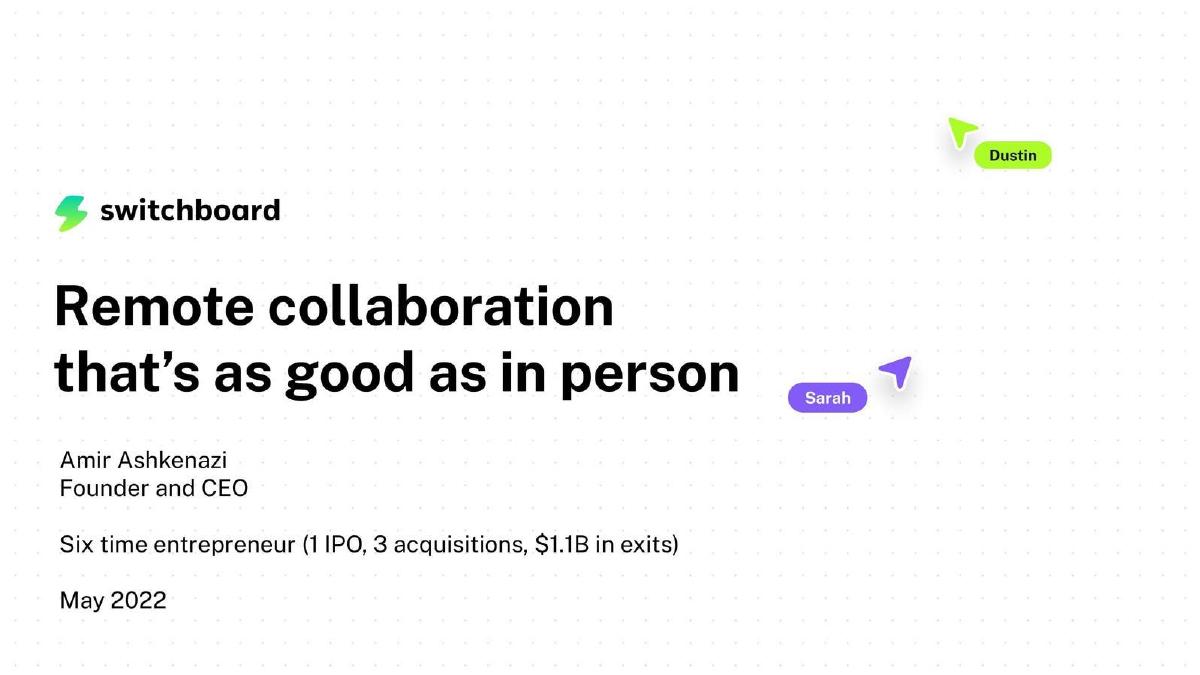
The title slide for Switchboard does more than just name the company. It immediately establishes the 'why now' and 'why us' through the lens of founder Amir Ashkenazi. The slide lists his credentials plainly: 'Six time entrepreneur (1 IPO, 3 acquisitions, $1.1B in exits).'
Analysis: By putting the $1.1B exit figure on the very first slide, Switchboard sets a valuation floor. Investors are not looking at a first-time founder trying to find their way; they are looking at a proven operator. The tagline 'Remote collaboration that’s as good as in person' sets a high bar for the product promise that follows.
Slide 2: Defining the 'Communication vs. Collaboration' Gap
Slide 2 uses a simple checklist to invalidate the current market leaders. It shows a grid of four people on a video call—a visual synonymous with Zoom—and provides a checklist: 'See & hear each other' (Check), 'Show a screen' (Check), and 'Do anything together' (Red X).
Analysis: This is a classic 'Problem' slide. It doesn't argue that Zoom is bad; it argues that Zoom is incomplete. By labeling existing platforms as 'just communication tools,' Switchboard carves out a new category for itself: true collaboration. This framing is essential for a Series A company entering a crowded space.
Slide 3: The Solution and Product Vision
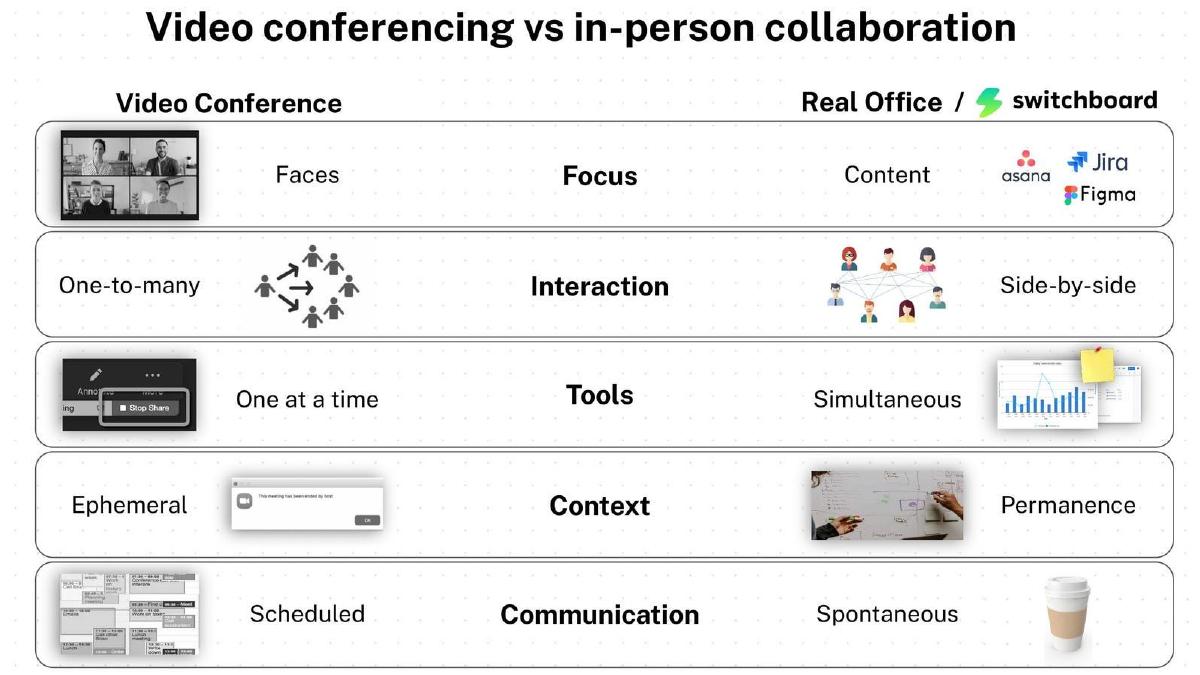
Slide 3 introduces the product interface. It highlights three key features: 'All apps,' 'Side-by-side collaboration,' and 'Permanent rooms.' The visual shows a dark-mode interface where multiple browser windows (Figma, Google Docs, etc.) are open simultaneously alongside video feeds of the participants.
Analysis: The 'Permanent rooms' feature is the most significant differentiator here. It implies a shift from synchronous meetings (which start and end) to persistent workspaces (which exist regardless of who is currently logged in). The inclusion of a 'Video' link suggests this was an interactive presentation, allowing the product to speak for itself.
Slide 4: The Macro Opportunity
Switchboard leans on third-party data to validate the market size. Citing Gallup and Fortune Business Insights, the slide notes that 53% of the workforce is 'Hybrid' and 24% is 'Exclusively Remote.' It also includes a bar chart showing the North America Team Collaboration Software Market growing from $5.68B in 2019 to a projected $40.79B by 2028.
Analysis: This slide addresses the 'Is this a big enough market?' question. By showing the global market at $17.15B in 2021 and scaling rapidly, the deck justifies a $25M investment. If the market is growing this fast, a dominant player in the 'collaboration' (not just communication) niche could be a multi-billion dollar entity.
Slide 5: The Launch Momentum
Slide 5 is the 'Traction' slide, and it focuses entirely on the company's May 2022 launch. It highlights being the '#1 Product of the Day' and '#2 Product of the Week' on Product Hunt. The key metric provided is '1,200 new teams within the first week' with '$0 paid marketing.'
Analysis: For a Series A, investors want to see organic pull. The 1,200 teams metric is powerful because it represents 'teams,' not just individual users. In enterprise SaaS, team-based adoption is the precursor to seat-based revenue. The $0 marketing spend indicates a high K-factor (virality) and strong product-market fit.
Slide 6: Social Proof and Early Praise
The final slide in the provided sequence is a collage of 'Early praise.' It features tweets and testimonials from industry figures like Chris Messina (credited with inventing the hashtag) and various CEOs. One quote stands out: 'Once you try it for 10 minutes... every subsequent non-Switchboard call will feel woefully incomplete.'
Analysis: This slide serves to mitigate the 'product risk.' If influential early adopters in the tech space are 'blown away,' it suggests the user experience lives up to the 'as good as in person' promise on Slide 1. The inclusion of an Instagram Reel screenshot also suggests the product has a visual appeal that lends itself to social sharing.
What Switchboard Does Well
Founder-Market Fit: The deck is built around the credibility of Amir Ashkenazi. In the venture capital world, a founder with $1.1B in exits is often given the benefit of the doubt on metrics that would sink a first-time founder. The deck leans into this strength immediately.
Category Creation: Switchboard successfully differentiates itself from the 'Red Ocean' of video conferencing. By framing the problem as a lack of 'doing' rather than a lack of 'seeing,' they move the goalposts for what a 'collaboration' tool should be.
Momentum Over Metrics: At the time of this raise, Switchboard was likely very early in its revenue journey. The deck smartly focuses on 'teams joined' and 'Product Hunt rankings' rather than MRR (Monthly Recurring Revenue). This keeps the conversation focused on the vision and the viral potential rather than the current bank balance.
What is Missing from the Deck
The Business Model: There is no mention of how Switchboard intends to make money. While a 'freemium' model is implied by the '1,200 teams' metric, the deck lacks a slide on pricing tiers, enterprise features, or projected Average Revenue Per User (ARPU).
The Full Team: Aside from the CEO, the deck (in the provided slides) does not introduce the CTO, Head of Product, or the engineering team. For a technically complex product involving shared browser states and low-latency video, the 'who is building this' is just as important as 'who is leading this.'
The Ask: The deck does not explicitly state how much they are raising or what the milestones for the next 18 months are. While the publisher reports a $25M raise, a standard pitch deck usually includes a slide detailing the use of funds (e.g., 50% Engineering, 30% GTM, 20% Ops).
Competitive Landscape: While Slide 2 alludes to Zoom, there is no formal competitive matrix. In 2022, companies like Miro, Mural, and even Slack were moving into the 'collaborative canvas' space. Switchboard ignores these competitors in the deck, choosing instead to focus entirely on its own narrative.
Lessons for Founders
Lead with your 'Unfair Advantage': If you have a massive exit, a PhD in a relevant field, or a patent, it should be on Slide 1. Switchboard didn't bury the $1.1B exit in the back; they used it as the hook. · Use 'The Checklist' to Frame the Problem: Slide 2 is a perfect example of how to visually demonstrate a gap in the market. By showing what competitors can do and highlighting the one thing they can't, you create an immediate need for your solution. · Focus on 'Teams' for Enterprise SaaS: If you are building a B2B tool, individual user signups are a vanity metric. Switchboard’s focus on '1,200 new teams' is a much stronger signal of potential enterprise value. · Leverage Social Proof Early: Even if you don't have revenue, you can have 'praise.' Collecting testimonials from 'Product Hunters' and industry influencers can fill the gap where financial metrics would usually sit in a later-stage deck.
Frequently asked questions
- What was the primary traction metric used in the Switchboard deck?
- Switchboard focused on rapid adoption following their public launch. Slide 5 highlights that they acquired 1,200 new teams within the first week. Crucially, they noted this was achieved with $0 in paid marketing, signaling strong organic demand and product-market fit among early adopters.
- How did Switchboard differentiate itself from Zoom or Microsoft Teams?
- On Slide 2, Switchboard explicitly labels existing platforms as 'just communication tools.' While competitors allow users to 'see & hear each other' and 'show a screen,' Switchboard claims they fail to let users 'do anything together.' The solution, shown on Slide 3, involves a persistent workspace where all apps can be used side-by-side.
- Why is the founder's exit history featured so prominently?
- Founder Amir Ashkenazi's history of $1.1B in exits is placed on the title slide (Slide 1). For a $25M Series A, investors are betting on the jockey as much as the horse. This pedigree reduces perceived execution risk and justifies a larger capital injection at an earlier stage of the product lifecycle.
- What market trends did the deck capitalize on?
- Slide 4 utilizes Gallup and Fortune Business Insights data to show that 77% of the workforce is expected to be 'Exclusively Remote' or 'Hybrid' in 2022 and beyond. It positions Switchboard as the essential infrastructure for a market growing toward a $40.79B valuation by 2028.
- What is missing from the Switchboard pitch deck?
- The deck is notably missing a business model slide, a detailed team slide (beyond the CEO), a roadmap, and a specific 'Ask' detailing how the $25M would be spent. It functions more as a vision and momentum deck than a granular operational plan.