Anvil’s Series A deck, which secured $5M in 2023, is notable for its brevity and conceptual clarity. Rather than overwhelming investors with complex spreadsheets, the 10-slide deck focuses on a singular thesis: paperwork is the bottleneck of modern business, and APIs are the solution. The presentation moves quickly from the problem of 'PDF-first' workflows to a three-pillar product solution (PDF API, E-Sign, and Workflows). While it lacks traditional slides for team, competition, and a specific financial 'ask,' it compensates with strong social proof from high-growth vertical SaaS customers l…
Key takeaways
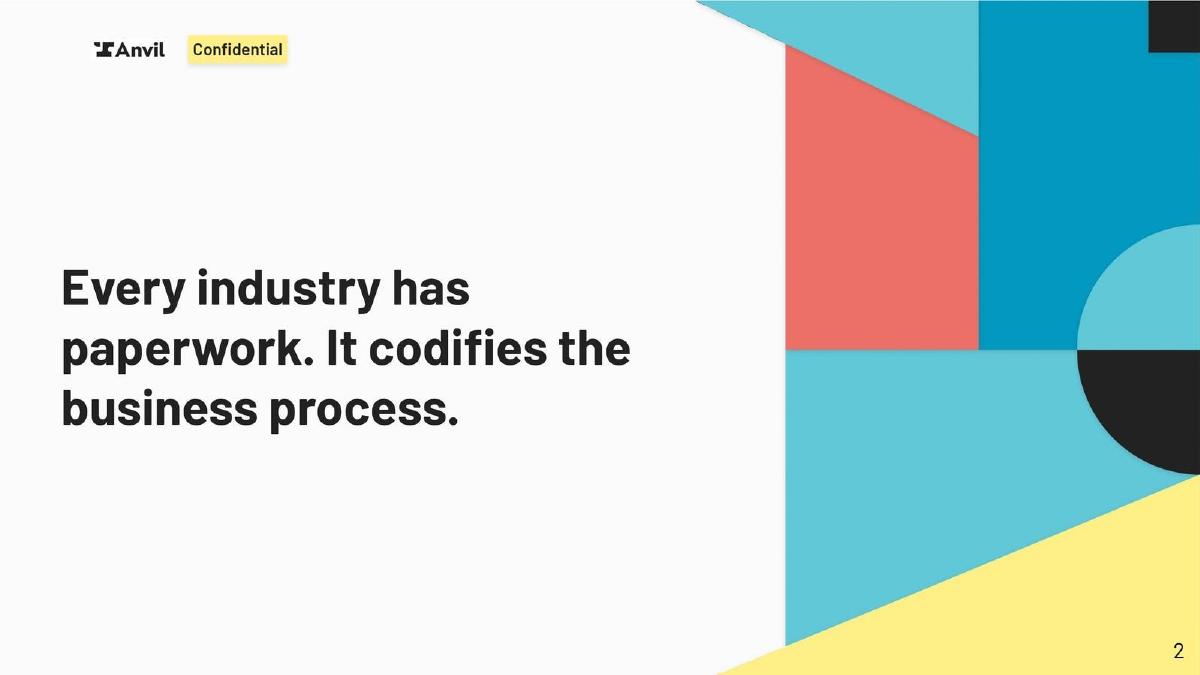
- The deck frames paperwork not as a nuisance, but as the 'codification of business process' on slide 2.
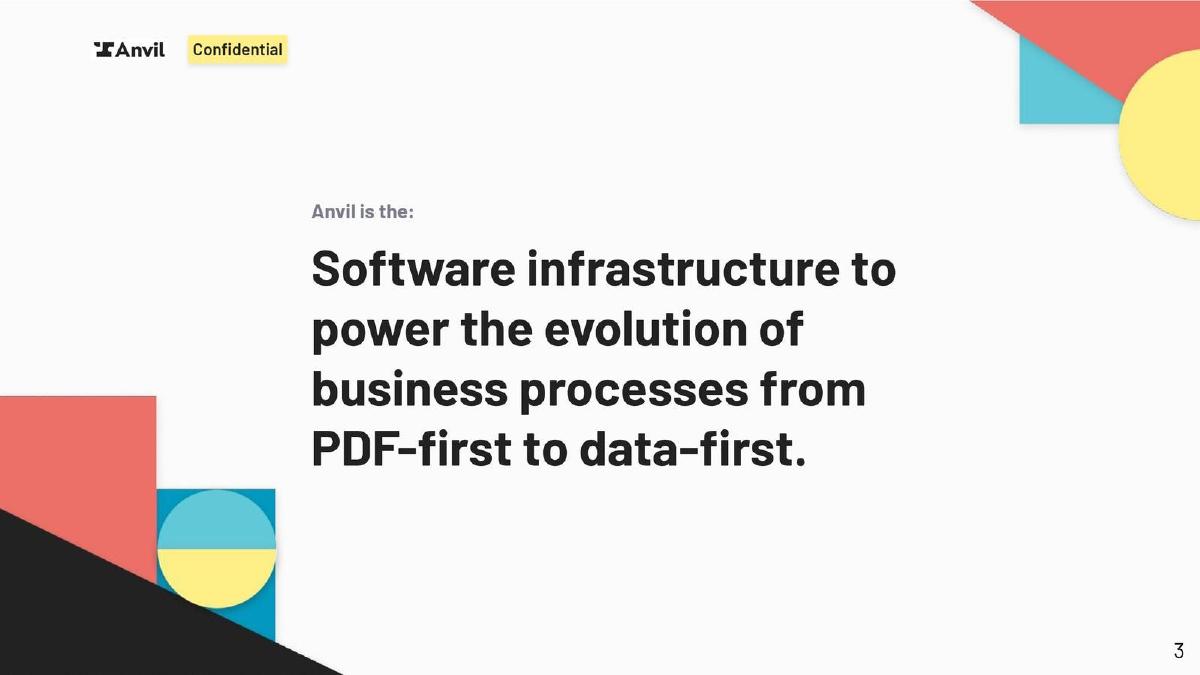
- Anvil positions itself as the infrastructure for a 'data-first' evolution, moving away from legacy PDF-centric models (slide 3).
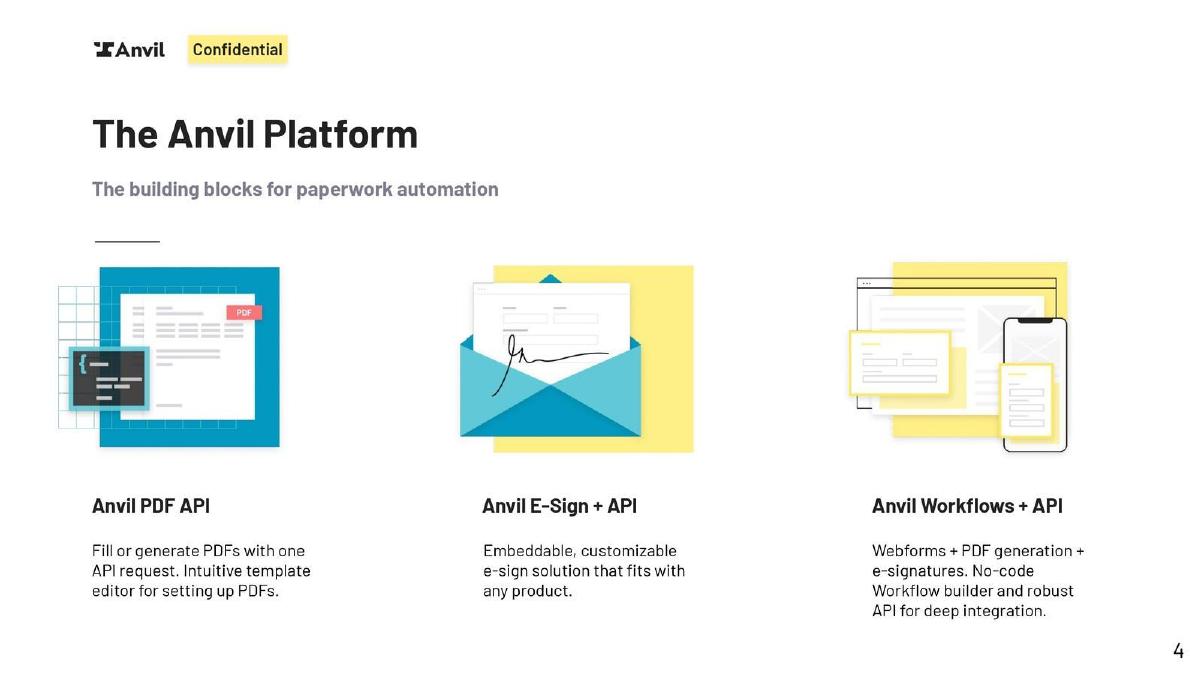
- Product functionality is broken down into three distinct building blocks: PDF API, E-Sign + API, and Workflows + API (slide 4).
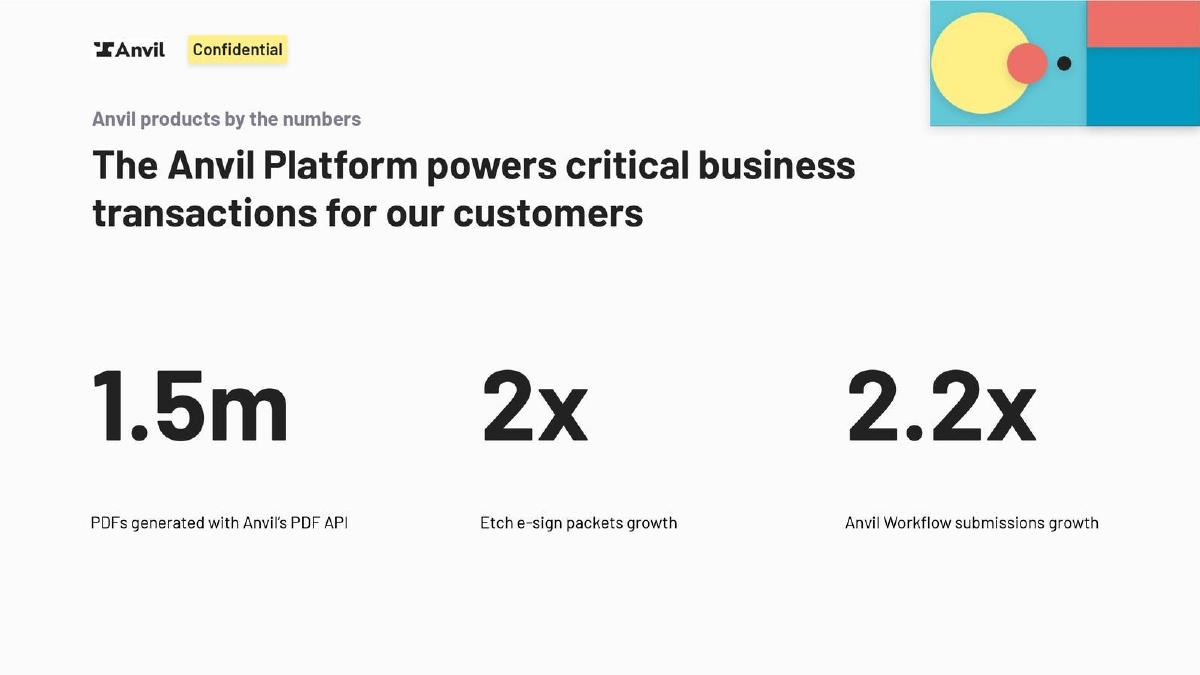
- Traction is demonstrated through high-level growth metrics, including 1.5 million PDFs generated and 2.2x growth in workflow submissions (slide 5).
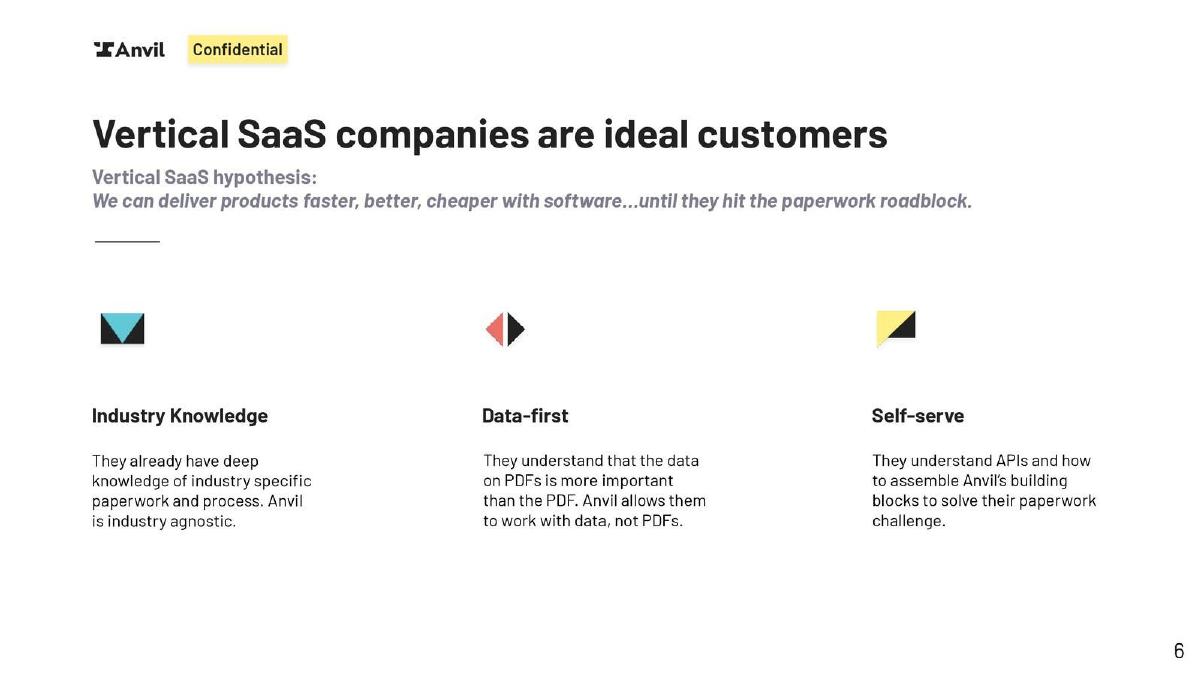
- The company identifies Vertical SaaS as its ideal customer profile, citing their industry knowledge and self-serve capabilities (slide 6).
- The deck provides a clear breakdown of how different internal teams (Ops, Product, Engineering) interact with the platform (slide 7).
- Social proof is concentrated on slide 8, featuring logos from major fintech and proptech players like Carta, Vouch, and Flyhomes.
- The deck entirely omits a team slide, financial projections, and a specific funding 'ask' within the 10-slide sequence.
The Narrative of Infrastructure: Anvil's Series A Teardown
Anvil's Series A pitch deck is a study in minimalist communication. Raising $5M in 2023, the company presented a 10-slide deck that avoids the clutter of traditional enterprise software pitches. Instead of deep-diving into the mechanics of OCR or data extraction, Anvil sells a vision of a 'data-first' future. As reported by Business Insider, this round was intended to fuel their mission of automating the paperwork that still clogs modern business processes.
Slide 1: Title and Positioning
The cover slide is clean, featuring the company logo and a simple subtitle: "APIs for paperwork and business process." This immediately identifies Anvil as a developer-first tool. By including the URL (useanvil.com) and the 'Confidential' tag, the slide sets a professional, standard tone for a Series A presentation. The geometric art style on the right side of the slide establishes a brand identity that feels modern and architectural, reinforcing the 'infrastructure' theme.
Slide 2: The Universal Problem
Slide 2 makes a bold, philosophical claim: "Every industry has paperwork. It codifies the business process." This is a sophisticated way of framing a problem. Rather than saying 'paperwork is annoying,' Anvil argues that paperwork is the actual logic of a business. This elevates the company's importance; if you control the paperwork, you control the business process itself. It’s a high-level 'Why' that applies to almost every sector, suggesting a massive Total Addressable Market (TAM) without needing a specific dollar-value slide.
Slide 3: The Mission Statement
Slide 3 defines Anvil as the "Software infrastructure to power the evolution of business processes from PDF-first to data-first." This is the core thesis of the deck. It identifies the 'villain' (the PDF) and the 'hero' (data-first infrastructure). For investors, this signals that Anvil isn't just a document editor; it is a foundational layer for the next generation of business software. The use of the word 'evolution' suggests an inevitable market shift that the company is positioned to capture.
Slide 4: The Product Building Blocks
This slide introduces the 'Anvil Platform' and breaks it down into three distinct modules: Anvil PDF API , Anvil E-Sign + API , and Anvil Workflows + API . By calling these 'building blocks,' Anvil appeals to the developer-centric nature of their product. The descriptions are concise: filling PDFs with one API request, embeddable e-signatures, and no-code workflow builders. This slide successfully explains what the product actually does after the high-level philosophy of the previous slides.
Slide 5: Traction by the Numbers
Slide 5 provides the quantitative proof of the platform's utility. It lists three key metrics: 1.5m PDFs generated, 2x growth in Etch e-sign packets, and 2.2x growth in Anvil Workflow submissions. While these numbers lack a specific timeframe (e.g., 'in the last 12 months'), they demonstrate significant volume and momentum. The 1.5 million figure is particularly strong for a Series A, suggesting the API is already deeply integrated into customer workflows.
Slide 6: The Ideal Customer Profile (ICP)
Anvil explicitly identifies "Vertical SaaS companies" as their target market on Slide 6. They provide a three-part rationale for this focus: Industry Knowledge (customers know the paperwork), Data-first (customers value data over PDFs), and Self-serve (customers understand how to use APIs). This is a strategic masterstroke. It tells investors that Anvil doesn't need a massive, expensive sales force to educate legacy industries; they can sell to other software companies who then do the heavy lifting of industry-specific implementation.
Slide 7: User Personas and Use Cases
Slide 7 details how different teams within a Vertical SaaS company use Anvil. It segments the value proposition into Anvil Builders (for Ops/Business teams), Embedded in Products (for Product/Design), and API + Webhooks (for Engineering). This demonstrates that Anvil is a 'sticky' product that provides value across the entire organization, reducing the likelihood of churn and increasing the potential for internal expansion.
Slide 8: Social Proof and Logos
This is arguably the most important slide in the deck. It lists "Innovative Vertical SaaS companies" that build with Anvil, categorized by industry: InsurTech (Vouch, Ascend, Newfront), PropTech (Vero, Flyhomes), HRTech (Seso, jobandtalent, Ganaz), and FinTech (Carta, MainStreet, collective). The inclusion of Carta, a heavyweight in the equity management space, provides immense credibility. If Carta trusts Anvil for their document infrastructure, it validates the platform's security and reliability for other high-stakes financial applications.
Slide 9: The Closing Vision
The penultimate slide reiterates the company's purpose: "Anvil supports companies redefining legacy industries by powering the transition from paperwork to datawork." It introduces the term 'datawork' as a counterpoint to 'paperwork,' effectively branding the category they intend to lead. This slide brings the narrative full circle, returning to the high-level vision established at the beginning of the deck.
Slide 10: Conclusion
The deck ends with a simple "Thank you" slide. Like the rest of the presentation, it is devoid of unnecessary contact information or social media links, assuming that the audience (the investors in the room) already has the means to reach the founders. It maintains the minimalist, confident aesthetic of the brand.
What Works in the Anvil Deck
The most successful element of this deck is its clarity of purpose . Anvil does not try to be everything to everyone. By narrowing their focus to Vertical SaaS companies, they present a highly efficient go-to-market strategy. Investors love efficiency, and the idea that Anvil can grow by 'piggybacking' on the growth of other successful SaaS companies is a compelling investment thesis.
Furthermore, the modular product description on Slide 4 is excellent. It avoids technical jargon while clearly explaining the three ways a customer can pay for and use the service. This makes the business model feel tangible and scalable. The social proof on Slide 8 is also top-tier; for a Series A company, having a roster of well-funded, recognizable customers like Vouch and Carta is often more persuasive than any financial projection.
What is Missing from the Anvil Deck
Despite its success in raising $5M, the deck has several notable omissions that would typically be expected in a Series A presentation. First, there is no team slide . While the founders' backgrounds were likely discussed, the absence of a slide highlighting their technical expertise or previous successes is unusual. For an infrastructure company, the 'pedigree' of the engineering team is usually a key selling point.
Second, there is no competitive landscape . The deck assumes that the transition from 'PDF-first to data-first' is a blue ocean, but in reality, Anvil competes with legacy players like DocuSign and Adobe, as well as other API-first document tools. Omitting the competition can sometimes make a founder look naive, though in this case, the customer logos likely served as a proxy for competitive superiority.
Finally, there is no 'Ask' slide . The deck does not specify how much money is being raised or how the funds will be allocated (e.g., hiring, R&D, marketing). While this information is often shared in the verbal pitch or a separate term sheet, its absence in the deck makes the presentation feel more like a brand overview than a formal solicitation for capital.
What Founders Should Copy
Founders should emulate Anvil's narrative framing . Instead of describing their product as a 'tool,' they describe it as 'infrastructure for an evolution.' This shift in language allows them to claim a much larger piece of the value chain. If you are building a B2B tool, try to identify the 'legacy' format you are replacing (like the PDF) and name the 'new' format you are enabling (like 'datawork').
Another takeaway is the segmentation of the ICP . Anvil’s Slide 6 is a perfect example of how to explain why a specific customer segment is the path of least resistance. By explaining that Vertical SaaS companies are 'self-serve' and 'understand APIs,' they demonstrate a deep understanding of their own sales cycle. If you can prove that your customers are predisposed to buy your product without a heavy sales lift, your valuation will benefit. Finally, the visual consistency of the deck—using a unified color palette and geometric theme—creates a sense of polish and professionalism that suggests the company pays similar attention to detail in its code and product design.
Frequently asked questions
- Why does the deck omit a team slide?
- For a Series A, the team is often already known to the lead investors or discussed in detail during the meeting. Anvil likely chose to focus the visual presentation on the product's scalability and its role as infrastructure, rather than the individual biographies of the founders, assuming that credibility was established elsewhere in the diligence process.
- Is 10 slides enough for a Series A raise?
- While 10 slides is shorter than the average 15-20, it is sufficient if the narrative is tight. Anvil focuses on the 'why now' and the 'who uses it.' By showing that industry leaders like Carta use their API, they reduce the need for exhaustive market size or competitive analysis slides, as the customer list validates the market need.
- What is the significance of the 'Vertical SaaS' focus?
- Vertical SaaS companies are 'ideal customers' because they have the industry-specific context but lack the specialized infrastructure for document automation. By targeting these companies, Anvil positions itself as a force multiplier that allows other software companies to ship faster, rather than trying to sell directly to fragmented legacy businesses.
- How does Anvil define its product categories?
- Anvil categorizes its platform into three 'building blocks': a PDF API for generation, an E-Sign API for signatures, and a Workflows API for webforms and logic. This modular approach tells investors that the company has multiple entry points into a customer's tech stack and can expand its footprint over time.
- What is missing from the traction slide?
- Slide 5 shows growth (2x, 2.2x) and volume (1.5m), but it lacks revenue figures, churn rates, or Net Revenue Retention (NRR). While the growth percentages are impressive, they are 'vanity-adjacent' without the underlying dollar amounts, which were likely reserved for the data room rather than the pitch deck.