Asia Pacific DealFlow is a deal management and promotion platform targeting the complex ecosystem of agents, angel investors, and venture capital in the APAC region. The deck describes a two-pronged revenue model: a USD$100 per month listing fee for direct deal profiles and a USD$150 per month subscription for 'APDealRoom,' a secure virtual data room service. The platform features include public/private deal profiles, picture galleries, and live web conferencing for virtual pitching. Notably, the deck references the upcoming 2012 US JOBS Act as a catalyst for crowdsourcing legitimacy. However…
Key takeaways
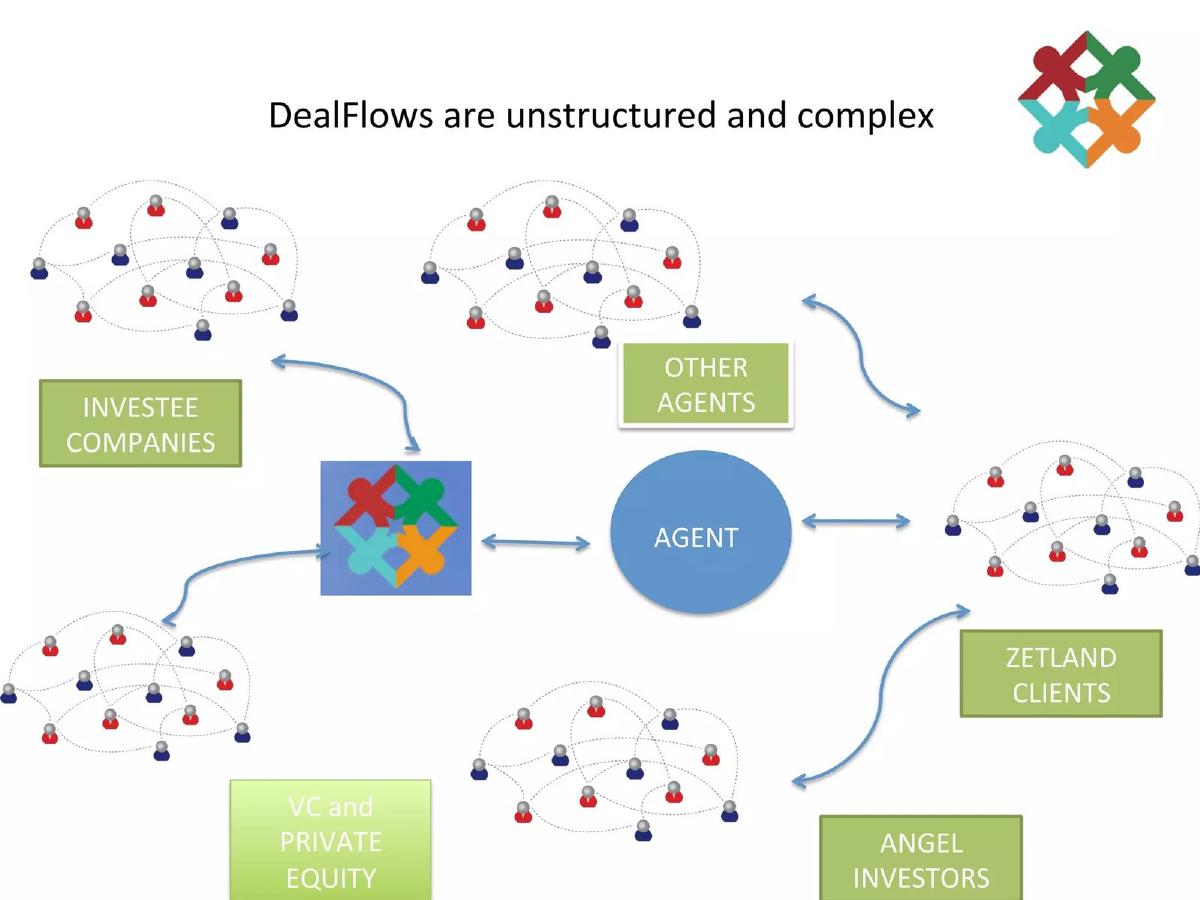
- The platform aims to centralize unstructured deal flow between agents, VCs, private equity, and angel investors (Slide 2).
- Direct users are charged a USD$100 per month listing fee to host their deal profiles on the platform (Slide 3).
- Deal profiles include a 180-character short description, executive summaries, and downloadable PDFs (Slide 4).
- The 'APDealRoom' product is a secure virtual data room priced at USD$150 per month, featuring audit trails and watermarking (Slide 8).
- The company utilizes live web conferencing to facilitate virtual pitching and initial meetings between founders and investors (Slide 7).
- The deck anticipates the US JOBS Act of April 2012 as a major driver for the legitimacy of crowdsourcing models (Slide 9).
- Several slides contain placeholder text like 'XXX' and 'YCCCC,' indicating the deck was in a draft state (Slide 6).
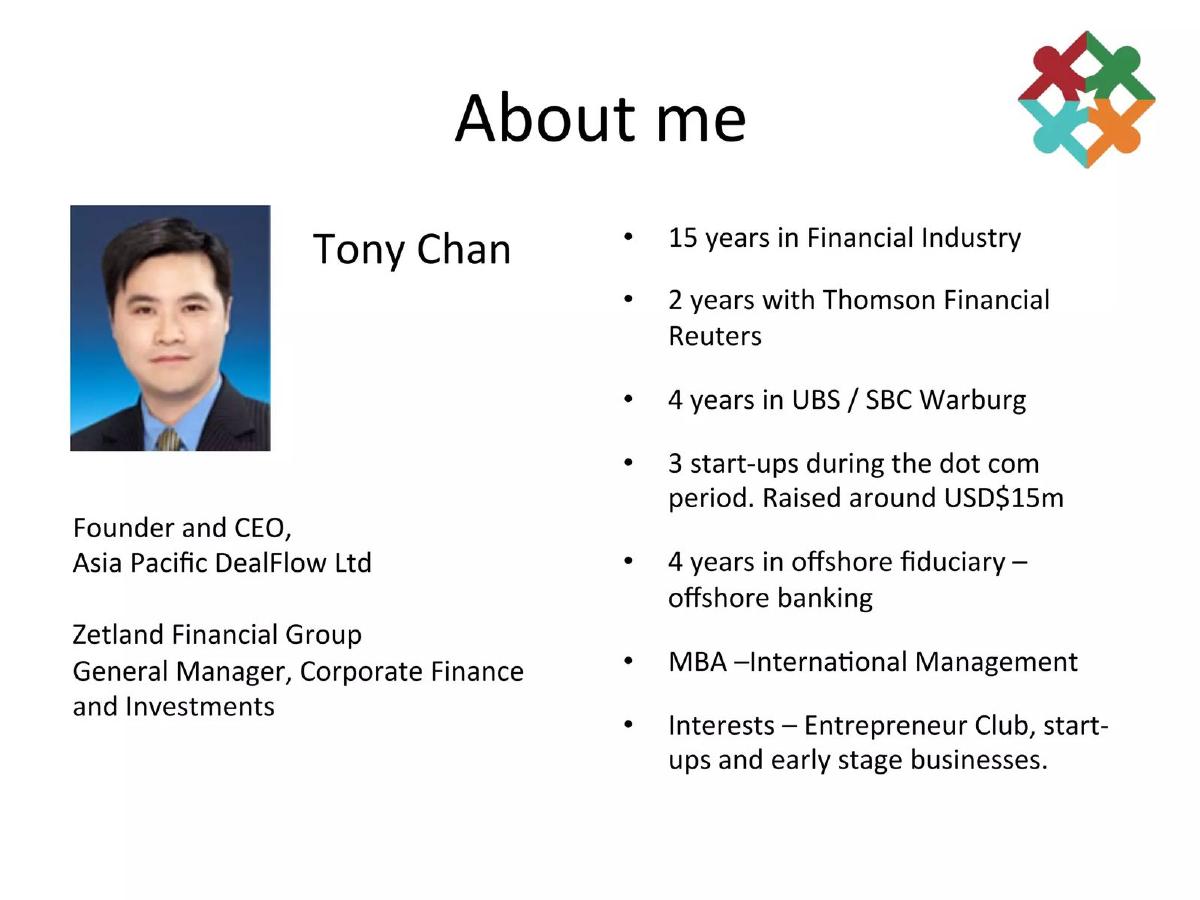
- There is no mention of the founding team, current user traction, or the amount of capital being raised.
Asia Pacific DealFlow: A Product-Centric Walkthrough
The Asia Pacific DealFlow deck is less of a traditional venture pitch and more of a functional product overview. It focuses heavily on the mechanics of how deals are listed, managed, and shared within a closed ecosystem of financial agents and investors. While it identifies a clear pain point—the messy, unstructured nature of private equity deal flow—it lacks the narrative arc typically required to secure institutional funding.
Slide 1: Title Slide
The deck opens with the company name 'Asia Pacific DealFlow' and the subtitle 'A platform for sharing DealFlows with Agents and Investors.' The branding uses a four-person interlocking icon in green, red, teal, and orange, suggesting collaboration and networking.
Slide 2: The Problem Statement
Slide 2 explicitly states that 'DealFlows are unstructured and complex.' It uses a network diagram to show the fragmented relationships between Investee Companies, Agents, VC/Private Equity, Angel Investors, and 'Zetland Clients.' The platform's logo is placed in the center, indicating its role as the connective tissue for these disparate groups.
Slide 3: Business Model
This slide is sparsely populated. It lists a 'Direct' business model consisting of a 'USD$100 per month listing fee' and 'Direct contact.' A 'With Agent' header is present on the left but contains no text, leaving the specifics of the agent-led revenue model unexplained.
Slide 4: Create Deals – Deal Profile
This slide provides a screenshot of a sample deal for a company called 'Aquaflow.' It details the 'Create Deal' function, which allows users to build a one-page public bio. Key features cited include a 180-character short description, the ability to add multiple pictures, and options for an Executive Summary. The slide notes that profiles can be public (like TechCrunch) or private via a hidden URL. The sample deal shows a 'Target Deal Amount' of USD$2,500,000 for a New Zealand-based company.
Slide 5: Create Deals – Picture Galleries
Focusing on the visual aspects of a deal listing, this slide shows a tabbed interface with sections for 'Biz Plan,' 'Financial,' 'Operating,' and 'Pictures.' It emphasizes the ability to add galleries of pictures to be viewed in a slideshow by the user. The example uses 'Green Leaf Film Studios' as a placeholder.
Slide 6: Q&A – Deal Creation
This slide appears to be a draft or template. It lists four questions regarding deal completion, public listings, deal preferences, and next steps. However, the answers are represented by placeholders: 'XXX,' 'How do I set my Deal Preferences?,' and 'YCCCC.' This indicates the deck was likely not in a final, investor-ready state when published.
Slide 7: Promoting Deals – Live Web Conferencing
The company highlights its use of 'live conferencing to do virtual pitching or initial Meetings.' The slide claims this saves time and money for both the company and the potential investor. A clip-art graphic depicts a central presenter connected to multiple remote workstations.
Slide 8: APDealRoom – Secure Virtual Deal Rooms
This slide introduces a secondary product called 'APDealRoom,' described as 'Instant secure virtual deal rooms.' It is priced at 'USD$150 per month' with a 'Free Trial Now.' The slide lists use cases such as M&A, due diligence, and fund raising. Features include secure file sharing, watermarking, audit trails, and advanced permissions. A diagram shows a 'Sender' locking documents that are then accessed by multiple 'Receivers.'
Slide 9: Crowd Sourcing Model
The final slide in the sequence addresses the regulatory environment. It notes that 'Crowdsourcing will become legitimate as a form of raising capital in the US' with the 'US JOBS Act to be signed in April 2012.' This dates the deck to early 2012 and suggests the platform was positioning itself to capitalize on the legalization of equity crowdfunding.
What Works in This Deck
Clear Pricing: The deck does not hide its cost. Stating USD$100 for listings and USD$150 for deal rooms provides an immediate understanding of the unit economics and the SaaS nature of the business.
Product Visualization: By including actual screenshots of the deal profiles and the tabbed navigation (Slides 4 and 5), the founders show that the product is likely built and functional, rather than just a concept.
Market Timing: Referencing the JOBS Act (Slide 9) shows an awareness of macro-regulatory shifts that could significantly expand the addressable market for deal-sharing platforms.
What Is Missing
The Team: There is no information regarding who is building this. In early-stage fintech and deal platforms, the credibility of the founders is paramount. Without a team slide, investors cannot assess the company's ability to navigate the complex regulatory and networking requirements of the APAC financial sector.
Traction: The deck mentions a sample deal (Aquaflow), but it does not list how many active deals are on the platform, the total dollar volume of deals facilitated, or the number of active investors/agents using the system.
Market Size: There is no attempt to quantify the 'Asia Pacific' opportunity. Investors need to see the Total Addressable Market (TAM) to understand if a USD$100/month subscription model can scale into a significant business.
The Ask: The deck never specifies how much money is being raised, what the valuation is, or how the funds will be allocated (e.g., engineering, sales, marketing).
Founder Takeaway: The Dangers of Placeholders
The most significant lesson for founders from this teardown is the danger of leaving placeholders in a deck. Slide 6, with its 'XXX' and 'YCCCC' text, immediately signals to an investor that the presentation is unfinished or that the founder is not detail-oriented. If a deck is being used for outreach, every slide must be complete. Furthermore, while product walkthroughs are useful, they should not replace the core pillars of a pitch: Team, Traction, and Market. This deck functions more as a user manual than a compelling investment thesis.
Frequently asked questions
- What is the primary problem Asia Pacific DealFlow solves?
- According to slide 2, the company addresses the fact that deal flows are currently 'unstructured and complex.' It positions itself as a central hub connecting investee companies, agents, venture capital, private equity, and angel investors to streamline communication and document sharing.
- How does the company generate revenue?
- The deck identifies two primary revenue streams. Slide 3 mentions a USD$100 per month listing fee for direct deal contacts. Slide 8 introduces the 'APDealRoom,' a secure virtual data room for due diligence and M&A, which carries a subscription fee of USD$150 per month.
- What features are included in the deal creation process?
- As shown on slides 4 and 5, users can create public or private profiles. Features include a 'TechCrunch-style' public bio, a 180-character short description, multiple picture galleries, executive summaries, and the ability to attach PDFs for download by interested parties.
- What is the significance of the JOBS Act mentioned in the deck?
- Slide 9 highlights the US JOBS Act, which was expected to be signed in April 2012. The company views this legislation as a turning point that would make crowdsourcing a 'legitimate form of raising capital' and a 'legal business model,' implying the platform intended to support this new asset class.
- Is this a complete investment deck?
- No. The provided slides lack critical investment information including a team slide, market size (TAM/SAM/SOM), competitive analysis, financial projections, and a specific funding ask. Slide 6 also contains 'XXX' placeholders, suggesting this version was a work-in-progress or a template.