Apheris presents a highly technical yet accessible 10-slide deck that focuses on the critical bottleneck of modern AI: the need for large, diverse datasets that are often locked behind privacy and intellectual property barriers. By positioning themselves as the infrastructure for 'privacy-preserving data ecosystems,' the founders—boasting PhDs and backgrounds at BCG and research institutions—successfully argued that they could unlock value in highly regulated sectors like pharma and chemicals. The deck is notable for its restraint, avoiding typical 'market size' fluff in favor of specific wor…
Key takeaways
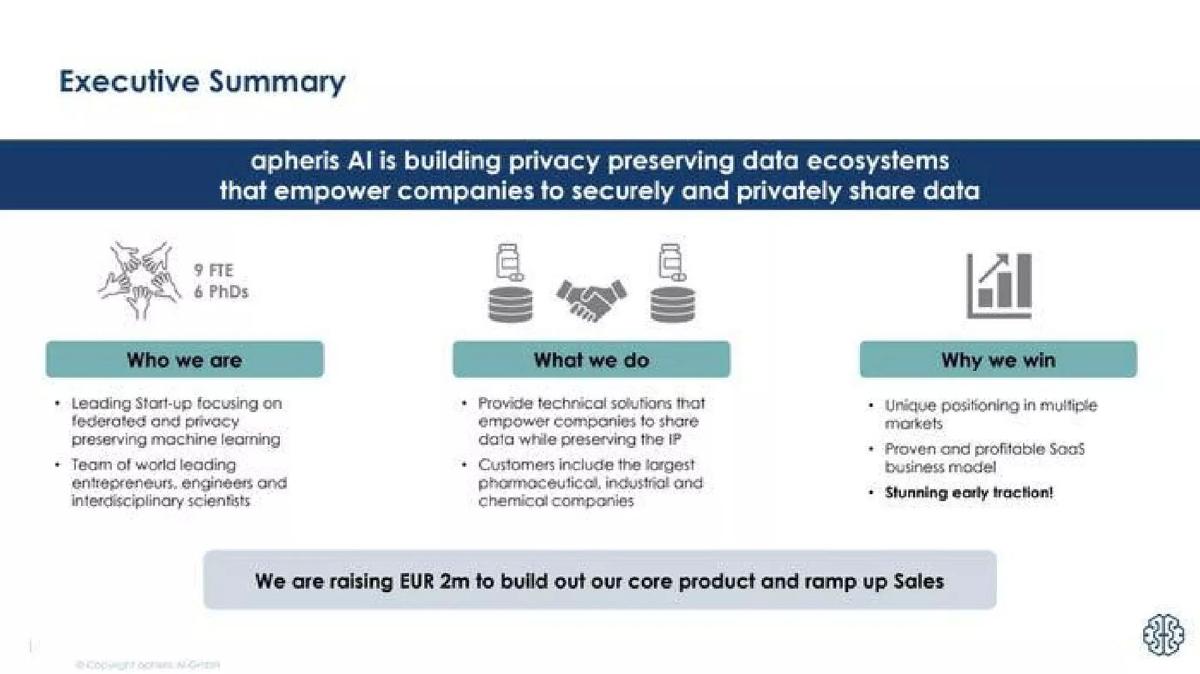
- The executive summary explicitly states an ask of EUR 2m to build the core product and ramp up sales (Slide 1).
- The team emphasizes high technical density, noting 9 FTEs with 6 PhDs on the staff (Slide 1).
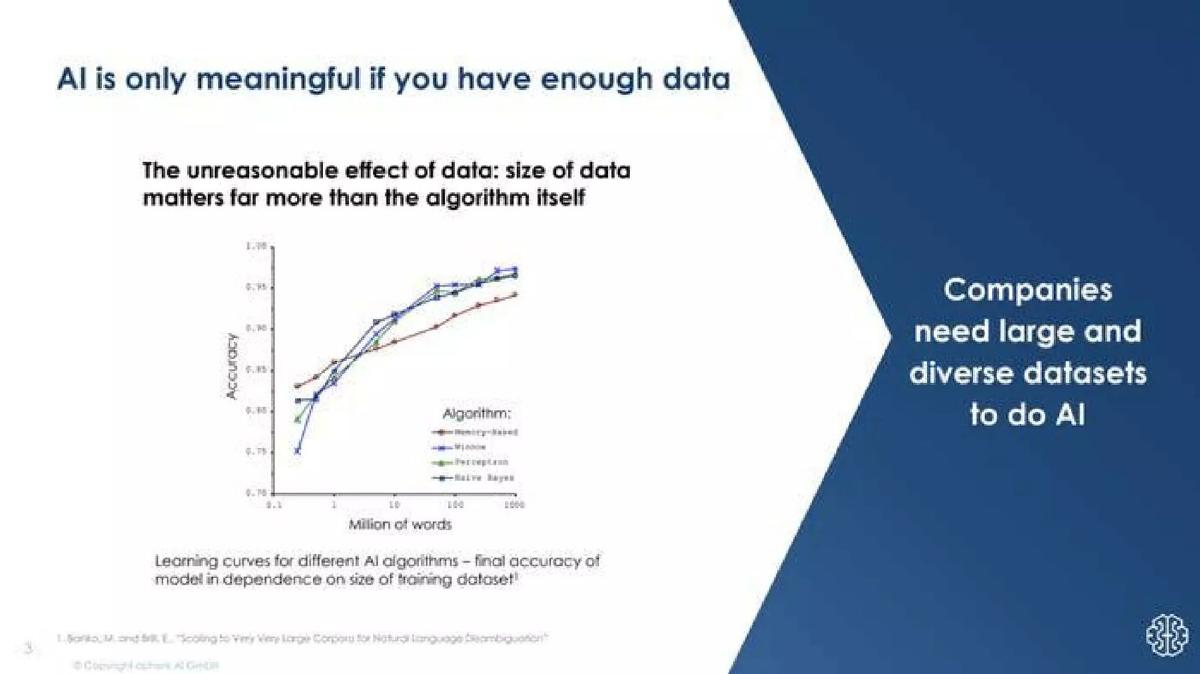
- Apheris identifies a core AI thesis: model accuracy depends more on the size of the training dataset than the algorithm itself (Slide 3).
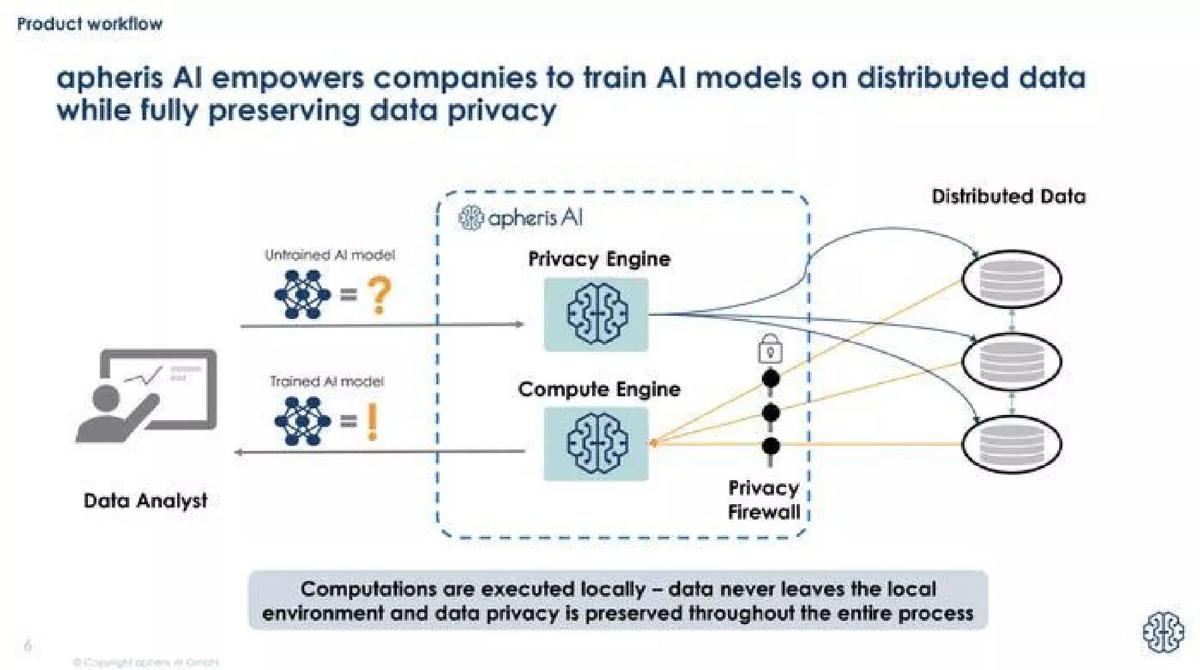
- The product workflow demonstrates that data never leaves the local environment, using a 'Privacy Engine' and 'Compute Engine' to maintain security (Slide 5).
- Traction is evidenced by 'multiple year contracts with leading enterprises' and a role as a privacy provider for COVID-19 apps (Slide 6).
- The roadmap sets a clear target of reaching more than 10 enterprise customers by Q4 2021 (Slide 7).
- The founders leverage massive brand equity by listing logos like Google, BCG, AstraZeneca, and UBS as places where the team has 'learned from the best' (Slide 8).
- The deck lacks a traditional competition slide, choosing instead to focus on their 'unique positioning' in the executive summary (Slide 1).
The Anatomy of a Technical Seed Deck
Apheris operates in the 'Other' industry category according to catalogue data, but more specifically, they are an infrastructure play for the Privacy-Enhancing Technology (PET) market. This 10-slide deck is a masterclass in selling a complex, technical solution to a high-value enterprise problem. It avoids the common mistake of over-explaining the math, focusing instead on the business outcome: unlocking AI opportunities that were previously impossible due to regulation or risk.
The Hook: Executive Summary and The AI Bottleneck
Slide 0: Title Slide The deck opens with a clean, professional aesthetic and a clear value proposition: "Collaborate on data securely without compromising privacy." The branding is understated, signaling a focus on enterprise reliability over consumer hype.
Slide 1: Executive Summary This is one of the most information-dense slides in the deck. It immediately establishes the team's technical depth (9 FTE, 6 PhDs) and their target market (largest pharmaceutical, industrial, and chemical companies). Most importantly, it puts the ask front and center: "We are raising EUR 2m to build out our core product and ramp up Sales." This transparency allows investors to immediately frame the rest of the presentation within the context of a seed-stage investment.
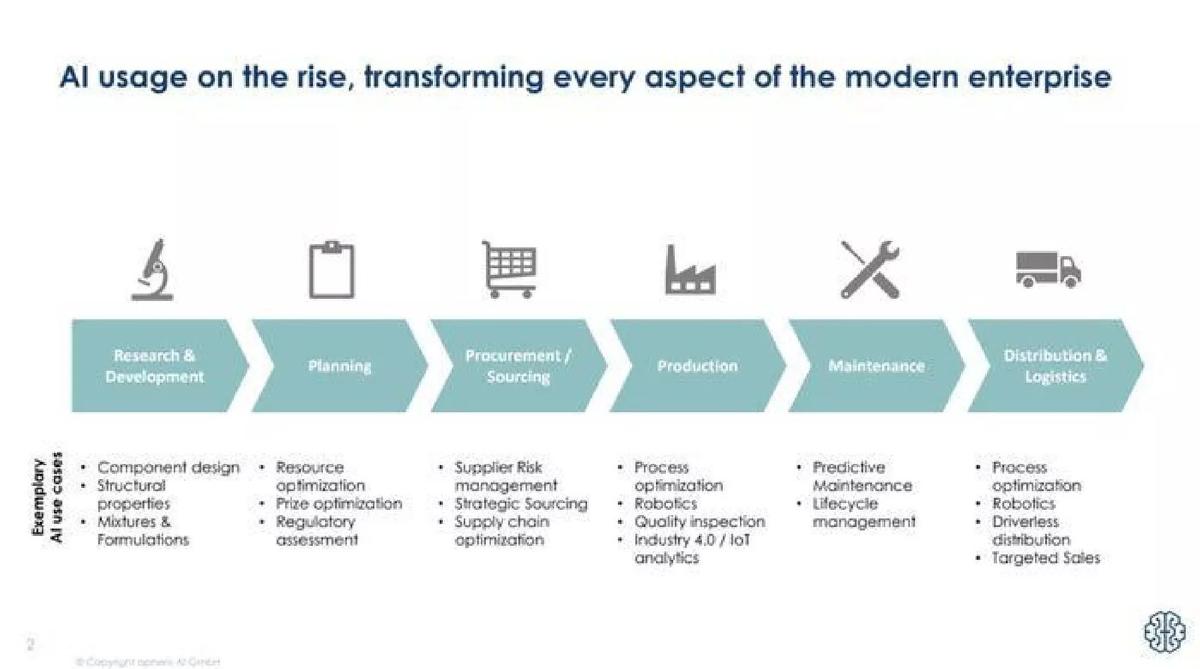
Slide 2: AI Usage on the Rise Apheris uses a horizontal chevron diagram to show AI's transformation across the enterprise value chain: R&D, Planning, Procurement, Production, Maintenance, and Logistics. By listing specific use cases like "Component design" and "Supplier Risk management," they move from abstract AI talk to concrete industrial applications.
Slide 3: The Unreasonable Effect of Data This is the 'Problem' slide, but it is framed as a technical necessity. Using a graph of accuracy versus millions of words, Apheris argues that "size of data matters far more than the algorithm itself." This sets up the logical gap: if you need more data to win, but you can't share data because of privacy, you are stuck. Apheris is the solution to this specific deadlock.
The Solution: Architecture and Workflow
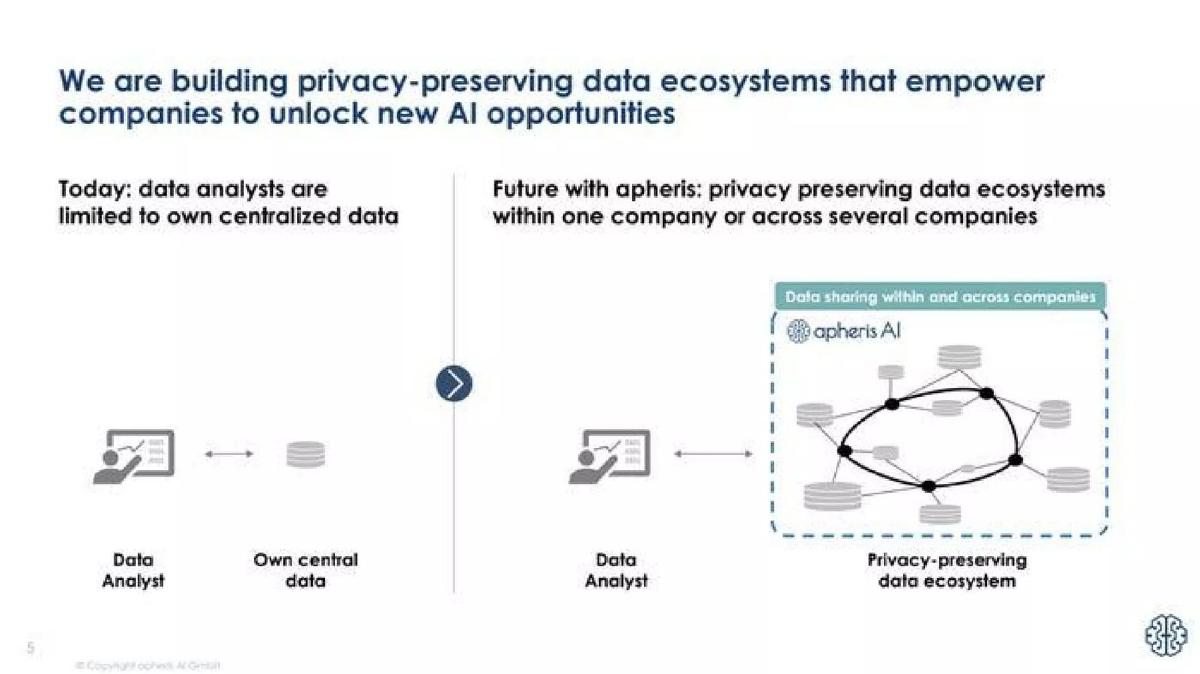
Slide 4: The Vision This slide contrasts the "Today" (data analysts limited to own centralized data) with the "Future with Apheris" (privacy-preserving data ecosystems). The visual of a decentralized web of data nodes connected by Apheris illustrates the shift from silos to a network effect.
Slide 5: Product Workflow For a technical deck, this slide is crucial. It explains the 'how' without getting lost in code. It shows an untrained model entering a box containing a "Privacy Engine" and "Compute Engine," which then interacts with "Distributed Data" behind a "Privacy Firewall." The key takeaway is highlighted in a callout: "Data never leaves the local environment." This is the primary objection-handler for any enterprise security officer.
Traction and Roadmap
Slide 6: Achievements Apheris demonstrates that they aren't just a research project. They cite "multiple year contracts" and their role in COVID-19 apps. The mention of a "massive pipeline" in pharma and chemistry suggests they have found product-market fit in sectors where data sensitivity is highest.
Slide 7: The Roadmap The timeline is aggressive but structured. Starting from an enterprise deal in February 2020, it leads to a Seed Round in July 2020, a goal of over 10 enterprise customers by Q4 2021, and a Series A in Q2 2022. This gives investors a clear set of milestones to track performance against.
The Team and Contact
Slide 8: The Team The pedigree here is the deck's strongest asset. The co-founders, Michael and Robin, possess the exact mix of academic rigor (PhDs, Medicine, Physics) and commercial experience (BCG) required for this space. The bottom of the slide is a 'logo soup' of prestigious institutions (Google, AstraZeneca, UBS, etc.) where the team has worked or studied, which serves as a proxy for quality in a highly technical field.
Slide 9: Closing The final slide provides direct contact information for the CEO, maintaining the professional and accessible tone of the entire presentation.
What Works in the Apheris Deck
Technical Credibility: By highlighting the number of PhDs on staff (Slide 1) and the founders' specific academic backgrounds (Slide 8), the deck establishes immediate authority in a field (cryptography/AI) where 'faking it' is impossible. · Visualizing the Invisible: Privacy-preserving computation is a difficult concept to visualize. Slide 5 does an excellent job of showing the flow of the model versus the stasis of the data. · Specific Industry Focus: Rather than claiming to solve data for everyone, they repeatedly mention Pharma, Chemicals, and Industrial sectors. This specificity makes the 'massive pipeline' claim more believable. · The 'Data Over Algorithm' Argument: Slide 3 provides a compelling reason for why their product is a 'must-have' rather than a 'nice-to-have.' If data size is the only way to improve AI, then a tool that unlocks more data is essential.
What is Missing from the Apheris Deck
Competitor Landscape: The deck completely omits a competitive analysis. While they mention 'unique positioning' on Slide 1, they do not explain how they differ from other federated learning startups or established cloud providers' privacy tools. · Unit Economics/Pricing: While they mention a "profitable SaaS business model" on Slide 1, there is no detail on contract sizes, implementation fees, or how they scale revenue. For a seed round, some indication of the pricing strategy is usually expected. · Market Size (TAM/SAM/SOM): There is no traditional 'trillion-dollar market' slide. While often inflated, a slide showing the specific spend on data integration or AI R&D in their target sectors would help quantify the opportunity. · Detailed Use Case: While they list many 'exemplary' use cases on Slide 2, the deck lacks a deep-dive 'Case Study' slide showing exactly how one of their 'multiple year contracts' (Slide 6) is actually using the platform to generate ROI.
What a Founder Should Copy
The Executive Summary Layout: Slide 1 is a perfect template for a seed deck. It covers 'Who,' 'What,' 'Why,' and 'The Ask' in a single, clean view. · The Problem Framing: Don't just say the problem is 'privacy.' Frame the problem as a barrier to a goal the investor already believes in (in this case, better AI through larger datasets). · The 'Learned From the Best' Section: If your team is young or the company is early, use the logos of previous employers and universities to borrow institutional trust, as seen on Slide 8. · The Roadmap Milestones: Use specific dates and quantifiable goals (e.g., "> 10 enterprise customers") rather than vague terms like "Scale" or "Growth."
Frequently asked questions
- What is the core problem Apheris is solving?
- Apheris addresses the 'data silo' problem. As shown on Slide 3, AI performance is limited by dataset size. However, companies cannot easily share data due to privacy and IP concerns. Apheris provides the infrastructure to run analytics on decentralized data without moving it, allowing for collaboration without compromising security.
- How does the Apheris technology actually work according to the deck?
- Slide 5 illustrates a workflow where a Data Analyst sends an untrained model into the Apheris 'Privacy Engine' and 'Compute Engine.' These engines interact with distributed data behind a 'Privacy Firewall.' Crucially, computations are executed locally; the data never leaves its original environment, and only the trained model (the 'insight') is returned.
- What kind of traction did Apheris have at the time of this deck?
- The company reported significant early momentum on Slide 6, including multiple-year contracts with leading enterprises and a 'very strong pharma & chemistry pipeline.' They also highlighted their role as a key privacy technology provider for COVID-19 contact tracing initiatives.
- Who are the founders and what is their background?
- The co-founders are Michael (CTO), a PhD in Physics and Computer Science with experience at BCG, and Robin (CEO), who studied Medicine, Philosophy, and Mathematics. Their combined expertise covers distributed computations and mathematical theories for data privacy, as detailed on Slide 8.
- What was the specific funding ask in this deck?
- Slide 1 and Slide 7 both state an ask of EUR 2 million. The funds were earmarked for hiring a 'world-class team,' building out data ecosystems, and creating a 'flexible core product for enterprise.' While the catalogue facts show a total of $11.7M raised, this specific deck was tailored for a EUR 2M seed milestone.