Space Forge, a Cardiff-based aerospace startup, successfully raised a $10.2M Seed round in 2022 to develop the ForgeStar, the world's first fully returnable and re-launchable satellite platform. The deck is remarkably concise at just six slides, focusing on the high-level value proposition of manufacturing advanced materials—such as semiconductors and pharmaceuticals—in the unique conditions of space (microgravity and vacuum). While the deck lacks traditional financial projections, a detailed roadmap, or a specific funding ask, it leans heavily on the founders' deep industry experience at the…
Key takeaways
- The company claims to be building the world's first fully returnable and re-launchable satellite platform, named ForgeStar (Slide 2).
- Space Forge identifies three primary barriers to in-space manufacturing: constraints of the ISS, lack of dedicated platforms, and no soft return mechanism (Slide 3).
- The solution is described as a low-cost, independent, and reusable space vehicle capable of scalable on-orbit manufacturing (Slide 4).
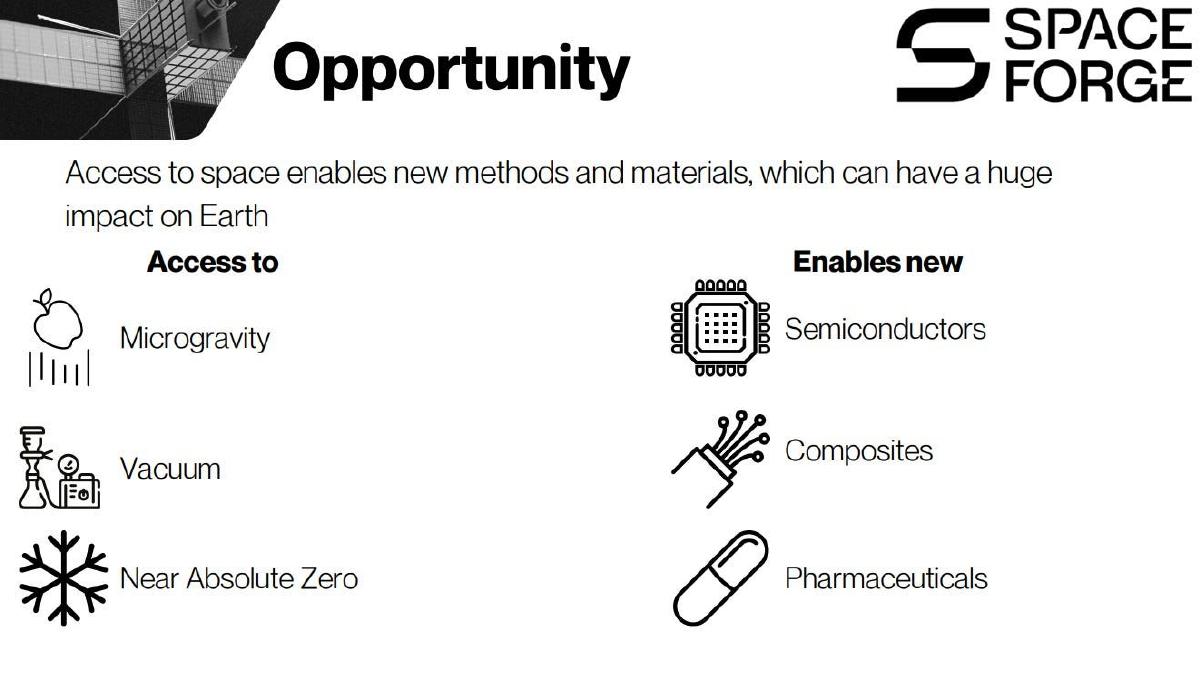
- The deck highlights three environmental advantages of space: microgravity, vacuum, and near absolute zero temperatures (Slide 5).
- Target industries for space-manufactured materials include semiconductors, composites, and pharmaceuticals (Slide 5).
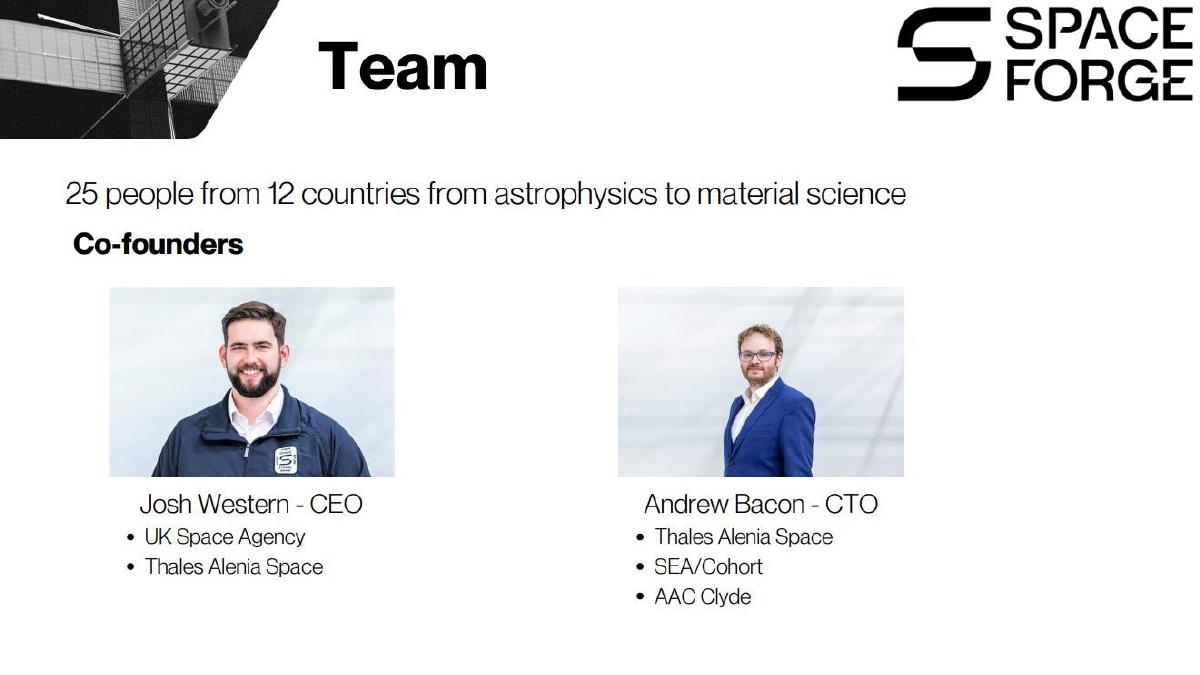
- The team consists of 25 people from 12 countries with backgrounds ranging from astrophysics to material science (Slide 6).
- Both co-founders, Josh Western and Andrew Bacon, cite experience at Thales Alenia Space, a major aerospace manufacturer (Slide 6).
- The deck omits a specific financial ask, use of funds, or business model details, suggesting it served as a high-level visual aid for a deeper conversation.
Space Forge: The 6-Slide Seed Deck for Orbital Manufacturing
Space Forge represents a growing sector of the 'New Space' economy: in-space manufacturing. While many space startups focus on launch or Earth observation, Space Forge focuses on the return trip. Their 2022 Seed round, reported by Business Insider as $10.2M, was a significant milestone for a European hardware startup. The deck they used is surprisingly brief, totaling only six slides. It functions less as a comprehensive business plan and more as a high-level vision statement designed to anchor a verbal pitch.
Slide 1: Title Slide
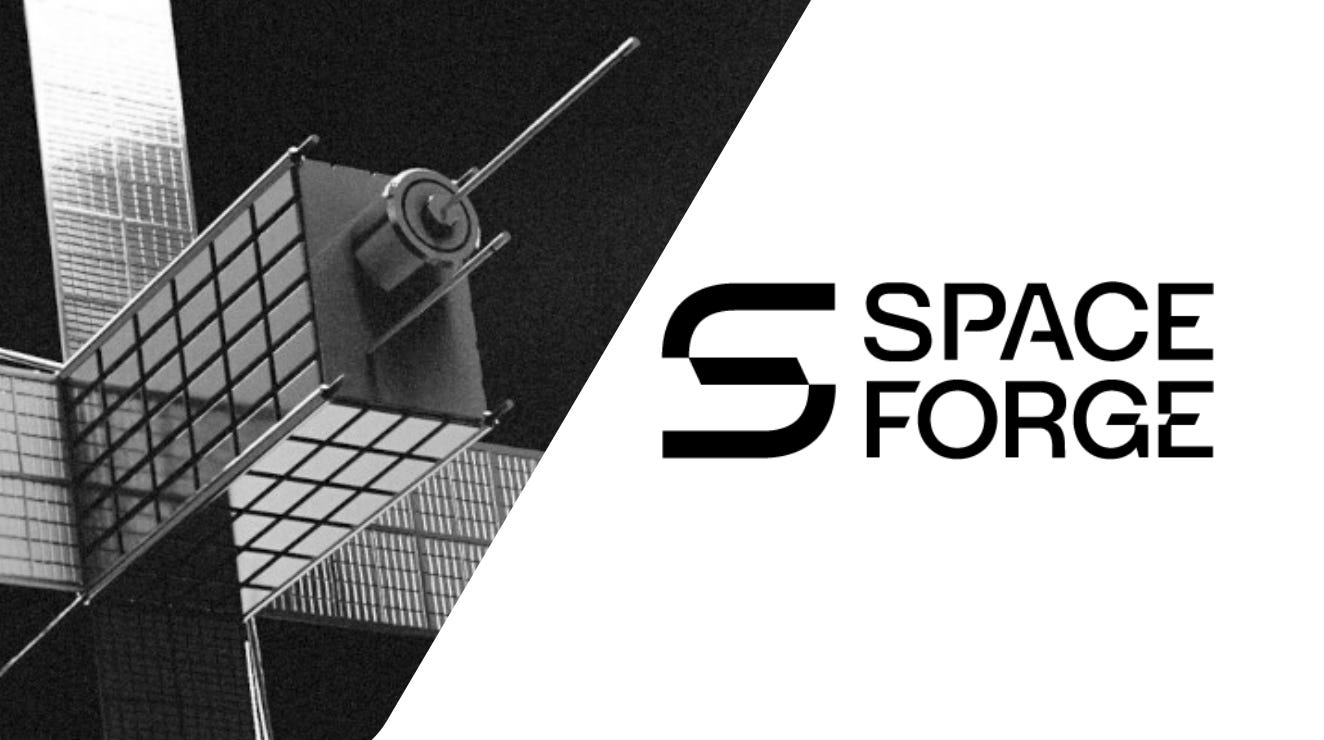
The opening slide is minimalist, featuring the company logo and a high-contrast, black-and-white image of a satellite. The branding is clean and industrial, setting a professional tone for a hardware-heavy pitch. There is no tagline or mission statement on this slide, relying entirely on the visual of the satellite to communicate the industry.
Slide 2: Introduction and The ForgeStar
Slide 2 introduces the company's core identity: 'Space Forge is an in-space manufacturing company.' It introduces the 'ForgeStar,' which it claims is the world's first fully returnable and re-launchable satellite platform. This is the central value proposition. The slide also connects the technology to terrestrial benefits, stating that materials manufactured in space can reduce energy use by 60% and assist in decarbonizing the automotive sector. This is a crucial move for a space company—linking high-cost orbital operations to massive, established markets on Earth.
Slide 3: The Problem
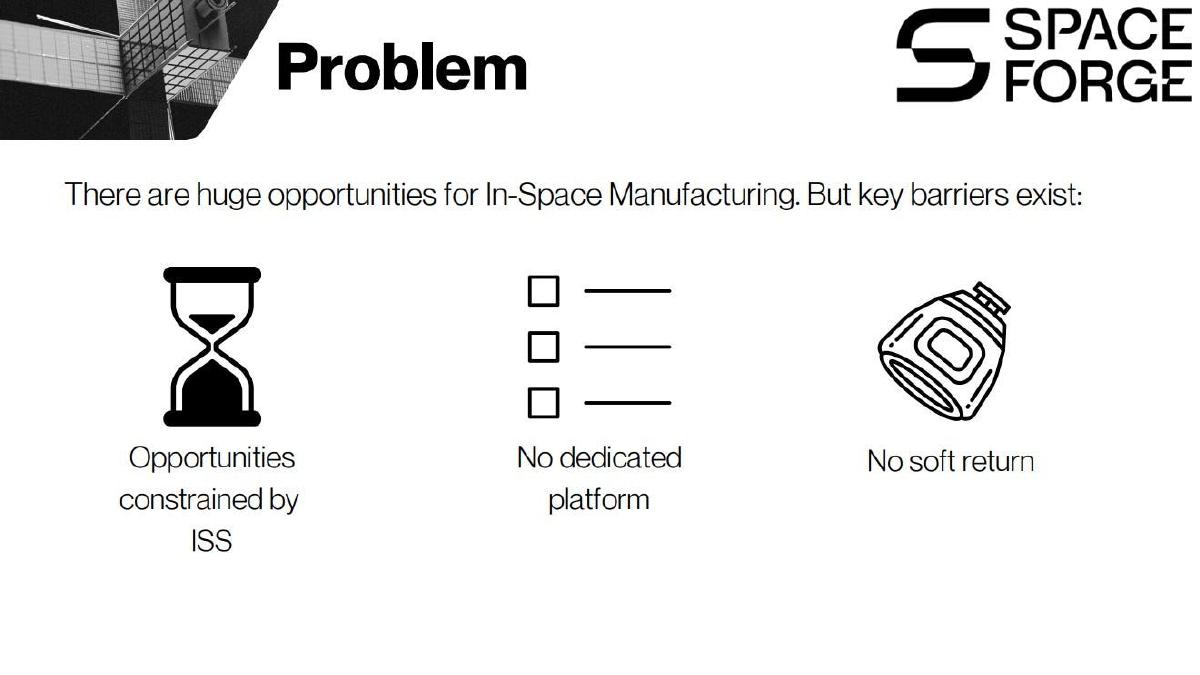
The problem slide identifies three 'key barriers' to in-space manufacturing. First, opportunities are currently 'constrained by ISS' (International Space Station), implying that relying on a shared, government-run station is too slow or restrictive. Second, there is 'no dedicated platform' for commercial manufacturing. Third, and perhaps most importantly for their business model, there is 'no soft return.' Current return methods often involve high-impact landings or destructive re-entry; Space Forge identifies the lack of a gentle, reliable way to get manufactured goods back to Earth as a primary market gap.
Slide 4: The Solution
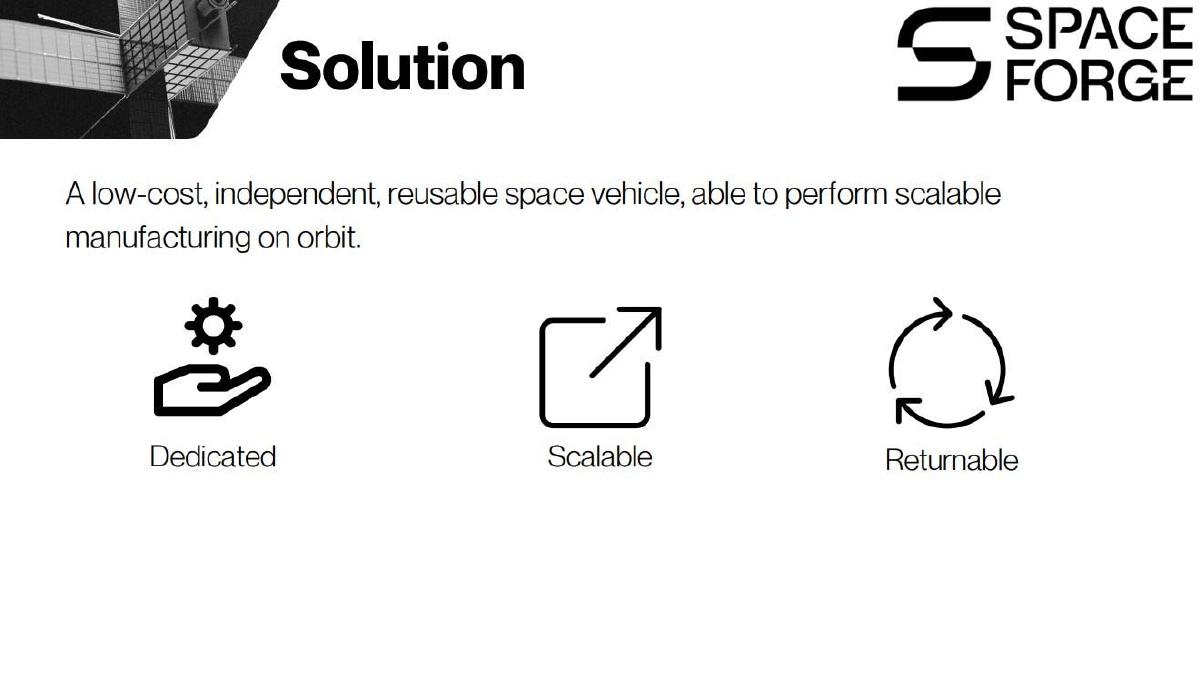
The solution is presented as a direct answer to the problems listed on the previous slide. Space Forge proposes a 'low-cost, independent, reusable space vehicle.' The slide uses three icons to emphasize that the solution is Dedicated, Scalable, and Returnable. By using the word 'independent,' they reinforce the idea that they are moving away from the constraints of the ISS mentioned in the problem slide. The focus on 'low-cost' is a standard but necessary claim in the aerospace industry, where capital expenditure is notoriously high.
Slide 5: The Opportunity
This slide explains why manufacturing in space is better. It lists three environmental factors available in orbit: Microgravity, Vacuum, and Near Absolute Zero. It then maps these factors to three high-value product categories: Semiconductors, Composites, and Pharmaceuticals. This slide is the 'Why Now' and 'Why Space' of the deck. It justifies the extreme cost of launching a factory into orbit by suggesting that the resulting materials are physically impossible to create within Earth's gravity and atmosphere.
Slide 6: The Team
The final slide focuses on the human capital. It notes a team of 25 people from 12 countries, covering disciplines from astrophysics to material science. The co-founders, Josh Western (CEO) and Andrew Bacon (CTO), are highlighted with their previous employers. Both have experience at Thales Alenia Space, a major European aerospace manufacturer. Western also brings experience from the UK Space Agency. For a Seed round in a deep-tech hardware sector, this pedigree is often the most important factor for investors, as it suggests the founders have the technical and regulatory knowledge to navigate the space industry.
What Space Forge Did Well
Clarity of Vision: The deck does not get bogged down in technical jargon. It clearly states what they are building (ForgeStar), why they are building it (to make materials impossible to manufacture on Earth), and how it differs from the status quo (returnable and independent of the ISS).
Market Linking: Space companies often struggle to explain why their technology matters to people on the ground. Space Forge explicitly mentions a 60% reduction in energy use and applications in the automotive and pharmaceutical sectors, making the 'space' element a means to an end rather than the end itself.
Founder-Market Fit: The team slide is strong. In hardware, investors look for 'been there, done that' experience. Listing Thales Alenia Space and the UK Space Agency provides immediate credibility that these founders understand the complexities of satellite manufacturing and launch logistics.
What is Missing from the Deck
The Ask: There is no slide detailing how much money is being raised or what the milestones for that funding will be. While publisher reports confirm a $10.2M raise, a founder using this deck as a template would need to add a clear 'Ask' slide.
Competition: The deck ignores other players in the in-space manufacturing and return vehicle market (such as Varda Space Industries). Investors generally want to see how a startup plans to defend its position against competitors.
Business Model: It is unclear how Space Forge intends to make money. Do they sell the satellites? Do they sell the materials? Do they offer 'Manufacturing as a Service'? The deck focuses entirely on the 'what' and 'why,' leaving the 'how' of the revenue model completely unaddressed.
Roadmap: There is no timeline. For a hardware company, knowing when the first launch is scheduled or when the first 'soft return' will be attempted is vital for assessing risk and time-to-market.
Founder Takeaways
Keep it Lean for the First Meeting: This deck is a perfect example of a 'teaser' or 'intro' deck. It is designed to be consumed in under two minutes. If you are in a high-complexity industry like aerospace or biotech, don't try to explain the physics on the slides. Use the slides to sell the vision and the team, and save the technical depth for the due diligence room.
Focus on the 'Return': Space Forge identified a specific technical bottleneck—getting things back to Earth safely—and built their entire narrative around it. Founders should identify the single biggest friction point in their industry and position their company as the primary solution to that specific problem.
Leverage Pedigree: If you have worked for the industry giants, put their logos or names front and center. In the Space Forge deck, the mention of Thales Alenia Space does more to de-risk the investment than any amount of technical diagrams could.
Frequently asked questions
- How much did Space Forge raise with this deck?
- According to publisher reports from Business Insider, Space Forge raised $10.2M in a Seed round in 2022. The deck itself does not state the amount raised or the specific terms of the round.
- What is the primary product Space Forge is developing?
- The primary product is the ForgeStar, which Slide 2 defines as the world's first fully returnable and re-launchable satellite platform designed for in-space manufacturing of materials that are impossible to produce on Earth.
- What industries does Space Forge target?
- Slide 5 identifies three key sectors that benefit from space-based manufacturing: semiconductors, composites, and pharmaceuticals. The company also mentions broader benefits for decarbonizing the automotive industry on Slide 2.
- Who are the founders of Space Forge?
- The co-founders are Josh Western (CEO) and Andrew Bacon (CTO). Their backgrounds include roles at the UK Space Agency, Thales Alenia Space, SEA/Cohort, and AAC Clyde, as detailed on Slide 6.
- What is missing from the Space Forge pitch deck?
- The deck is missing several standard components: a specific funding ask, a competitive landscape analysis, detailed unit economics, a go-to-market strategy, and a technical roadmap for the ForgeStar development.