The EcoVadis pitch deck is a concise, high-level presentation designed for a growth-stage audience. Rather than focusing on early-stage hurdles, the deck highlights the sheer scale of the ESG opportunity, citing a $13T total supply spend among the Global 500 (Slide 3). The narrative moves quickly from the macro-economic drivers—governments, investors, and value chains—to the specific friction points of sustainability reporting (Slide 5). By the final slide, the company establishes itself as the 'market standard,' boasting 95,000+ rated companies and $3+ trillion in spend covered (Slide 11). T…
Key takeaways
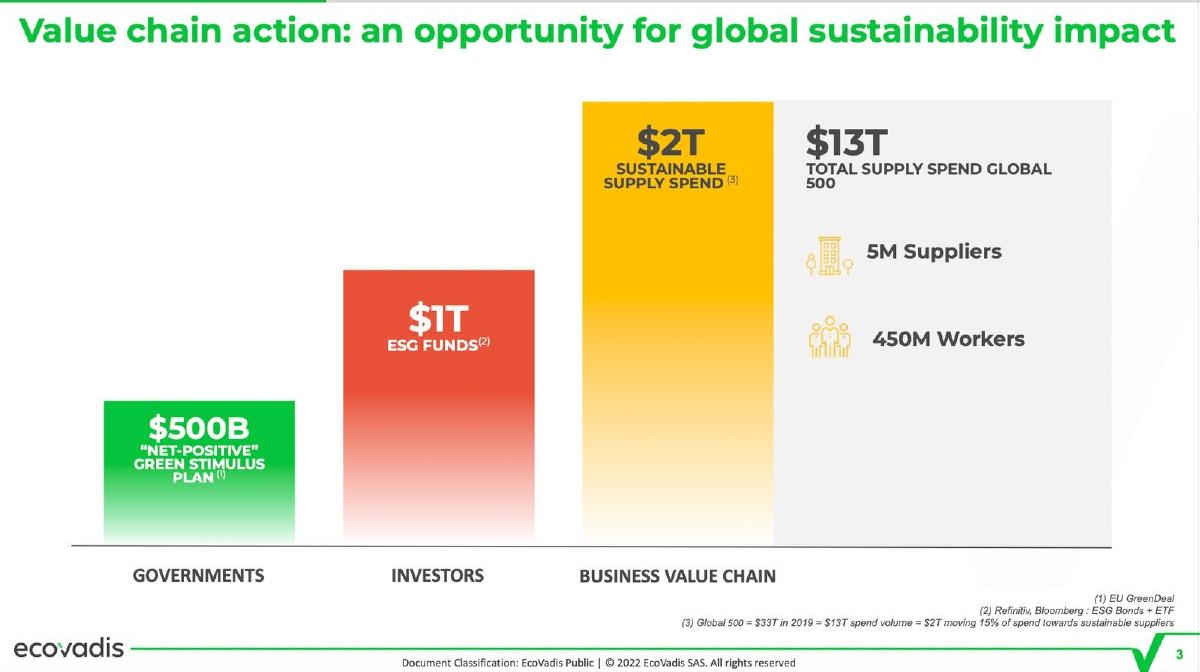
- The deck identifies a $2T sustainable supply spend opportunity within a larger $13T global supply spend market (Slide 3).
- It categorizes market pressure into three distinct pillars: Governments ($500B stimulus), Investors ($1T ESG funds), and Business Value Chains (Slide 3).
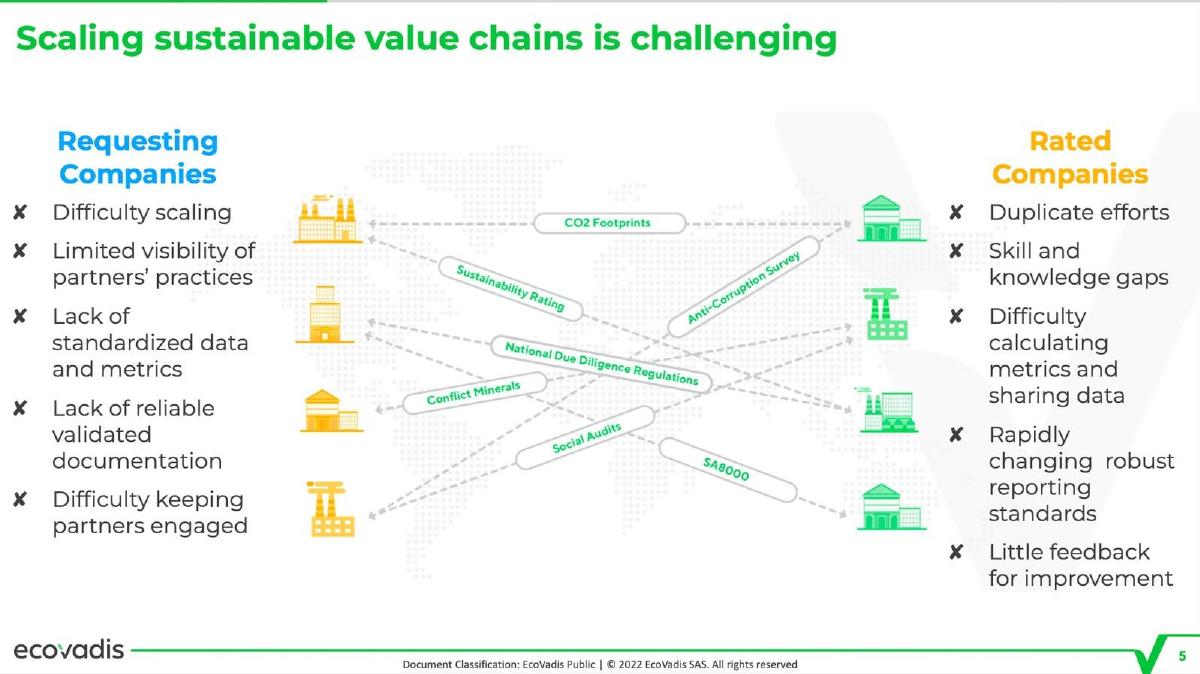
- The 'Problem' slide effectively bifurcates pain points between 'Requesting Companies' and 'Rated Companies,' highlighting the bilateral friction in ESG reporting (Slide 5).
- The product is framed as a 'Sustainability Intelligence Suite,' encompassing risk mapping, carbon action, and an academy (Slide 7).
- The workflow is simplified into a four-step flywheel: Onboarding, Rating, Results, and Improvements (Slide 9).
- Traction is the deck's strongest point, citing 95,000+ companies rated across 175 countries (Slide 11).
- The company leverages social proof through a logo wall featuring global giants like Nestlé, Coca-Cola, and Johnson & Johnson (Slide 11).
- The deck omits specific financial performance metrics like ARR, churn, or LTV, which is common for publicly shared growth-stage decks.
The Macro Opportunity: ESG as a Financial Imperative
Slide 1-2: Title and Branding
The deck opens with a minimalist title slide featuring the EcoVadis logo and the tagline 'Sustainability Intelligence Suite: Drive Impact at Scale.' The imagery of coffee harvesting immediately grounds the high-tech 'Intelligence Suite' in the physical reality of global supply chains. Slides 1 and 2 serve primarily as placeholders in this sequence, establishing the brand identity.
Slide 3: Value Chain Action
This is the foundational 'Market' slide. EcoVadis breaks down the drivers of sustainability into three categories: Governments, Investors, and the Business Value Chain. They cite a $500B 'Net-Positive' Green Stimulus Plan for governments and $1T in ESG Funds for investors. However, the largest bar on the chart is the Business Value Chain, representing a $13T total supply spend for the Global 500. By highlighting that $2T is already 'Sustainable Supply Spend,' they demonstrate that this isn't a future market—it is a massive, existing market that is currently being reallocated based on ESG criteria. The slide also notes the human scale: 5 million suppliers and 450 million workers.
The Friction: Why Scaling Sustainability is Hard
Slide 4: Transition
Slide 4 is a transition slide that sets the stage for the problem statement.
Slide 5: The Problem - Scaling Challenges
This slide is a sophisticated take on the 'Problem' slide. Instead of a simple list, it uses a bilateral diagram to show the friction between 'Requesting Companies' (the buyers) and 'Rated Companies' (the suppliers). For the buyers, the problems are 'Difficulty scaling' and 'Lack of standardized data.' For the suppliers, the primary grievance is 'Duplicate efforts'—having to fill out different sustainability forms for every customer. The diagram shows a messy web of CO2 footprints, social audits, and conflict mineral reports, positioning the current state of the industry as fragmented and inefficient. This sets up the EcoVadis 'standard' as the solution to this chaos.
The Solution: A Multi-Module Intelligence Suite
Slide 6: Transition
Slide 7: The EcoVadis Sustainability Intelligence Suite
This slide moves the company beyond being 'just a rating.' It visualizes the product as a circular ecosystem. The 'Sustainability Ratings' sit at the top, but they are supported by 'IQ Risk Mapping,' a 'Carbon Action Module,' the 'EcoVadis Academy' (for education), and 'Program Management.' The center of the wheel describes the value proposition: Identify risks, Assess practices, Understand/Improve performance, Monitor/Report results, and Manage impact. This is a classic growth-stage product slide designed to show 'platform play' rather than 'single-feature tool.'
Slide 8: Transition
Slide 9: The EcoVadis Solution Flywheel
This slide explains the user journey in four steps: 01 Onboarding (online registration), 02 Rating (customized questionnaires and expert evaluation), 03 Results (actionable scorecards), and 04 Improvements (corrective action plans and tracking). By labeling step 04 'Improvements' and showing an arrow leading back to the start, EcoVadis emphasizes that their platform isn't just for compliance—it's for 'continuous improvement.' This is a key selling point for enterprise ESG programs that need to show progress over time.
The Proof: Market Dominance and Traction
Slide 10: Transition
Slide 10 leads into the final evidence of the company's market position.
Slide 11: Accelerating Traction as the Market Standard
The final slide is a 'shock and awe' traction slide. It features a logo wall of approximately 40 global enterprises, including Verizon, Nokia, L'Oreal, and Sanofi. To the right, it lists massive KPIs: 175 countries covered, 800+ sustainable procurement programs, 95,000+ companies rated, 1,200+ employees, and $3+ trillion in spend covered. The bottom of the slide lists awards and previous funding, including a $200 million investment in 2020 from CVC, Bain, and others. This slide effectively ends the deck by arguing that EcoVadis is no longer a startup, but the 'market standard' for the entire industry.
What Works in the EcoVadis Deck
Bilateral Problem Solving: Most B2B decks focus only on the buyer. EcoVadis correctly identifies that their platform only works if suppliers (the 'Rated Companies') also find value or at least reduced friction. By addressing the 'Duplicate efforts' pain point on Slide 5, they show they understand the network effects required to win the market.
Scale Visualization: The use of $13T and $3T figures (Slides 3 and 11) places the company in the context of global trade. For a $500M growth round, investors need to see that the company is operating at a systemic level, not just a departmental level.
Platform Positioning: Slide 7 is excellent at showing product breadth. By including an 'Academy' and 'Risk Mapping,' they signal that they can capture more budget from an enterprise than a simple auditing firm could.
What is Missing from the EcoVadis Deck
Financial Specifics: As is common with decks leaked or shared via Business Insider, the sensitive financial slides are often omitted. We see no revenue growth charts, net retention rates, or gross margins. For a growth round of this size, these would have been the most important slides in the actual partner meeting.
Unit Economics: There is no mention of the cost to acquire a supplier versus the lifetime value of a procurement program. Given the '95,000+ companies rated,' the efficiency of their rating engine is a critical business driver that isn't explained here.
The 'Ask': The deck ends on traction. There is no slide detailing how much they are raising (though reported as $500M) or what they plan to do with the capital. This suggests this version of the deck was used as a high-level teaser or a company overview rather than the final closing presentation.
Founder Takeaways
Use the 'Standard' Narrative: If you have high market share, stop selling your features and start selling your status as the 'market standard.' EcoVadis does this by showing how many other companies already use them, creating a 'fear of missing out' for enterprises not yet on the platform.
Map the Ecosystem: Don't just show your product; show how your product sits in the middle of a complex web of regulations, stakeholders, and existing manual processes. Slide 5 is a perfect template for any founder trying to explain a complex B2B workflow.
Quantify the 'Spend Covered': If you are in Fintech, Supply Chain, or Enterprise SaaS, 'Spend Covered' or 'Total Contract Value Managed' is often a more impressive metric than your own ARR. It shows the level of trust and the size of the 'pipe' you are sitting on.
Frequently asked questions
- What is the primary market opportunity EcoVadis identifies?
- EcoVadis points to the 'Business Value Chain' as the largest lever for impact. According to Slide 3, they are targeting a $13 trillion total supply spend within the Global 500, with $2 trillion already categorized as sustainable supply spend. They also highlight the influence of 5 million suppliers and 450 million workers within these chains.
- How does EcoVadis define its product offering?
- The company describes its offering as a 'Sustainability Intelligence Suite.' As shown on Slide 7, this includes five core components: IQ Risk Mapping, Sustainability Ratings, Carbon Action Module, EcoVadis Academy, and Program Management. This positioning suggests they are moving beyond simple ratings into a full-stack management platform.
- What are the main challenges in the ESG rating space according to the deck?
- Slide 5 outlines challenges for both sides of the market. For buyers (Requesting Companies), the issues are lack of standardized data and difficulty scaling. For suppliers (Rated Companies), the pain points are 'duplicate efforts' (answering many different surveys) and 'skill and knowledge gaps' in sustainability reporting.
- Does the deck include a team slide?
- No, the provided 11-slide deck does not include a team slide or founder biographies. At the growth stage, especially for a company with 1,200+ employees (Slide 11), the focus often shifts from individual founders to the collective scale and institutional backing of the organization.
- What kind of traction does EcoVadis show?
- The traction is significant. Slide 11 reports 95,000+ rated companies, 800+ sustainable procurement programs, and coverage in 175 countries. They also mention covering over $3 trillion in spend and having a workforce of 1,200+ employees across 13 global offices.