The E-commerce Iran pitch deck, dated May 2018, presents a classic 'clone and conquer' strategy for the Iranian classifieds market. By positioning itself against domestic players like Digikala and Divar, the company seeks to leverage a 'Head & Software Factory' in Sweden to deploy localized platforms across Iran, Iraq, and North Africa. The deck is notable for its explicit ambition—targeting a $500M valuation within six years—and its detailed competitive analysis that includes specific investment figures for rivals. However, the provided slides lack individual team biographies and specific un…
Key takeaways
- The company identifies a 'Best Timing' window due to weak domestic competition and international obstacles for global players (Slide 2).
- A detailed competitor review lists Digikala as having received $17M in investment for a 5% stake, citing a lack of C2C options as a weakness (Slide 4).
- The financial model projects a correlation between marketing investment and daily traffic, aiming for 9,210 daily visitors by year seven (Slide 5).
- The deck sets an explicit goal of reaching a $500M valuation within six years of operation (Slide 6).
- Funding requirements are broken down by year, starting with $2.8M in year one from founders and angel capital (Slide 6).
- The operational structure uses a centralized 'Software Factory' in Sweden to support regional 'Body & Operations' teams in the MENA region (Slide 8).
- The strategy is openly modeled after successful venture builders like Rocket Internet and Schibsted (Slide 8).
- The deck identifies four 'must-have' characteristics to challenge incumbents like Craigslist and Blocket, though the specific four are not listed on the summary slide (Slide 7).
E-commerce Iran: The 'Clone and Conquer' Strategy
The E-commerce Iran pitch deck is a fascinating artifact from 2018 that illustrates how regional startups pitch against global giants by leveraging geopolitical barriers. The deck does not shy away from its identity as a 'clone' business, explicitly citing successful European models as its blueprint. This teardown explores the 10 slides provided, which cover everything from competitive positioning to a seven-year traffic forecast.
Slide 1: Title Slide
The deck opens with a minimalist blue background featuring the company logo—a stylized orange 'e' inside a white teardrop shape. The text reads 'e-commerce IRAN' and is dated 'May 2018, Iran.' It establishes a professional, if somewhat generic, visual identity from the outset.
Slide 2: Market Timing and Segment
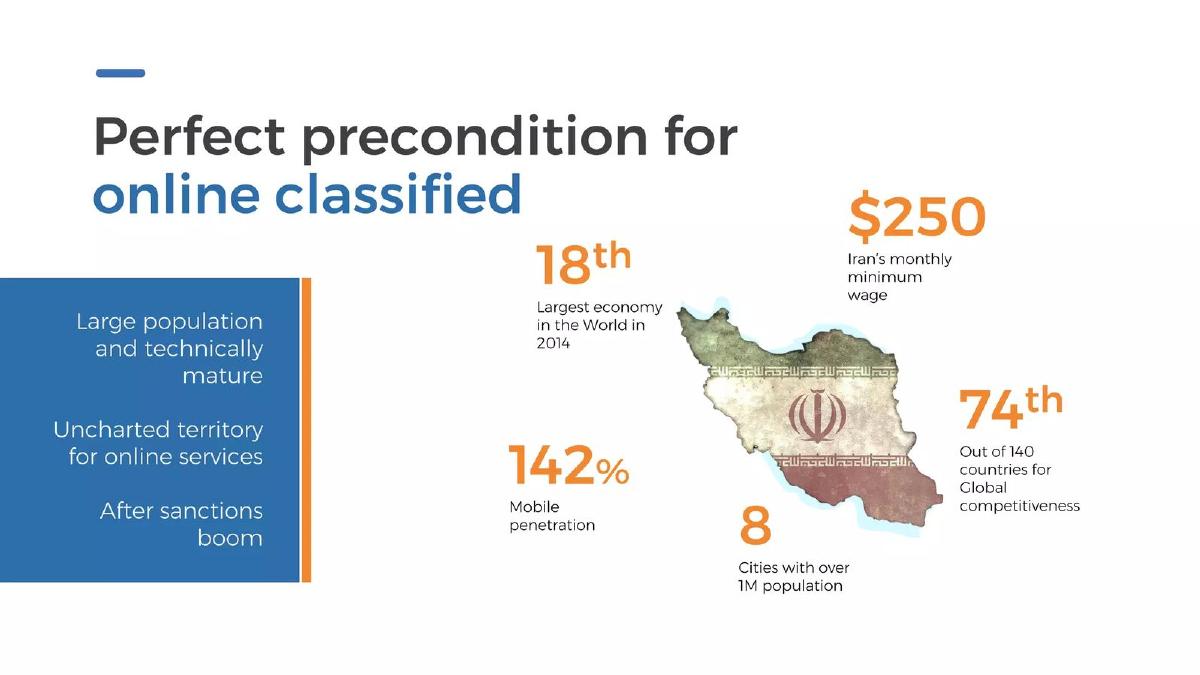
Slide 2, titled 'BEST TIMING,' attempts to justify why the venture should exist now. It uses a split-screen design to highlight two main arguments: the 'Right Business Segment' (Online Classifieds) and 'Proven Concept.' The most critical points here are the 'Low domestic & international competition' and 'International obstacle,' which is a veiled reference to the sanctions and economic barriers that prevent companies like eBay or Craigslist from entering the Iranian market directly. The slide claims a 'First-mover advantage,' despite the existence of other local players mentioned later in the deck.
Slide 3: Strategy Overview
This slide is titled 'CATCHING THE MARKET STRATEGY' and features a hexagonal graphic with numbers 01 through 06. However, in this version of the deck, the text for these six strategic pillars is missing. This is a significant omission, as it leaves the viewer wondering about the actual tactical steps the company plans to take to 'catch' the market.
Slide 4: Detailed Competitor Review
This is arguably the strongest slide in the deck. It provides a comprehensive table comparing four competitors: Digikala, Divar, Shaypoor, and Bazaargahan (Qalixa). Key data points include:
Digikala: 4 years old, 1,000 staff, received $17M for a 5% stake from Pomegranate Investment. · Divar: 5 years old, 50 staff, 13,000 ads per day, received $0.5M for a 2% stake. · Shaypoor: 4 years old, 40 staff, 4,000 ads per day, received $2M for a 30% stake.
The company identifies 'Opportunity for future investments' as 'Yes' for themselves because they believe they can 'Bypass Competitors' who suffer from 'Culture Clash' or 'Lack of C2C options.'
Slide 5: Financials and Traffic Projections
Slide 5, titled 'FINANCE build traffic,' uses a mountain-chart visualization to map 'Marketing investment' against 'Average traffic/day' over a seven-year period. The projections are specific: Year 1 starts with a 342k investment for 120 daily visitors, scaling to a 6.48M investment for 9,210 daily visitors by Year 7. The slide also marks milestones where they expect to 'Pass competitor #2' (Year 2) and 'Pass competitor #1' (Year 3). The use of 'k#' on the Y-axis is slightly ambiguous—it likely refers to thousands of units of currency, though the currency is not explicitly defined on this slide.
Slide 6: Funding Roadmap and Valuation
This slide sets an audacious goal: a '$500M valuation in 6 years.' It breaks down the funding needs into three years, totaling $7M in requested capital ($2.8M in Year 1, $2.8M in Year 2, and $1.4M in Year 3). The funding is split between 'Founders' and 'Angel capital.' The bottom of the slide includes a roadmap: Year 1 is for going live and developing the mobile app; Year 2 focuses on the 'Business Intelligence Engine'; and Year 3 is dedicated to 'Growth' and 'Upsale.'
Slide 7: Product Characteristics
Titled '4 MUST HAVE CHARACTERISTICS OF #1 CLASSIFIED APP,' this slide is more of a positioning statement than a feature list. It mentions challenging 'US Craigslist' and 'European players such as Blocket.' It notes that 'Wallapop is just a small but important step in the right direction,' suggesting the company intends to iterate on existing mobile classified designs. However, the specific four characteristics are not explicitly bulleted, leaving the 'what' of the product somewhat vague.
Slide 8: Team and Execution Model
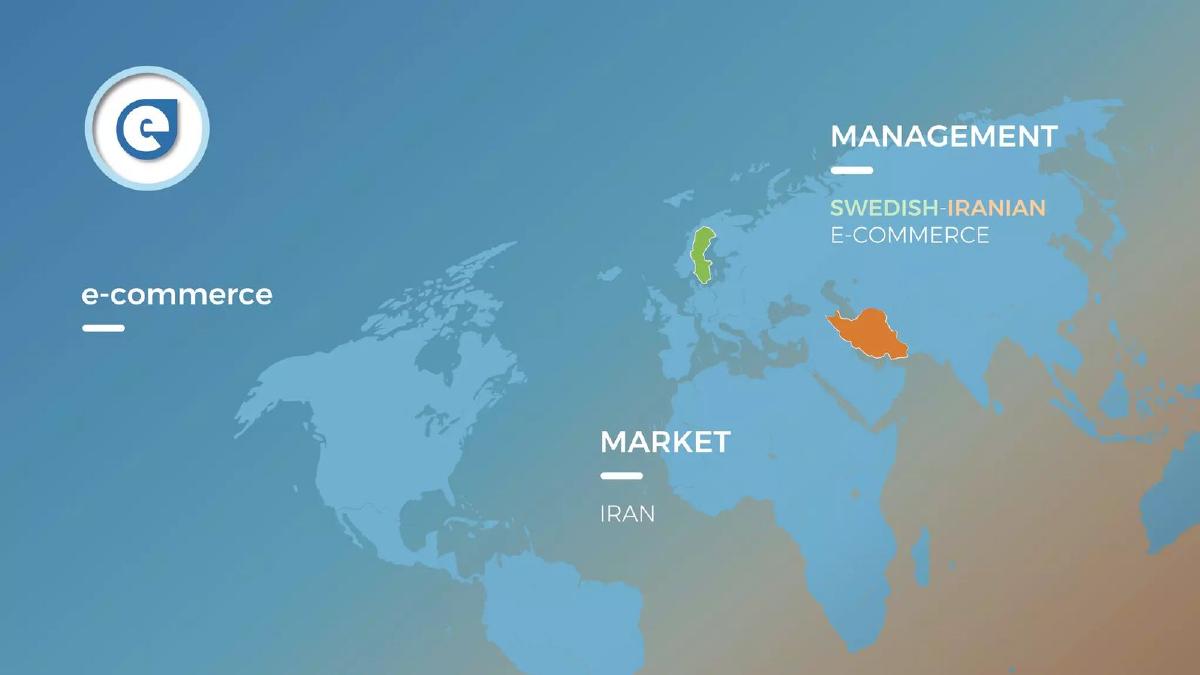
This slide explains the 'Head & Software Factory' model. The company plans to have a 'centralized head in Sweden' to handle R&D and platform development, while 'Body & Operations' (Country Managers, Marketing) are localized in Iran, Iraq, and other MENA countries. They explicitly state their strategy is 'Based on Mixed Schibsted, Rocket Internet, and Kinnevik strategies,' which are all famous for the 'copy-paste' venture building model in emerging markets.
Slide 9 & 10: Appendix and Closing
Slide 9 is a transition slide for the 'PRODUCT FEATURES APPENDIX,' and Slide 10 is a standard 'THANK YOU' slide. Neither contains additional data or metrics.
What Works in This Deck
The Competitor Analysis: The level of detail on Slide 4 is impressive. Providing specific investment amounts and equity percentages for competitors gives investors a clear benchmark for market valuation and the 'price of entry.'
The Regional Arbitrage Play: The deck clearly articulates why a clone works in this specific geography. By highlighting 'International obstacles,' they turn a market weakness (sanctions/isolation) into a startup strength (lack of global competition).
Clear Valuation Targets: While a $500M target is aggressive, stating it clearly helps investors understand the intended exit scale and the founders' ambitions.
What is Missing from This Deck
Specific Team Biographies: While Slide 8 mentions a 'Software Factory' in Sweden and lists roles (CEO, CFO, etc.), there are no names, faces, or track records. In a 'clone' model, the ability to execute is everything, and the lack of team pedigree is a major red flag.
Unit Economics: The deck focuses on 'traffic,' but not on 'revenue.' There is no mention of Customer Acquisition Cost (CAC), Lifetime Value (LTV), or the specific monetization strategy (e.g., featured ads, transaction fees, or subscriptions).
Product Specifics: Despite an 'Appendix' slide, the core 10 slides do not show a single screenshot of the app or explain the '4 Must Have Characteristics' in detail. Investors are left to assume it will look like Blocket or Wallapop.
What a Founder Should Copy
The 'Software Factory' Concept: For startups in emerging markets, the idea of separating high-end R&D (in a tech hub like Sweden) from local operations (in the target market) is a proven way to maintain product quality while keeping operational costs low.
The Benchmark Strategy: Founders should copy the way this deck uses established international companies (Schibsted, Rocket Internet) as a shorthand for their business model. It reduces the 'cognitive load' for the investor by saying, 'We are the [Successful Company X] of [Market Y].'
Visualizing the 'Pass': Slide 5's visualization of when they will 'pass' specific competitors is a great way to communicate market share goals without needing a complex spreadsheet. It turns a boring traffic chart into a competitive narrative.
Frequently asked questions
- What is the core business model proposed in this deck?
- The company operates in the 'Online Classified' segment. According to Slide 2, the business is based on a 'proven concept' of C2C (consumer-to-consumer) marketplaces. Slide 8 further clarifies that the model is a 'Platform Clone' strategy, drawing inspiration from international successes like Blocket (Sweden) and Wallapop (Spain), adapted specifically for the Iranian and Middle Eastern markets.
- How does the company plan to compete with established local players like Digikala?
- Slide 4 provides a SWOT-style analysis of competitors. It notes that while Digikala is a massive 'Private webshop' with 1,000 staff, it lacks a C2C option. The company intends to exploit this gap by focusing on used items and classified ads, similar to the 'Blocket' model, which they claim domestic competitors like Divar and Shaypoor are not executing effectively due to 'culture clash' or 'poor performance.'
- What are the specific funding requirements mentioned?
- Slide 6 outlines a three-year funding roadmap. In Year 1, they seek $2.8M ($0.8M from founders, $2.0M from angels). Year 2 repeats this $2.8M requirement. By Year 3, the ask scales to $1.4M ($0.4M founders, $1.0M angels). Interestingly, the 'Venture Capital' and 'Public Capital' rows are left blank for the first three years, suggesting a heavy reliance on angel investors for the initial build.
- What is the geographic scope of the project?
- While the title slide specifies 'Iran,' Slide 8 reveals a much broader ambition. The 'Body & Operations' map includes Iran, Iraq, Saudi Arabia, Egypt, Libya, Algeria, and Morocco. The strategy involves a 'centralized head in Sweden' developing products that can be launched 'simultaneously in several e-commerce segments/markets' across the MENA region.
- What metrics does the deck use to define success?
- The primary success metrics shown are 'Average traffic/day' and 'Marketing investment.' Slide 5 shows a growth curve starting at 120 daily visitors in Year 1 and scaling to 9,210 by Year 7. Success is also defined by 'passing' specific competitors at Year 2 and Year 3 milestones, eventually leading to a $500M valuation target as stated on Slide 6.