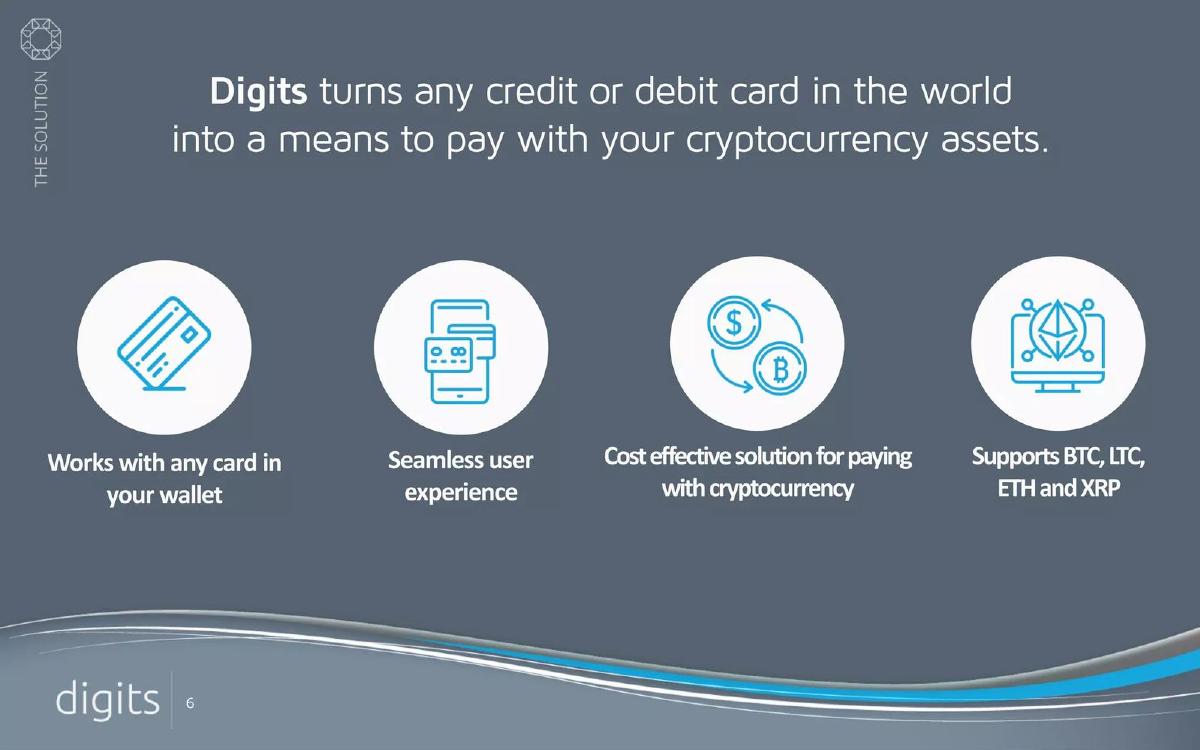
Digits aims to bridge the gap between cryptocurrency and traditional retail by allowing users to spend crypto via their existing debit and credit cards. The deck identifies core friction points in the 2017-era crypto market, such as slow transaction speeds (7 per second for crypto vs. 24,000 for traditional systems) and low merchant adoption. Their solution, the Hedge Lending Network, uses smart contracts to collateralize crypto assets for up to 12 months, enabling instant fiat settlement for merchants without requiring new hardware. The fundraising model is an Initial Coin Offering (ICO) for…
Key takeaways
- The company identifies a massive performance gap, noting that traditional payment systems process 24,000 transactions per second compared to just 7 for crypto (Slide 5).
- Digits utilizes a three-step consumer experience where users register existing cards and connect a crypto wallet to enable instant, collateralized transactions (Slide 7).
- The technical backend relies on the Hedge Lending Network to generate smart contracts that cover the cost of user transactions (Slide 9).
- Merchants are incentivized by the promise of zero technical implementation, as the system runs on existing Visa, MasterCard, and Amex rails (Slide 11).
- The growth strategy focuses on B2B partnerships with software platforms and payment gateways rather than direct merchant sales (Slide 13).
- The team includes David Jaques, cited as one of the first CFOs of PayPal and a former treasurer at Silicon Valley Bank (Slide 15).
- The ICO structure involves a total supply of 1,000,000,000 DSI tokens, with 550,000,000 available in the sale (Slide 17).
- The DSI token serves a specific utility: paying for access to the Digits API for online merchants (Slide 17).
Digits Pitch Deck Analysis: Bridging the Fiat-Crypto Divide
The Digits ICO deck, specifically version 9, represents a snapshot of the fintech landscape during the height of the initial coin offering era. The company positions itself not as a new currency, but as a layer of infrastructure designed to make existing cryptocurrencies spendable at any point of sale that accepts traditional credit or debit cards. By leveraging the existing financial rails of Visa and MasterCard, Digits attempts to solve the 'last mile' problem of crypto adoption.
Slide 1: Title and Branding
The deck opens with a minimalist design featuring a geometric logo and the text Digits ICO deck . The background uses a network-style node graphic, which was a standard visual trope for blockchain companies during this period. There is no tagline on the cover, leaving the value proposition for the subsequent slides.
Slide 2: The Core Mission
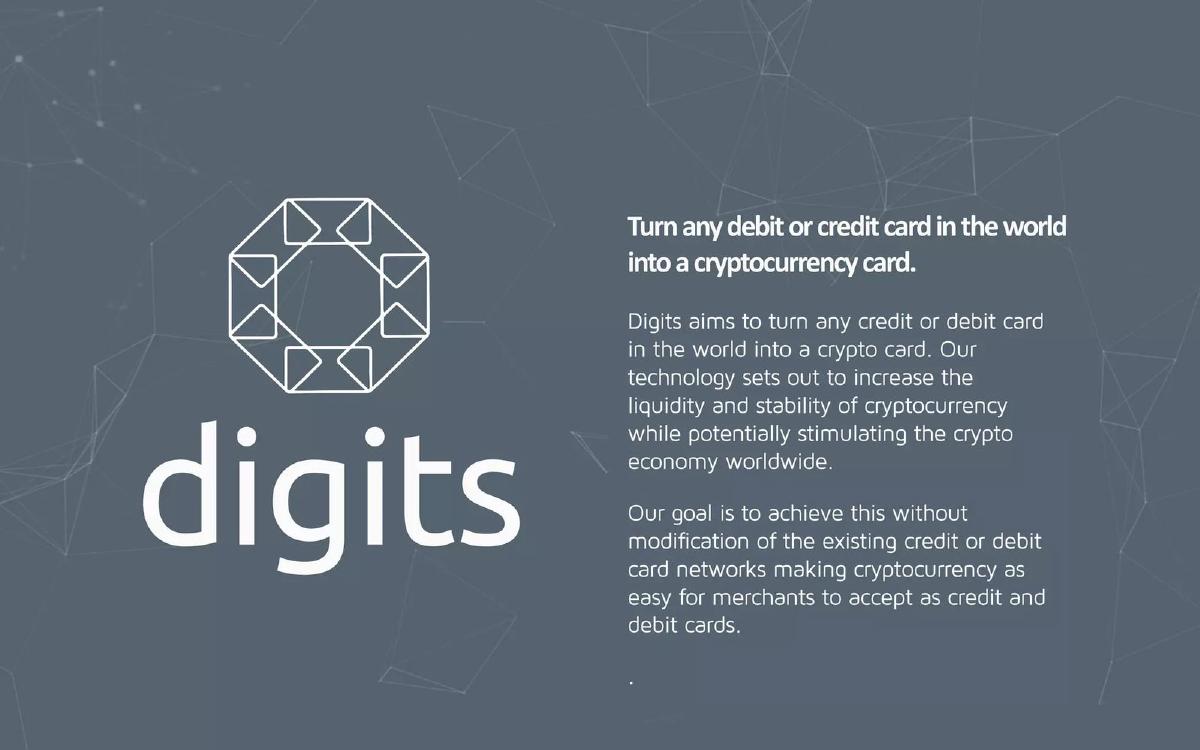
Slide 2 introduces the primary hook: Turn any debit or credit card in the world into a cryptocurrency card. This is a powerful value proposition because it removes the need for specialized hardware or new merchant behavior. The slide notes that the technology aims to increase liquidity and stability in the crypto economy by making crypto as easy for merchants to accept as fiat. Crucially, it mentions this is achieved without modification of the existing credit or debit card networks .
Slide 5: The Problem: No Easy Way To Pay
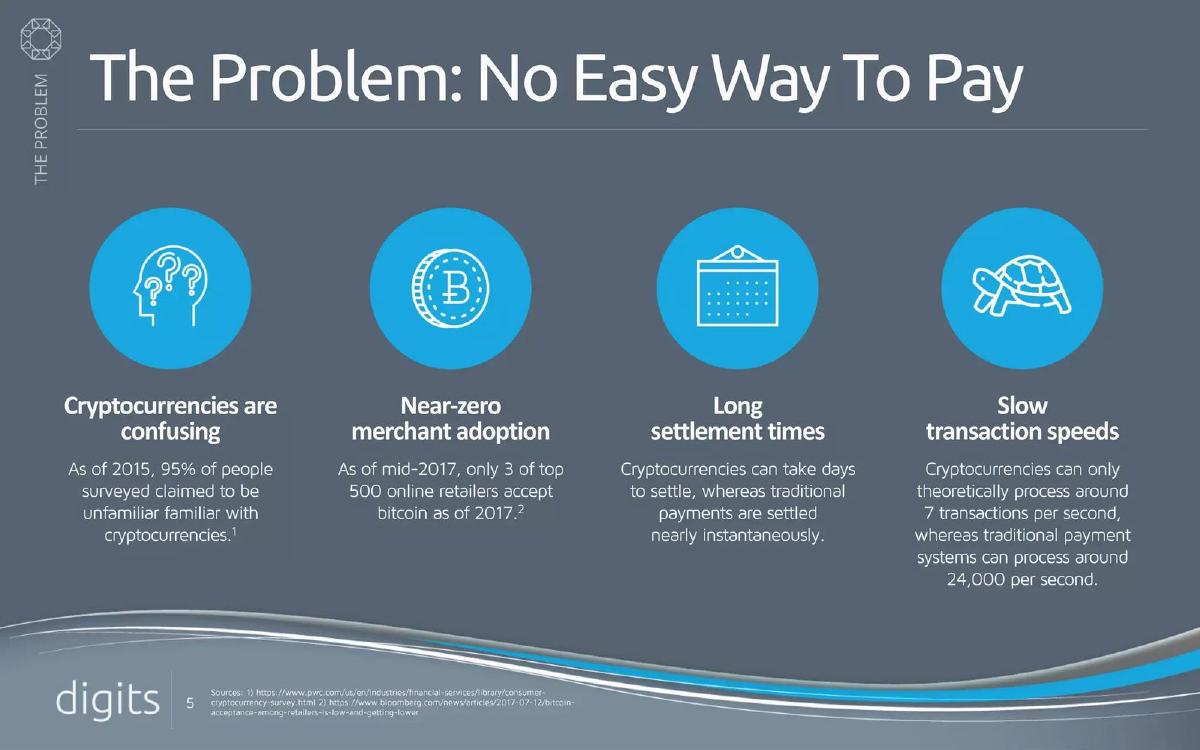
This slide breaks down the market friction into four categories. First, it cites a 2015 PwC survey stating that 95% of people were unfamiliar with cryptocurrencies . Second, it highlights near-zero merchant adoption, noting that as of mid-2017, only 3 of the top 500 online retailers accepted bitcoin . Third, it compares settlement times, noting crypto can take days while traditional payments are nearly instantaneous. Finally, it provides a stark technical comparison: crypto processes approximately 7 transactions per second , while traditional systems handle 24,000 per second .
Slide 7: The Digits Consumer Experience
The consumer journey is presented in a three-step flow. Step 1 involves registering a card and connecting a crypto wallet via the Digits app. Step 2 covers the purchase and the approval of larger transactions via SMS. Step 3 explains that the transaction is instantly processed and secured (collateralized) by crypto . An interesting feature mentioned here is the ability for the user to delay tax impact and pay later , suggesting a lending-based approach to spending.
Slide 9: Digits Payment Process
This is the most technical slide in the deck, illustrating the Hedge Lending Network . The process begins with a Digits API call when a card number is entered. If the card is registered with Digits, the API transfers funds from the user's crypto wallet to a Digits custodial wallet (Step 2). A smart contract is generated to cover the transaction cost (Step 3), backed by the crypto as collateral (Step 4). The crypto is held for up to 12 months (Step 5). At the end of the term, the crypto is liquidated or the user pays off the contract with fiat (Step 6). This mechanism allows the merchant to receive an Instant Payment in Fiat Currency .
Slide 11: Benefits Consumers And Merchants
The deck bifurcates the value proposition. For consumers, the benefits are crypto spending via traditional cards, two-factor authentication for security, and the use of the Hedge Lending Network to delay a short-term taxable event . For merchants, the benefits are significant: no special technology required, no new merchant agreements, and the same exact cost and settlement time as a standard card transaction. This addresses the merchant's primary concern: friction.
Slide 13: A Focused Growth Strategy
Digits identifies its Primary Target as Merchant Software Platforms, Payment Gateways, and Payment Processors. The slide quotes: Digits believes the opportunity lies with software platforms and payment gateways used by millions of merchants. This B2B2C approach is designed to keep sales and marketing outreach targeted and scalable, rather than attempting to sign up individual retail stores one by one.
Slide 15: The Digits Team
The team slide features five individuals. Ben Way (CEO) is described as a Silicon Valley-based inventor. Laura Wagner (CCO) , Leo Patching (COO) , and Nick Fallon (CTO) are listed with their respective backgrounds in payments and software development. The standout profile is David Jaques (Chairman) , who is credited as one of the first CFOs of PayPal and a former treasurer at Silicon Valley Bank, providing the project with significant institutional credibility in the fintech space.
Slide 17: Initial Coin Offering Details
The final slide in this selection details the ICO. The Token Name is DSI , with a total supply of 1,000,000,000 (550,000,000 available in the sale). The token's purpose is to pay for access to the Digits API. The offering includes a 10% Revenue Share and accepts BTC, ETH, and LTC. Notably, it specifies compliance with Reg D: Rule 506(c) , which was a common regulatory path for ICOs seeking to remain compliant with US securities laws.
What Digits Does Well
The Digits deck excels at identifying a specific, high-friction problem: the inability to spend crypto at scale without merchant-side changes. By focusing on the 'Hedge Lending Network' (Slide 9), they provide a technical solution that avoids the volatility and slow settlement times of direct crypto payments. The inclusion of a high-profile Chairman like David Jaques (Slide 15) serves as a strong signal to investors that the company understands the complexities of the traditional payment rails they are attempting to bridge. Furthermore, the growth strategy (Slide 13) is realistic, acknowledging that a startup cannot feasibly build a direct sales force to reach millions of merchants and must instead rely on gateway partnerships.
What Is Missing from the Digits Deck
Despite the technical clarity, there are several critical omissions in these slides. First, there is no financial modeling or unit economics . While a 10% revenue share is mentioned (Slide 17), the deck does not explain how that revenue is generated—whether through transaction fees, API subscription costs, or interest on the collateralized loans. Second, there is no competitive analysis . In 2017, several other 'crypto card' projects were emerging, and Digits does not differentiate itself from competitors who were issuing their own branded Visa cards. Third, the roadmap is absent . There is no timeline for the API rollout, partnership milestones, or the ICO phases. Finally, the deck lacks user traction data ; it is unclear if the Digits app mentioned on Slide 7 was functional or merely a concept at the time of the pitch.
Founder's Guide: What to Copy
Founders should look to Slide 11 as a masterclass in dual-sided value propositions . By clearly listing the benefits for both the consumer and the merchant, Digits shows they understand the ecosystem's incentives. The 'How It Works' flow on Slide 9 is also a strong example of how to visualize a complex backend process in a way that remains accessible to a non-technical investor. Finally, the regulatory transparency on Slide 17—specifically citing Reg D: Rule 506(c)—is a professional touch that many ICO-era decks lacked, signaling a commitment to legal compliance that is essential for any fintech venture.
Frequently asked questions
- How does Digits handle the slow settlement times of cryptocurrency?
- Digits bypasses slow blockchain settlement by using a collateralization model. According to Slide 9, when a user makes a purchase, the Hedge Lending Network generates a smart contract backed by the user's crypto. This allows for an 'Instant Payment in Fiat Currency' to the merchant bank, while the crypto is held in a custodial account for up to 12 months.
- Does a merchant need to install new hardware to accept Digits?
- No. Slide 11 explicitly states that the service 'doesn't require the merchant to implement special technology' and 'doesn't require a new merchant agreement.' It functions by running on existing Visa, MasterCard, and Amex rails, meaning the merchant receives fiat currency just as they would with a standard credit card transaction.
- What is the utility of the DSI token mentioned in the ICO?
- According to Slide 17, the DSI token is used to pay for access to the Digits API. This API is what allows online merchants to accept fiat currency payments from users who are paying with cryptocurrency. The slide also notes a 10% revenue share associated with the offering.
- Who are the key members of the Digits leadership team?
- The team is led by CEO Ben Way, described as a Silicon Valley-based inventor and serial entrepreneur. Other key figures include CCO Laura Wagner, COO Leo Patching, and CTO Nick Fallon. Notably, the Chairman is David Jaques, who brings significant fintech pedigree as a former CFO of PayPal and treasurer at Silicon Valley Bank (Slide 15).
- What is the primary target market for Digits' growth?
- Slide 13 indicates that while Digits will support large national retailers directly, their 'Focused Growth Strategy' centers on merchant software platforms, payment gateways, and payment processors. By targeting these intermediaries, they aim to reach millions of merchants through a very targeted sales and marketing outreach.