Dimension Trash Warrior presents an on-demand waste management solution, positioning itself to capitalize on the market disruption caused by China's ban on waste imports. The deck identifies incumbent competitors as slow, expensive, and unreliable, and introduces an MVP launched in September 2019 serving the SF Bay area. It demonstrates early traction with 60% MoM GMV growth, reaching $560K annualized GMV by March 2020. The company aims to connect customers with small providers, streamlining the process and offering a competitive alternative to existing services like 1-800-Got-Junk and Craigs…
Key takeaways
- The deck immediately establishes the company name, 'Trash Warrior,' and its core offering: 'On-Demand Waste Management at Your Fingertips' on Slide 1.
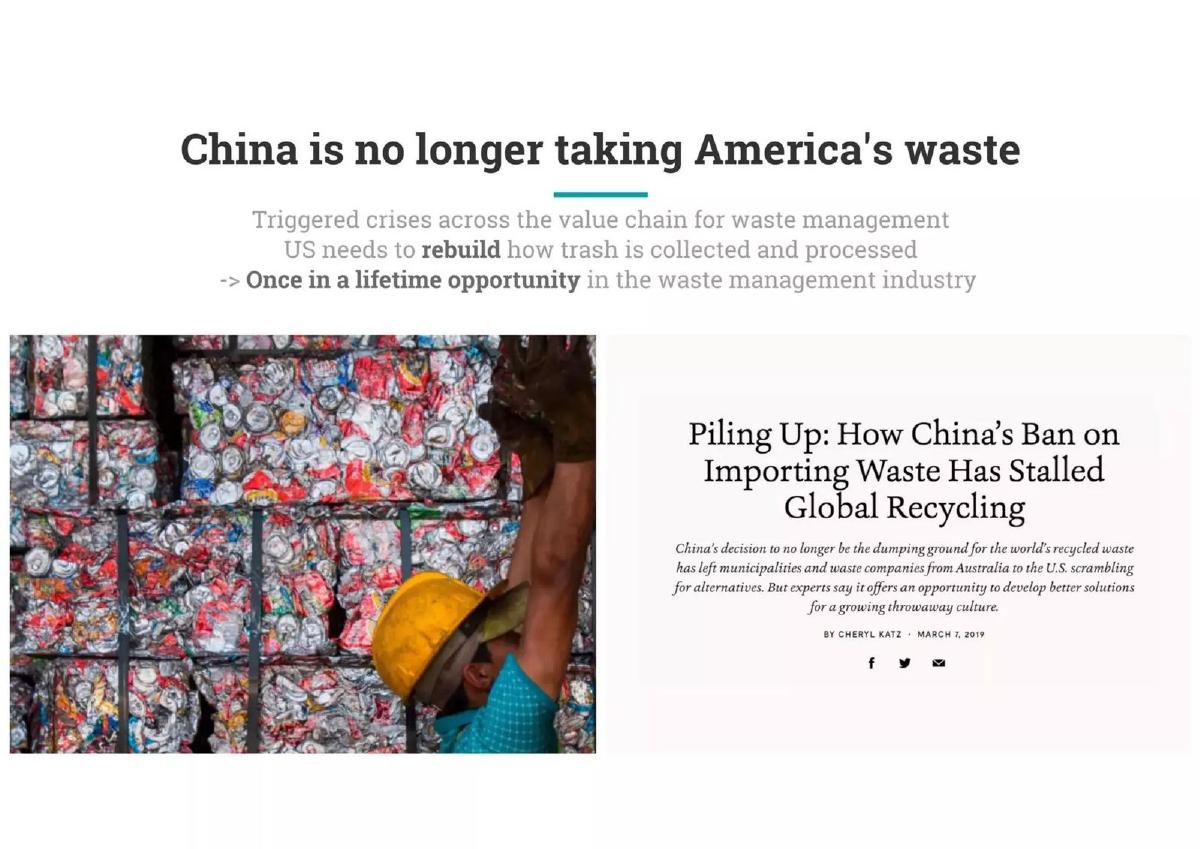
- A significant market problem is identified on Slide 2: 'China is no longer taking America's waste,' creating a 'once in a lifetime opportunity' in the waste management industry.
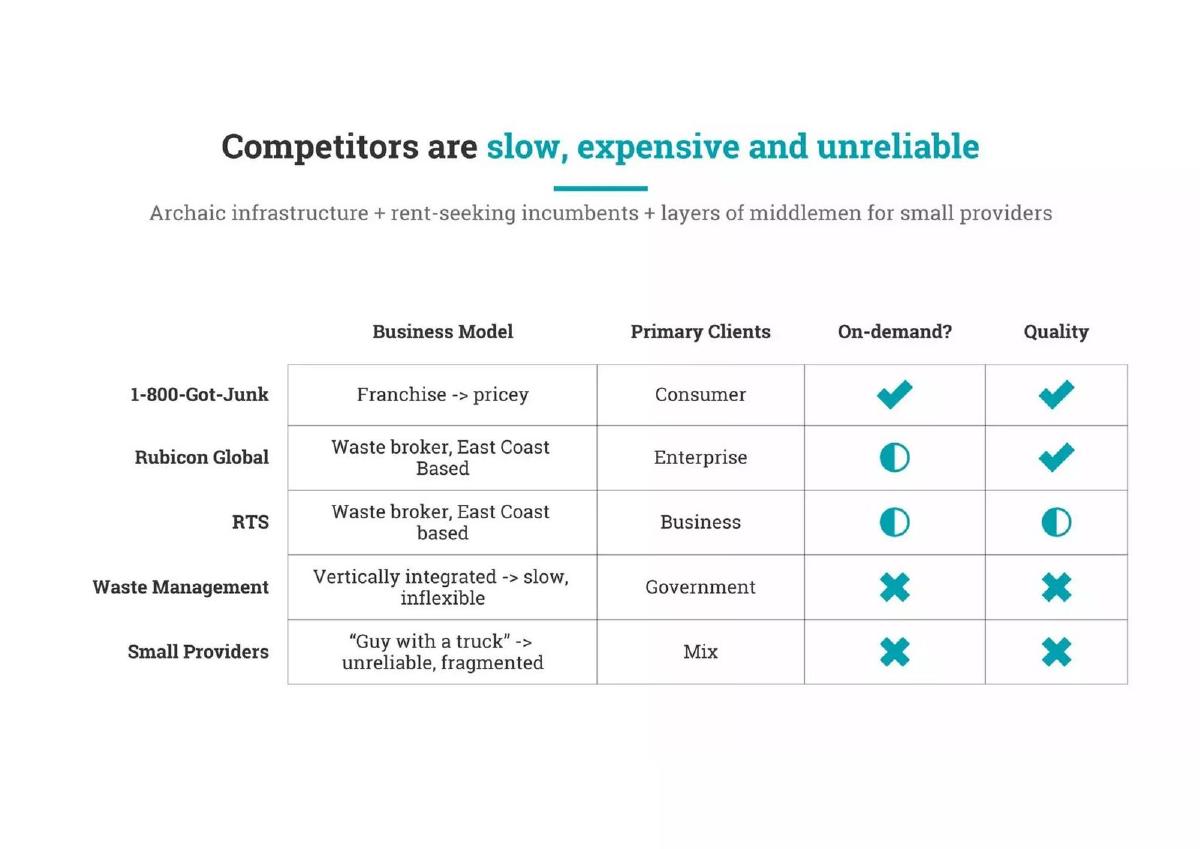
- Competitors are characterized as 'slow, expensive and unreliable,' with a detailed comparison table on Slide 3 highlighting issues with 1-800-Got-Junk, Rubicon Global, RTS, Waste Management, and Small Providers.
- The 'How it works' section on Slide 4 showcases an MVP (bookbeta.trashwarrior.com) launched in 09/2019, serving the SF Bay, detailing a 5-step customer and provider workflow.
- Early traction is presented on Slide 6, showing '60% MoM growth' in GMV, reaching '$560K annualized GMV' by March 2020, just seven months into operations.
- The deck includes a strong 'Investors + Advisors' slide (Slide 8) featuring Lightspeed Ventures, Altair Capital, 500 Startups, Alumni Ventures Group, and individuals with experience from Lyft, Groupon, Caviar, and Stripe.
- The problem for providers is addressed on Slide 7, illustrating how Trash Warrior helps 'David: Owner of a small hauling business' and 'Gilberto: Seeking ways to avoid subcontracting' by automating sourcing and skipping middlemen.
- The deck does not include a dedicated 'Team' slide, an 'Ask' slide detailing funding requirements, or specific unit economics.
Dimension Trash Warrior Pitch Deck Teardown
This teardown provides a detailed analysis of the Dimension Trash Warrior pitch deck, focusing on its structure, content, and effectiveness in conveying the company's value proposition. The deck presents an on-demand waste management solution, aiming to disrupt a traditional industry facing significant shifts. We will examine each slide in order, highlighting what works well and identifying areas for potential improvement, particularly from a fundraising perspective.
Slide 1: Title Slide
The first slide immediately introduces the company as "Trash Warrior" with the tagline "On-Demand Waste Management at Your Fingertips." A simple, stylized green logo is present in the top left corner, and a black and white icon depicting a person disposing of trash into a bin is on the right. The website trashwarrior.com is also prominently displayed. This slide is clear and concise, effectively communicating the company's name and core offering upfront. The visual elements are clean and directly related to the business, setting a professional tone.
Slide 2: Problem / Market Opportunity
This slide presents a critical market problem and opportunity. The bold headline states, "China is no longer taking America's waste." Below this, the text elaborates: "Triggered crises across the value chain for waste management US needs to rebuild how trash is collected and processed -> Once in a lifetime opportunity in the waste management industry." The slide includes two visual elements: a photograph of compressed aluminum cans and a snippet of an article titled "Piling Up: How China's Ban on Importing Waste Has Stalled Global Recycling" by Cheryl Katz, dated March 7, 2019. This slide effectively frames a large-scale, current event as the impetus for the company's existence, establishing a compelling and timely market need. The article snippet lends credibility to the problem statement.
Slide 3: Competitor Analysis
Titled "Competitors are slow, expensive and unreliable," this slide critiques existing solutions. The sub-headline states: "Archaic infrastructure + rent-seeking incumbents + layers of middlemen for small providers." A table compares five entities: 1-800-Got-Junk, Rubicon Global, RTS, Waste Management, and Small Providers, across four categories: Business Model, Primary Clients, On-demand?, and Quality. For 1-800-Got-Junk, it notes "Franchise -> pricey" and serves "Consumer" with checks for "On-demand?" and "Quality." Rubicon Global is described as "Waste broker, East Coast Based" serving "Enterprise," with a half-check for "On-demand?" and a check for "Quality." RTS is also a "Waste broker, East Coast Based" for "Business," with a half-check for "On-demand?" and a cross for "Quality." Waste Management is "Vertically integrated -> slow, inflexible" for "Government," with crosses for both "On-demand?" and "Quality." Small Providers are characterized as "'Guy with a truck' -> unreliable, fragmented" serving a "Mix," with crosses for both "On-demand?" and "Quality." This slide clearly positions Trash Warrior against existing players by highlighting their weaknesses, particularly in terms of speed, cost, and reliability. The visual checks and crosses provide an immediate understanding of the competitive landscape.
Slide 4: How It Works (MVP & Demo)
This slide, titled "How it works (MVP in beta, demo)," details the user experience. It states: "MVP: bookbeta.trashwarrior.com Beta launched in 09/2019, serving SF Bay." The slide displays five mobile phone screen mockups, illustrating a 5-step process: "1. Customer books online," "2. Customer fills out information," "3. Provider claims the task," "4. Provider uploads results," and "5. Customer rates service." The screenshots show various stages of the app, from selecting a service (Junk Removal, Trash Bin Pull-Out, Exterior & Garden Cleanup, Graffiti Removal, Street Sweeping), to reviewing details, seeing nearby tasks, uploading before/after photos, and rating the service. This slide effectively demonstrates the product's functionality and user flow, providing tangible evidence of the solution. The mention of the MVP launch date and service area provides context for its stage of development.
Slide 5: Competitor Pricing & Pain Points
This slide, titled "Our competitors charge up to $430..." , expands on the competitive landscape by focusing on pricing and specific pain points. It compares 1-800-Got-Junk and Craigslist. For 1-800-Got-Junk, it states "$430: 1-800-Got-Junk" and lists issues: "Too expensive for most business clients," "No price quote when booking online," and "Need to make calls to confirm a booking." For Craigslist, it notes "$20 - $400: 15 Craigslist replies" and lists problems: "Never showed up to the appointment," "Highly variant service quality," "Difficult scheduling: cannot get desirable time slot," "Cash only," and "Waste time talking to 15 strangers." This slide reinforces the competitive advantage by highlighting specific monetary and experiential shortcomings of alternatives, further solidifying the need for Trash Warrior's solution.
Slide 6: Traction (GMV Growth)
This slide is dedicated to showcasing traction, with the bold title "GMV: avg. 60% MoM growth." It further specifies: "March 2020 - Month 7 in operations: $560K annualized GMV Service area: SF Bay." A bar chart visually represents monthly GMV from 9/2019 to 3/2020, with a projection for March 2020. The bars show consistent month-over-month growth, starting small in 9/2019 and increasing significantly by 3/2020. The March 2020 bar is slightly lighter, indicating it's a projection. This slide is crucial for demonstrating early market validation and growth potential. The clear metrics and visual representation make the traction compelling.
Slide 7: Provider Value Proposition
Titled "... And so do providers," this slide focuses on the value proposition for the supply side of the marketplace. It introduces two provider personas: "David: Owner of a small hauling business" and "Gilberto: Seeking ways to avoid subcontracting." For David, it notes: "Former Recology employee with deep field experience," "Finding new clients takes a long time," and "Trash Warrior allows him to automate sourcing." For Gilberto, it states: "Always on the job: a top notch with 20 years of experience," "Primarily receive jobs through subcontracting," and "Trash Warrior allows him to review and accept jobs instantly, skipping brokers and middle men." This slide effectively illustrates how Trash Warrior solves problems not just for customers, but also for the critical network of service providers, which is essential for a marketplace model. It highlights efficiency and direct access to work as key benefits.
Slide 8: Investors + Advisors
This slide is titled "Investors + Advisors: Experts in scaling on-demand marketplaces." It features logos and names of several investment entities and individuals. Investment entities include: Lightspeed Ventures (Scout fund), Altair Capital, 500 Startups (Current batch), and Alumni Ventures Group. Individual advisors listed are: Ran Makavy (CPO @ Lyft), Jason Komosa (Former head of sales @ Groupon), Carl Wang (Partner @ TSVC), Shawn Tsao (Co-founder @ Caviar), and Emma Tang (Eng Manager @ Stripe). This slide is very strong, showcasing significant institutional backing and a highly experienced network of advisors with relevant expertise in on-demand marketplaces. This lends considerable credibility to the team and the company's potential to scale.
Slide 9: Contact Us
The final slide is a contact slide. On the left, there's an image of a neon sign that says "Thank you!" On the right, the text reads: "Contact us" followed by a call to action: "Help us solve the 268 million tons of trash in the US!" Contact information includes: "Contact: lily@trashwarrior.com," "Landing page: trashwarrior.com," and "MVP: bookbeta.trashwarrior.com." This slide provides all necessary contact details and reiterates the large scale of the problem, ending the deck with a clear invitation for engagement and a reminder of the company's mission.
What Works Well
The Dimension Trash Warrior pitch deck effectively communicates a compelling story, starting with a significant market problem and presenting a clear solution. The problem statement on Slide 2, leveraging China's waste import ban, is timely and establishes a large, urgent opportunity. This is a strong hook that immediately captures attention by framing the issue as a "once in a lifetime opportunity."
The competitive analysis (Slides 3 and 5) is well-executed, clearly articulating the shortcomings of existing solutions, both traditional incumbents and more fragmented options like Craigslist. By highlighting specific pain points such as high costs, unreliability, and poor service quality, the deck effectively carves out a niche for Trash Warrior. The use of a comparison table with checks and crosses on Slide 3 makes the competitive landscape easy to digest and understand at a glance.
The demonstration of the MVP on Slide 4 is a significant strength. Showing the actual user interface and the 5-step workflow provides tangible evidence of product development and a clear vision for the customer experience. The mention of the launch date and service area adds credibility and context to their operational stage.
Perhaps the strongest element is the traction slide (Slide 6). Reporting "60% MoM growth" in GMV and an annualized GMV of "$560K" within seven months of operation is impressive and signals strong early market adoption. This quantitative proof of concept is vital for attracting investor interest.
Finally, the "Investors + Advisors" slide (Slide 8) is exceptionally strong. The presence of reputable funds like Lightspeed Ventures and 500 Startups, coupled with advisors from successful on-demand companies like Lyft, Groupon, and Caviar, provides immense credibility. This signals to potential investors that experienced individuals and institutions believe in the company's vision and ability to execute.
What Is Missing
Despite its strengths, the Dimension Trash Warrior pitch deck has several notable omissions that could hinder a fundraising effort. The most significant absence is a dedicated "Team" slide . While the advisors are impressive, investors primarily back founders. Without a slide introducing the core team, their backgrounds, relevant experience, and roles, investors cannot assess the leadership driving the company. This is a critical piece of information for any early-stage investment decision.
Another major omission is an "Ask" slide . The deck does not specify how much capital the company is seeking, what the funds will be used for, or what valuation they are targeting. This leaves investors guessing about the financial requirements and the proposed deal structure, which is a fundamental component of any pitch.
The deck also lacks detailed unit economics . While GMV growth is presented, a deeper dive into metrics such as customer acquisition cost (CAC), customer lifetime value (LTV), gross margins, or churn rates would provide a clearer picture of the business's underlying profitability and scalability. For a marketplace model, understanding both customer and provider economics is crucial.
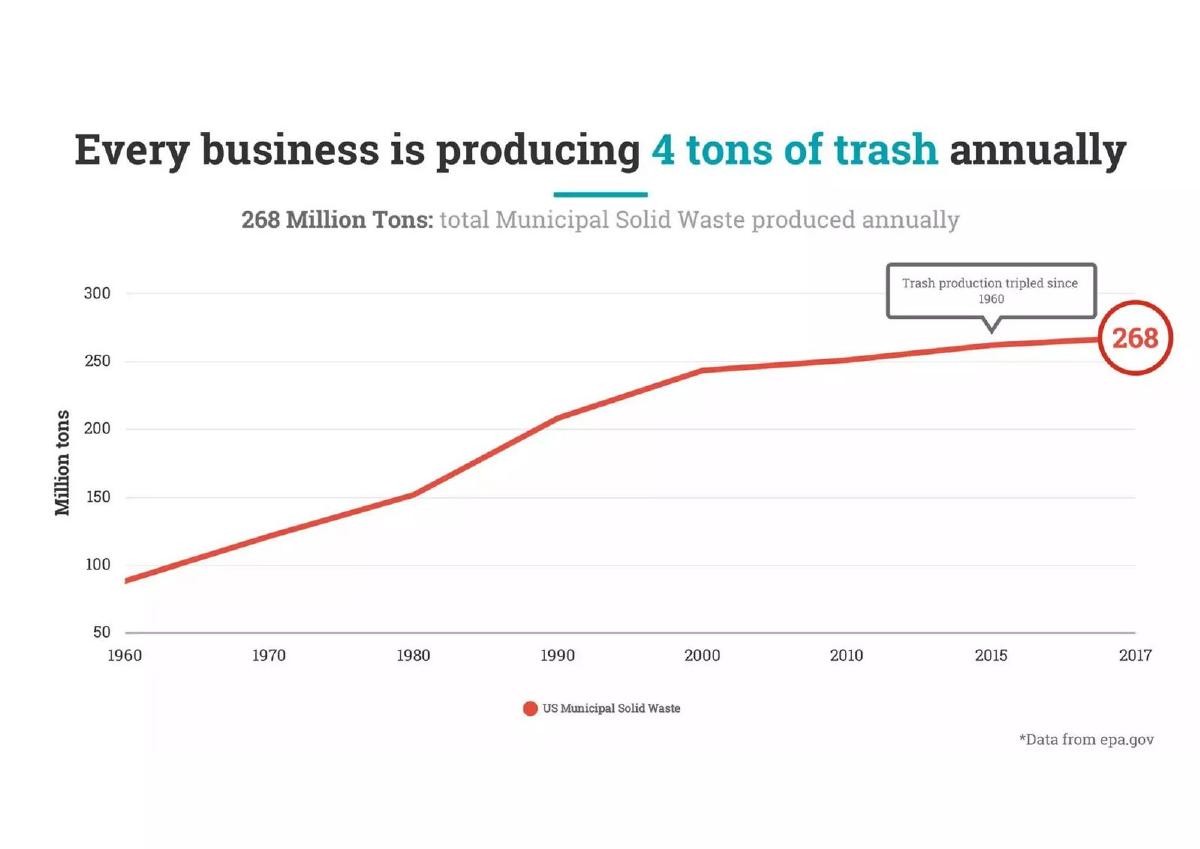
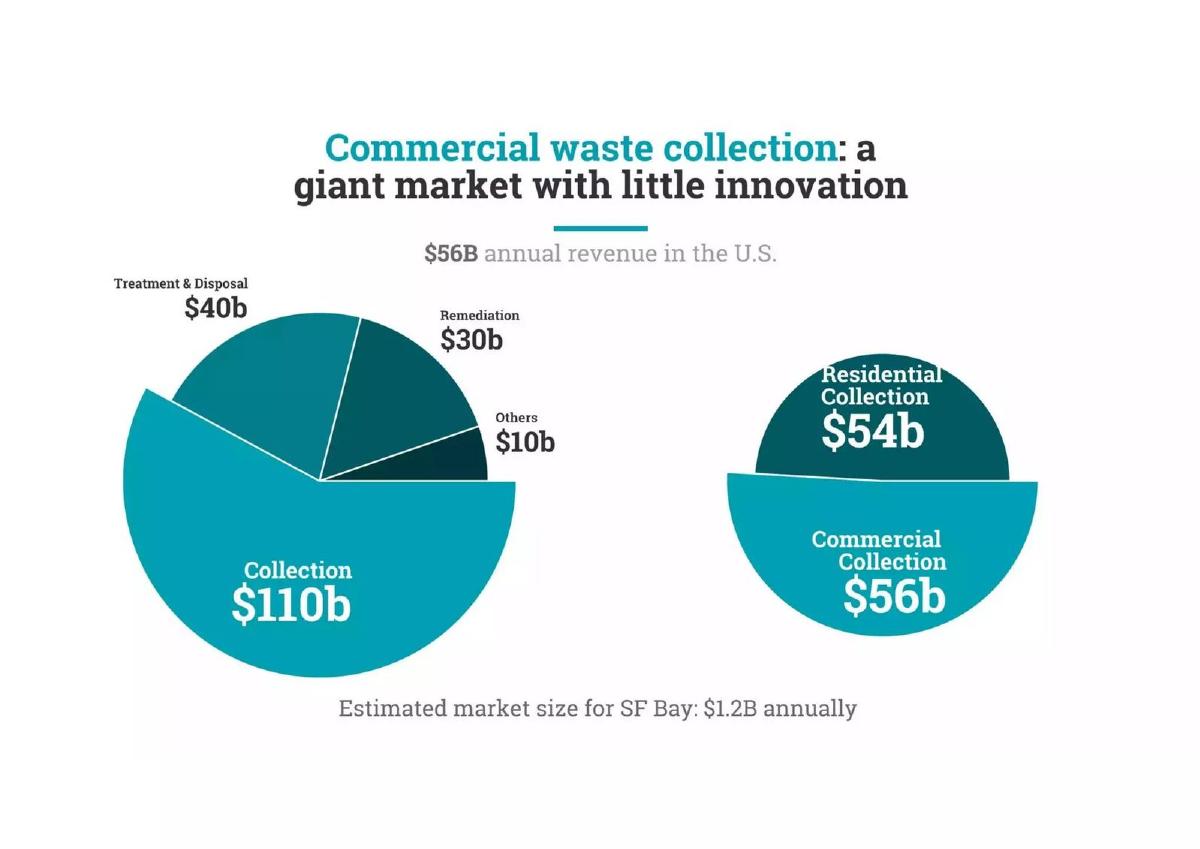
There is no explicit discussion of the market size (TAM, SAM, SOM) beyond the problem statement on Slide 2, which mentions "268 million tons of trash in the US." While this hints at a large market, a more structured breakdown of the serviceable market and how Trash Warrior plans to capture it would be beneficial. Similarly, a clear go-to-market strategy beyond simply operating in the SF Bay area is not detailed.
Finally, while the MVP is shown, there's no mention of the technology stack or any proprietary technology that might create a defensible moat. For a tech-enabled marketplace, highlighting any unique technological advantages could strengthen the pitch.
What a Founder Should Copy
Founders can learn several valuable lessons from the Dimension Trash Warrior pitch deck. First, the strategy of leading with a compelling and timely problem statement (Slide 2) is highly effective. Tying the business to a macro-economic or societal shift can create immediate relevance and urgency for investors.
Second, the approach to competitive analysis (Slides 3 and 5) is excellent. Clearly identifying competitors and articulating their specific weaknesses, both in terms of business model and customer pain points, helps to position the new solution as a superior alternative. The visual comparison table is particularly effective for quick comprehension.
Third, the inclusion of a clear MVP demonstration (Slide 4) is crucial for early-stage companies. Showing, rather than just telling, how the product works provides tangible proof of concept and helps investors visualize the solution. Highlighting the launch date and initial service area adds credibility to the development stage.
Fourth, the presentation of early traction with clear metrics (Slide 6) is exemplary. Quantifying growth with specific figures like "60% MoM growth" and "$560K annualized GMV" provides strong evidence of market validation. Visualizing this growth with a bar chart makes the data easily digestible and impactful.
Finally, the strategic use of an "Investors + Advisors" slide (Slide 8) to leverage the credibility of well-known individuals and institutions is a powerful tactic. For early-stage companies, demonstrating that respected figures are already involved can significantly de-risk the investment for new potential investors, especially when those advisors have experience relevant to scaling the business model.
Frequently asked questions
- What problem is Dimension Trash Warrior trying to solve?
- Dimension Trash Warrior aims to solve the inefficiencies and high costs in the waste management industry, particularly in light of China's ban on waste imports. It addresses the issues of slow, expensive, and unreliable incumbent services, as well as the challenges faced by small waste hauling businesses and independent providers.
- What is the core offering of Trash Warrior?
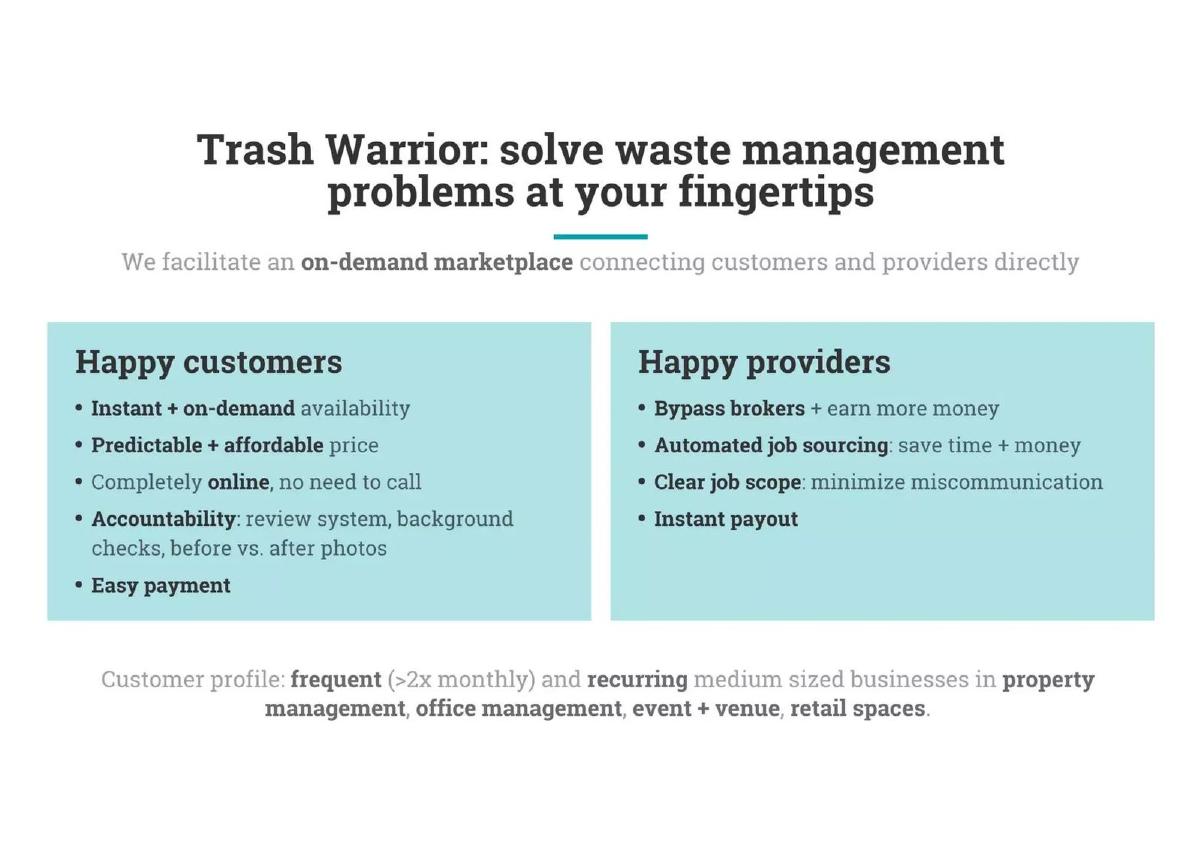
- Trash Warrior offers 'On-Demand Waste Management at Your Fingertips.' It operates as a marketplace connecting customers with small waste hauling providers, streamlining the process of booking, task fulfillment, and payment for various waste removal and outdoor cleanup services.
- What traction has Dimension Trash Warrior demonstrated?
- As of March 2020, seven months into operations, Dimension Trash Warrior reported an average of '60% MoM growth' in GMV. Their annualized GMV reached '$560K' by March 2020, operating within the SF Bay service area, indicating strong early market acceptance and growth.
- Who are the key investors and advisors mentioned in the deck?
- The deck lists several notable investors and advisors, including Lightspeed Ventures (Scout fund), Altair Capital, 500 Startups (Current batch), and Alumni Ventures Group. Individual advisors include Ran Makavy (CPO @ Lyft), Jason Komosa (Former head of sales @ Groupon), Carl Wang (Partner @ TSVC), Shawn Tsao (Co-founder @ Caviar), and Emma Tang (Eng Manager @ Stripe).
- What key information is missing from this pitch deck?
- The deck notably omits a dedicated 'Team' slide, which is crucial for showcasing founder experience and expertise. It also lacks an 'Ask' slide, meaning the specific funding amount sought, use of funds, and valuation are not presented. Additionally, detailed unit economics or financial projections beyond GMV growth are not included.