Diplomat Pharmacy Inc. (DPLO) presented this deck at the Wells Fargo Healthcare Conference in September 2017 to showcase its dominance in the specialty pharmacy sector. The company positioned itself as a critical intermediary between pharmaceutical manufacturers and patients, particularly for high-cost, limited-distribution drugs. With a projected 2017 revenue of approximately $4.45 billion and a history of aggressive acquisitions—including five major deals between 2015 and 2017—the deck emphasizes scale and operational depth. However, the financials from Q2 2017 revealed challenges, includin…
Key takeaways
- Diplomat achieved a 54% revenue CAGR between 2006 and 2016, growing from $58 million to $4.41 billion (Slide 3).
- The company holds a 4% market share in a $115 billion total market, positioning it as the largest independent player behind giants like CVS and Express Scripts (Slide 3).
- Limited distribution drugs accounted for approximately 53% of revenue in 2016, providing a significant barrier to entry (Slide 9).
- The M&A strategy is highly active, with nine acquisitions listed between Q4 2013 and Q3 2017, focusing on infusion and specialty services (Slide 12).
- Q2 2017 results showed revenue growth to $1.126 billion, but adjusted EBITDA margins compressed from 2.7% to 2.2% (Slide 15).
- Net income dropped significantly from $8.5 million in 2Q16 to $3.6 million in 2Q17 (Slide 15).
- Management cited a decision not to renew unfavorable contracts as a reason for impact on existing drug growth (Slide 18).
- The acquisition of BioRx in 2015 was the largest listed, with a $272 million adjusted purchase price (Slide 24).
Executive Summary: The Independent Giant
Diplomat Pharmacy Inc. (DPLO) used this September 2017 deck to communicate its value proposition during a period of rapid transition. Founded in 1975 and headquartered in Flint, Michigan, the company had evolved from a local pharmacy into a multi-billion dollar national specialty pharmacy powerhouse. The deck focuses heavily on the company's ability to navigate the complex 'Limited Distribution' drug market and its disciplined approach to M&A. While the growth story is compelling, the deck also provides a transparent look at the margin pressures and contract discipline that defined the specialty pharmacy landscape in the late 2010s.
Slide 1: The Human Element
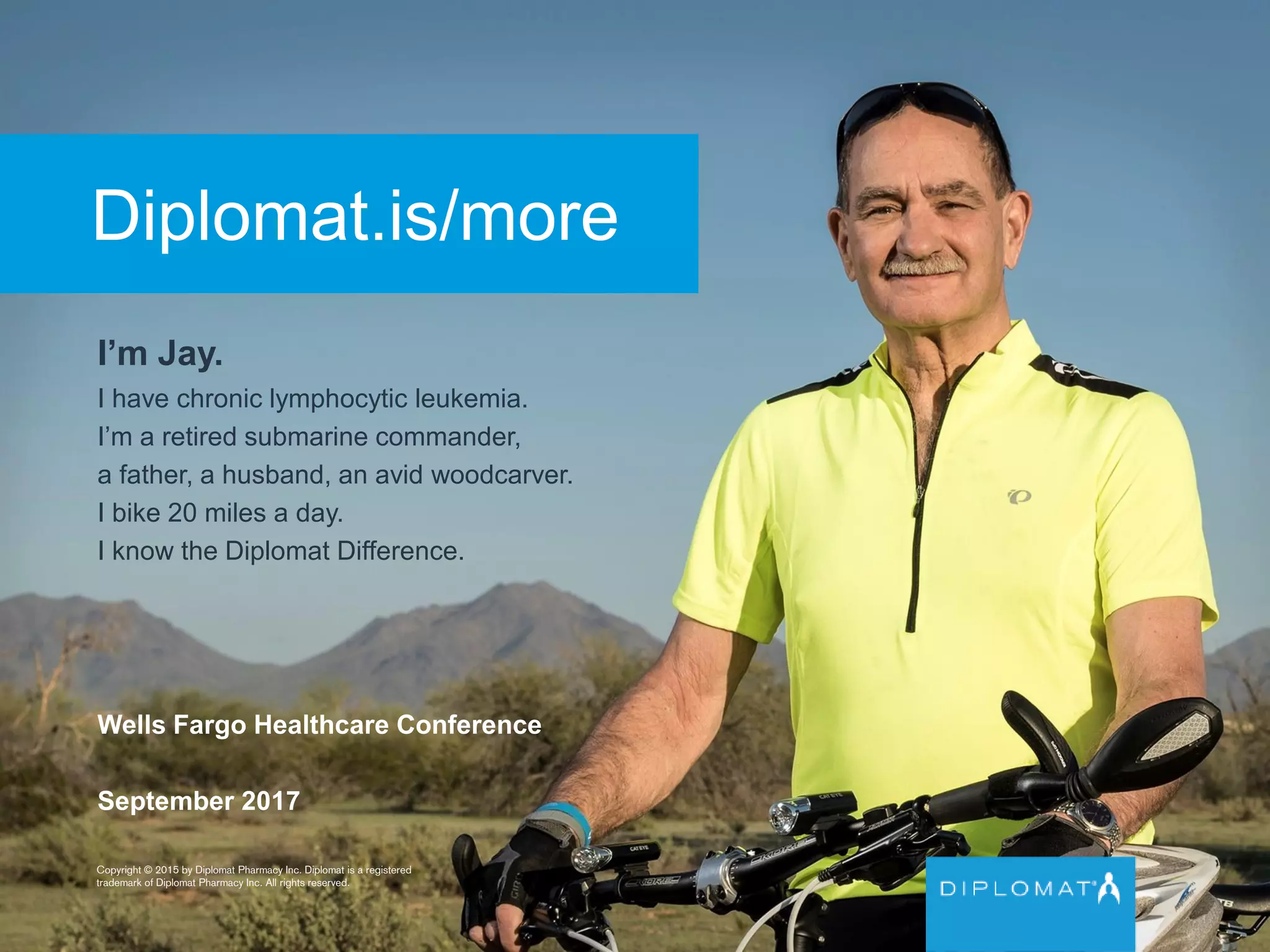
The cover slide sets a patient-centric tone. It features 'Jay,' a patient with chronic lymphocytic leukemia and a retired submarine commander. By leading with a human story rather than a corporate logo, Diplomat emphasizes the 'Diplomat Difference'—the clinical and personal support required for patients managing life-threatening illnesses. This slide establishes the emotional stakes of the business before diving into the multi-billion dollar financials.
Slide 3: Diplomat at a Glance
This is the 'traction' slide, and it is dense with data. It establishes four key pillars: history (founded 1975), scale (~1,800 employees and ~$4.45 billion in 2017E revenue), partnerships (listing marquee names like Pfizer, Novartis, and Gilead), and market share. The revenue chart is the standout feature, showing a 54% CAGR from 2006 to 2016, moving from a $58 million business to a $4.41 billion one. The market share pie chart places Diplomat as the largest independent player with 4% of a $115 billion market, trailing only the massive PBM-aligned entities like CVS and Express Scripts. A map shows a national footprint with pharmacy locations in 22 states.
Slide 6: Service Expansion via WRB
Slide 6 focuses on the acquisition of WRB Communications in May 2017. It details how WRB operates in four segments: Medical Information, Customer Care, Reimbursement and Access, and Inside Sales. This slide is crucial because it demonstrates Diplomat's move beyond just dispensing drugs. By acquiring WRB, they added 'educational support for patients' and 'remote patient monitoring,' moving higher up the value chain for pharmaceutical manufacturers.
Slide 9: The Limited Distribution Moat
This slide explains the 'Limited Distribution' (LD) model, which Diplomat identifies as a central theme in specialty pharmacy. It contrasts the 'Traditional' model (Manufacturer -> Multiple Wholesalers -> 65,000 Pharmacies -> Patient) with the 'Limited' model (Manufacturer -> One/few pharmacies -> Patient). Diplomat highlights that it has a portfolio of ~100 LD drugs, which accounted for 53% of its 2016 revenue. The slide lists specific drugs like Cometriq, Imbruvica, and Zejula, noting where Diplomat is the exclusive or semi-exclusive provider. This is the company's competitive 'moat'—access to drugs that general pharmacies simply cannot stock.
Slide 12: The M&A Engine
Slide 12 provides a transparent look at Diplomat's acquisition criteria and history. The company explicitly states it looks for targets that make them 'better, not just bigger.' A table lists nine acquisitions from 2013 to 2017, categorized by their contribution (e.g., New Therapy, Expanded Geography, New Technology). The slide shows a heavy focus on 'Infusion' services in 2017, with acquisitions like Affinity, Comfort Infusion, and Accurate Rx. This indicates a strategic shift toward higher-margin clinical services.
Slide 15: Financial Performance and Margin Pressure
This slide presents the Q2 2017 results, and it is where the challenges become visible. While revenue grew from $1.089 billion in 2Q16 to $1.126 billion in 2Q17, other metrics were less favorable. Adjusted EBITDA dropped from $29.6 million to $25.2 million, and Net Income plummeted from $8.5 million to $3.6 million. The adjusted EBITDA margin compressed from 2.7% to 2.2%. The company highlights that Gross Profit per script actually increased (from $339 to $371), suggesting that while they were making more per transaction, the overall volume or cost structure was under pressure.
Slide 18: Deconstructing Revenue Growth
Slide 18 uses a stacked bar chart to show the components of quarterly revenue growth. It reveals a significant 'Management decision not to renew unfavorable contracts,' represented by the red bars showing a -13% to -14% impact on existing drug growth in early 2017. This is a defensive slide; it explains to investors that the slowing growth in the core business is a deliberate choice to preserve margins rather than a loss of market competitiveness. It also highlights that price inflation comprised 6% of revenue in 2Q17.
Slide 21: Investment Highlights
This slide serves as the summary pitch. It reiterates that the specialty pharmacy industry is a growth market with a robust drug pipeline, particularly in oncology. It emphasizes Diplomat's unique position as the largest independent player and its 'modest balance sheet leverage' which provides 'ample dry powder' for further acquisitions. The mention of a CEO who founded the company 40+ years ago adds a layer of leadership stability to the narrative.
Slide 24: Key Acquisitions Detail
The final slide in this selection provides the 'receipts' for the M&A strategy. It lists the consideration and rationale for five major deals. The BioRx acquisition in 2015 stands out with a $272 million purchase price, aimed at adding scale to the specialty infusion business. The slide includes EBITDA multiples for the deals, ranging from 4.2x (Burman's) to 13.6x (WRB), providing investors with a clear picture of how management allocates capital.
What Diplomat Does Well
Diplomat excels at defining its 'moat.' In a world dominated by massive PBMs, an independent pharmacy must explain why it still exists. By focusing on Limited Distribution drugs (Slide 9), Diplomat makes a convincing case that its specialized clinical data and manufacturer relationships create a barrier to entry that scale alone cannot overcome. The deck is also exceptionally transparent regarding its M&A strategy, providing specific rationale and financial multiples for its deals, which builds trust with institutional investors.
What is Missing from the Deck
The deck lacks a clear 'Future Outlook' or specific guidance slide in this selection, though it alludes to it in footnotes. More importantly, while it mentions 'unfavorable contracts' as a reason for declining growth, it does not detail the competitive pressures from PBMs that were likely driving those contract terms. There is also no detailed breakdown of the 'Inside Sales' or 'Medical Information' revenue streams, making it hard to judge if the diversification strategy is actually contributing to the bottom line yet.
What Other Founders Should Copy
Founders building a 'roll-up' or M&A-heavy business should study Slide 12 and Slide 24. Instead of just saying 'we acquire companies,' Diplomat shows a matrix of why they acquire them and what specific capabilities each deal added. Additionally, the use of a 'Components of Growth' chart (Slide 18) is an excellent way to handle 'bad news.' By breaking down revenue into 'Acquired,' 'New Drugs,' and 'Contract Decisions,' they turn a revenue slowdown into a story of disciplined management.
Frequently asked questions
- What is Diplomat's core business model?
- Diplomat operates as a specialty pharmacy, focusing on complex, high-cost medications for chronic diseases like oncology and immunology. Unlike traditional pharmacies that use multiple wholesalers, Diplomat often uses a 'Limited Distribution' model where manufacturers ship directly to one or a few pharmacies. This allows Diplomat to provide real-time clinical data to pharma partners and specialized support to patients, creating a higher barrier to entry than retail pharmacy.
- How does Diplomat justify its aggressive M&A strategy?
- The deck outlines specific M&A criteria on Slide 12, emphasizing that acquisitions must make the company 'better, not just bigger.' Rationale includes expanding into new therapeutic areas, enhancing clinical capabilities, and accessing higher-margin business lines like infusion services. By acquiring companies like WRB Communications and BioRx, Diplomat integrated medical information services and large-scale infusion capabilities to diversify its revenue beyond simple drug dispensing.
- What were the primary financial headwinds in 2017?
- Despite top-line growth, Diplomat faced margin pressure. Slide 15 shows that while revenue increased, Net Income fell by over 50% year-over-year in Q2. Slide 18 explains that the company intentionally walked away from 'unfavorable contracts,' which impacted growth in existing drugs. Additionally, adjusted EBITDA margins declined, suggesting that the costs of integration or changes in reimbursement rates were outpacing the benefits of increased scale.
- Who are Diplomat's main competitors according to the deck?
- Slide 3 identifies the major players in the $115 billion market. Diplomat, with a 4% share, competes against CVS Health / Omnicare (28%), Express Scripts (19%), Walgreens (10%), OptumRX (7%), and Prime Therapeutics (3%). As the largest independent specialty pharmacy, Diplomat positions itself as a neutral alternative to the massive PBM-owned (Pharmacy Benefit Manager) pharmacies.
- What is the significance of 'Limited Distribution' drugs for Diplomat?
- Limited Distribution (LD) is a central theme. Slide 9 notes that Diplomat has access to approximately 100 LD drugs, which represented 53% of its 2016 revenue. For biotech and pharma companies, this model eliminates wholesalers and provides better utilization data. For Diplomat, it creates a 'moat' because competitors cannot easily access these drugs, and it fosters deeper, earlier partnerships with drug manufacturers.