Apptite entered the Brazilian food-tech scene in 2016 with a marketplace model connecting independent chefs directly to consumers. Their 15-slide deck focuses heavily on the supply-side value proposition, demonstrating how a typical chef could increase their monthly earnings from $2,000 to $8,000 by joining the platform. With a strong emphasis on high-quality 'real food' and a 35-minute delivery promise, the deck presents compelling traction metrics, including a 5x growth in Gross Merchandise Volume (GMV) over one year and a high 82% recurrence rate. While the deck lacks a formal 'Ask' slide…
Key takeaways
- The deck uses a specific persona, 'Maria,' to illustrate a 4x increase in earnings from $2,000 to $8,000 per month on the platform (Slides 6-7).
- Apptite differentiates itself from standard delivery apps by focusing on 'Real Food' and independent chefs rather than fast-food chains (Slides 3-5).
- The company achieved a 5x GMV growth between Q3 2017 and Q3 2018, reaching R$ 1 million (Slide 11).
- Customer loyalty is a core strength, with the deck reporting an 82% recurrence rate among users (Slide 11).
- The platform manages a supply side of 200 chefs delivering 7,000 meals a month, generating R$ 350k in monthly volume (Slide 10).
- The founding team emphasizes their history of working together across three previous startups (Slide 13).
- The deck targets a $10 billion food delivery market in Brazil, projected to grow 10x over the next decade (Slide 12).
- The presentation omits a specific funding request, valuation, or breakdown of how capital will be deployed (Slides 1-15).
Apptite Pitch Deck Teardown: The Independent Chef Marketplace
Apptite’s 2016 pitch deck is a lean, visually-driven presentation that relies on the power of the marketplace 'flywheel.' By focusing on the economic empowerment of chefs, the company builds a case for a high-quality, high-retention food delivery service in the Brazilian market. This teardown examines how they presented their growth from a Pre-Seed stage to a $3.1M raise.
The Hook: Visualizing the Product and the Problem
Slide 1: Title Slide The deck opens with a minimalist black background featuring the 'apptite' logo in white. It is clean and professional, noting that it is 'Presented by Guilherme Parente.' There is no tagline here, which forces the viewer to move quickly to the next slide to understand the value proposition.
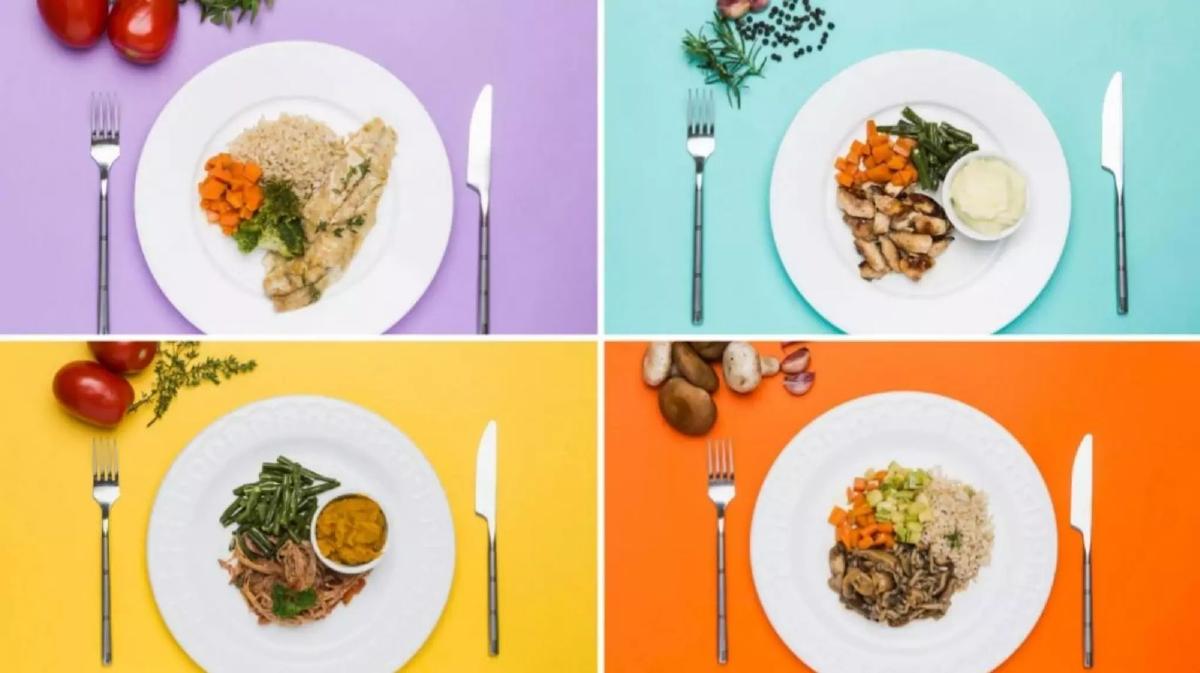
Slide 2: Visual Product Gallery This is a pure 'show, don't tell' slide. It features four high-quality, top-down photos of plated meals (fish, chicken, pulled pork, and mushrooms) on vibrant, color-coded backgrounds. This immediately establishes the brand's focus on 'real food'—meals that look home-cooked and nutritious rather than processed fast food.
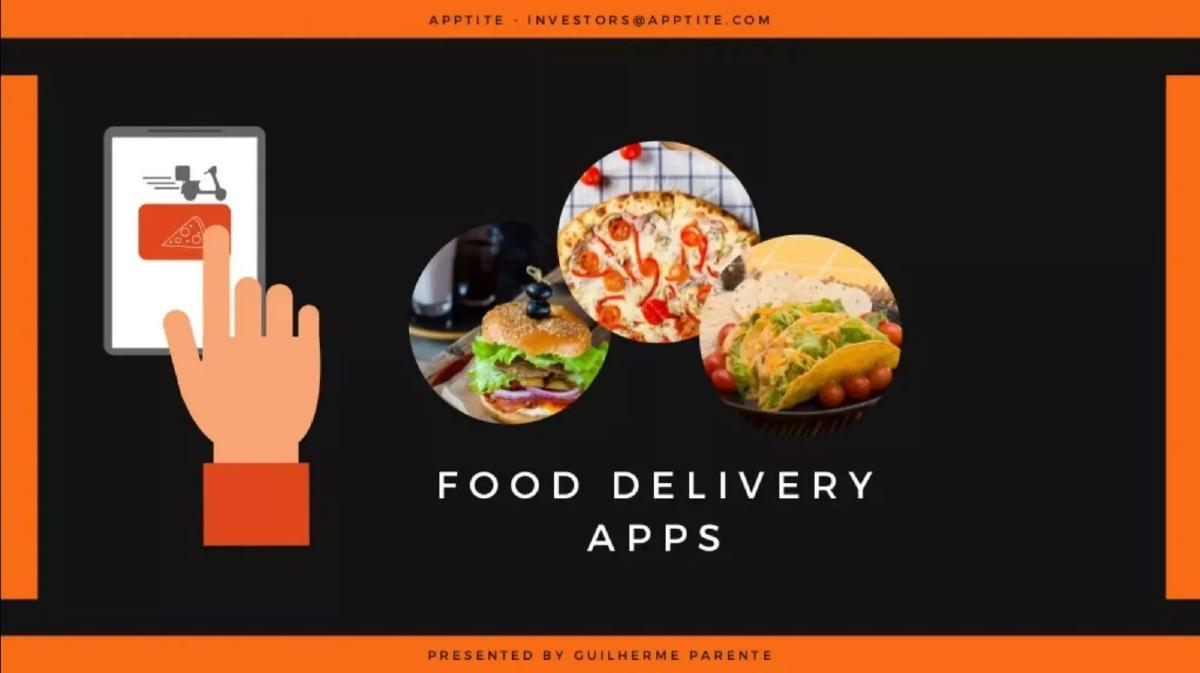
Slide 3: The Market Context The slide titled 'Food Delivery Apps' shows a hand interacting with a generic delivery app alongside photos of a burger, pizza, and tacos. This represents the status quo. By grouping these together, Apptite is subtly positioning the existing market as 'junk food' or 'standard fare,' setting the stage for their alternative.
The Solution: Speed and Quality
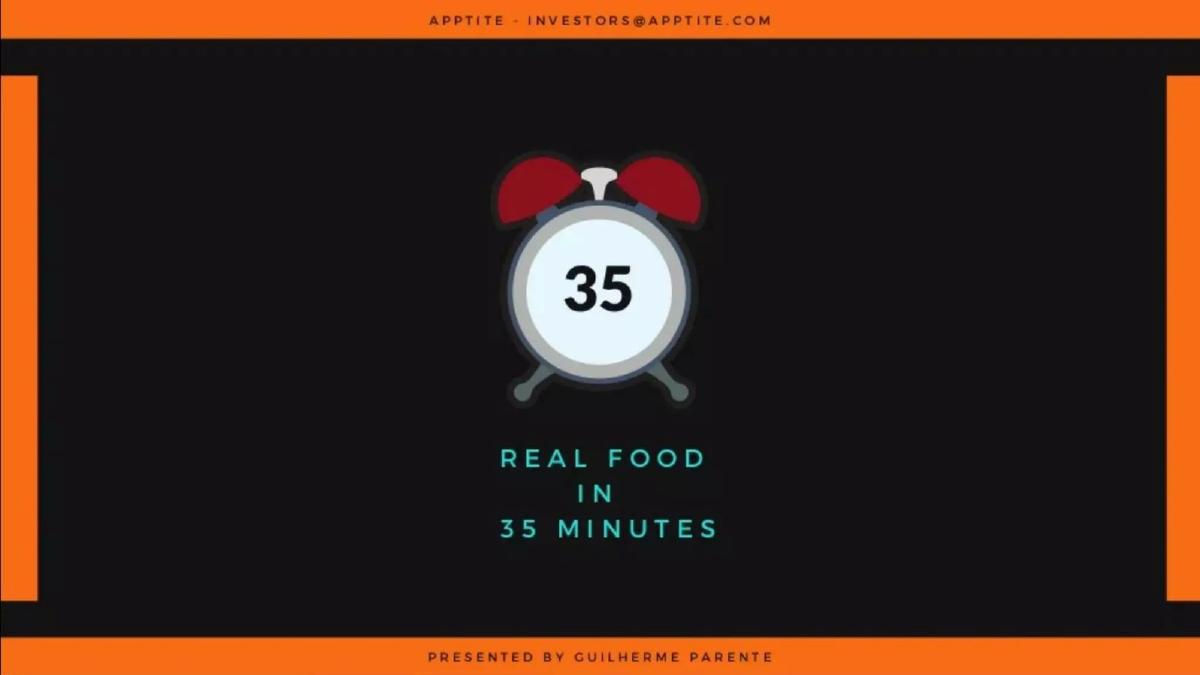
Slide 4: The 35-Minute Promise A simple graphic of an alarm clock with the number '35' is paired with the text: 'Real food in 35 minutes.' This is a critical slide because it addresses the two biggest hurdles in food-tech: quality ('Real Food') and logistics ('35 Minutes'). It promises the convenience of fast food with the quality of a home-cooked meal.
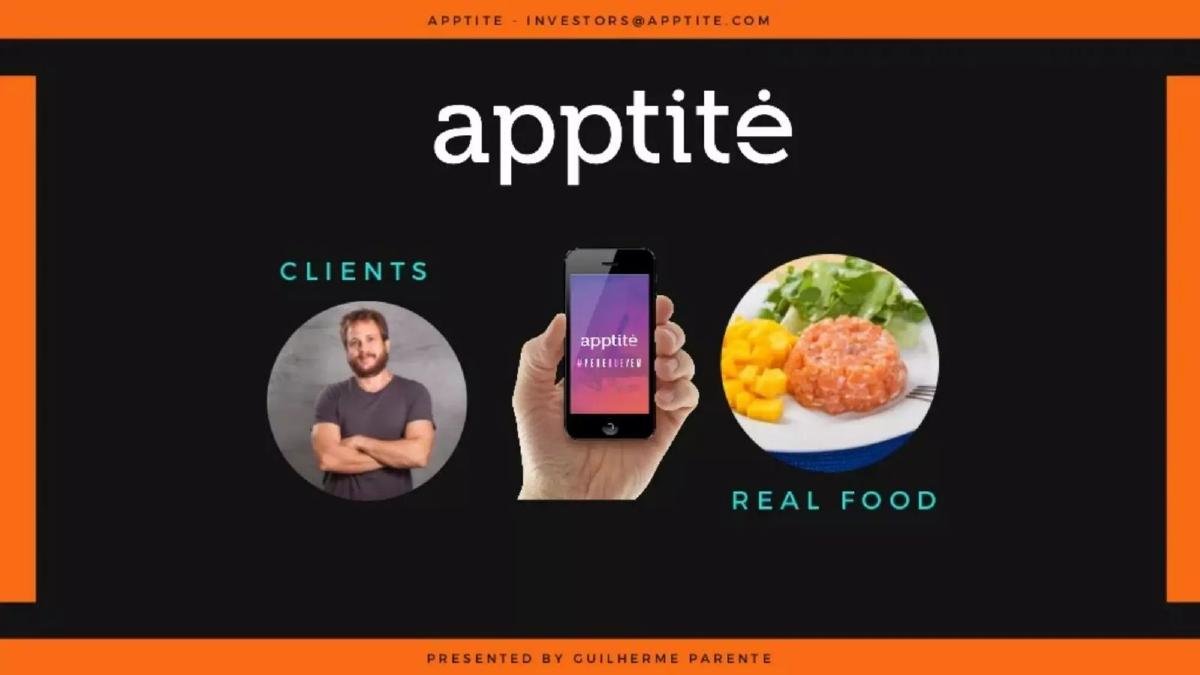
Slide 5: The Marketplace Connection This slide introduces the three pillars of the business: 'Clients,' the 'App' (shown on a smartphone), and 'Real Food.' It uses a photo of a salmon tartare to reinforce the premium nature of the offerings. It clarifies that Apptite is the bridge between the hungry consumer and the high-quality meal.
The 'Chef Maria' Narrative: Supply-Side Economics
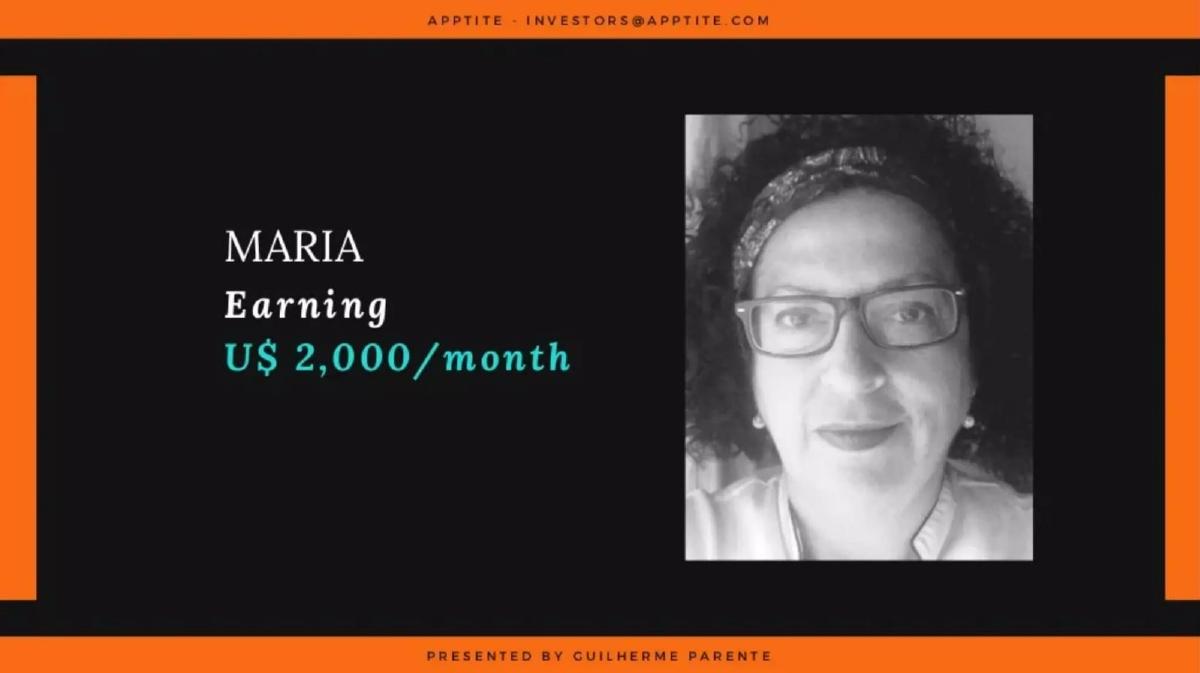
Slide 6: The Before State The deck uses a persona named 'Maria' to explain the supply side. It shows a black-and-white photo of a woman with the text 'Maria Earning U$ 2,000/month.' This establishes a baseline for an independent chef's income before using the platform.
Slide 7: The Apptite Effect The contrast here is stark. Maria is now 'Chef Maria,' shown in full color wearing a chef’s coat. The text reads: 'Earning U$ 8,000/month' and '4X MORE.' This is the strongest slide in the deck for explaining the 'Why now' and the 'Why us' for the supply side. If the platform can quadruple a chef's income, supply acquisition becomes significantly easier and more sustainable.
Slide 8: Diversity of Supply To show that Maria isn't an outlier, Slide 8 features a grid of eight different chefs. Each is labeled with a specialty: 'organic,' 'low carb,' 'comfort food,' 'healthy snacks,' 'plant based,' 'poke,' 'ceviches,' and 'gluten free.' This demonstrates the breadth of the marketplace and its ability to cater to niche dietary needs that large chains often ignore.
Business Model and Traction
Slide 9: The Connection Points This slide summarizes the value prop: '+ 1000 Original Recipes,' 'Fresh Ingredients,' and 'Personalized by your favorite chef.' It connects the 'Independent Chefs' to the 'Clients' via the app. It emphasizes the 'originality' of the content, suggesting that Apptite owns a unique catalog of food that cannot be found elsewhere.
Slide 10: Current Scale The traction slide uses three simple icons to report: 200 Chefs, 7,000 Meals, and R$ 350k a month. Using the Brazilian Real (R$) reminds the investor of the primary operating market (São Paulo, as per the catalogue facts). These numbers show a functional, mid-scale marketplace that has moved past the proof-of-concept phase.
Slide 11: Growth and Retention This is the 'money slide.' It shows a bar chart of GMV (Gross Merchandise Volume) in R$. In Q3 2017, the volume was R$ 200k. By Q3 2018, it reached R$ 1 million—a 5x increase. Even more impressive is the '82% recurrent' figure. In the high-churn world of food delivery, an 82% recurrence rate is an elite metric that suggests very high product-market fit.
Market Opportunity and Team
Slide 12: The Brazilian Market Apptite defines its sandbox: a 'U$ 10 Billion' food delivery market in Brazil. They project the market to grow '10X Next 10 Years.' This provides the 'venture scale' context necessary for a $3M+ raise. It tells investors that while they are currently in one city, the ceiling is massive.
Slide 13: The Team The team slide features four founders: Guilherme Parente (CEO), Marcelo Monteiro (COO), Roberto Kanitz (CFO), and Ricardo Kobayashi (CTO). The most important text on this slide is '3 Startups Together.' This mitigates 'founder conflict' risk, a common reason for early-stage failure. It signals that this team knows how to execute and stay together through the stresses of scaling.
Conclusion and Contact
Slide 14: Summary of Value A final recap slide lists: 'Independent Chefs,' '1000 Menus,' and 'Specific Dietary Needs.' The slogan 'one meal at a time' appears in large bold letters. It’s a soft landing that reinforces the core mission of the company.
Slide 15: Contact Slide The deck ends with the logo and the CEO’s email address. There is no 'Ask' here—no mention of the $3.1M raised or the terms of the round.
What Works in the Apptite Deck
The 'Chef Maria' Story: Using a specific person to illustrate the economic impact of the platform is far more memorable than a generic chart about 'supplier earnings.' · High-Quality Imagery: In food-tech, the 'craveability' of the product matters. The deck uses professional photography that makes the product look premium. · Retention Metrics: Highlighting the 82% recurrence rate is the smartest move in the deck. It proves that once a customer tries the service, they stay, which lowers long-term CAC (Customer Acquisition Cost). · Team History: Stating they have done three startups together is a powerful signal of operational maturity.
What is Missing from the Apptite Deck
The Ask: There is no slide detailing how much money they are raising, at what valuation, or what the milestones for the next 18 months are. · Unit Economics: While they show GMV and recurrence, they don't show the margin per meal or the CAC. Investors would want to know if that R$ 1M in GMV is actually profitable or at least trending toward it. · Competitive Landscape: The deck mentions 'Food Delivery Apps' generally but doesn't name specific competitors like iFood (the dominant player in Brazil) or UberEats, nor does it explain how they will defend their niche against these giants. · Logistics Explanation: Delivering 'Real Food' in 35 minutes is a massive operational challenge. The deck doesn't explain if they have their own fleet, use third-party couriers, or how they manage the 'last mile' from independent home kitchens which are geographically dispersed.
What a Founder Should Copy
The Supply-Side Value Prop: If you are building a marketplace, don't just talk about the customers. Show exactly how much more money the suppliers make on your platform compared to their current alternative. · Clean, Bold Metrics: Slide 10 and 11 are excellent examples of how to present data. Big numbers, clear labels, and no unnecessary 'chart junk.' · Focus on One Region: The deck doesn't claim they will take over the world tomorrow. It focuses on the Brazilian market, which makes the $10B opportunity feel attainable and grounded.
Frequently asked questions
- How much did Apptite raise with this deck?
- According to the catalogue data, Apptite raised $3,100,000 in 2016 during its Pre-Seed stage. Interestingly, the deck itself contains data points from 2017 and 2018, suggesting this version of the deck was used for follow-on interest or updated during the fundraising process.
- What is Apptite's primary differentiation?
- Apptite differentiates through its supply source. While competitors focus on established restaurants and fast food (Slide 3), Apptite focuses on 'Independent Chefs' and 'Real Food' (Slide 5). They emphasize curated menus, including organic, low carb, and gluten-free options, which are often harder to find on mass-market delivery platforms.
- What are the key traction metrics shown?
- The deck highlights three primary metrics on Slide 10: 200 chefs, 7,000 meals per month, and R$ 350k in monthly volume. Slide 11 further shows a jump from R$ 200k GMV in Q3 2017 to R$ 1 million in Q3 2018, alongside a very high 82% recurrence rate.
- Who are the founders of Apptite?
- The founding team consists of Guilherme Parente (CEO), Marcelo Monteiro (COO), Roberto Kanitz (CFO), and Ricardo Kobayashi (CTO). A key selling point on Slide 13 is that this group has built three startups together previously, indicating high team stability and execution experience.
- Is there a clear 'Ask' in the deck?
- No. The deck completely omits an 'Ask' slide. There is no mention of the amount being raised, the valuation, or the intended use of funds. It functions more as a high-level business overview and traction report than a direct solicitation for a specific investment amount.