AppVirality positions itself as a plug-and-play solution for mobile app growth, targeting the high cost of user acquisition. The deck is heavily focused on product mechanics, dedicating several slides to the four-step integration process and dashboard capabilities. By highlighting features like A/B testing, fraud detection, and a recommendation engine, the company attempts to solve the 'what works for my app' dilemma faced by developers. While the deck excels at explaining the 'how' through UI screenshots, it is notably light on traction metrics, financial projections, and a specific funding…
Key takeaways
- The product is a 'Growth Hacking Toolkit' requiring no coding for implementation (Slide 8).
- Integration is centered around a lightweight 120 KB SDK that can be installed in under 10 minutes (Slide 10).
- The solution addresses high acquisition costs, citing mobile ad spend reaching $18B by 2014 and download costs of $1 to $3 (Slide 18).
- The business model is a monthly subscription that is free for the first 10,000 MAUs, then $2 for every 1,000 MAUs thereafter (Slide 19).
- Product features include a WYSIWYG dashboard, fraud detection for referrals, and A/B testing (Slide 15).
- The team highlights prior experience with one exit and one failed venture among the founders (Slide 16).
- Advisors include leadership from InMobi and TechJini, and the company was part of Microsoft Ventures Accelerator Batch #4 (Slide 17).
- The deck lacks a specific investment ask, financial forecasts, or current traction metrics like existing customer count.
AppVirality Pitch Deck Analysis
AppVirality presents a specialized growth hacking toolkit for mobile apps, emphasizing a no-code SDK approach. This teardown examines how they communicate technical simplicity and market demand through a product-heavy presentation.
The Hook and Problem Definition (Slides 1-4)
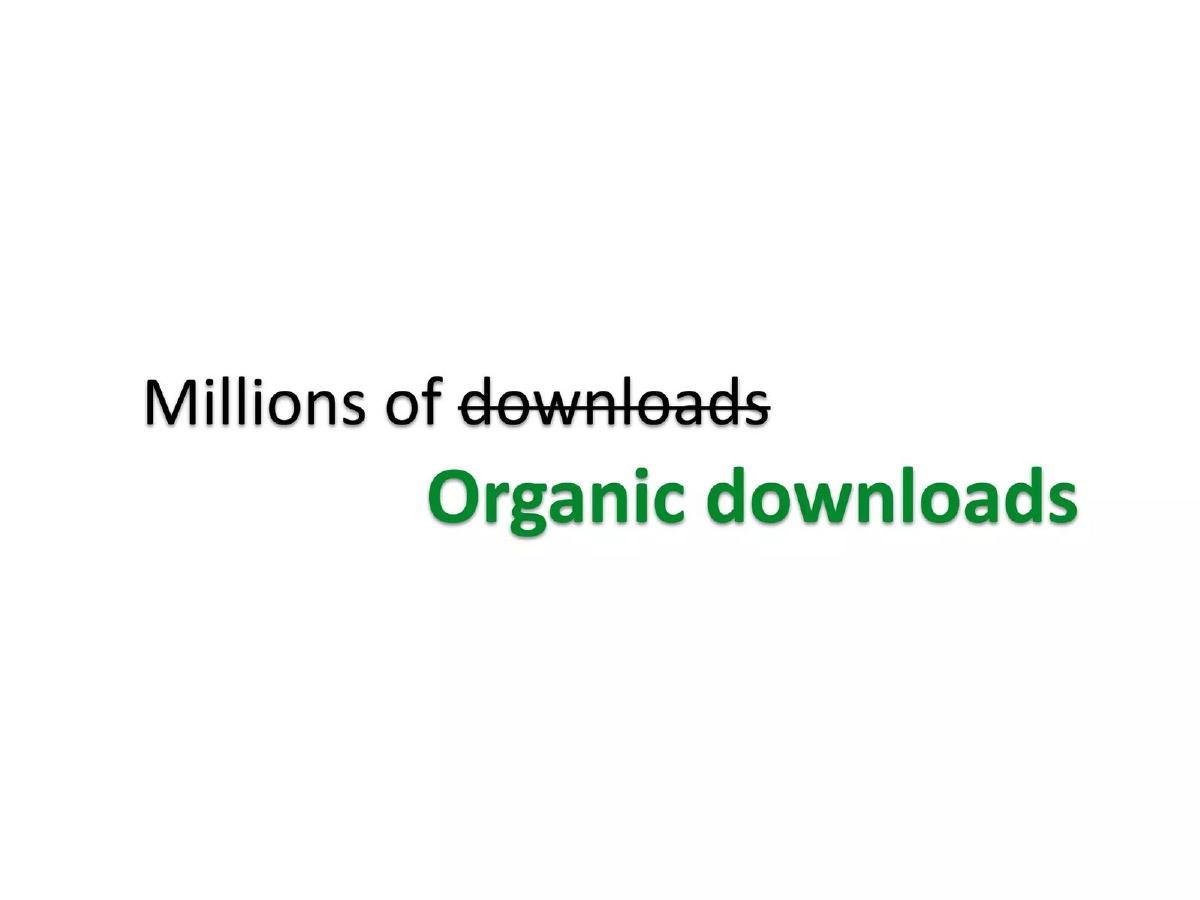
Slide 1 introduces the company with the tagline "Growth Hacking Toolkit For Mobile Apps." The visual identity uses a rocket ship emerging from a smartphone, a common trope for growth-oriented startups. Slides 2 through 4 use a rhetorical approach to define the problem. Slide 2 asks, "What does an app developer want?" and Slide 3 answers by crossing out "Millions of downloads" in favor of "Organic downloads." Slide 4 adds "User engagement and retention" to the list of goals. This framing is effective because it acknowledges that raw downloads are a vanity metric if they aren't organic or retained.
Market Context and Current Solutions (Slides 5-6)
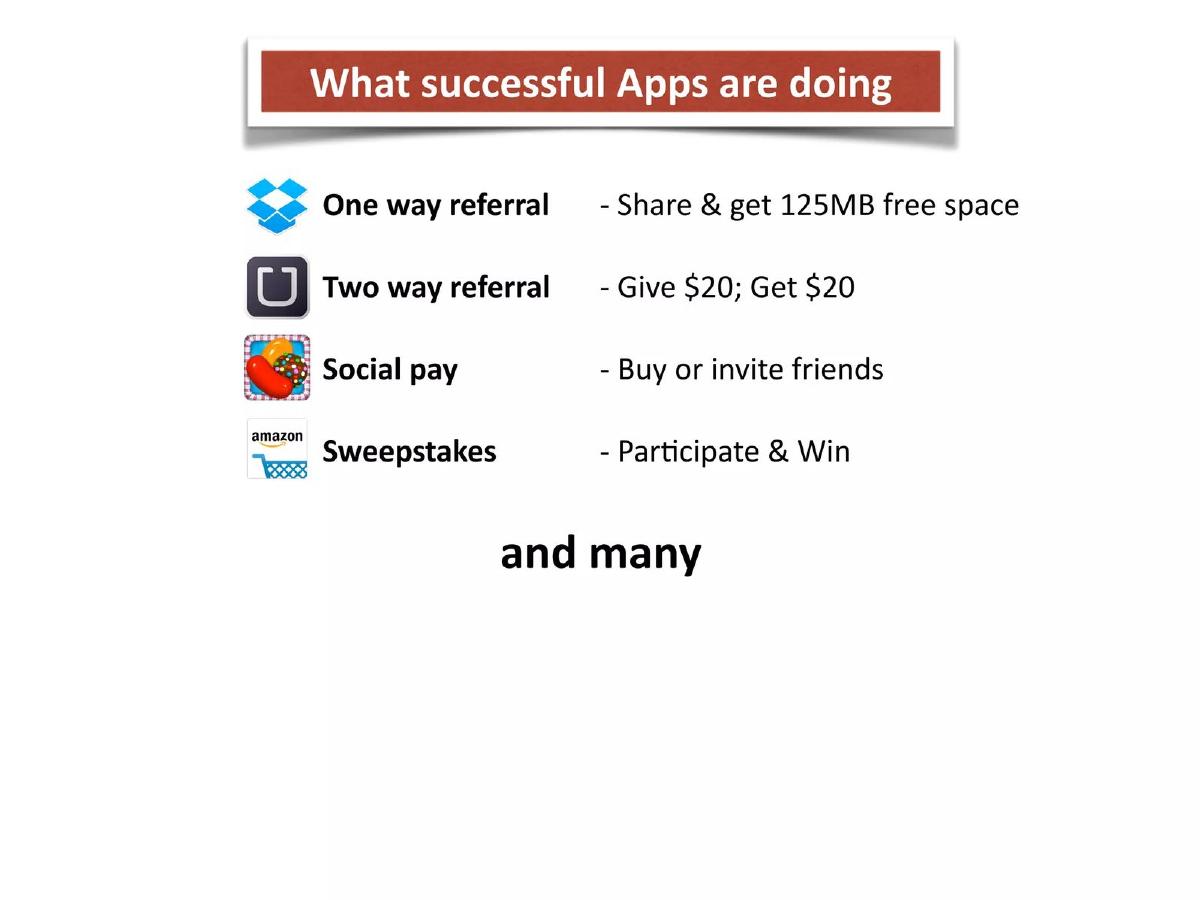
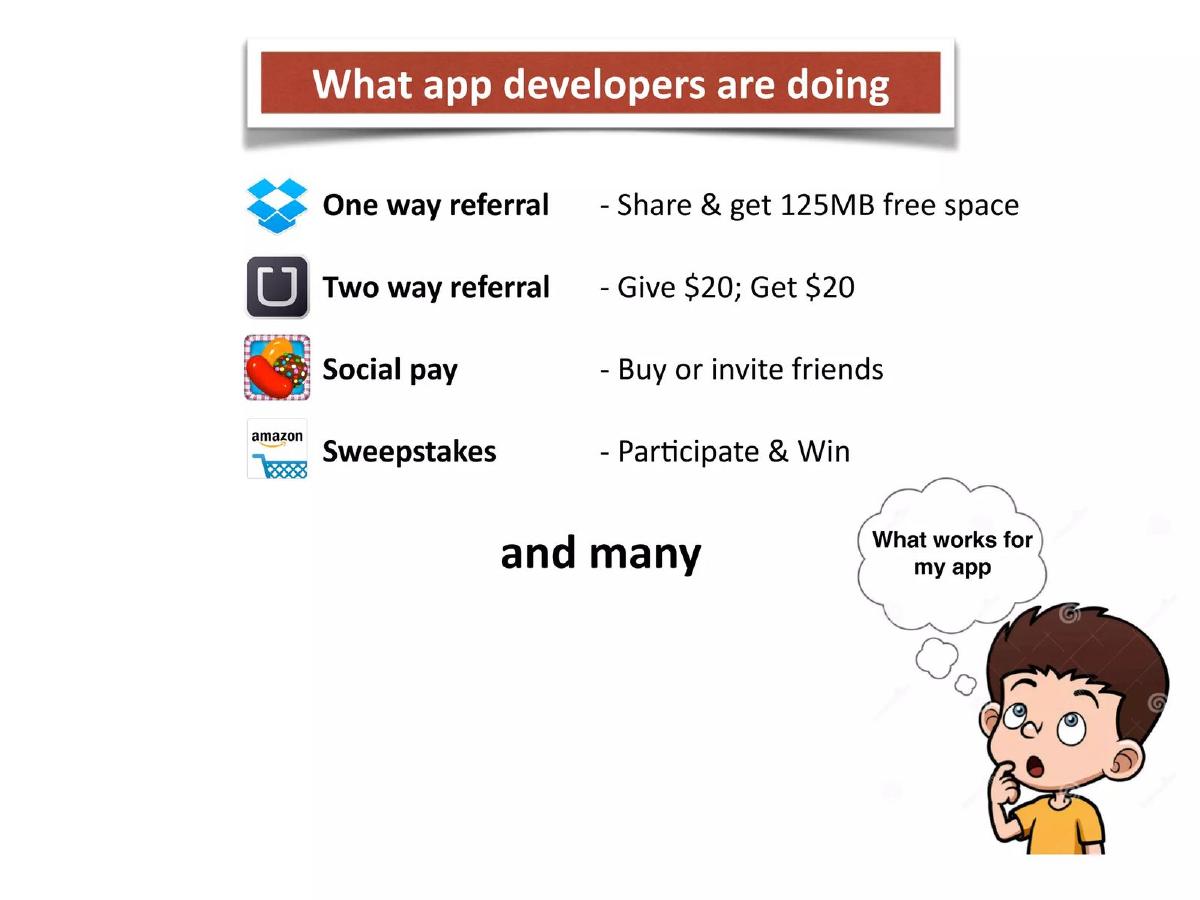
Slide 5 lists what "successful Apps are doing," citing Dropbox (one-way referral), Uber (two-way referral), Candy Crush (social pay), and Amazon (sweepstakes). Slide 6 mirrors this list but adds a cartoon character wondering, "What works for my app?" This identifies the gap: while big players have custom-built growth engines, the average developer lacks the resources to experiment with these mechanics. It sets the stage for a democratized solution.
The Solution and Value Proposition (Slides 7-8)
Slide 7 introduces AppVirality as the solution that helps developers "identify and implement the right growth techniques, within minutes." The key differentiator is explicitly stated: "No coding required." Slide 8 lists the core components: a light weight SDK, a WYSIWYG (What You See Is What You Get) dashboard, a recommendation engine, in-depth analytics, and A/B testing. This slide serves as a high-level summary of the product's technical and functional scope.
Product Walkthrough: The Four-Step Process (Slides 9-14)
The deck devotes a significant portion (six slides) to explaining how the product works. Slide 9 introduces the "simple 4 step process." Slide 10 focuses on Step 1: Integration. It shows a dashboard screenshot with a "Download SDK for Android" button and notes the SDK is only 120 KB and takes 10 minutes to integrate. Slide 11 shows Step 2: Selecting Growth Hacks. The UI displays options for Customer Retention and Refer-A-Friend, with others marked as "Coming Soon." Slide 12 covers Step 3: Configuration. It demonstrates how a user can set campaign dates and customize colors/messages without touching code. Slide 13 shows the social action selection (Facebook, Twitter, WhatsApp). Finally, Slide 14 shows Step 4: Tracking. The analytics dashboard displays "Total Shares," "Impressions," "Clicks," and "Downloads." This walkthrough is thorough and proves the product is more than just a concept.
Feature Deep Dive (Slide 15)
Slide 15 summarizes the "Key Features" using icons. It reiterates the WYSIWYG dashboard and A/B testing but introduces new concepts like "User Targeting" (based on behavior, location, events) and "Fraud Detection" (identifying and preventing fraud referrals). Fraud detection is a critical pain point in referral marketing, and mentioning it here adds credibility to their understanding of the space.
Team and Advisors (Slides 16-17)
Slide 16 introduces the team: Laxman Papineni, Ram Papineni, and Madhu Manne. The slide lists logos of prominent Indian and global tech firms like Oracle, Infosys, and Wipro. A small footnote mentions the team has "1 exit & 1 failed venture," which is a common way to signal experience and resilience. Slide 17 lists two advisors: Mohit Saxena (Co-founder of InMobi) and Shyamal Mehta (CEO of TechJini). It also highlights their participation in the Microsoft Ventures Accelerator, Batch #4, in Bangalore. This provides the necessary social proof for an early-stage company.
Market Size and Business Model (Slides 18-19)
Slide 18 addresses the market opportunity. It cites Gartner Inc. data, stating mobile ad spend will reach "$18B by 2014" and notes that download costs range from "$1 to $3." This justifies the need for an organic growth tool. Slide 19 outlines the pricing model: a monthly subscription that is free up to 10,000 MAUs, then "$2 for every 1,000 MAUs." An example is provided: a 300k MAU app would pay $600 monthly. This transparent pricing suggests a self-service, scalable SaaS model.
Go-to-Market Strategy (Slide 20)
Slide 20, titled "Customer acquisition route," outlines three channels: Online Channels (SEO, SEM, Social Media), Influencing Influencers (Conferences, Developer Groups), and Direct Sale (Marquee clients, Strategic partnerships). It lists logos of platforms they intend to leverage, including GrowthHackers, StackOverflow, and various app-building platforms like Appery.io and BiznessApps. This shows a clear understanding of where their target audience (developers) spends time.
What Works in This Deck
Clarity of Process: The four-step walkthrough (Slides 9-14) makes a technical product feel accessible and easy to adopt. · Transparent Pricing: Including a specific pricing model (Slide 19) helps investors understand the unit economics and potential revenue scaling. · Problem/Solution Alignment: The deck does a good job of linking high acquisition costs (Slide 18) to the need for their specific toolkit.
What Is Missing
Traction Metrics: There is no mention of how many apps are currently using the SDK, how many downloads they have facilitated, or any growth rates. · The Ask: The deck does not state how much money the company is looking to raise or what the valuation expectations are. · Financial Projections: There are no forward-looking statements regarding revenue or market share targets. · Competitive Landscape: The deck ignores other growth-hacking tools or attribution platforms that might offer similar features.
Founder Takeaways
Show, Don't Just Tell: Using actual UI screenshots to explain a process is much more effective than bullet points. Founders should copy the way AppVirality visualized their "4 step process." · Address Technical Friction: For SDK-based startups, the biggest hurdle is the developer's "no." By emphasizing "10 minutes" and "120 KB," AppVirality proactively addresses developer concerns. · Don't Forget the Business Case: While product-focused decks are great for demos, an investor deck needs to include the 'Ask' and the 'Traction.' Without these, the deck feels like a sales presentation rather than a fundraising tool.
Frequently asked questions
- What is the core problem AppVirality is solving?
- AppVirality addresses the difficulty app developers face in achieving organic downloads and user retention (Slides 3-4). They note that while successful apps use referrals and social pay, smaller developers struggle to identify and implement these techniques. The deck highlights that mobile ad spend is projected at $18B with high per-download costs, making organic growth tools essential for sustainability.
- How does the technical implementation work?
- The company emphasizes a low-friction technical start. Developers integrate a 120 KB SDK, which AppVirality claims takes less than 10 minutes (Slide 10). Once integrated, growth 'hacks' like customer retention coupons or refer-a-friend programs can be configured and launched via a web-based dashboard without further code changes or app store updates (Slide 12).
- What is the revenue model for AppVirality?
- AppVirality uses a 'Pay as you grow' monthly subscription model. It is free for apps with up to 10,000 Monthly Active Users (MAUs). Beyond that threshold, the cost is $2 for every 1,000 MAUs. The deck provides an example where an app with 300k MAUs would pay $600 monthly or $7,200 annually (Slide 19).
- Who is behind the company and what is their pedigree?
- The team is led by Laxman Papineni (Business) and Ram Papineni (Product), with Madhu Manne as the first hire. The founders have a history of '1 exit & 1 failed venture.' The deck lists corporate backgrounds including Oracle, Infosys, and Wipro. They are supported by Mohit Saxena (Co-founder of InMobi) and Shyamal Mehta (CEO of TechJini) as advisors (Slides 16-17).
- What critical information is missing from this deck?
- The deck is missing several standard venture capital requirements: a specific funding 'Ask' (how much they are raising), a 'Use of Funds' slide, financial projections (revenue targets), and current traction metrics (how many apps are currently using the SDK). It functions more as a product overview than a complete investment case.