AppFollow’s 2017 pitch deck, presented at TechChill in Riga, serves as a snapshot of a SaaS startup leveraging the 'bot' craze of the mid-2010s to build a serious B2B tool. The company reported significant growth in 2016, scaling from 350 to 6,200 customers while increasing MRR from $1,180 to $7,200. The deck is notably product-centric, showcasing Slack integrations and automated review monitoring rather than deep market sizing or competitive analysis. Seeking $1 million in equity to scale globally, the founders leaned heavily on their status as 'Startup Sauna' alumni and accolades from Produ…
Key takeaways
- The company reported a steady growth rate of 15% month-over-month throughout 2016 as stated on slide 4.
- Customer count grew significantly from 350 in 2015 to 6,200 in 2016 according to the bar chart on slide 4.
- Monthly Recurring Revenue (MRR) increased from $1,180 in 2015 to $7,200 by the end of 2016 as shown on slide 4.
- The startup previously raised $150,000 in convertible notes during 2016 as noted on slide 5.
- The product strategy relies heavily on integrations, specifically featuring a 'Brilliant Bot' featured by Slack in 2017 on slide 5.
- The 2017 investment plan explicitly asks for $1 million for equity to fund product, team, and marketing for global scaling on slide 6.
- Future product development focuses on machine learning for App Store Optimization (ASO) and smart alerts as listed on slide 6.
- The deck omits a dedicated team slide, competitive landscape analysis, and total addressable market (TAM) calculations.
Introduction and Context
AppFollow’s 2017 pitch deck is a concise, six-slide excerpt from a larger 12-slide presentation delivered at the TechChill conference in Riga. At this stage, the company was positioning itself as a critical layer between app developers and the fragmented data provided by the Apple App Store and Google Play Store. The deck reflects the era's fascination with 'bots' and Slack integrations as a primary interface for B2B SaaS.
Slide 1: Title and Positioning
The title slide is functional and minimalist. It defines AppFollow as a "Reviews and Updates Monitor for App Store and Google Play." By including the TechChill Riga 2017 event details and the URL, it establishes the time and place of the pitch. The branding is clean, using a green accent that persists throughout the deck. There is no high-level vision statement here; the focus is strictly on the utility of the tool.
Slide 2: The Data Fragmentation Problem
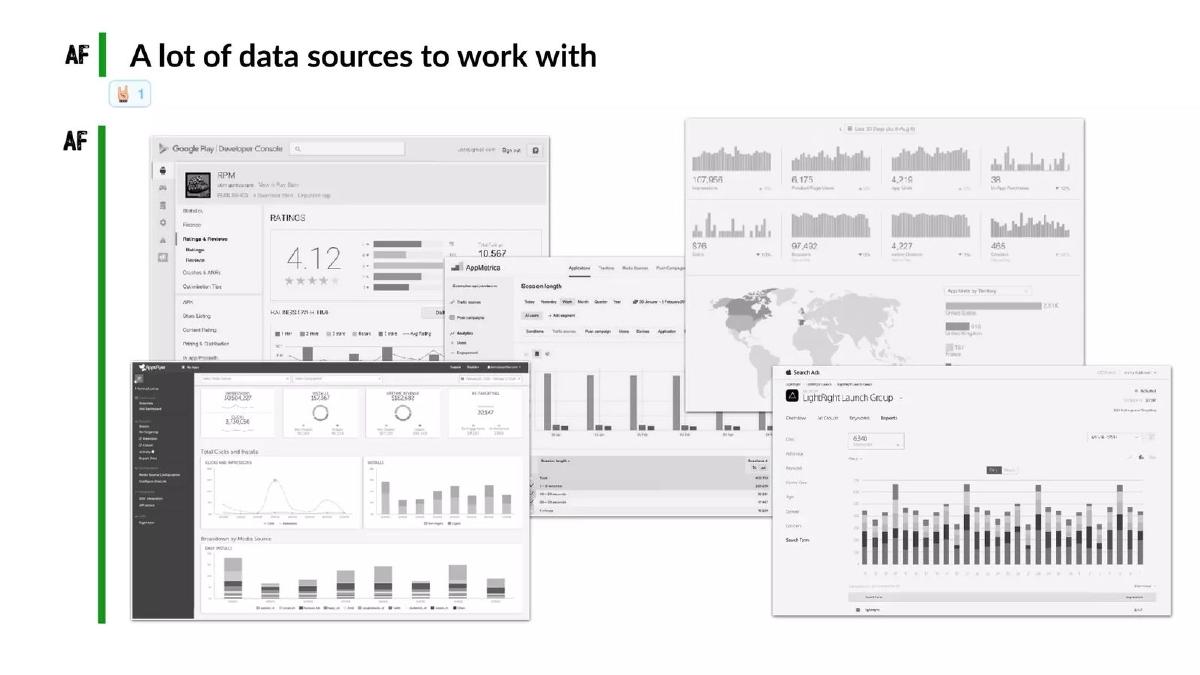
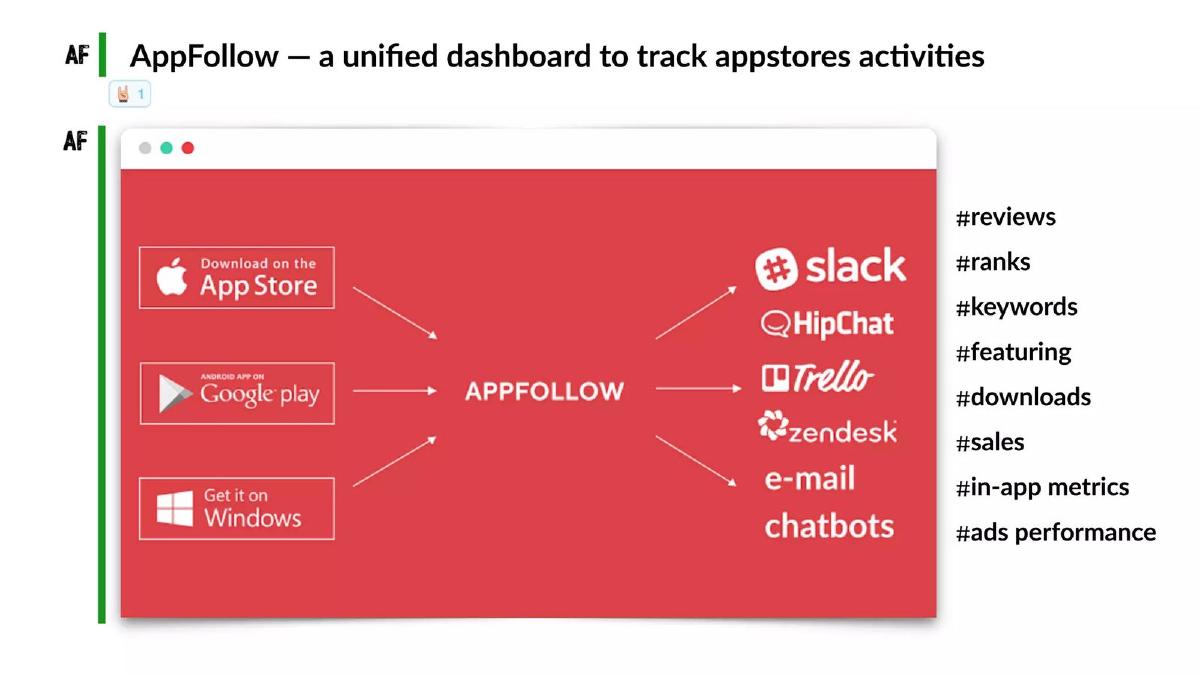
Slide 2, titled "A lot of data sources to work with," serves as a visual representation of the problem without using a single bullet point of text. It displays a collage of various dashboards, including the Google Play Developer Console, AppMetrica, Search Ads, and AppsFlyer. The visual clutter is intentional, designed to make the investor feel the overwhelm that an app manager faces when trying to aggregate performance data manually. It sets the stage for a consolidation solution.
Slide 3: The Solution and Interface
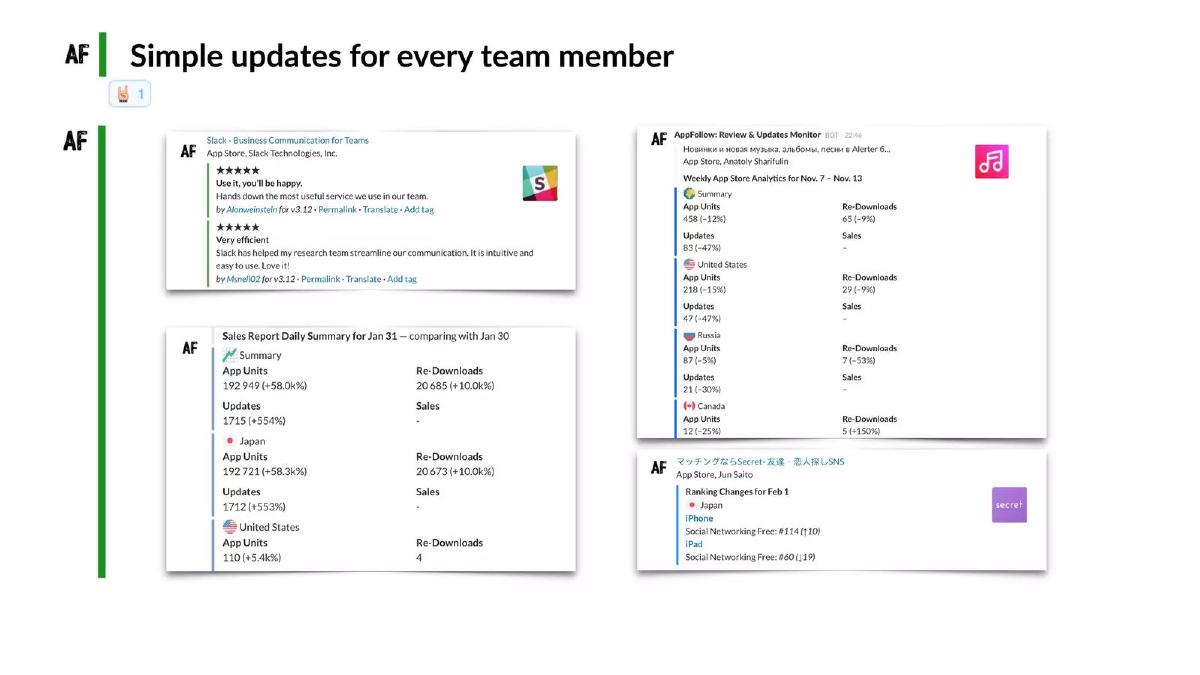
Slide 3 presents the solution: "Simple updates for every team member." This slide is crucial because it shows the product in situ. Instead of showing a proprietary dashboard, it shows how AppFollow pushes data into Slack. The screenshots include review alerts for Slack Technologies Inc., daily sales report summaries, and ranking changes. By showing the product within Slack, AppFollow emphasizes its frictionless integration into existing workflows. The data points shown include App Units, Updates, Re-Downloads, and Sales, broken down by country (US, Russia, Canada, Japan).
Slide 4: Traction and Growth Metrics
This is the 'meat' of the deck. Titled "Steady growth 15% MoM in 2016," it provides two clear bar charts comparing 2015 to 2016. Customers grew from 350 to 6,200 , and MRR grew from $1,180 to $7,200 . While the growth is impressive in percentage terms, the absolute revenue figures ($7,200 MRR) indicate a very early-stage company. The low ARPU suggests the company was in a 'land and expand' phase, focusing on user acquisition over high-ticket monetization at this juncture.
Slide 5: History and Validation
Slide 5 provides the pedigree of the founders and the product. It notes that in 2016 they raised $150k in convertible notes . The slide features a group video call screenshot, humanizing the team despite the lack of a formal 'Team' slide with bios. It lists three major milestones: 2015 Startup Sauna alumni , 2016 Best Bot of the Year nominee by Product Hunt , and 2017 Brilliant Bot featured by Slack . This slide is designed to prove that the team can execute and that the market (and platform partners) likes what they have built.
Slide 6: The Roadmap and The Ask
The final slide in this set covers both the "2017 product plan" and the "2017 investment plan." The product roadmap includes Machine learning ASO , Smart alerts , and an Appstore intelligence assistant . The right side of the slide shows a mobile interface for the AppFollow bot, demonstrating features like 'Top apps for category' and 'Trending searches.' The investment ask is clear: "$1 mln for equity to scale globally" with funds allocated to product, team, and marketing. This is a standard seed round ask for the 2017 market environment.
What Works in This Deck
Clarity of Product: By slide 3, an investor knows exactly what the product does and where it lives (Slack). The use of actual screenshots rather than mockups builds immediate trust.
Traction Transparency: The founders did not hide their low MRR. By showing the $7,200 figure alongside the 6,200 customer count, they demonstrated a high-volume, low-churn potential, even if the monetization was still in its infancy.
Ecosystem Alignment: Leveraging the Slack brand was a smart move in 2017. By showing they were a 'Brilliant Bot' featured by Slack, they offloaded some of the technical due diligence to a major platform's editorial team.
What Is Missing
Market Sizing (TAM/SAM/SOM): There is no mention of how large the app intelligence market is. Investors need to know if this is a $10M business or a $1B business. Without market data, it's hard to justify a $1M equity round if the ceiling is low.
Competitive Landscape: In 2017, companies like App Annie (now Sensor Tower) and Sensor Tower were already established. AppFollow does not explain how it differentiates from these giants, other than perhaps its focus on Slack-first delivery and review management.
Team Bios: While the group photo is nice, it doesn't tell an investor who the CTO is, where the founders worked previously, or if they have the domain expertise to build machine learning ASO tools.
Unit Economics: With such a low ARPU, investors would naturally ask about the Cost of Acquisition (CAC). If it costs $50 to acquire a customer paying $1.16 a month, the business is not sustainable. The deck omits these vital efficiency metrics.
Founder Takeaways
Show, Don't Just Tell: The way AppFollow used slide 2 to visualize 'messy data' and slide 3 to show 'clean updates' is a masterclass in visual storytelling for a technical product. · Be Honest with Early Metrics: Even if your revenue is small, showing a consistent growth curve (15% MoM) is more important than the absolute dollar amount at the seed stage. · Leverage Third-Party Validation: If you have been featured by a platform (Slack, Apple, AWS) or an accelerator (Startup Sauna), make it a central pillar of your credibility slide. · Keep the Ask Simple: The breakdown of the $1M ask into 'Product, Team, Marketing' is standard, but the specific mention of 'Machine Learning ASO' gives investors a concrete idea of what the 'Product' spend actually entails.
Frequently asked questions
- What was AppFollow's primary value proposition in 2017?
- AppFollow positioned itself as a 'Reviews and Updates Monitor for App Store and Google Play.' As shown on slide 3, the core value was simplifying complex data sources into 'simple updates for every team member,' primarily delivered through Slack notifications. This allowed mobile app teams to track ratings, reviews, and ranking changes in real-time without manually checking multiple developer consoles.
- How did the company's revenue compare to its user growth?
- Slide 4 reveals a significant disparity between user count and revenue. While they had 6,200 customers, the MRR was only $7,200. This suggests a very low Average Revenue Per User (ARPU) of approximately $1.16, indicating that the vast majority of their 2016 user base was likely on a free tier or a very low-cost entry plan.
- What external validation did AppFollow cite to build credibility?
- On slide 5, the company highlighted three key milestones: being 2015 Startup Sauna alumni, receiving a 'Best Bot of the Year' nominee from Product Hunt in 2016, and being featured as a 'Brilliant Bot' by Slack in 2017. These accolades served to validate their technical execution and their position within the growing Slack app ecosystem.
- What were the specific goals for the $1 million funding round?
- According to slide 6, the $1 million equity investment was intended to 'scale globally.' The founders allocated these funds across three specific buckets: product development (including machine learning ASO), team expansion, and marketing efforts. This is a standard seed-stage allocation aimed at moving from a validated product to a scalable business model.
- What critical business information is missing from this deck?
- The deck is missing several standard components: a team slide (though a group photo appears on slide 5), a market size (TAM) analysis, a competitive landscape, and unit economics such as Customer Acquisition Cost (CAC) or Lifetime Value (LTV). It also lacks a clear 'Problem' slide, opting instead to show the 'Solution' immediately through dashboard screenshots.