Assembly’s 19-slide deck is a masterclass in product-led storytelling for the post-pandemic enterprise landscape. By framing the 'culture shift that COVID built' as a retention crisis, the company positions its all-in-one platform not just as a tool, but as a defensive moat against employee turnover. The deck relies heavily on high-fidelity product screenshots and a standout 'Stickiness' chart that claims nearly 80% user retention over 12 months. While the deck is light on traditional financial modeling and competitive landscape analysis, it compensates with specific value propositions, such…
Key takeaways
- The deck identifies a specific macro catalyst, citing the 'culture shift that COVID built' as the primary driver for employee disconnection (Slide 5).
- Assembly claims significant ROI for its recognition features, stating they can raise team productivity by 31% and reduce voluntary turnover by 37% (Slide 10).
- A critical 'Stickiness' chart shows user retention starting near 80% in the first month and remaining flat through month 12, suggesting high platform utility (Slide 9).
- The product is positioned as a consolidator, offering over a dozen 'initiatives' including surveys, icebreakers, and goal defining in one interface (Slide 8).
- Efficiency is a core selling point, with the search feature promising to save users 'at least 4 clicks or over 20 seconds each time' (Slide 12).
- The go-to-market strategy emphasizes low friction, offering free implementation that takes only 1-3 weeks (Slide 13).
- The deck omits a traditional 'Ask' slide, financial projections, and a detailed competitive matrix within the 10 core slides provided.
- Reported data from Business Insider confirms the deck successfully raised $10M in a Series A round in 2023.
The Narrative: Solving the Disconnection Crisis
Assembly’s Series A deck arrives at a pivotal moment for enterprise software. As reported by Business Insider, the company raised $10M in 2023, a year when venture capital became significantly more selective. The deck succeeds by leaning into a specific, painful problem: the erosion of company culture in a post-COVID, remote-heavy world. By framing the problem as a 'recruitment risk' rather than just a 'HR annoyance,' Assembly elevates the stakes of its software from a nice-to-have to a business necessity.
Slides 1-2: The Founding Team
The deck opens with a focus on the human element, introducing the four co-founders: Jonathan Fields, Josh Purvis, Muthu Rajendran, and Vijay Kumar. While these slides are simple headshots, they establish the leadership quartet early. In a Series A round, investors are looking for a team that can scale from early traction to enterprise dominance. By giving the founders their own dedicated space at the front of the deck, Assembly signals that the leadership is unified and experienced.
Slides 3-4: Branding and Structure
Slide 3 serves as the title slide with the tagline 'Assemble your culture suite.' This immediately defines the product category. Slide 4 outlines the agenda, which is a standard but effective way to manage investor expectations during a live pitch. It signals a professional, organized approach to the fundraising process.
Slide 5: The Macro Problem
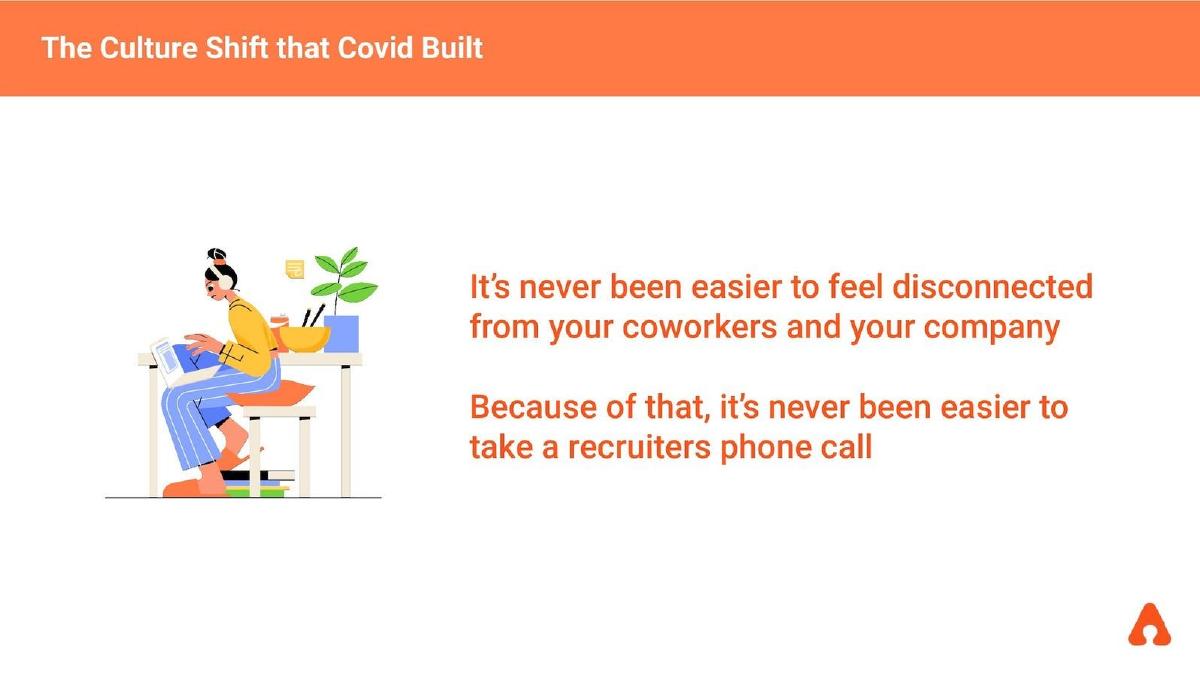
This is the 'Why Now?' slide. Titled 'The Culture Shift that Covid Built,' it hits on a universal pain point for modern CEOs. The text is blunt: 'It’s never been easier to feel disconnected... it’s never been easier to take a recruiters phone call.' By linking software to employee retention, Assembly is speaking the language of the C-suite. They aren't just selling a social feed; they are selling a way to prevent talent bleed.
Slide 8: The All-in-One Solution
Slide 8 is a visual representation of the platform's breadth. It displays various 'cards' or modules, including 30/60/90 Day Plans, Pulse Surveys, Icebreakers, Company Wikis, and Costume Contests. This slide addresses the 'tool fatigue' problem by suggesting that Assembly can replace multiple point solutions. The visual layout implies a modular, customizable experience where companies can 'assemble' the specific initiatives that match their unique culture.
Slide 9: The Power of Stickiness
For a Series A investor, traction is everything. Slide 9 features a 'Stickiness' graph that is arguably the most important data point in the deck. It shows a retention curve that starts at approximately 80% in the 'Same month' and stays remarkably flat through 'Within 12 months.' In SaaS, a flat retention curve is the 'holy grail' because it indicates that the product has become an essential utility. The headline reinforces this: 'you can grow usage over time by bringing all of your work and culture initiatives into one place.'
Slide 10: Quantifiable ROI
Slide 10 moves from usage metrics to business outcomes. It focuses on 'Recognition' and provides two hard figures: a 31% increase in team productivity and a 37% reduction in voluntary turnover. These are bold claims. By providing specific percentages, Assembly gives the champion within a target company the data they need to justify the purchase to a CFO. The slide also includes a UI mockup showing how recognition looks in practice, featuring social-media-style posts and reward options like 'Company Hoodies' or 'Half Day Off.'
Slide 11: Leadership and Transparency
This slide highlights the 'Leadership Announcements' feature. The UI mockup shows a feed where executives can broadcast important updates. Interestingly, the mockup includes a meme of Leonardo DiCaprio, suggesting that the platform encourages a less formal, more engaging style of corporate communication. The goal here is to 'set the tone for the overall culture, transparency, priorities, and collaboration.'
Slide 12: Solving the Information Silo
Slide 12 introduces a more technical value proposition: cross-tool search. It claims to save users 'at least 4 clicks or over 20 seconds each time you search your work.' The mockup shows a search bar that pulls results from Asana, Google Docs, and Assembly itself. This is a strategic move; it positions Assembly as the 'operating system' that sits on top of a company's existing tech stack, rather than just another siloed app.
Slide 13: Frictionless Onboarding
The final content slide addresses the 'How?' of implementation. Enterprise software often suffers from long, expensive deployment cycles. Assembly counters this by offering 'Free implementation' and a setup time of '1-3 weeks.' They also mention 'Dedicated account management' and 'Educational webinars.' This slide is designed to de-risk the purchase for the customer and the investment for the VC by showing a clear, repeatable path to customer success.
What Works in the Assembly Deck
The Retention Narrative: The deck successfully pivots from 'culture' (which can feel soft) to 'retention' (which is a hard cost). By showing a flat 80% retention curve, they prove that their solution is habit-forming and durable.
Product Breadth: The 'initiatives' slide (Slide 8) does a great job of showing the versatility of the platform. It looks like a comprehensive suite rather than a single-feature tool, which justifies enterprise-level pricing.
Specific ROI: Using figures like '37% reduction in voluntary turnover' (Slide 10) gives the pitch teeth. It moves the conversation from qualitative feelings to quantitative business impact.
What is Missing from the Assembly Deck
Financials and Projections: The 10 slides provided do not include any information on ARR (Annual Recurring Revenue), growth rates, or future financial projections. While the retention data is strong, investors at the Series A stage usually require a deep dive into the unit economics (CAC, LTV, Payback Period).
Competitive Landscape: The deck does not explicitly address how Assembly differs from major incumbents like Slack, Microsoft Teams, or specialized HR platforms like Lattice or 15Five. While Slide 12 shows integrations, it doesn't explain why a company would choose Assembly over the 'culture' features built into the tools they already pay for.
The Ask: There is no slide detailing how much capital is being raised or how that capital will be deployed (e.g., hiring, R&D, sales expansion). Although we know from external reports that they raised $10M, the deck itself is silent on the terms of the round.
Founder Takeaways
Focus on 'Stickiness': If you have a retention curve that stays flat over 12 months, make it a centerpiece of your deck. It is the strongest evidence of product-market fit you can provide.
Bridge the Macro to the Micro: Assembly starts with a global problem (COVID culture shift) and immediately shows the micro-solution (recognition cards and search). This helps investors see the 'big picture' while understanding exactly what the product does.
Sell the Outcome, Not the Feature: Instead of saying 'we have a search bar,' Assembly says 'save 20 seconds every time you search.' Instead of saying 'we have a recognition feed,' they say 'reduce turnover by 37%.' Always translate your features into time or money saved for the customer.
Frequently asked questions
- What is Assembly's primary value proposition?
- Assembly positions itself as an all-in-one 'culture suite' that replaces fragmented tools. Its primary goal is to increase employee retention and productivity by centralizing recognition, announcements, and internal search. According to slide 10, the platform aims to reduce voluntary turnover by 37% and increase productivity by 31% through its recognition features.
- How does Assembly address the problem of remote work?
- Slide 5 explicitly calls out the 'culture shift that COVID built,' noting that it has never been easier for employees to feel disconnected or to take a recruiter's phone call. The deck frames remote work as a retention risk that requires a dedicated software solution to maintain company culture.
- What metrics does the deck use to prove product-market fit?
- The most prominent metric is the 'Stickiness' chart on slide 9. It shows that user retention remains exceptionally high and stable, hovering around 80% from the first month through the first year. This suggests that once a company adopts Assembly, the usage becomes a permanent part of the workflow.
- Does the deck include a competitive analysis?
- No, the provided slides do not include a traditional competitive grid. Instead, slide 12 shows a search interface that integrates with competitors like Asana, Google Docs, and LinkedIn, suggesting a strategy of 'co-opetition' where Assembly acts as the central hub for other enterprise tools.
- What is the implementation timeline for the software?
- Assembly emphasizes speed and low cost of entry to attract enterprise clients. Slide 13 states that implementation is free and that companies can get fully set up within 1 to 3 weeks, which is relatively fast for enterprise-grade software.