Skeleton Technologies' Series E deck is a masterclass in industrial positioning, moving away from the crowded consumer EV battery space to dominate 'high power' applications. By leveraging a proprietary material science advantage—Curved Graphene—the company addresses a €95bn market for short-duration energy storage. The deck emphasizes a robust European manufacturing footprint, with facilities in Estonia, Germany, and Finland, and provides concrete technical benchmarks: 1,000,000+ lifecycles for supercapacitors and 30-second charging for their 'SuperBattery.' While the deck lacks a traditiona…
Key takeaways
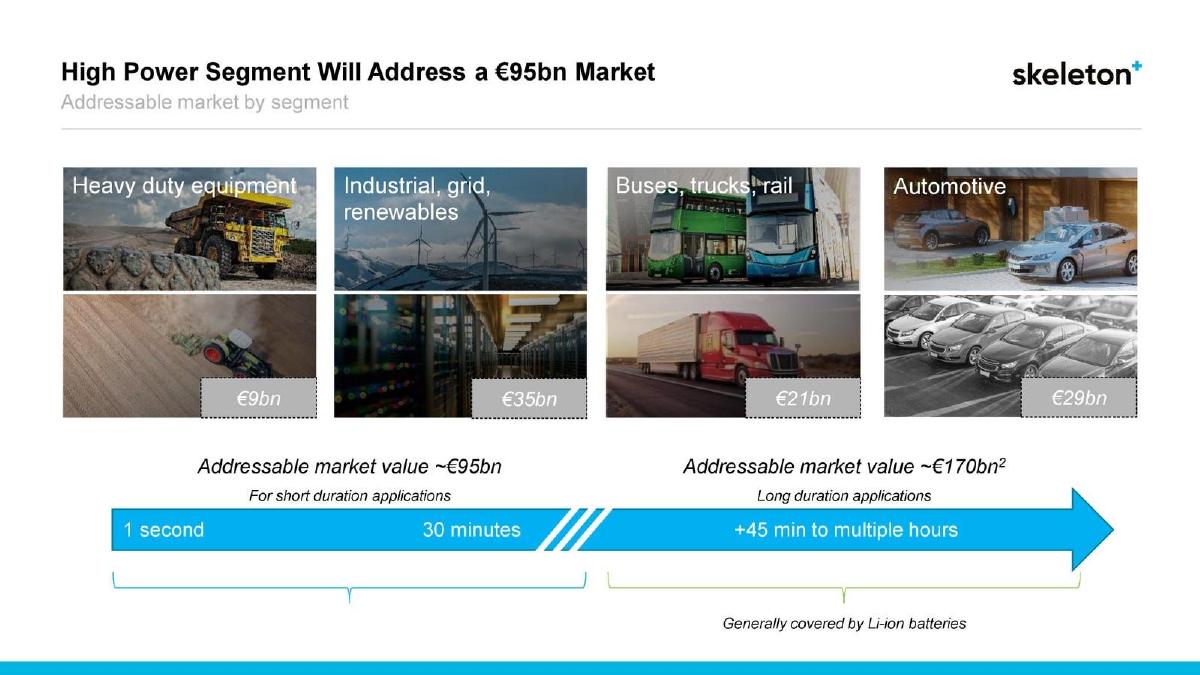
- The company identifies a €95bn addressable market specifically for short-duration (1 second to 30 minutes) high-power applications (Slide 3).
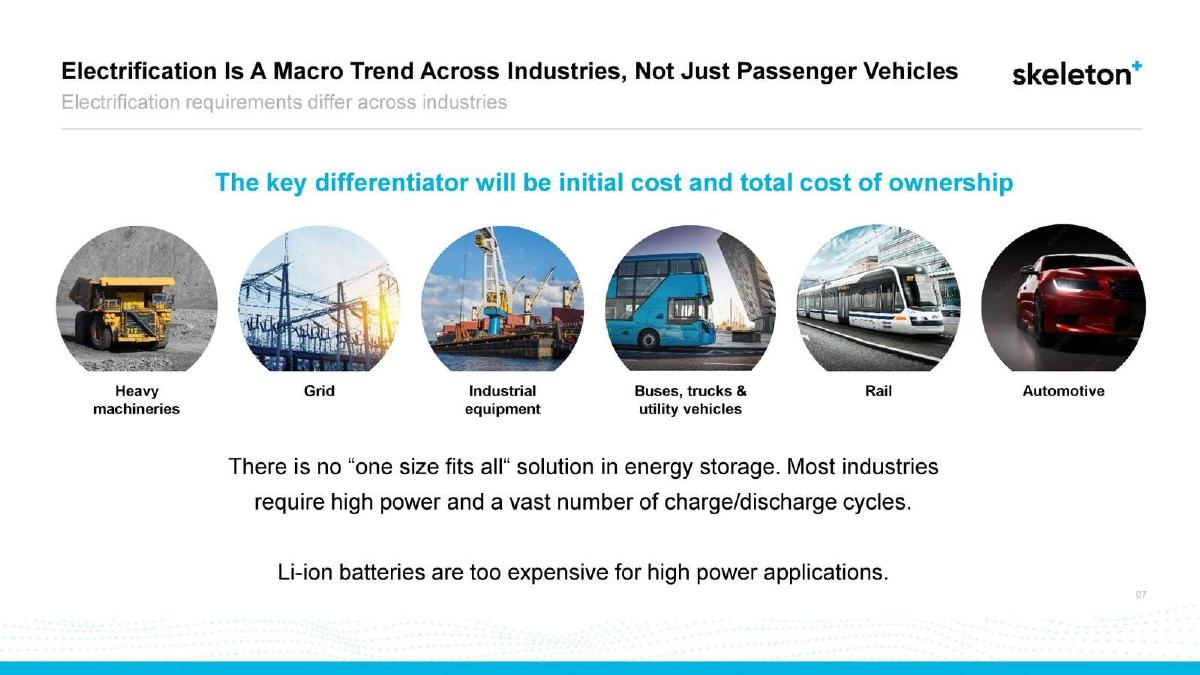
- Skeleton positions its technology as a lower Total Cost of Ownership (TCO) alternative to Li-ion batteries, which they claim are too expensive for high-power cycles (Slide 4).
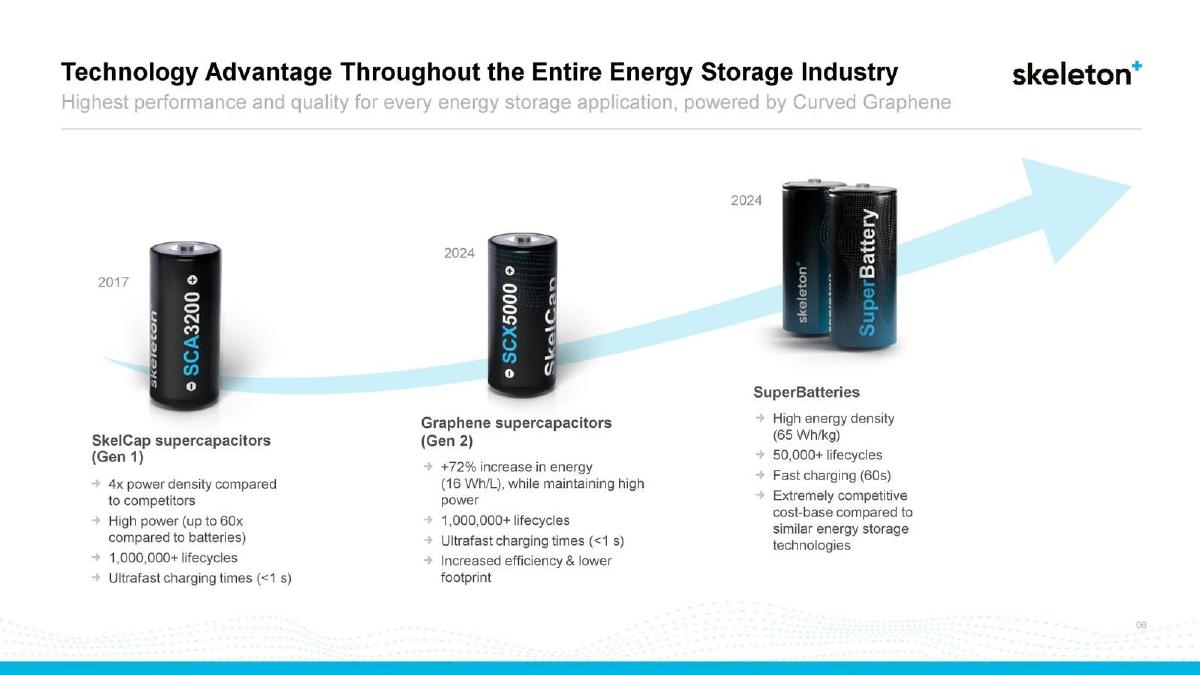
- Proprietary 'Curved Graphene' is the core IP, enabling a 72% increase in energy density for Generation 2 supercapacitors (Slide 7).
- The 'SuperBattery' offers a 30-second charge time compared to 15 minutes for standard Li-ion batteries (Slide 7).
- Manufacturing is vertically integrated across Europe, including the world's 'largest and most modern supercapacitor factory' in Markranstädt, Germany (Slide 2).
- The technology provides significant hardware efficiency, requiring 50% fewer supercapacitors for power quality applications than competitors (Slide 5).
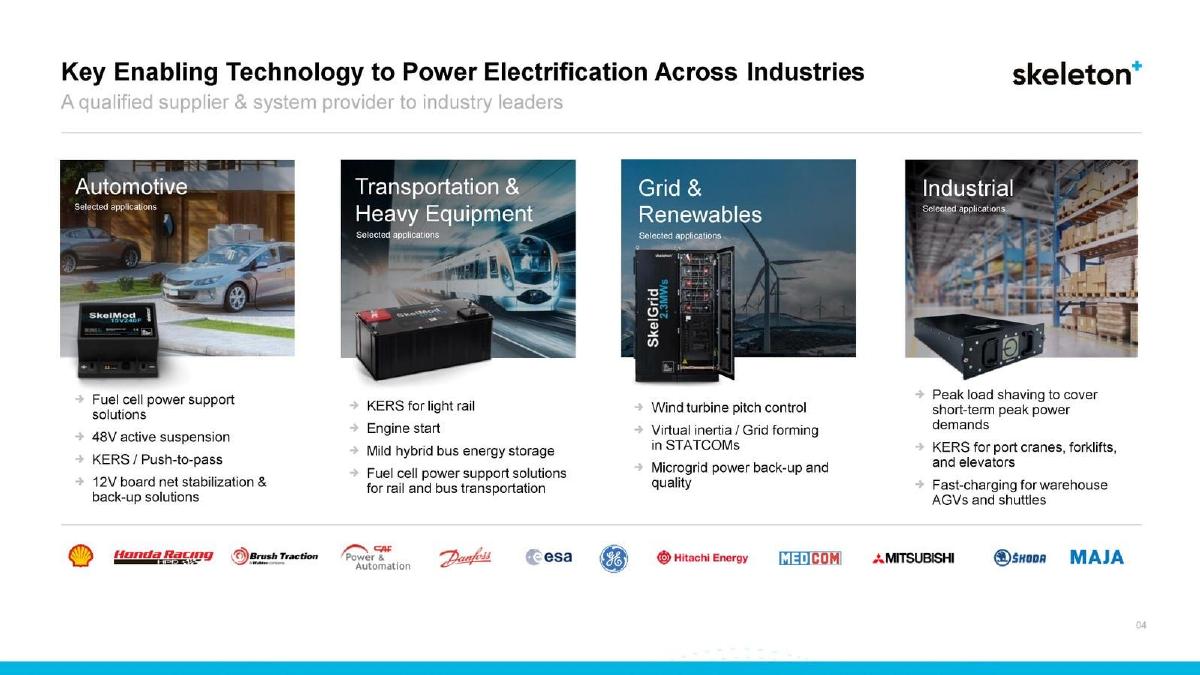
- Skeleton is moving beyond components into systems, as evidenced by the SkelGrid 2.3MWs solution delivered for grid stabilization (Slide 5).
- The production process for SuperBatteries and supercapacitors is unified, allowing for shared equipment and manufacturing scale (Slide 8).
Skeleton Technologies: The High-Power Energy Storage Play
Skeleton Technologies is not a typical battery startup. While most of the industry chases the consumer EV market with lithium-ion variants, Skeleton has built a massive business around 'high power' energy storage. Their Series E deck, which facilitated a $114M raise in 2024 as reported by Business Insider, focuses on industrial scale, proprietary material science, and a robust European supply chain. The following teardown examines how they positioned a complex hardware play to late-stage investors.
Slide 1: The Vision Statement
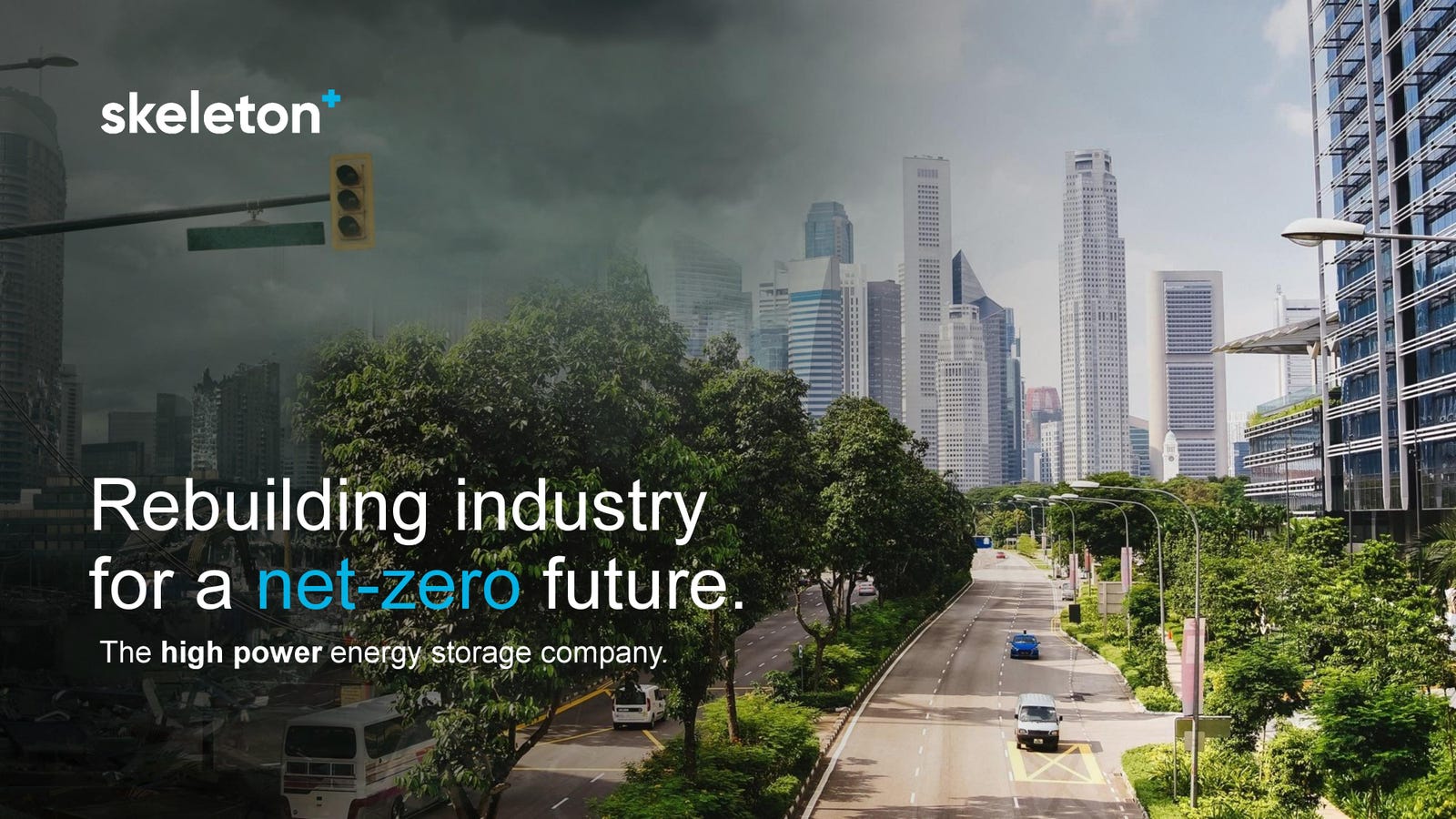
The cover slide sets a clear tone: 'Rebuilding industry for a net-zero future.' By identifying as 'The high power energy storage company,' Skeleton immediately carves out its niche. The imagery—a split view of a smoggy industrial past and a clean, modern city—is a standard but effective trope for ESG-focused investments. It signals that this is a macro-infrastructure play rather than a consumer gadget play.
Slide 2: A Pan-European Infrastructure
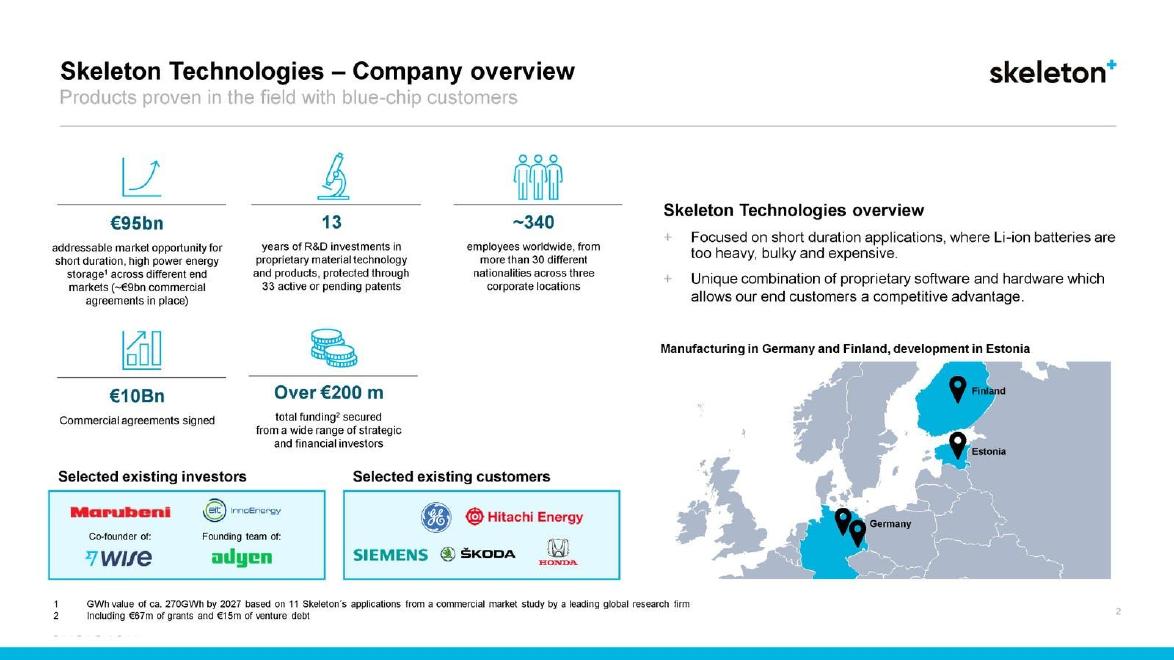
Slide 2 is a logistical powerhouse. It maps out a comprehensive value chain across Estonia, Germany, and Finland. For a Series E company, proving the ability to manufacture at scale is critical. The slide highlights the 'largest and most modern supercapacitor factory in the world' in Markranstädt, Germany, scheduled for production in 2024. This isn't just a pitch for a product; it is a pitch for a sovereign European industrial asset. The breakdown of specific functions—from graphene synthesis in Bitterfeld-Wolfen to software development in Tallinn—demonstrates a mature, vertically integrated organization.
Slide 3: Defining the €95bn Opportunity
Market slides often suffer from 'TAM-inflation,' but Skeleton provides a nuanced breakdown. They segment the market by duration. They concede the 'long duration' market (+45 mins to hours, valued at €170bn) to Li-ion batteries. Instead, they claim the 'short duration' market (1 second to 30 minutes), valued at €95bn. This honesty builds credibility. They identify four key verticals: Industrial/Grid (€35bn), Automotive (€29bn), Buses/Trucks/Rail (€21bn), and Heavy Duty Equipment (€9bn). By focusing on the 'High Power Segment,' they position themselves as the leader of a specific, massive niche rather than a runner-up in the general battery market.
Slide 4: The Economic Argument
Slide 4 addresses the 'Why Now?' and 'Why Us?' questions. The headline states that electrification is a macro trend across all industries, not just passenger vehicles. The core argument is economic: 'Li-ion batteries are too expensive for high power applications.' They argue that the key differentiator will be the Total Cost of Ownership (TCO). High-power applications require frequent charge/discharge cycles that degrade standard batteries quickly. Skeleton’s technology is positioned as the durable, cost-effective solution for these high-stress environments.
Slide 5: Grid Stabilization and Industrial Validation
Traction is demonstrated through a specific product: the SkelGrid 2.3MWs. The slide claims a massive efficiency gain: '50% FEWER supercapacitors needed for power quality applications compared to competition.' This is a bold technical claim that directly impacts the customer's CAPEX. To anchor this claim, they include a quote from Hitachi Energy, calling Skeleton the 'Most competitive supercapacitor-based ESS for grid applications.' Third-party validation from a global industrial giant like Hitachi is worth more than a dozen slides of internal metrics.
Slide 6: The Frontier Case Study: Fusion Energy
Slide 6 moves from the practical (grid) to the aspirational (fusion). It details how Skeleton’s supercapacitors are used to 'kickstart' fusion reactors, providing 120 MW for 3 seconds to heat plasma to 100 million degrees Celsius. While fusion is not yet a commercial market, this slide serves a dual purpose: it proves the extreme performance capabilities of the hardware and associates the brand with the absolute cutting edge of energy technology. If the hardware can handle a fusion reactor, it can handle a city bus.
Slide 7: Product Portfolio and Material Science
This is the technical heart of the deck. It introduces 'Curved Graphene' as the enabling technology. The slide compares two product lines: the Supercapacitor and the SuperBattery. The metrics are impressive: 1,000,000+ lifecycles for supercapacitors and a 72% increase in energy density for Generation 2. The SuperBattery is positioned as a bridge between supercapacitors and Li-ion, offering 30-second charging and 50,000+ lifecycles. Crucially, they mention the 'extremely competitive cost-base' and 'non-flammable' nature, addressing the two biggest pain points of the battery industry: price and safety.
Slide 8: Manufacturing and Software Integration
Slide 8 focuses on the production process. It shows a linear progression from electrode production to module assembly. The key takeaway here is that SuperBatteries and supercapacitors use the same equipment and production steps. This implies significant manufacturing synergies and lower incremental costs as they scale new product lines. The bottom of the slide mentions that their portfolio is 'underpinned by software' to detect overheating and prolong cell life, moving the company away from being a 'dumb' hardware manufacturer toward a 'smart' energy systems provider.
Slide 9: The Closing and Certification
The final slide is a standard contact page but includes important 'trust signals.' It displays ISO 9001, ISO 14001, and IATF 16949 certifications. For automotive and industrial investors, these certifications are non-negotiable prerequisites. The tagline 'WE HELP TO SAVE ENERGY' reinforces the ESG mission that opened the deck.
What Skeleton Technologies Does Well
The deck excels at segmentation . By explicitly defining the 'high power' market and ceding the 'high energy' market to Li-ion, Skeleton avoids a direct comparison with giants like CATL or Tesla. This makes their market leadership claim much more believable. They also do an excellent job of vertical integration storytelling . Showing the synthesis of graphene all the way through to the software-enabled grid module suggests a company with deep defensibility and high margins.
Furthermore, the technical benchmarking is precise. Using '1,000,000 lifecycles' and '30-second charging' gives investors concrete numbers to compare against existing solutions. The inclusion of a blue-chip partner (Hitachi) provides the necessary 'social proof' for a Series E round.
What is Missing from the Deck
The most glaring omission is a Team Slide . While the company is well-established, investors at the Series E level still want to see the leadership responsible for executing a $100M+ capital deployment. There is also no Financial History or Projections slide. While these are likely in the data room, a summary of revenue growth, backlog, or unit economics would have strengthened the narrative of commercial readiness. Finally, there is no 'The Ask' slide. The deck describes the company's state and potential but does not explicitly state how much they are raising or what the specific milestones for the next 24 months are.
Lessons for Founders
Founders in the deep-tech or hardware space should study how Skeleton commoditizes their IP . They don't just talk about 'Curved Graphene' as a scientific curiosity; they immediately translate it into energy density percentages and charging times. They turn a material science breakthrough into a business advantage.
Another lesson is the use of geography as an asset . In the current geopolitical climate, being a 'Pan-European' company with manufacturing in Germany is a strategic advantage for securing both private investment and government grants. If your startup contributes to regional industrial sovereignty, make that a central pillar of your deck. Finally, don't fight every battle . By acknowledging where Li-ion is better, Skeleton makes their claims about where they are better much more persuasive.
Frequently asked questions
- What is the primary technical advantage of Skeleton Technologies?
- The primary advantage is their proprietary 'Curved Graphene' material. According to slide 7, this material allows their Generation 2 supercapacitors to increase energy density by 72% (reaching 16 Wh/L) while maintaining high power and achieving over 1,000,000 lifecycles. It also enables their SuperBattery to charge in just 30 seconds.
- Which market segments does Skeleton Technologies target?
- Slide 3 identifies four main segments for high-power applications: Industrial/Grid/Renewables (€35bn), Automotive (€29bn), Buses/Trucks/Rail (€21bn), and Heavy Duty Equipment (€9bn). They specifically target short-duration applications ranging from 1 second to 30 minutes, where traditional Li-ion batteries are less cost-effective.
- Where is Skeleton Technologies' manufacturing located?
- As shown on slide 2, the company has a pan-European footprint. Key locations include Tallinn (Estonia) for software and R&D, and several German sites: Großröhrsdorf (R&D/Production), Markranstädt (the world's largest supercapacitor factory), and Bitterfeld-Wolfen (Graphene synthesis). They also have a pilot plant in Varkaus, Finland.
- How does Skeleton compare to traditional Lithium-ion batteries?
- Slide 4 and slide 7 highlight that Li-ion batteries are too expensive for high-power applications due to cycle requirements. Skeleton's SuperBattery offers 50,000+ lifecycles and 30-second charging, whereas Li-ion typically takes 15 minutes. Furthermore, Skeleton's products are marketed as non-flammable, providing a safety advantage over standard Li-ion chemistries.
- Does the deck include financial projections or a team overview?
- No. The 17-slide deck provided focuses almost entirely on market opportunity, technology, and manufacturing infrastructure. It omits a team slide, historical revenue figures, and specific forward-looking financial projections. This is common in late-stage (Series E) decks where such data is often moved to a separate data room.