Siren Care’s 2015 pitch deck is a textbook example of how to pitch a hardware-enabled service by focusing on a specific, high-cost medical problem. While the company describes itself as a 'Next Generation Smart Textile' platform (Slide 1), the deck spends the majority of its time on the 'Diabetic Foot'—a condition affecting 40% of the 415 million people with diabetes (Slide 5). The deck is visually driven, using stark imagery of medical complications (Slide 6) and clear financial stakes ($17B/year cost to the U.S. healthcare system, Slide 7) to justify its existence. Despite the lack of finan…
Key takeaways
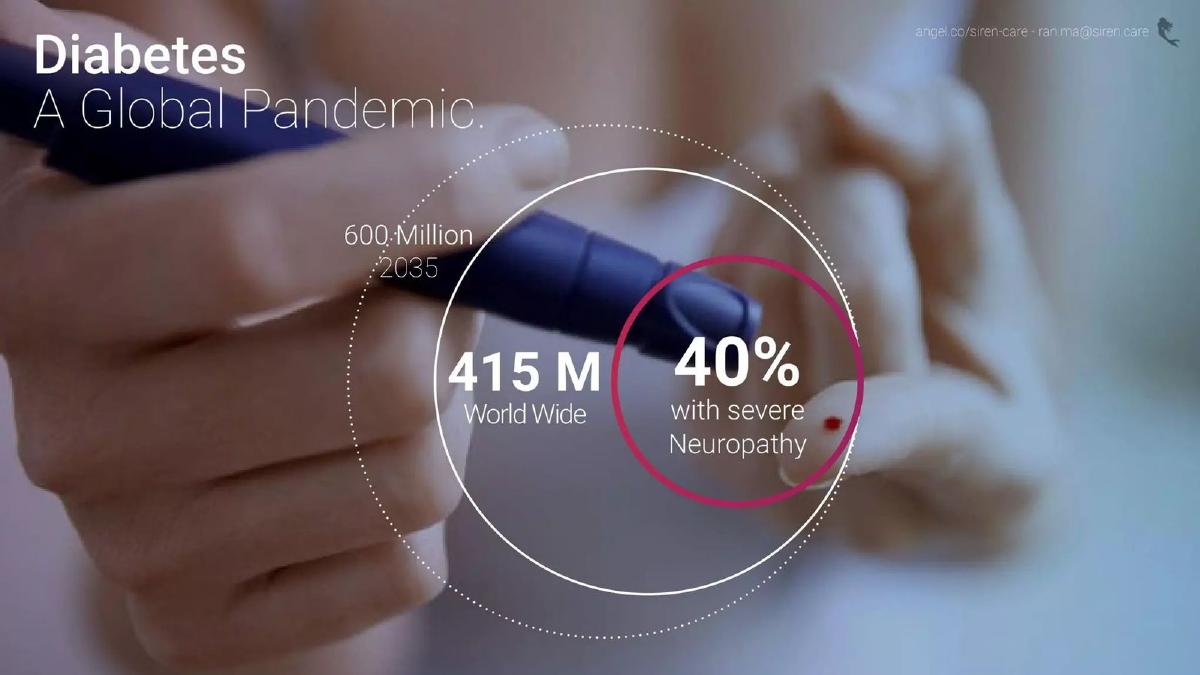
- The deck frames the technology as a solution to a 'Global Pandemic' of diabetes, citing 415 million current cases (Slide 5).
- It identifies a specific, high-risk niche: the 40% of diabetic patients with severe neuropathy (Slide 5).
- The financial burden of the problem is quantified at $17 billion per year for the U.S. healthcare system (Slide 7).
- Clinical efficacy is highlighted by stating that temperature monitoring can reduce foot ulcers by 72% (Slide 8).
- The product is positioned as 'Made for Manufacturing,' emphasizing scalability and adaptability (Slide 3).
- The team slide showcases deep institutional ties, including Johns Hopkins, Philips, and Cisco (Slide 11).
- The deck lacks any mention of unit economics, revenue models, or a specific funding request.
- The vision expands beyond healthcare into fitness, fashion, military, and entertainment (Slide 12).
The Siren Care Pitch Deck: A Strategic Teardown
Siren Care’s 13-slide deck from 2015 is a study in focused storytelling. At a time when 'wearables' were often dismissed as toys, Siren Care successfully pivoted the conversation toward clinical necessity. By the time this deck was circulating, the company was positioning itself for a Series B, eventually raising $21.9 million to bring its smart textile technology to market. The deck does not rely on complex charts; instead, it uses high-impact imagery and massive macro-economic figures to build a case for a product that is, at its core, a pair of socks.
Introduction and Technology Foundation (Slides 1-3)
Slide 1: Title The deck opens with a minimalist title slide. The tagline, "Next Generation Smart Textiles To Empower People," sets a broad, ambitious tone. The contact information for CEO Ran Ma is visible in the top right corner, a standard but necessary inclusion for investor outreach.
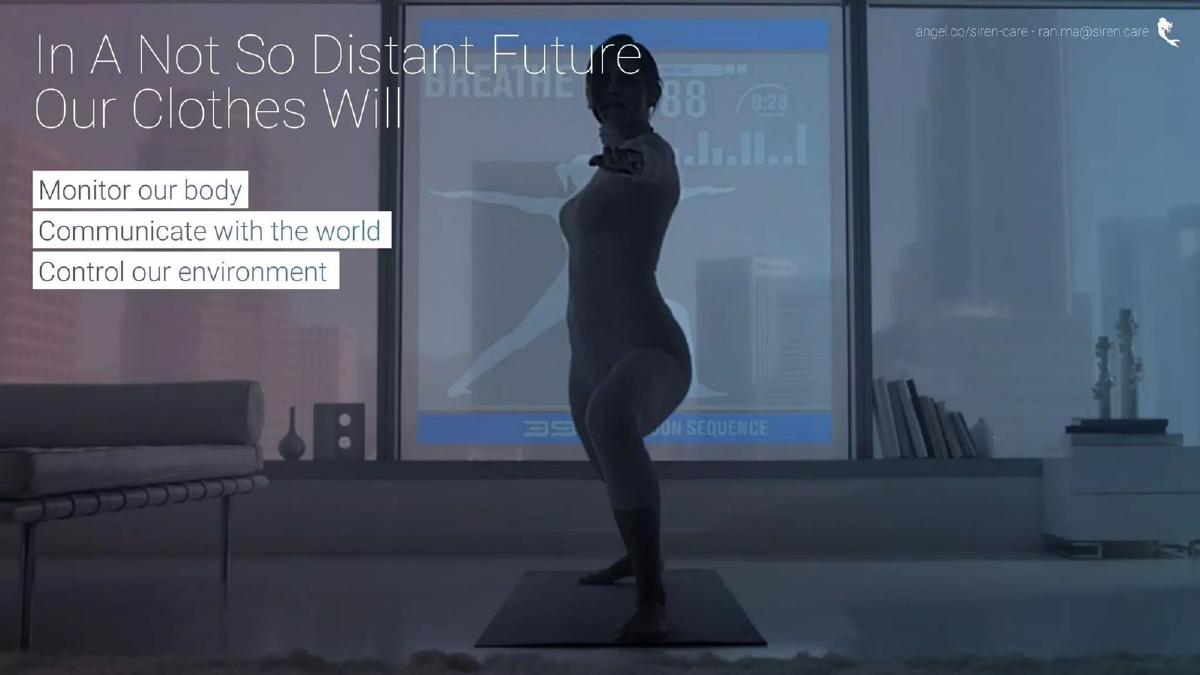
Slide 2: The Vision This slide uses a 'future-casting' approach. It claims that in the "not so distant future," clothes will monitor the body, communicate with the world, and control the environment. This is a classic 'Why Now?' setup, suggesting that the era of passive clothing is ending.
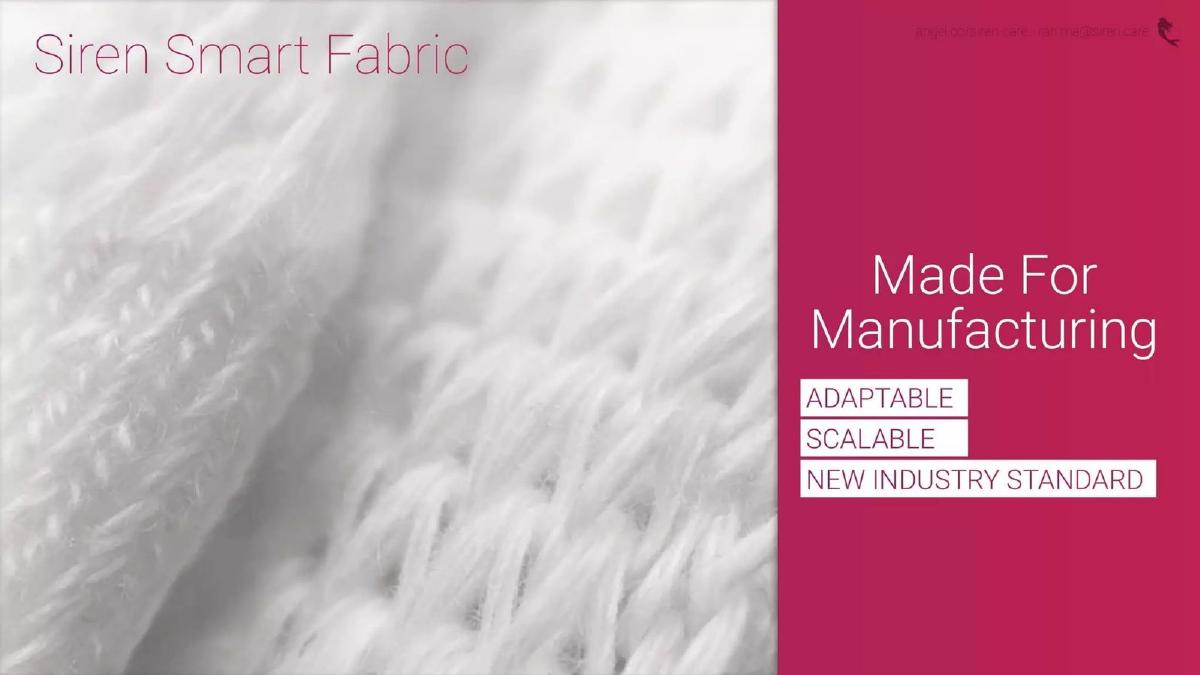
Slide 3: Siren Smart Fabric Here, the company addresses a major concern for hardware investors: manufacturability. By labeling the fabric as "Made For Manufacturing," "Adaptable," and "Scalable," they attempt to de-risk the technical hurdles of integrating electronics into textiles. The claim that this is a "New Industry Standard" is bold, though the slide lacks technical specifications to back it up.
The Problem: The Diabetic Foot (Slides 4-7)
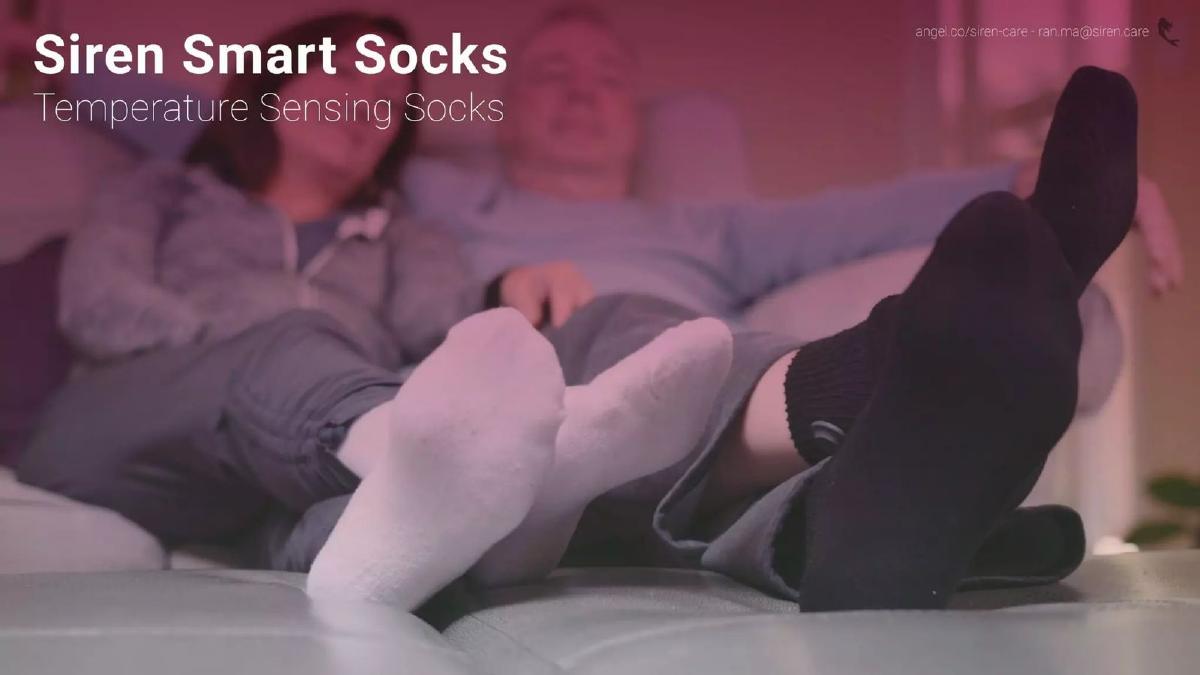
Slide 4: Siren Smart Socks This slide introduces the flagship product: Temperature Sensing Socks. The imagery is domestic and non-threatening, showing a couple relaxing, which emphasizes that the technology "blends into everyday life."
Slide 5: Diabetes - A Global Pandemic The deck shifts from product to market size. It cites 415 million people worldwide with diabetes, projected to grow to 600 million by 2035. Crucially, it narrows the focus to the 40% of patients with "severe Neuropathy." This is a vital distinction—it shows the founders understand their specific high-risk cohort.
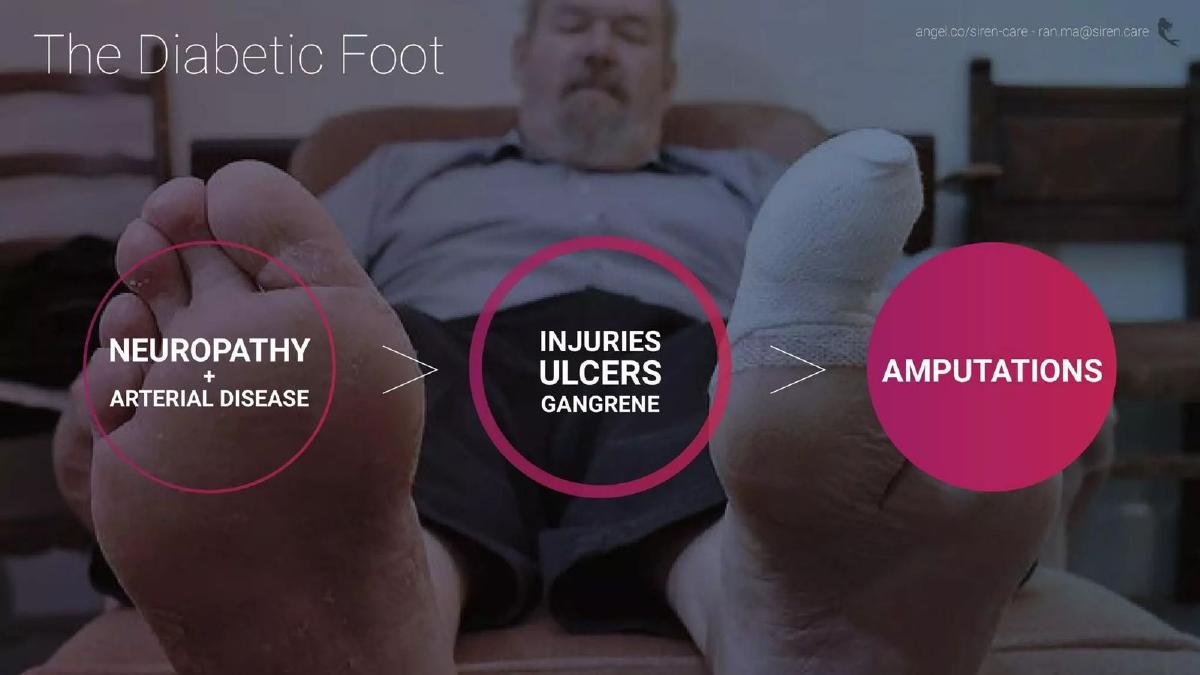
Slide 6: The Clinical Progression This is the most visceral slide in the deck. It shows a clear, three-step path: Neuropathy + Arterial Disease leads to Injuries/Ulcers/Gangrene, which leads to Amputations. By showing a bandaged foot, the deck makes the stakes of the problem undeniable. It moves the product from a 'nice-to-have' to a 'must-have' for limb preservation.
Slide 7: Financial Impact For the institutional investor, the human cost must be paired with a financial one. The slide features a stethoscope over stacks of cash with the figure "$17B/YEAR" in bold. This represents the cost to the U.S. healthcare system, suggesting that a preventative tool like Siren Socks could capture a significant portion of this 'wasted' spend through cost savings.
The Solution and Efficacy (Slides 8-10)
Slide 8: Data Can Save Lives This slide provides the 'Proof of Concept.' It states that "Temperature Monitoring Can Reduce Foot Ulcers By 72%." It contrasts the Siren approach with "Temptouch," a manual temperature probe. The implication is that continuous monitoring (Siren) is superior to point-in-time checks.
Slide 9: Product Integration The deck returns to the physical product, showing a close-up of the sock with a small, white circular sensor. The text reiterates that the technology "blends into every day life," addressing potential patient compliance issues—if it looks like a normal sock, patients are more likely to wear it.
Slide 10: The Siren Care App This slide demonstrates the user interface. It shows a heat map of the feet with green, orange, and red indicators. A push notification reads: "Please check your left heel for a sore or injury. And reduce activity in that area." This clarifies the value proposition: the hardware is just the data collector; the software is the intervention tool.
Team and Future Vision (Slides 11-13)
Slide 11: Our Team and Advisors The team slide is exceptionally strong for a Series B deck. It highlights Ran Ma (Biomedical Engineering, Johns Hopkins), Jie Fu (Manufacturing, Cisco/Philips), and Henk Jan Scholten (Global Textile Sourcing). The inclusion of logos from Johns Hopkins, Philips, and Cisco adds immediate institutional credibility. The advisor section is equally dense, featuring five medical and business experts, including a "Business Advisor" from Guitar Hero (Charles Huang), suggesting expertise in scaling consumer hardware.
Slide 12: The Future is Now This is the 'Platform' slide. It suggests that while they are starting with healthcare, the "Siren Eco-System" has applications in Fitness, Fashion, Military, and Entertainment. This is designed to expand the Total Addressable Market (TAM) in the eyes of an investor who might worry that diabetic socks are too niche.
Slide 13: Contact A simple closing slide with the website and contact email. It mirrors the branding of the opening slide, maintaining a consistent visual identity.
What Works in This Deck
High-Stakes Problem Framing: The deck does an excellent job of making the 'Diabetic Foot' seem like an urgent, solvable crisis. By linking neuropathy to a $17 billion cost, they make the investment case about cost-avoidance, which is a powerful motivator in healthcare. · Visual Simplicity: The deck avoids 'wall-of-text' slides. It uses large fonts and high-quality photography to convey one idea per slide. This is ideal for a presentation that is being talked through by a founder. · Credibility by Association: The team slide (Slide 11) is a masterclass in using logos to build trust. Even if an investor doesn't know the founders, they know Johns Hopkins and Philips.
What is Missing
The Business Model: There is no mention of how Siren Care actually makes money. Is it a one-time hardware sale? A monthly subscription for the monitoring service? A reimbursement play through insurance (CPT codes)? This is a major omission for a Series B deck. · Unit Economics: Investors at this stage want to know the Cost of Goods Sold (COGS) and the Customer Acquisition Cost (CAC). None of this is present. · Competition: The deck operates as if Siren Care is the only company in the world working on smart textiles or diabetic foot care. A slide acknowledging competitors (like Orpyx) would have shown market awareness. · The Ask: The deck ends without telling the investor what the company wants. There is no mention of the round size, the valuation, or the milestones they intend to hit with the new capital.
What a Founder Should Copy
The 'Progression' Slide: Slide 6 is a perfect way to illustrate a problem. If your product prevents a catastrophic outcome, show the steps leading to that catastrophe and place your product as the barrier. · Focusing on a Niche First: Even though Siren has a 'platform' technology (smart fabric), they spent 80% of the deck on one specific use case. Founders should copy this 'wedge' strategy—prove you can solve one big problem before claiming you can solve everything. · Quantifying the Macro-Pain: Using the $17B figure (Slide 7) gives the investor a sense of the 'prize' if the company succeeds. Always find the largest, most reputable number associated with the problem you are solving.
Frequently asked questions
- What is the primary product described in the Siren Care deck?
- The primary product is the Siren Smart Sock, a temperature-sensing wearable designed for diabetic patients. According to Slide 4 and Slide 9, these socks use proprietary smart fabric to monitor foot temperature continuously. This data is then transmitted to a mobile app to detect potential injuries or ulcers before they become severe, as shown on Slide 10.
- How does Siren Care justify the market need for smart socks?
- Siren Care justifies the need by highlighting the 'staggering financial costs' of diabetic foot complications, which Slide 7 states is $17 billion annually in the U.S. alone. Furthermore, Slide 6 illustrates a direct progression from neuropathy to ulcers and, ultimately, amputations, positioning the socks as a preventative tool that can reduce ulcers by 72% (Slide 8).
- Who are the key members of the Siren Care leadership team?
- The team is led by CEO Ran Ma, who has a background in Biomedical Engineering from Johns Hopkins University. Other key members include CTO Jie Fu (formerly of Cisco and Philips) and COO Henk Jan Scholten, who specializes in global textile sourcing. The team is supported by a robust board of medical and business advisors, as detailed on Slide 11.
- What is missing from the Siren Care pitch deck?
- The deck is notably missing several standard venture capital components. There are no slides detailing the business model (subscription vs. hardware sale), no financial projections, no competitive landscape analysis, and no specific 'Ask' regarding the amount of capital being raised or the intended use of funds.
- Is Siren Care strictly a healthcare company according to the deck?
- While the deck focuses almost entirely on the 'Diabetic Foot Program,' Slide 12 reveals a much broader vision. It describes a 'Siren Eco-System' where their smart textile technology could be applied to fitness, fashion, military, and entertainment sectors, suggesting the company views itself as a platform technology rather than a single-product medical device firm.