Aurion Biotech’s 2022 pitch deck is a masterclass in clinical-stage biotech storytelling, successfully securing $120M in funding. The company addresses a massive unmet need in ophthalmology: corneal blindness affecting 16 million people. By showcasing 5-year longitudinal data from initial Japanese trials—demonstrating sustained visual acuity improvements from 20/220 to 20/30—the deck effectively de-risks the core technology. A critical highlight is the manufacturing breakthrough: the ability to produce 100+ treatments from a single donor, solving the chronic global shortage of corneal tissue.…
Key takeaways
- The company identifies a $4.75 billion Total Addressable Market based on 475,000 procedures annually at $10k per procedure (Slide 9).
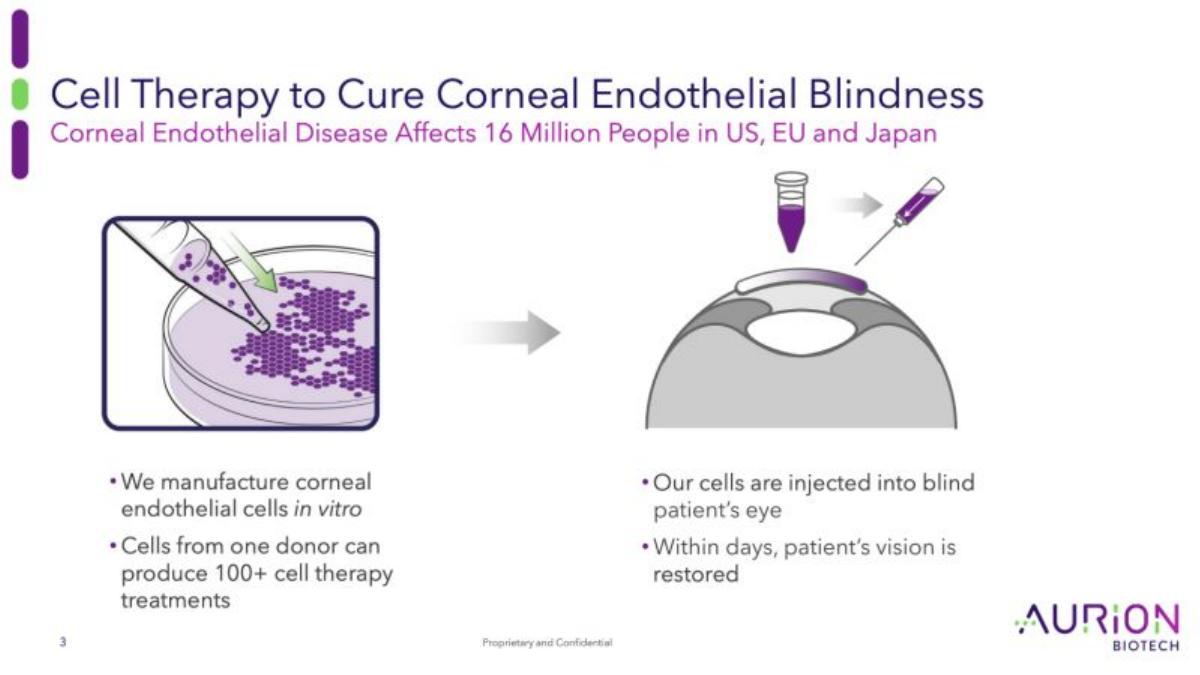
- Aurion's manufacturing process solves the donor shortage by producing 100+ treatments from a single donor (Slide 3).
- Clinical data shows long-term efficacy, with mean visual acuity improving from 20/220 at baseline to 20/30 after five years (Slide 15).
- The procedure is designed for rapid adoption, taking approximately 10 minutes and being straightforward for ophthalmologists to learn (Slide 11).
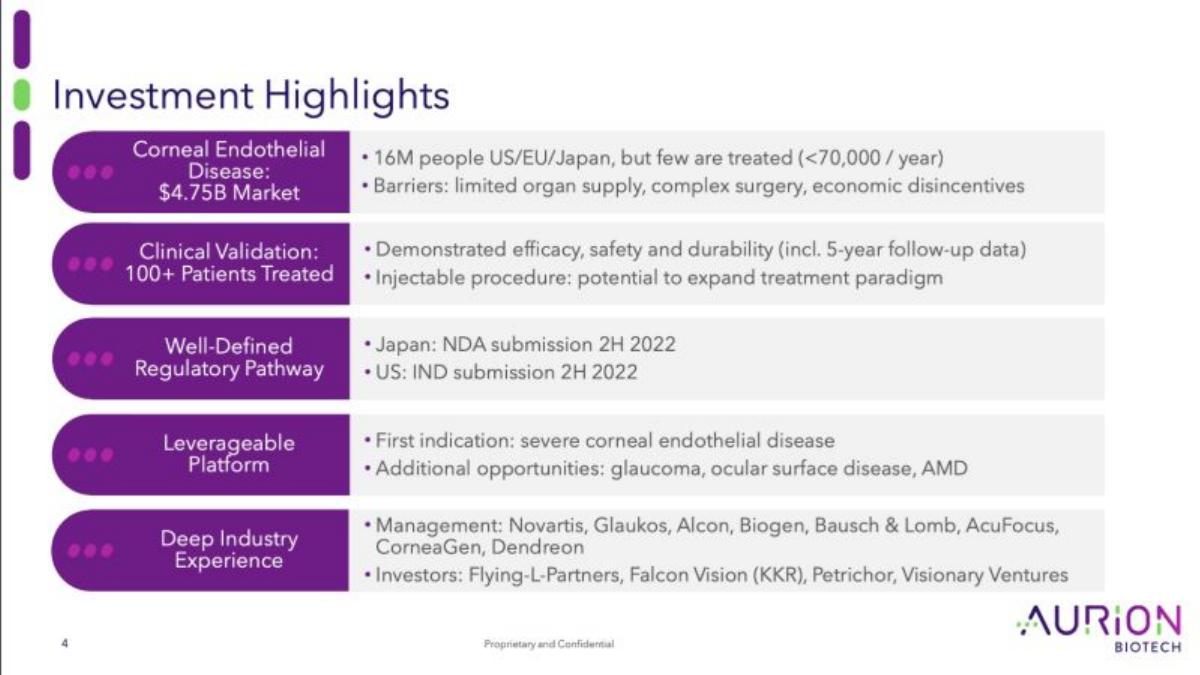
- The regulatory roadmap targeted both Japan NDA and US IND submissions in the second half of 2022 (Slide 23).
- The management team features extensive industry experience from major firms including Glaukos, Alcon, and Bausch & Lomb (Slide 21).
- The investment highlights include a 'leverageable platform' with future indications for glaucoma and AMD (Slide 23).
- Safety data from the first 11 patients reported no serious adverse events over a five-year period (Slide 15).
Introduction and Vision
The Aurion Biotech pitch deck, dated Q1 2022, opens with a clear and focused value proposition: curing blindness through cell therapy. The cover slide (Slide 1) introduces CEO Greg Kunst and CFO David Rostov, setting a professional tone with high-quality medical imagery. The company positions itself not just as a biotech startup, but as a clinical-stage entity with a transformational platform.
The Core Innovation
Slide 3 provides a high-level overview of the solution. It identifies that corneal endothelial disease affects 16 million people in the US, EU, and Japan. The technical breakthrough is twofold: first, the ability to manufacture corneal endothelial cells in vitro, and second, the efficiency of the process. The deck states that cells from one donor can produce 100+ cell therapy treatments. This is a critical point for investors, as it addresses the primary bottleneck in corneal health: the scarcity of donor tissue. The slide also notes that vision is restored within days of the injection.
Historical Context and Traction
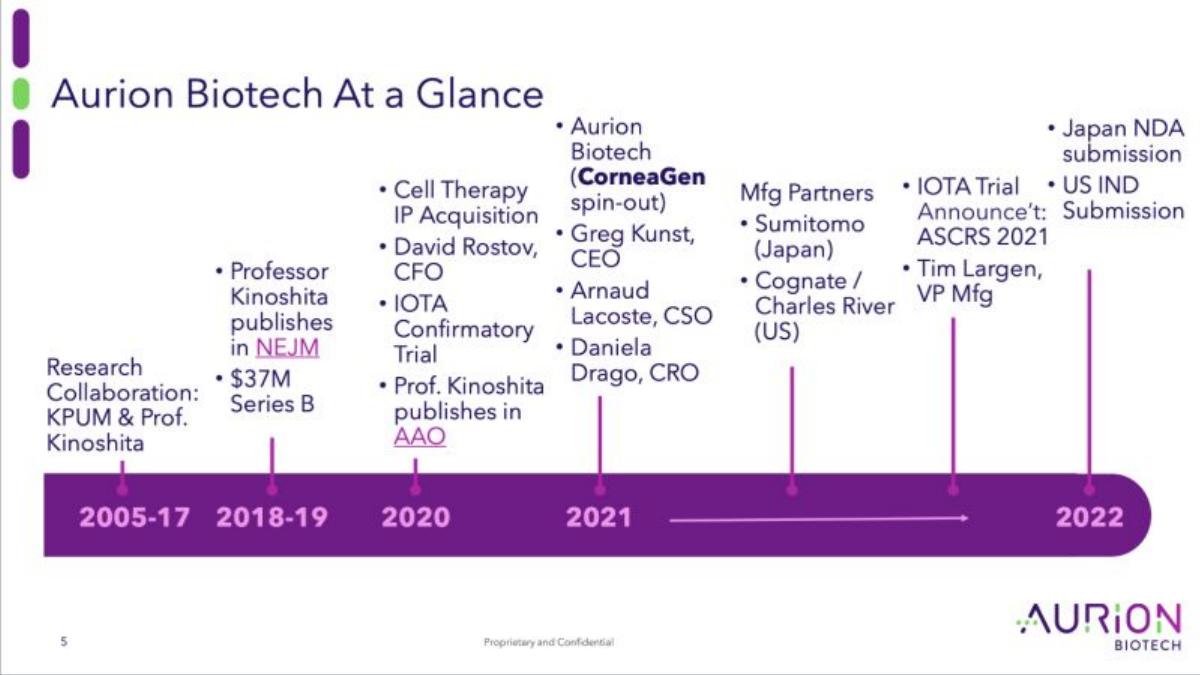
Slide 5 presents a comprehensive timeline titled 'Aurion Biotech At a Glance.' It traces the company's roots back to a research collaboration between KPUM and Professor Kinoshita starting in 2005. Key milestones include a $37M Series B in 2018-19 and the acquisition of cell therapy IP in 2020. The timeline highlights the company's evolution from a research project to a CorneaGen spin-out in 2021, culminating in the 2022 goal of Japan NDA and US IND submissions. This timeline demonstrates nearly two decades of foundational work, which is essential for establishing credibility in the biotech sector.
The Market Opportunity
Patient Impact and Need
Slide 7 uses visual aids to communicate the patient perspective of corneal blindness. It shows the progression from a cloudy cornea to glare, halos, and eventually blurred vision. By visualizing the problem, the deck moves beyond abstract statistics to the reality of the patient experience. This emotional hook is immediately followed by the hard data of the market opportunity.
Quantifying the TAM
On Slide 9, Aurion quantifies the market. They note that 4% of the population age 40+ have corneal endothelial disease. The total prevalence is 16 million people, with an annual incidence of 500,000. The company calculates a $4.75 Billion Total Addressable Market (TAM) based on 475,000 eyes multiplied by a $10,000 per procedure price point. Crucially, they point out that fewer than 70,000 patients are currently treated annually, highlighting a massive underserved market due to current surgical and supply limitations.
The Solution: Key Success Factors
Competitive Advantages
Slide 11 outlines why Aurion's therapy is positioned to win. It lists four key success factors: solving the unmet need for donor tissue (1 donor to 100+ treatments), a simple 10-minute injection, broad accessibility for ophthalmologists to learn, and favorable economics. The mention of 'Medicare Part-B injectable' is a strategic inclusion, signaling to investors that the company has already considered the reimbursement landscape in the US, which is often a major hurdle for new therapies.
The Procedure
Slide 13 details the 'How it Works' of the procedure. It involves removing the diseased endothelium, injecting the cells in suspension into the patient's anterior chamber, and a recovery period where the patient remains in a prone position. The simplicity of an injection versus a full transplant is a recurring theme, emphasizing the potential for rapid clinical adoption.
Clinical Validation
Long-Term Safety and Efficacy
Slide 15 is perhaps the most important slide in the deck for a clinical-stage company. it presents data from the first 11 patients in Japan, with follow-up stretching to five years. The results are significant: mean corneal thickness dropped from 743μm to 555μm (within the healthy range), and mean visual acuity improved from 20/220 to 20/30. The slide proudly displays logos from the New England Journal of Medicine and Ophthalmology, citing peer-reviewed validation. The fact that there were 'No serious adverse events' over five years provides the long-term safety profile that regulatory bodies and investors demand.
Strategic Roadmap and Team
Regulatory and Manufacturing Focus
Slides 17 and 19 serve as section dividers for the 'US Clinical Development Plan' and 'Manufacturing / IP.' While the specific details of these plans are not fully expanded in the provided slides, their inclusion in the table of contents indicates a structured approach to the two biggest risks in biotech: regulatory approval and scalable production.
Management Pedigree
Slide 21 introduces the management team. The roster is impressive, featuring executives with backgrounds at Alcon, Novartis, Biogen, and Bausch & Lomb. For example, CEO Greg Kunst comes from Glaukos and Alcon, while CSO Arnaud Lacoste led cell and gene therapy at Novartis. This 'who's who' of ophthalmology and biotech leadership is designed to convince investors that the company has the operational expertise to navigate the complex path to commercialization.
Investment Highlights Summary
Slide 23 summarizes the investment case. It reiterates the $4.75B market, the clinical validation of 100+ patients treated, and the well-defined regulatory pathway for 2H 2022. It also introduces the idea of a 'leverageable platform,' suggesting that the technology could eventually be applied to glaucoma and AMD (Age-related Macular Degeneration). Finally, it lists high-profile investors like KKR's Falcon Vision and Petrichor, signaling that the company already has the backing of sophisticated institutional capital.
What Works and What is Missing
Strengths of the Deck
The Aurion Biotech deck excels at de-risking a high-stakes investment. By leading with 5-year clinical data and peer-reviewed citations, they move the conversation from 'if it works' to 'how fast can we scale.' The manufacturing slide (Slide 3) is a standout because it addresses the economic viability of the product—turning one donor into 100 doses is a 100x improvement in supply chain efficiency. The team slide is also exceptionally strong, showing a deep bench of industry veterans rather than first-time founders.
Omissions and Weaknesses
Despite its strengths, the deck has notable omissions. There is no detailed financial slide showing the use of proceeds for the $120M raise, nor are there specific projections for revenue or burn rate. While the 'Favorable Economics' are mentioned, a more detailed breakdown of the cost of goods sold (COGS) versus the $10k price point would have strengthened the business case. Additionally, the competitive landscape is largely ignored; while they mention the 'current standard of care,' they do not name other biotech firms working on similar cell therapies or gene therapies for the cornea.
Founder's Guide: What to Copy
Founders in the deep tech or biotech space should emulate Aurion's use of 'Social Proof' through clinical journals. Citing the New England Journal of Medicine is more powerful than any internal metric. Furthermore, the way Aurion framed their 'Manufacturing' breakthrough as a solution to a 'Supply' problem is a brilliant way to explain technical innovation in business terms. Finally, the 'Investment Highlights' slide (Slide 23) is a perfect example of a closing slide—it synthesizes the entire pitch into five digestible bullet points that an investor can easily relay to their partners.
Frequently asked questions
- What is the primary problem Aurion Biotech is solving?
- Aurion Biotech targets corneal endothelial disease, which affects 16 million people across the US, EU, and Japan. Currently, treatment is limited by a severe shortage of donor corneal tissue and the complexity of existing surgical procedures. Only about 70,000 patients are treated annually despite an annual incidence of 500,000 new cases, leaving a massive gap in care that Aurion intends to fill with its scalable cell therapy.
- How does Aurion's technology differ from traditional corneal transplants?
- Traditional transplants require one donor cornea for one recipient. Aurion's platform allows them to manufacture corneal endothelial cells in vitro, enabling a single donor to provide enough material for over 100 treatments. Furthermore, the procedure is a minimally invasive 10-minute injection rather than a complex surgery, which significantly lowers the barrier to entry for both patients and performing ophthalmologists.
- What clinical evidence does the deck provide?
- The deck presents impressive longitudinal data from a study in Japan. For the first 11 patients (ages 49-82), mean corneal thickness was reduced from a diseased 743μm to a healthy 555μm over five years. More importantly, visual acuity improved from 20/220 (legal blindness) to 20/30 (near-normal vision), with no serious adverse events reported throughout the five-year follow-up period.
- Who are the key investors and leaders behind the company?
- The company is led by CEO Greg Kunst (formerly of Glaukos and Alcon) and a team with experience at Novartis, Biogen, and Bausch & Lomb. According to the deck and catalogue facts, the company raised $120M in 2022. Key investors listed include Flying-L-Partners, Falcon Vision (KKR), Petrichor, and Visionary Ventures, providing a mix of specialized healthcare and large-scale private equity backing.
- What are the next major milestones for the company?
- As of the Q1 2022 deck, the primary milestones were regulatory submissions. The company planned to submit a New Drug Application (NDA) in Japan and an Investigational New Drug (IND) application in the United States during the second half of 2022. These steps are critical for transitioning from a clinical-stage research entity to a commercial-stage biotech company.