Voro's 2016 Seed deck is a masterclass in demographic targeting and trust-based positioning. Raising $2.5 million, the 12-slide presentation identifies a clear gap in the market: the lack of a healthcare social network utilizing real identities. The deck leans heavily on early traction, citing 50,000+ users and 50,000+ doctor reviews (Slide 5). Most notably, it defines its core user base with surgical precision—90% women with a median age of 39 (Slide 7)—positioning 'moms' as the primary engine of community growth. While the deck is light on specific financial projections, it compensates with…
Key takeaways
- Voro positions itself as the first healthcare social network where people use their real names, a direct contrast to anonymous forums (Slide 10).
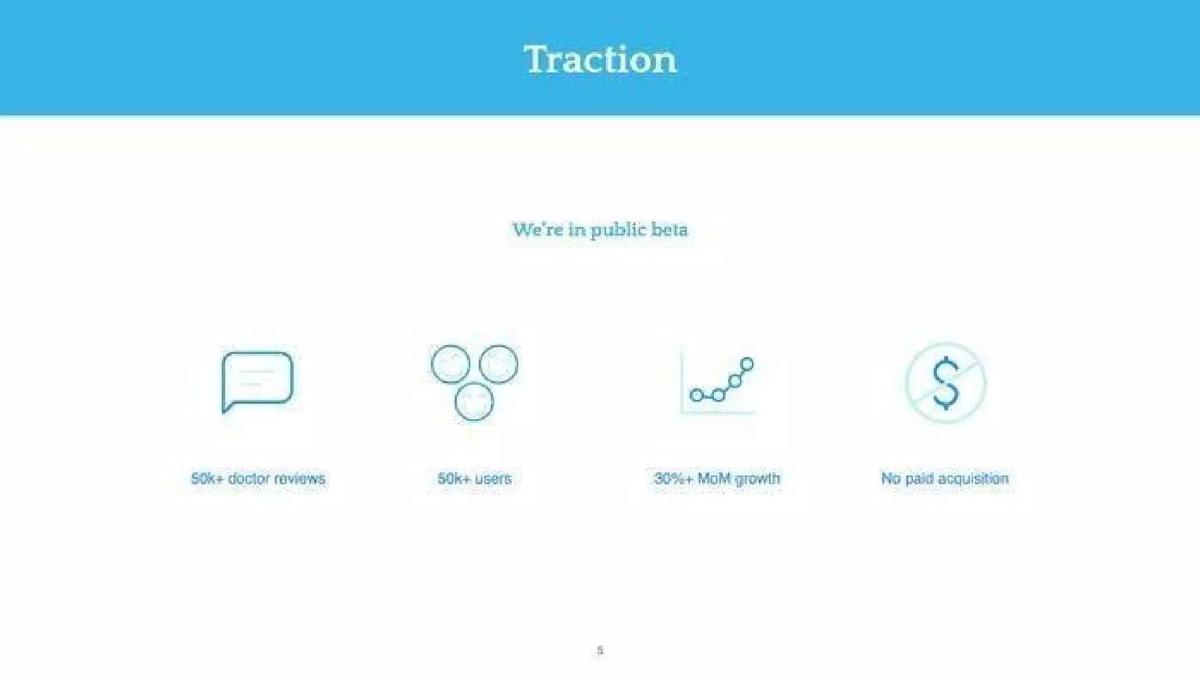
- The company achieved significant scale in public beta with 50,000+ users and 50,000+ doctor reviews (Slide 5).
- Growth was entirely organic at the time of the deck, with the company reporting 'No paid acquisition' (Slide 5).
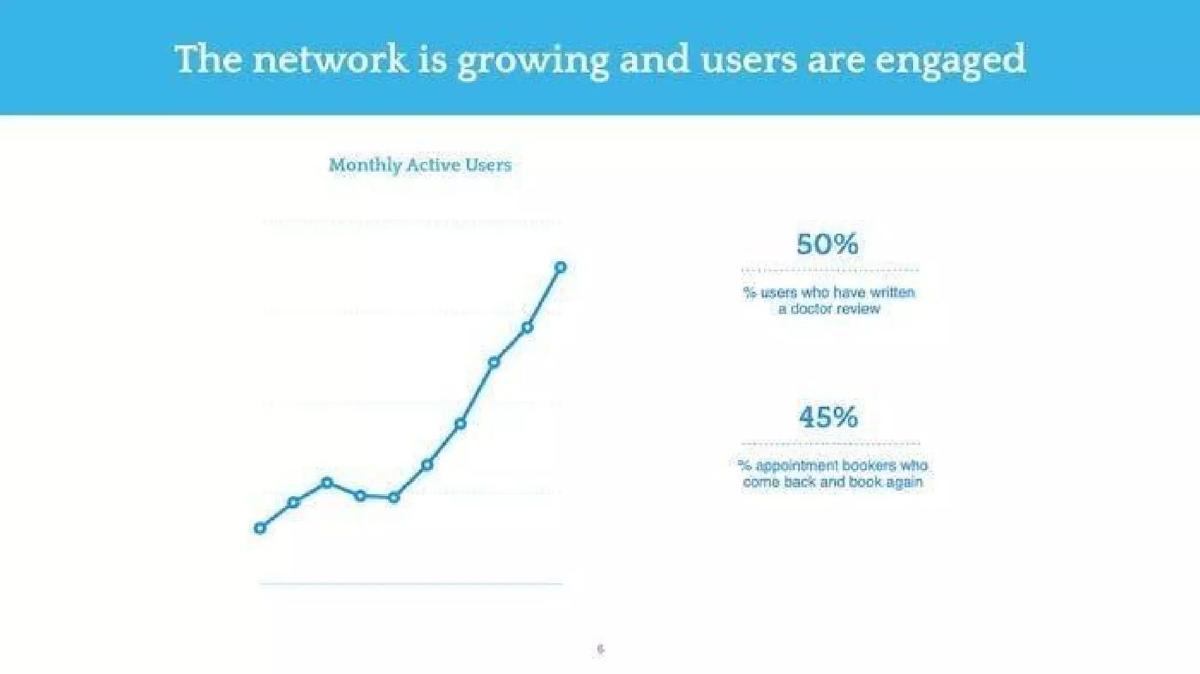
- User engagement is high, with 50% of users having written a doctor review and 45% of appointment bookers returning to book again (Slide 6).
- The target demographic is explicitly defined as women (90%) with a median age of 39, characterized as 'moms' (Slide 7).
- The business model relies on 'Steerage,' routing patients to high-value care via transaction or PMPM fees billed to insurers and employers (Slide 11).
- The Total Addressable Market is estimated at $300 billion, defined as total US healthcare spending on low-value or unnecessary medical care (Slide 11).
- The deck lacks a specific 'Ask' slide detailing the amount being raised or the intended use of funds.
The Trust Factor: How Voro Sold a Healthcare Social Network
In 2016, the healthcare technology landscape was crowded with anonymous forums and legacy review sites. Voro’s pitch deck for its $2.5 million Seed round took a different path by emphasizing real identity and community trust . By focusing on a very specific user persona—the suburban mom—Voro demonstrated that healthcare decisions are rarely made in a vacuum; they are made through recommendations from trusted peers. This teardown examines the 12-slide deck that successfully articulated a vision for a 'Healthcare Social Network.'
Slides 1-2: The Vision and the Hook
The deck opens with a clean, minimalist title slide featuring the Voro logo (Slide 1). The brand identity is established immediately with a bright blue color palette and a magnifying glass integrated into the 'Q-like' shape of the first 'O,' signaling search and discovery. Slide 2 serves as the mission statement: 'The Healthcare Social Network: health advice and doctor reviews from people you trust.' The background image of a group of people in a park at sunset reinforces the 'social' and 'community' aspect of the product, moving away from the clinical or sterile imagery often associated with healthcare startups.
Slides 3-4: Defining the Problem and Solution
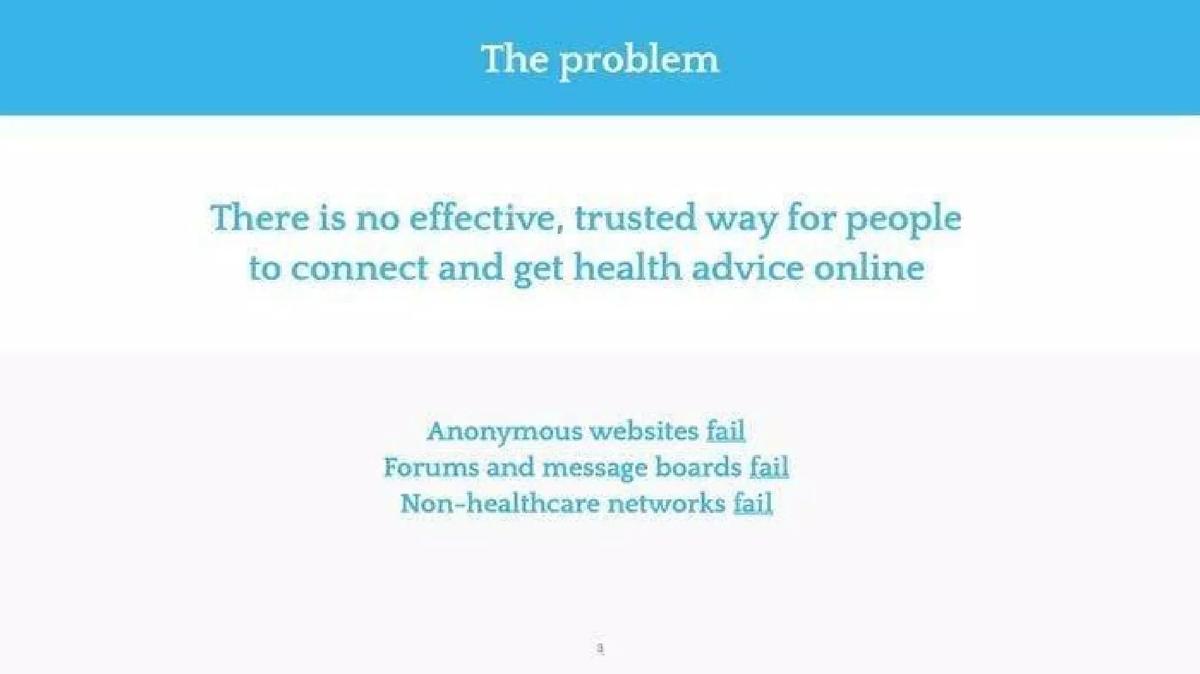
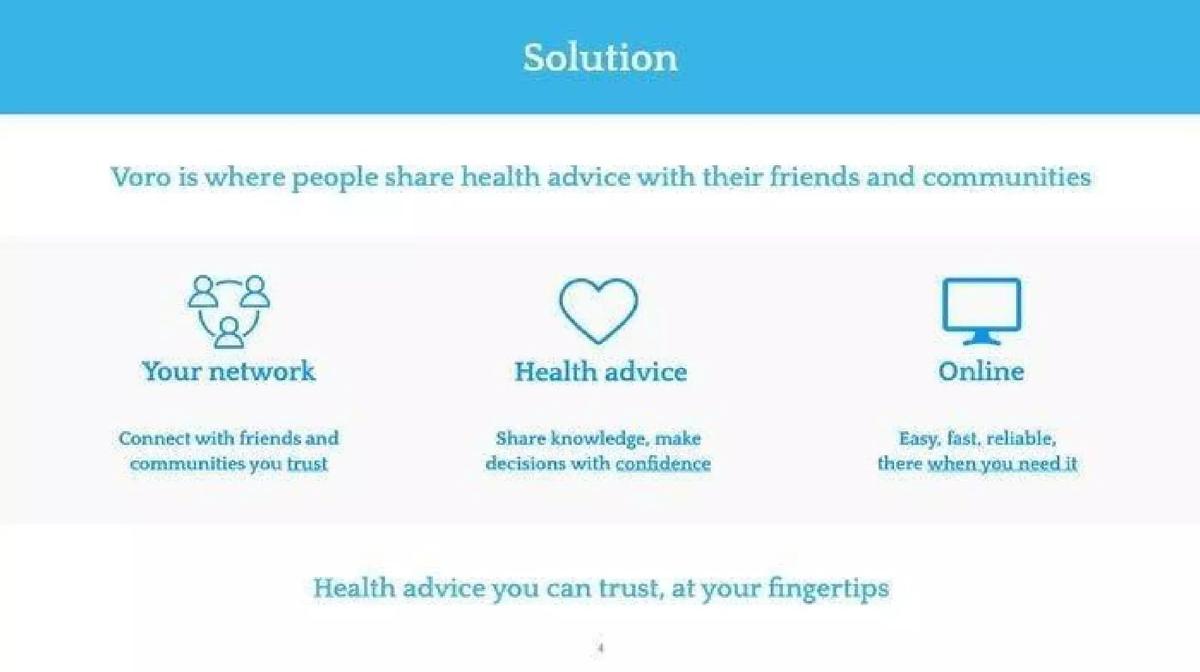
Slide 3, 'The problem,' is concise. It states there is no 'effective, trusted way for people to connect and get health advice online.' It explicitly lists why current solutions fail: anonymous websites, forums, and non-healthcare networks. This sets the stage for Slide 4, 'Solution,' which introduces Voro as the place where people share advice with their friends and communities. The solution is broken down into three pillars: Your network, Health advice, and Online. The takeaway is that Voro is 'Easy, fast, reliable,' and most importantly, 'there when you need it.'
Slides 5-6: Proving Traction and Engagement
One of the strongest sections of the deck begins on Slide 5. Voro reveals they are in public beta with impressive numbers: 50k+ doctor reviews , 50k+ users , and 30%+ MoM growth . The most compelling data point on this slide is 'No paid acquisition,' suggesting a high viral coefficient or strong organic word-of-mouth. Slide 6 deepens this narrative with a Monthly Active Users (MAU) graph showing a sharp upward trajectory. It also includes two critical engagement metrics: 50% of users have written a review, and 45% of appointment bookers return to book again. These figures suggest that the platform isn't just a one-off search tool but a sticky social utility.
Slides 7-9: The 'Mom' Strategy and Geographic Focus
Slide 7 is perhaps the most strategically important slide in the deck. Titled 'Users are moms...', it provides a clear demographic profile: 90% women with a median age of 39 . By identifying moms as their primary users, Voro taps into the demographic that typically manages healthcare for entire families. A testimonial from 'Kate' about her experience with a doctor during pregnancy adds a human element to the data. Slide 8 shows how these users build communities, categorized into Neighborhood Groups, Parent Groups, and Medical Condition Groups. Slide 9 illustrates their 'land and expand' strategy, showing a high density of groups in the New York City metro area, including specific counties in NY, NJ, and CT. This geographic focus demonstrates a disciplined approach to building a network effect.
Slides 10-11: Competition and Market Opportunity
Slide 10 uses a standard 2x2 matrix to position Voro against competitors. The axes are 'Real identity vs. Anonymous' and 'Non-healthcare vs. Healthcare.' Voro occupies the top-right quadrant alone, distinguishing itself from Facebook (Real identity/Non-healthcare) and PatientsLikeMe (Anonymous/Healthcare). This visual makes the 'white space' in the market obvious to investors. Slide 11 addresses the 'Market opportunity' through the lens of 'Steerage.' It defines the Total Addressable Market (TAM) as $300 billion , which represents the total US healthcare spending on low-value or unnecessary medical care. The revenue model is described as a transaction or PMPM fee billed to insurers and employers, indicating a B2B2C monetization strategy.
Slide 12: The Team
The deck concludes with the 'Team' slide. Tomas Hoyos (CEO) is highlighted for his background as a Private Equity Investor at American Securities with a focus on healthcare acquisitions and a Harvard degree. Drew Tunney (CTO) is noted for his experience as a technical team lead at Sighten and his role in growing a team from 5 to 25 employees, with a degree from Dartmouth. The team profile suggests a balance of financial/healthcare expertise and technical scaling experience.
What Works in the Voro Deck
1. Extreme Demographic Clarity: Many startups try to be 'for everyone.' Voro’s decision to explicitly state that 90% of their users are moms (Slide 7) is a bold and effective move. It tells investors exactly who the customer is and why the platform is growing organically.
2. Engagement Over Vanity Metrics: While 50k users is a good Seed-stage number, the 45% repeat booking rate (Slide 6) is the real 'hero' metric. It proves that the product solves a recurring pain point and has long-term value.
3. The 'Real Identity' Moat: By centering the competitive landscape (Slide 10) on identity, Voro addresses the biggest weakness of existing healthcare forums: the lack of trust in anonymous advice. This positioning is a powerful differentiator.
What is Missing from the Voro Deck
1. The 'Ask' Slide: The deck completely omits a slide detailing how much capital they are looking to raise, the valuation, or the specific milestones they intend to reach with the new funding. While this is sometimes removed for public versions of decks, its absence in a fundraising teardown is notable.
2. Unit Economics: While the revenue model is mentioned (Slide 11), there is no data on the cost of acquiring a user (CAC) versus the lifetime value (LTV) of a 'steered' patient. Even in a Seed round, some indication of the margin on a transaction or PMPM fee would be beneficial.
3. Product Deep Dive: The deck shows three mobile screens (Slide 8), but it doesn't walk the investor through the actual user journey of finding a doctor, reading a friend's review, and booking an appointment. The 'concierge' aspect mentioned in the company description is not clearly explained in the slides.
What a Founder Should Copy
1. Use 'The Network is Growing' Visuals: The MAU graph on Slide 6 is a perfect example of how to show momentum. It doesn't need a Y-axis with specific numbers if the trendline and the supporting percentages (50% reviewers, 45% repeaters) tell the story of a healthy, active community.
2. Geographic Concentration: If your product relies on network effects, copy Voro’s Slide 9. Showing that you are winning a specific, high-value region (like the NYC metro) is more impressive to investors than having a handful of users scattered across fifty states.
3. The Quadrant Positioning: Slide 10 is a textbook example of how to use a competitive matrix. Don't just list features; find the two most important philosophical differences between you and the incumbents (in this case, Identity and Sector) and show why you are the only one in your quadrant.
Frequently asked questions
- How much did Voro raise with this deck?
- According to catalogue facts from pitchdeckhunt.com, Voro raised $2,500,000 in 2016 during its Seed round.
- What is Voro's primary competitive advantage according to the deck?
- Voro’s primary advantage is 'Real Identity.' As shown on Slide 10, they position themselves in the top-right quadrant of the competitive landscape, separating themselves from anonymous healthcare sites like Reddit or PatientsLikeMe, and non-healthcare networks like Facebook or Nextdoor.
- Who is the target user for the Voro platform?
- The deck identifies 'moms' as the primary users. Slide 7 specifies that 90% of users are women with a median age of 39. This demographic is targeted because they often act as the Chief Medical Officer of the household, building communities around neighborhoods, parenting, and specific medical conditions (Slide 8).
- How does Voro plan to make money?
- Slide 11 outlines a 'Steerage' revenue model. This involves routing patients to high-value care to improve outcomes and reduce costs. The revenue is generated through transaction fees or per member per month (PMPM) fees billed to insurance companies, providers, and self-insured employers.
- What traction did Voro have at the time of the pitch?
- At the time of the deck, Voro was in public beta with over 50,000 users and 50,000 doctor reviews. They reported 30%+ month-over-month growth and a 45% repeat rate for appointment bookings, all achieved with zero paid acquisition (Slides 5 and 6).