TransferWise's 2011 deck skipped slick design and market-size theatre. It won on three pillars: a value proposition anyone could restate, early traction that spoke for itself, and founders whose background made the problem credible.
Introduction
This 2011 pitch deck from TransferWise (now Wise) is a fascinating artifact from the early days of a fintech giant. The provided text is sparse, likely extracted via optical character recognition, and missing visual context. Yet, even in this stripped-down form, it is a powerful lesson for early-stage founders. This is not a deck that relies on slick design or expansive market size projections. Instead, it builds its case on three pillars: a dead-simple value proposition, jaw-dropping early traction, and impeccable founder credibility. It’s a testament to the idea that when you have true product-market fit, you don’t need to shout; you just need to show the numbers.
The Problem & Solution: Before vs. After
The deck opens with a title slide identifying the founders, Kristo Käärmann and Taavet Hinrikus, and a concept: “Peer-to-peer currency exchange.” It immediately dives into the core value proposition with a brilliantly simple “Before” and “After” slide.
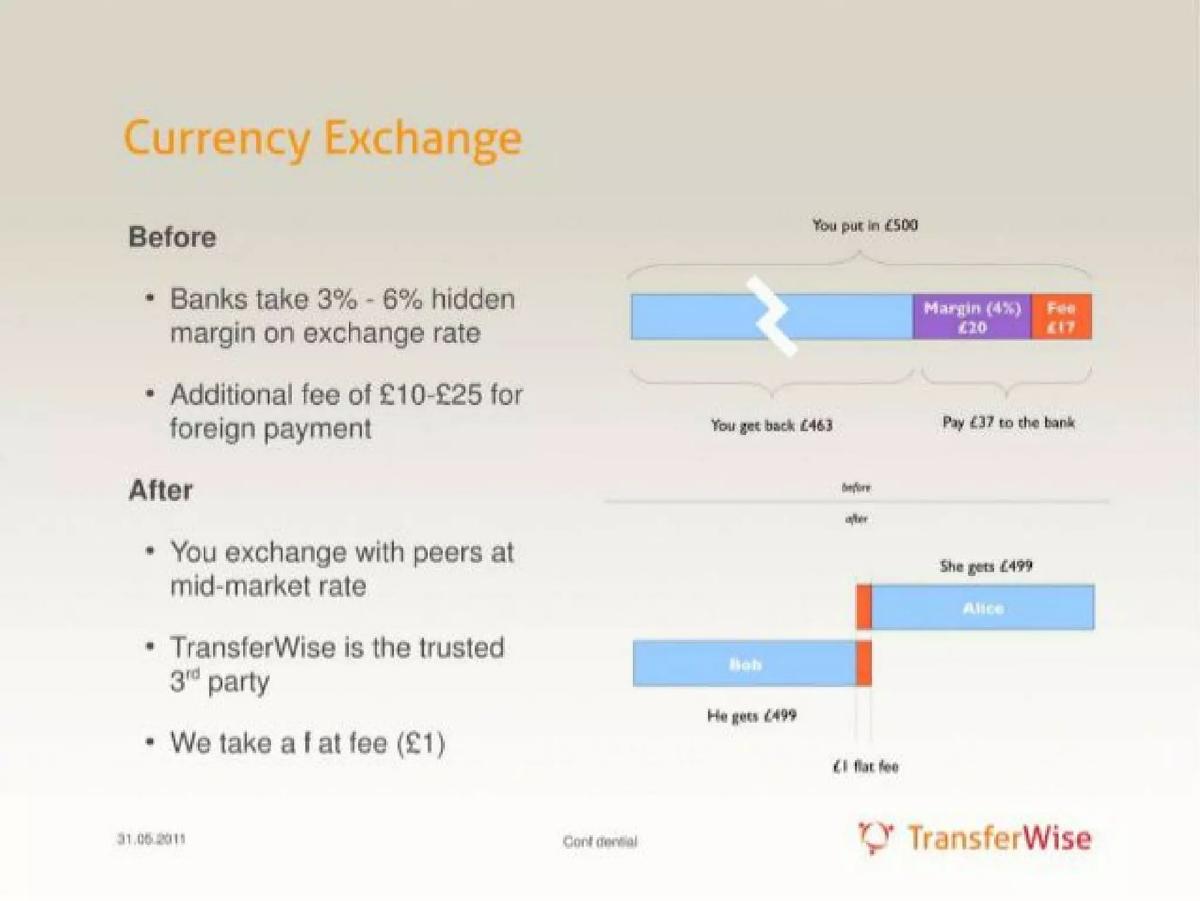
Before TransferWise
Banks take a 3% - 6% hidden margin on the exchange rate. · Banks charge an additional fee of £10-£25 for the payment.
After TransferWise
You exchange with peers at the mid-market rate. · TransferWise acts as the trusted 3rd party. · They take a flat fee of £1.
This is masterfully done. It frames the incumbents (banks) as greedy and opaque, highlighting both hidden and explicit costs. It then positions TransferWise as the transparent, low-cost hero. By anchoring the problem to a concrete pain point—a user sending €500 and losing €37 to the bank—it makes the issue immediately relatable and quantifies the value of the solution. The contrast between a €37 fee and a £1 fee is stark and requires no further explanation. This slide alone tells an investor nearly everything they need to know about the market opportunity and the company’s approach.
How It Works (The Partial Picture)
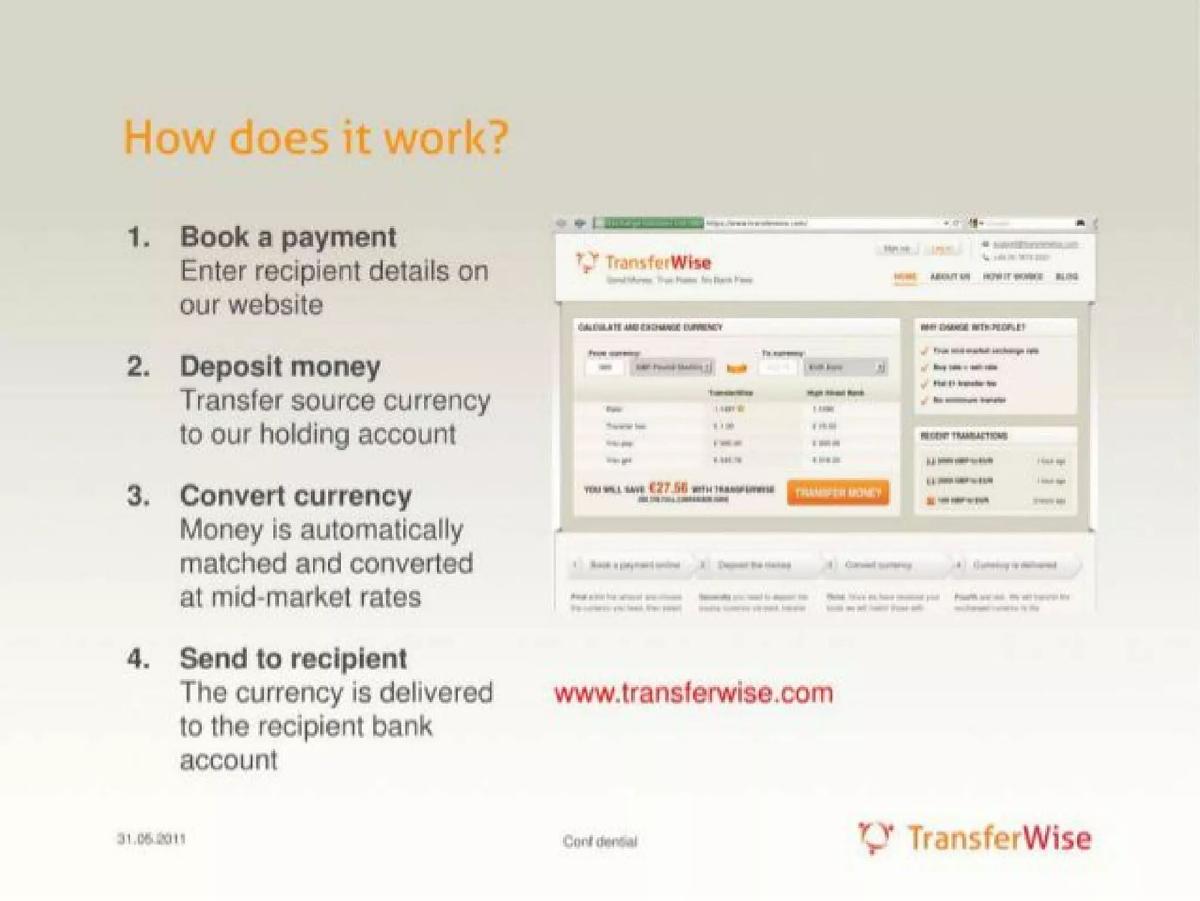
The provided text offers only a fragment of what was likely a multi-step “How It Works” slide. We see only step 4:
4. Send to. The currency is delivered to the recipient bank account.
This is a significant gap in the provided text. A peer-to-peer currency exchange model was novel in 2011, and investors would have absolutely needed to understand the mechanics of how the money moved without crossing borders (i.e., holding pools of currency in different countries and matching payments). While we can't analyze what isn't here, its absence in this text forces us to focus on what the founders chose to emphasize elsewhere: the outcome for the user, not the plumbing. For an early-stage pitch, this might be a deliberate choice — get investors excited about the 'what' and 'why' before diving into the 'how' during the Q&A.
Traction: The Heart of the Pitch
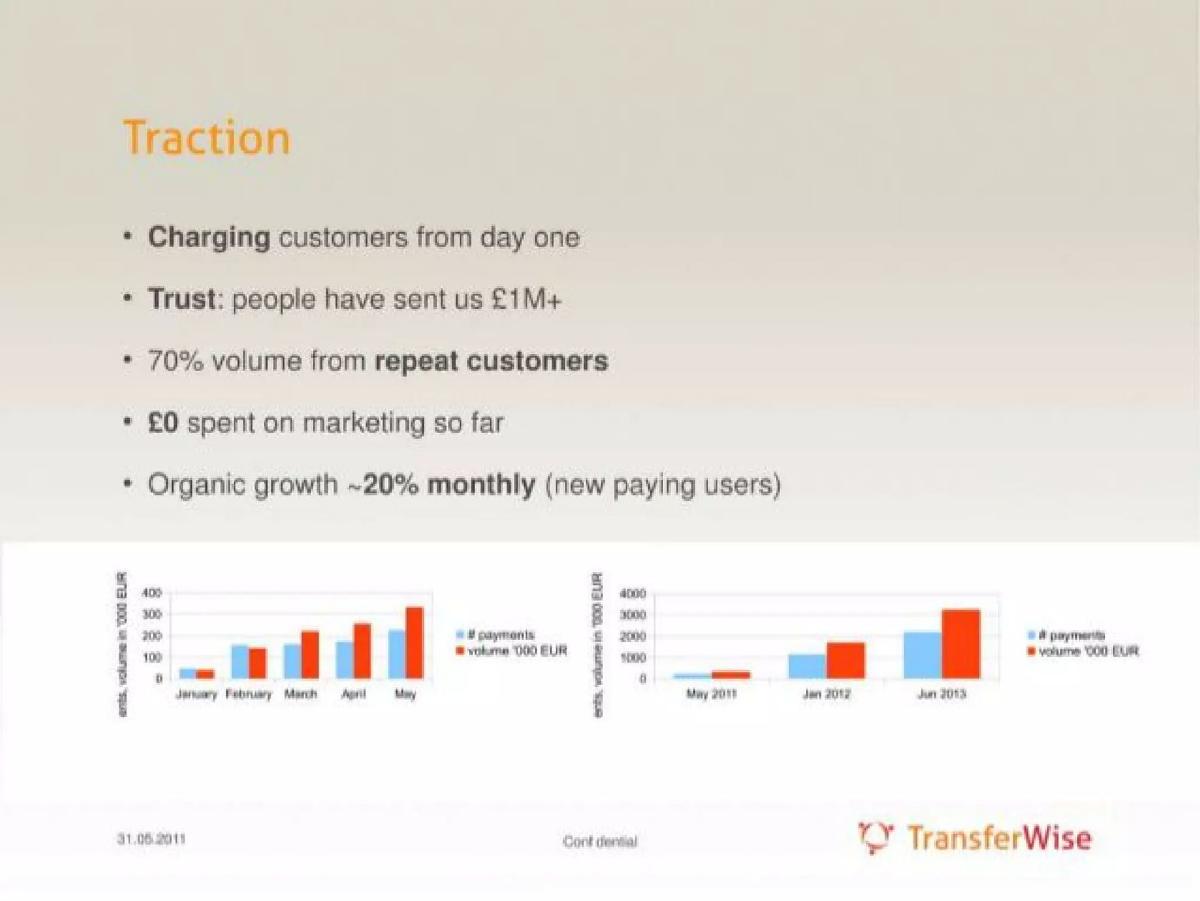
If the Problem/Solution slide was the hook, the Traction slide is the knockout punch. This is where TransferWise moves from a good idea to an investable business. The text is clear, direct, and overwhelmingly positive.
Charging customers from day one: This is a crucial signal. It establishes that this is a business, not a hobby or a free tool fishing for users. It proves that the pain point is so acute that users are willing to pay for a solution immediately. · Trust: people have sent us £1M+: For a fintech startup, especially one handling cross-border payments, trust is the single most important currency. This metric isn't revenue; it's total transaction volume. It answers the critical question: “Will anyone trust a new, unproven website with their money?” The answer is an emphatic yes. Surpassing the £1 million mark in handled funds is a massive validation of the platform's credibility. · 70% volume from repeat customers: This is arguably the most powerful metric on the slide. It demonstrates that TransferWise is not just a novelty product users try once. It solves a recurring need, and the solution is sticky enough to create loyalty. A 70% repeat volume indicates intense product-market fit and a sustainable, long-term business model. · £0 spent on marketing so far: This is the amplifier. The impressive growth isn't being bought; it's being earned. · Organic growth ~20% monthly (new paying users): When combined with zero marketing spend, 20% month-over-month growth is phenomenal. It signals that the product is so good that word-of-mouth is driving a powerful acquisition engine. This is the definition of viral growth.
The text also references a chart, though the data is too garbled in the extraction to interpret. However, the bullet points alone paint a picture of a company with unstoppable momentum. Any investor seeing these metrics in 2011 would immediately sit up and pay close attention.
Roadmap and Competition
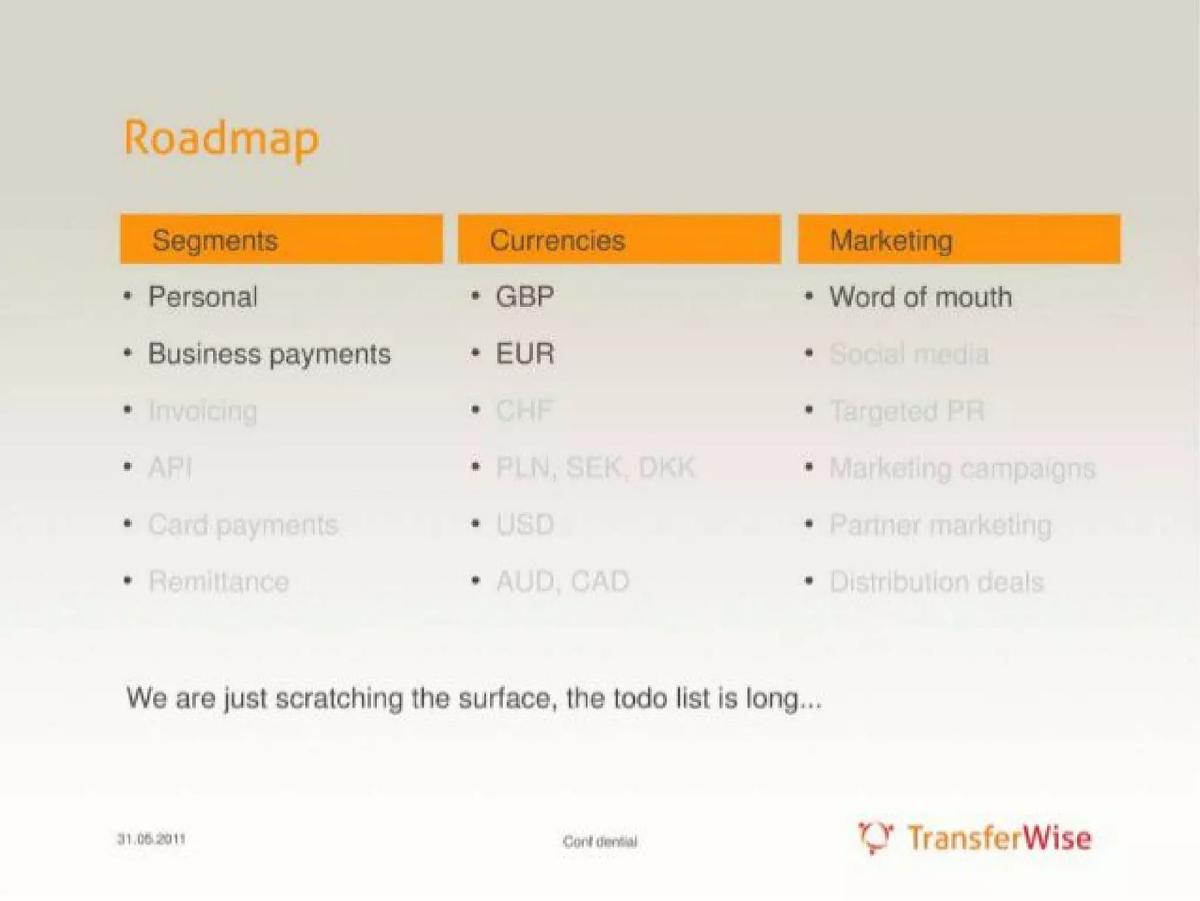
The Roadmap slide is high-level but effective in its simplicity. It lays out three vectors for growth:
Customer type: Personal → Business payments · Currencies: GBP & EUR → Adding more · Acquisition: Word of mouth → Scalable strategy
This shows a clear, logical expansion plan. They will move upmarket from consumers to businesses, expand their geographical/currency footprint, and professionalize their marketing efforts. The line, “We are just scratching the surface, the todo list is long...” adds a nice touch of founder humility and ambition.
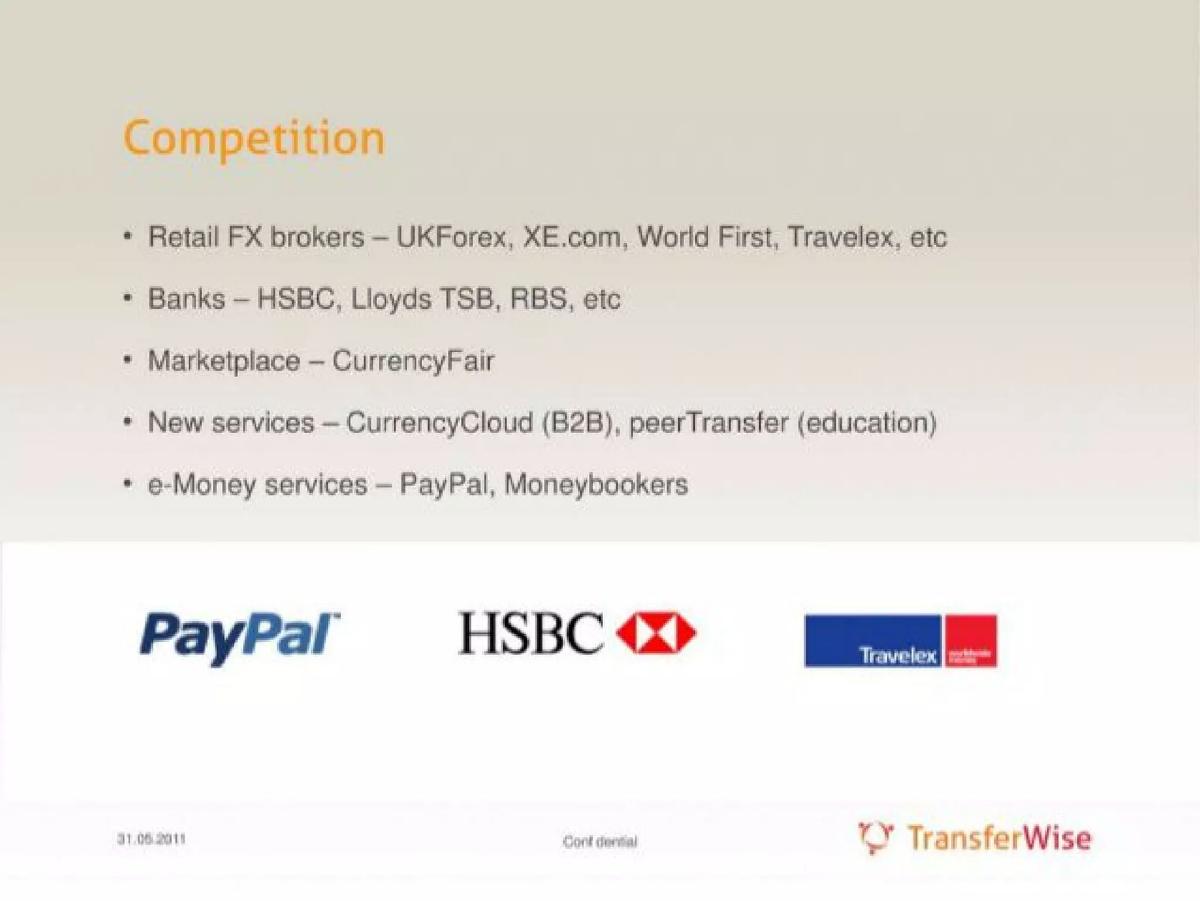
The Competition slide demonstrates a solid understanding of the market landscape. They categorize competitors, showing they've thought beyond the obvious foil of traditional banks:
Retail FX brokers: UKForex, XE.com · Banks: HSBC, Lloyds TSB · Marketplace: CurrencyFair (their closest peer-to-peer competitor at the time) · New services: CurrencyCloud (B2B), peerTransfer (niche) · e-Money services: PayPal, Moneybookers
This isn't a slide that dismisses competition; it acknowledges a crowded field but implicitly trusts that the traction and value proposition already shown are strong enough to carve out a winning position. By listing CurrencyFair, they show they are aware of their direct model competitors, which is a sign of diligence.
The Team: Credibility Personified
For an early-stage company, the team is as important as the idea. The TransferWise founders present an ideal combination of skills and experience.
Kristo Käärmann, co-founder, CEO: His background in financial services consulting with Deloitte and PwC provides the industry knowledge and credibility. He understands the belly of the beast they are trying to disrupt. · Taavet Hinrikus, co-founder: Taavet’s bio is investor gold. As “Skype early employee,” he has direct experience helping a disruptive European technology company achieve massive global scale. This is a rare and incredibly valuable credential. His INSEAD MBA and angel investing experience round out a perfect profile for a tech startup founder.
The deck also briefly mentions roles for “Backoffice, customer support” and “Developers,” indicating they are thinking about the broader team needed to execute.
The Ask & Use of Funds
The final slide ties everything together with a clear and concise request.
This is a specific amount with a specific runway. The real strength, however, is in the stated goals for the funding. They are not asking for a blank check; they are asking for capital to achieve precise, business-de-risking milestones.
Prove our model... on the way to financial break-even: This is an honest assessment. They know their current back-office and support systems aren't fully scalable. The funding is to build the robust infrastructure needed for growth. · Increase average revenue per payment to to £3-£5: This is a critically important—and transparent—point. They are openly stating that the initial £1 fee is a customer acquisition tool, not a long-term sustainable price. They have a plan to improve unit economics, and they aren't hiding it. This demonstrates strategic thinking about the business model. · Develop a scaleable customer acquisition strategy: They acknowledge that word-of-mouth, while amazing, is not a strategy. The capital will be used to find repeatable, scalable marketing channels to fuel the fire that has already started. · Expand supported currencies (CHF, SEK/PLN), preparation for USD: This shows a clear product expansion roadmap, targeting specific new markets and preparing for the largest one, the United States.
This slide tells an investor exactly how their money will be used to turn a promising, high-traction product into a massive, scalable business. It’s a compelling end to a very strong pitch.
Frequently asked questions
- How important was a detailed 'How it Works' slide in this deck?
- Based on the provided text, it seems less important than proving *that* the product works via traction. The mechanism can be a complex story, but customer adoption is a simple one. In an early pitch, it's often better to hook investors with undeniable user love and explain the technical details when they're already leaning in.
- Was it risky to state they plan to raise prices?
- It was transparent and strategic. By stating their plan to increase the average fee from £1 to £3-£5, they showed they were thinking about long-term unit economics. It told investors that the initial price was a deliberate strategy to gain trust and market share, to be followed by a monetization optimization phase. This honesty builds credibility.
- What's more important for an early fintech: revenue or transaction volume?
- This deck makes a strong case for transaction volume. The £1M+ sent through the platform was a proxy for trust and adoption, which were the biggest risks for a new financial service. It proved the core behavior—people trusting a new app with their money—before they worried about optimizing the revenue from that behavior.
- The deck doesn't have a Market Size slide. Was that a mistake?
- No, it was likely a deliberate omission. The problem was framed as taking on 'banks' who charge '3-6%' on international transfers. The total addressable market is implicitly the entire multi-trillion dollar foreign exchange market. By stating the problem so effectively, they let the investor's own knowledge fill in the massive market size, making the deck more concise and impactful.
- How much did the founders' backgrounds matter?
- Immensely. A founder who was 'Skype's first employee' (Taavet Hinrikus) brings unparalleled credibility regarding scaling a disruptive, global technology company from Europe. This, combined with a co-founder with deep financial consulting experience (Kristo Käärmann), created a team that was perfectly matched to the problem, giving investors huge confidence in their ability to execute.