Coinbase's 2012 seed deck successfully raised $600K by distilling a complex idea into a simple value proposition: 'Bitcoin's iTunes.' The deck's strength was its clarity, a powerful analogy (Coinbase:Bitcoin::iTunes:MP3s), and early traction metrics like 20% daily user growth. It was extremely light on details—lacking slides on team, business model, or the ask—which would not be acceptable in today's market, but in 2012 it perfectly captured the 'why now' of a new technological wave.
Key takeaways
- Use a powerful analogy. The 'iTunes for MP3s' slide was the most effective slide, instantly explaining their entire strategy to non-technical investors.
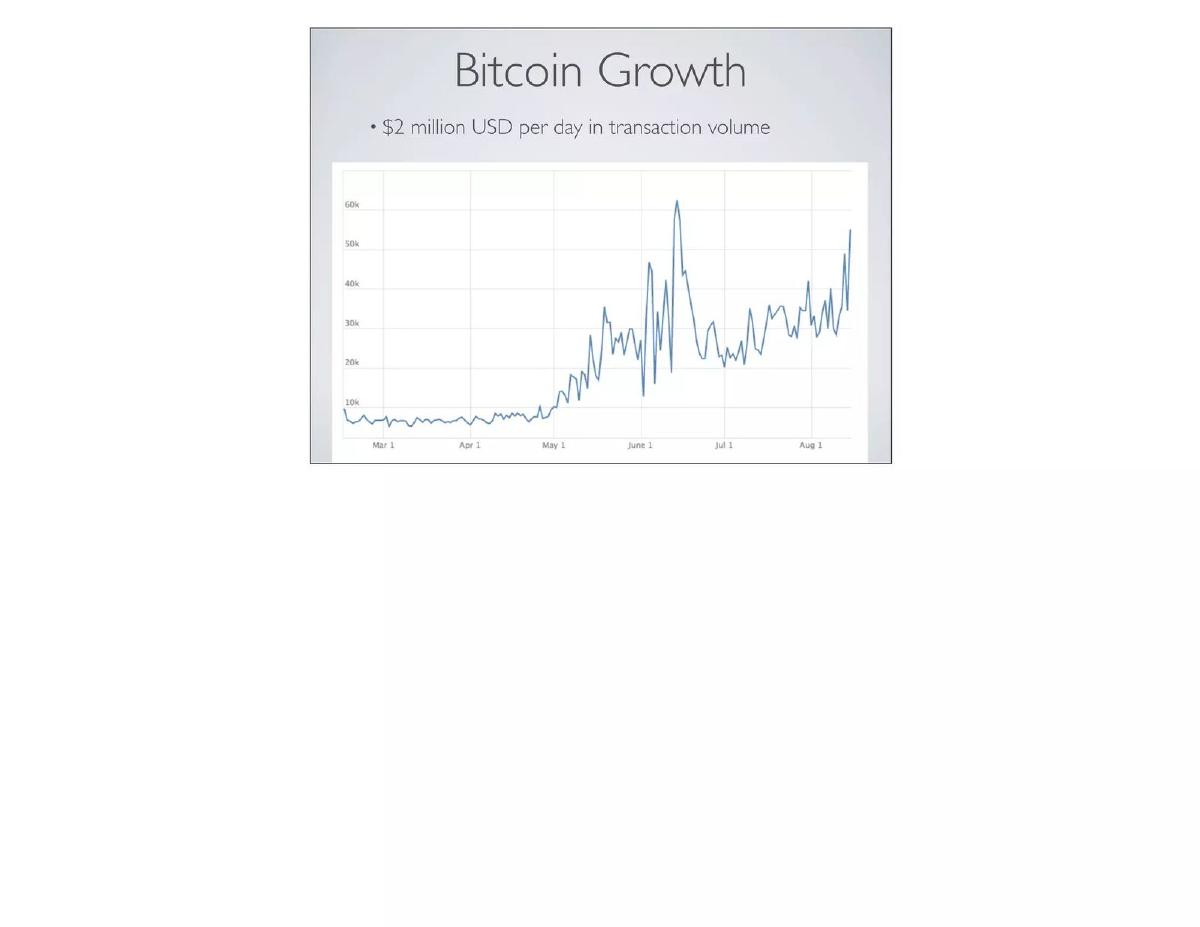
- Focus on the 'Why Now.' The deck established Bitcoin as a growing wave ($2M daily transaction volume) and positioned Coinbase as the surfboard.
- Show early traction, no matter how small. 20% daily signup growth and $65,000 in transactions over 5 weeks proved the product was solving a real problem.
- Simplicity wins in the early stages. The deck is just 12 slides with minimal text, forcing a focus on the core problem and solution.
- A deck's job is to secure a meeting. This deck was a conversation starter, not a complete business plan. The founders had to fill in the gaps in person.
- This deck's sparseness is a product of its time. Raising a 2024-era seed round of $2M+ requires granular detail on team, go-to-market strategy, and business model that is absent here.
- Don't be afraid to educate. The deck spent time explaining what Bitcoin was, which was essential for a novel technology in 2012.
The Coinbase Seed Deck: An Exercise in Radical Simplicity
In 2012, Bitcoin was not a household name. It was a fringe obsession for cryptographers, libertarians, and a handful of engineers. Mentioning it in a venture capital pitch was more likely to get you blank stares than a term sheet. Yet, this is the environment in which Brian Armstrong and Fred Ehrsam went out to raise capital for a "hosted bitcoin wallet." They were not selling a financial revolution on day one; they were selling a simple tool to fix a user experience nightmare.
The result was a $600,000 seed round from some of the sharpest investors at the time, including Union Square Ventures, Ribbit Capital, and Initialized Capital. Nine years later, that company, Coinbase, executed a direct listing on the Nasdaq with a valuation that touched $100 billion. The journey from a few slides to a public market behemoth started here.
This deck is a study in minimalism. It is sparse, direct, and almost completely devoid of the financial projections and detailed market sizing that founders feel obligated to include today. It made a bet on a simple analogy and a powerful demonstration of a "before and after." Analyzing this deck is not about celebrating a unicorn's birth; it is a critical look at what it takes to sell a complex idea when nobody understands the underlying technology. Some of its tactics are timeless; others would get a founder laughed out of a Zoom call in 2026.
The Problem: Complexity as the Enemy
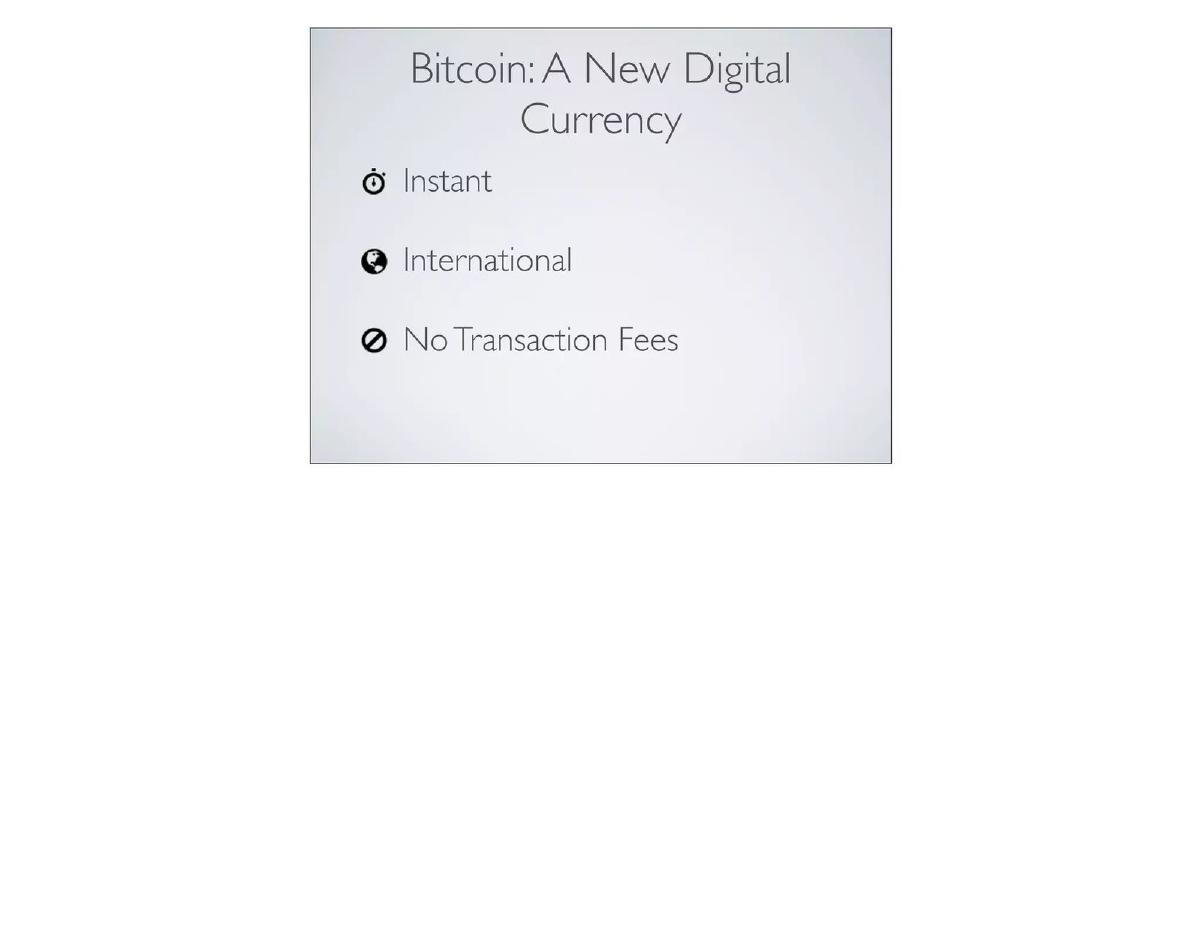
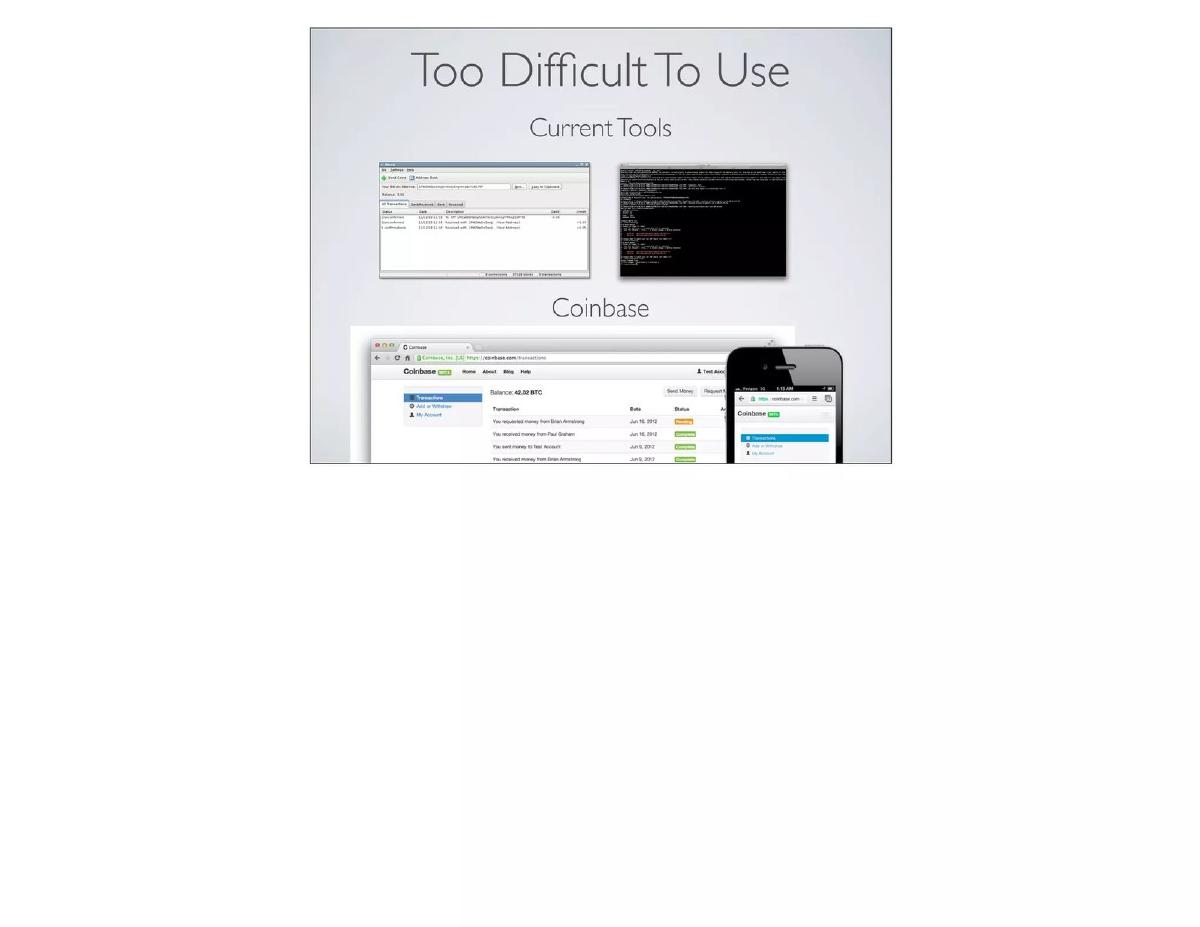
The deck doesn't waste time with a conventional "Problem" slide. It jumps straight into defining Bitcoin as a new form of currency—instant, international, and without transaction fees. The problem is not explicitly stated but powerfully implied two slides later. After a brief mention of Bitcoin's growth, a slide titled "Too Difficult To Use" appears, showing a screenshot of what appears to be a command-line interface or a complex piece of software. This is a masterstroke of framing.
Armstrong wasn't claiming that the financial system was broken or that fiat currency was doomed. The pitch was much smaller, much more tangible. The problem was that this new, interesting thing called Bitcoin was an absolute pain to acquire, store, and use. By showing a complex interface, he made the problem visceral for anyone in the room, technical or not. You did not need to understand how public-key cryptography worked to understand that the image on the screen was not user-friendly.
This approach sidesteps the need to convince investors that Bitcoin itself is the future. It only asks them to believe that some people find it interesting, and for those people, the current tools are inadequate. This is a classic "pick and shovel" play during a gold rush. You don't need to bet on whether any individual miner will find gold; you just bet that they will all need shovels. Here, the "shovel" is a usable interface.
The Solution: An Analogy Worth Millions
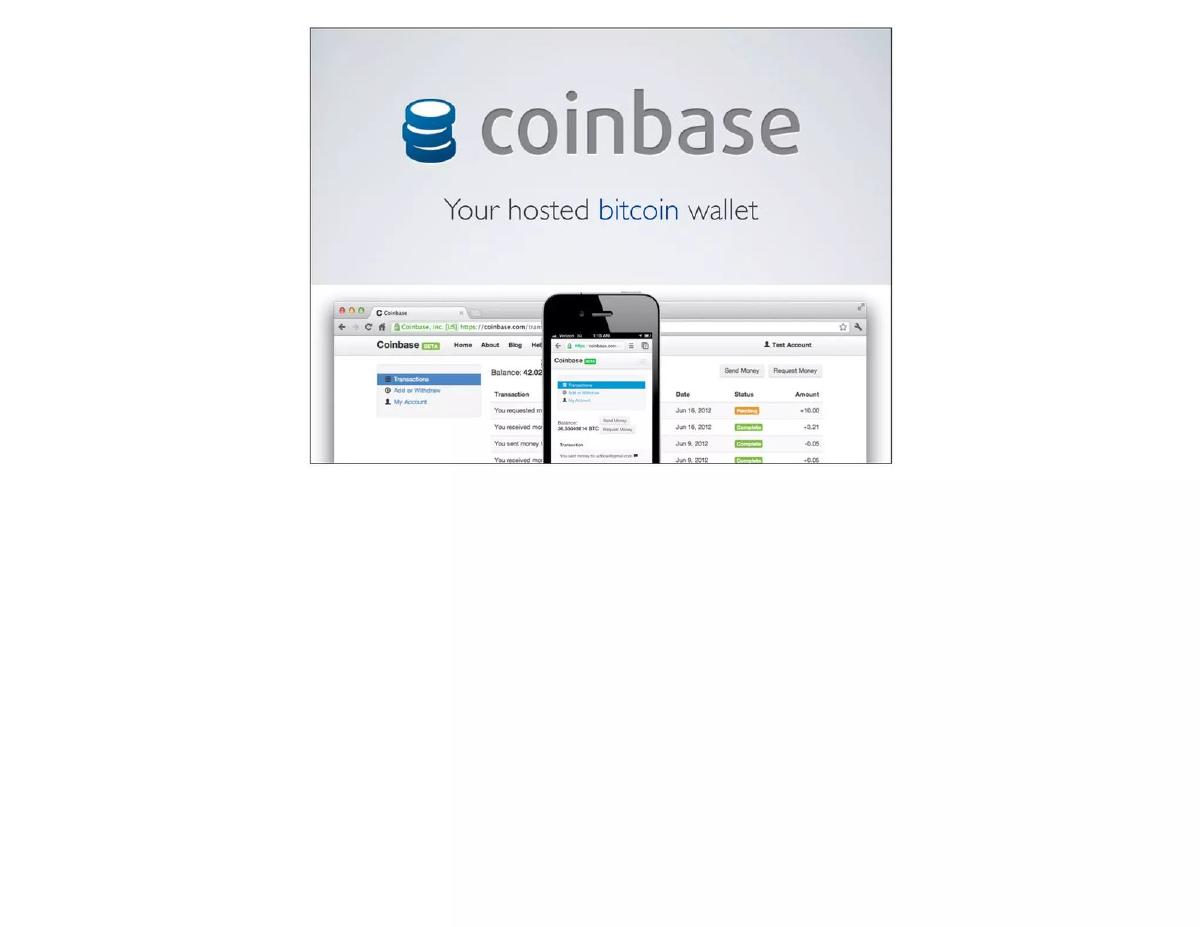
The solution is presented with surgical clarity across two slides. The first simply states, "Coinbase: A Hosted Bitcoin Wallet." No jargon, no buzzwords. It is a plain-spoken description of the product's function. The following slide, however, contains the most powerful statement in the entire deck.
This analogy is the core of the entire pitch. In six words, it explains everything an investor needs to know about the business. In the early 2000s, MP3s were a technical mess. They were difficult to rip, organize, and load onto a player. Software was clunky and unreliable. Then Apple released iTunes, a simple, integrated application that made being a digital music fan easy. It abstracted away the complexity and presented users with a clean library and a simple "sync" button. iTunes didn't invent the MP3, but it made it accessible to the masses.
By drawing this parallel, Coinbase positioned itself not as a niche crypto tool, but as a potential category-defining consumer application. The message was clear: "We do for Bitcoin what iTunes did for digital music." This told investors the product strategy (usability and simplicity), the market opportunity (taking a niche technology mainstream), and the business model (becoming the central platform for a new digital asset class) all at once. It’s one of the most effective uses of an analogy I have ever seen in a seed-stage deck.
Market Size: Early Adopters and Velocity
Today's founders are conditioned to produce detailed TAM, SAM, and SOM slides with multi-billion dollar figures sourced from market research reports. The Coinbase deck has none of that. Instead, it defines the market through current activity and potential use cases. The first data point presented is:
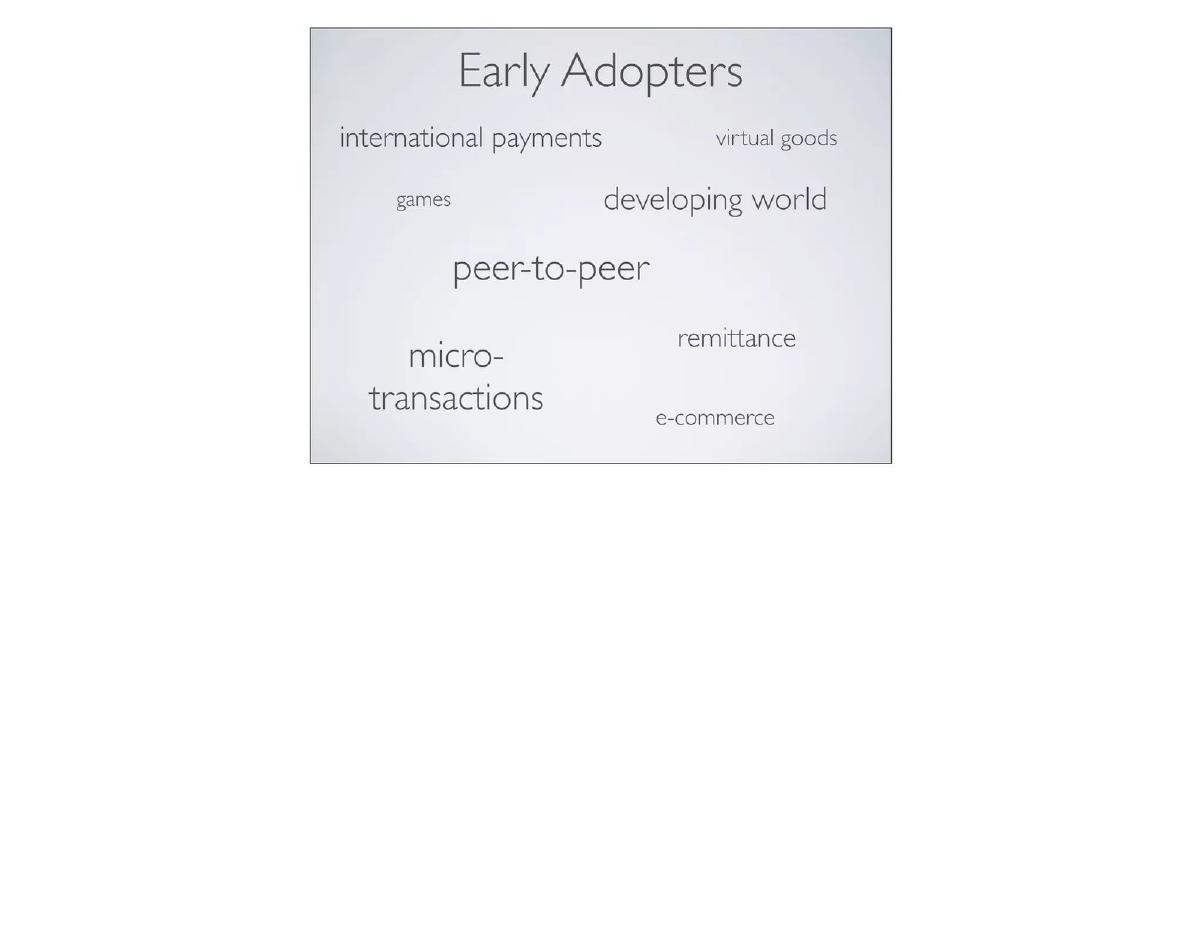
This number, in isolation, is not massive. But for a fledgling, purely digital currency in 2012, it demonstrated that real economic activity was already happening. It proved the market was not purely theoretical. The next slide, "Early Adopters," listed a web of potential applications: e-commerce, virtual goods, international payments, games, remittance, and micro-transactions. This was not a quantitative market sizing exercise; it was qualitative. It was designed to get investors thinking about the breadth of possibilities, even if the depth in each was still nascent.
This approach works only when you are creating a new market or fundamentally transforming an existing one. When there are no Gartner reports to cite, you must sell the vision by pointing to green shoots of behavior. The goal was not to prove a $100 billion market existed on day one, but to show that a passionate, growing base of early adopters was already using Bitcoin despite the friction. Coinbase's bet was that by removing the friction, they could dramatically expand this activity.
The Product: The Power of 'Before and After'
The deck’s product section is a visual one-two punch. First, the "Too Difficult To Use" slide shows the "before": a mess of code or a complicated interface representing the status quo for managing Bitcoin. It primes the audience to feel the user's pain.
Immediately after, a slide simply titled "Coinbase" shows the "after": a clean, web-based interface with recognizable buttons and clear balances. It looks simple. It looks like a modern web app, not a tool for cypherpunks. The contrast is stark and immediate. Without a lengthy demo or a list of features, the deck communicates the core value proposition: "We take that mess and turn it into this simple experience."
This is a lesson many founders miss. You do not need to show every screen and feature of your product. You need to show how you create a fundamentally better experience. For Coinbase, the product was not a bundle of features; the product was simplification. By placing the two images back-to-back, they made this point more effectively than a 10-minute live demo ever could. It respects the investor's intelligence and time, trusting them to understand the significance of the leap in user experience.
Business Model: A Bet on the Network
The deck is conspicuously light on its business model. There is no pricing slide, no discussion of revenue streams, no financial projections. The closest it comes is a slide near the end that reads:
This is less a business model and more a statement of ambition. It recasts the company from a simple "hosted wallet" to something far larger. The implication, combined with the iTunes analogy, is that once you become the primary interface for an asset class, you can monetize in numerous ways: transaction fees, float, merchant services, brokerage services, and more. Apple's iTunes Store didn't just organize MP3s; it sold them, creating a massive new revenue stream.
In 2012, for a seed round, this was acceptable. The immediate focus was on user acquisition and becoming the default platform. Investors were backing the team and the vision, betting that if Coinbase could aggregate the users, monetization would follow. Today, this would be a much harder sell. Even at the seed stage, investors expect founders to have a clear hypothesis on how they will make money. Vague ambitions of becoming a "network" would be met with pointed questions about pricing, customer acquisition cost, and lifetime value. The absence of a concrete model in this deck highlights how much fundraising expectations have shifted toward unit economics, even at the earliest stages.
Traction: Small Numbers, Big Velocity
For an early-stage company, traction is not about large, absolute numbers. It is about demonstrating velocity and proving that your product has found a nerve. The Coinbase deck does this perfectly. It presents two key metrics. First, a graph titled "Coinbase Signups" shows a steep upward curve with a single, crucial annotation:
A 20% daily growth rate in signups is an extraordinary number. Even off a small base, this kind of compounding gets any VC's attention. It is the definition of a "rocket ship" metric. It signals that the product is resonating deeply with its target audience and has the potential for viral or exponential growth. This single data point likely generated more excitement than any financial model could have.
This refers to transaction volume through the platform. By itself, $65,000 is a tiny number. But paired with the user growth metric, it tells a compelling story. Not only were people signing up at a record pace, but they were also starting to use the platform for real financial activity almost immediately. It validated that the simplified user experience was successfully unlocking behavior. This is a masterclass in presenting early traction: lead with a velocity metric to show momentum, and follow up with an absolute number to show that the momentum is tied to meaningful activity.
Competition: The Status Quo Is the Enemy
There is no traditional "Competition" slide in this deck. You will not find a 2x2 matrix plotting Coinbase against other early crypto companies like BitPay or Mt. Gox. Instead, the deck cleverly defines the competition as the messy, complex status quo. The "Too Difficult To Use" slide, showing a command-line interface, is the competition slide.
This is a brilliant strategic move. It frames Coinbase not as a marginally better option in a crowded field, but as the only viable solution for a mainstream audience. It implies that the true battle is not against other companies, but against complexity and user apathy. This elevates the discussion. Instead of getting bogged down in a feature-by-feature comparison with rivals, the conversation becomes about market creation. "Are we the ones who can finally make this technology accessible to everyone?"
By framing the competition this way, Coinbase positioned itself as an enabler for the entire ecosystem. It suggested that its success would grow the pie for everyone, rather than just stealing a slice from a competitor. This is a powerful narrative for investors, as it points to a much larger potential outcome than simply winning a single market segment.
The Team and The Ask: Conspicuously Absent
Two of the most critical slides in any modern pitch deck are completely missing here: the Team and the Ask. There is no slide detailing the background of Brian Armstrong and his co-founders. There is no slide stating, "We are raising $600,000 for 18 months of runway to hire 3 engineers and a marketer." The deck ends abruptly with a contact slide.
In 2012, this was perhaps forgivable, especially with a founder like Armstrong who had a track record as an engineer at Airbnb. He had credibility. The team and the specifics of the fundraise were almost certainly discussed at length in the meeting itself. The deck was a conversation starter, not the entire conversation.
Today, a deck without a team slide would be a non-starter for 99% of founders. Investors invest in people first, especially at the seed stage. You must sell yourself and your team's unique ability to solve the problem. Similarly, omitting the Ask is now seen as unprofessional. It signals a founder hasn't thought through their capital needs and operating plan. Leaving it to a verbal discussion is inefficient and creates ambiguity. The absence of these two slides is the single biggest indicator of how much the norms of fundraising have evolved.
What Worked
The iTunes Analogy: It was the perfect shortcut to explain a complex value proposition. It simultaneously defined the product, the strategy, and the market opportunity in six words. · Problem Framing: By defining the problem as "too difficult to use" rather than "Bitcoin must replace fiat," it grounded the pitch in a tangible, solvable UX issue, not an ideological crusade. · Visual 'Before & After': Contrasting the complex command-line interface with Coinbase's clean UI was a powerful, instant demonstration of the product's value. No words were necessary. · Velocity Over Volume: The "20% Daily" signup growth was the most important metric in the deck. It proved product-market fit with a key audience and signaled exponential potential, making the small absolute numbers irrelevant. · Strategic Competition Framing: Positioning the competition as "the difficult status quo" rather than other companies elevated the pitch from a market-share battle to a market-creation story.
What Would Fail in 2026
No Team Slide: Sending a deck without a slide explaining who you are and why you are the right people to build this business is an immediate red flag. It is the single most important slide at the seed stage. · No Business Model: The vague ambition of being a "payment network" would not suffice. Investors in 2026 demand a clear hypothesis on monetization, even if it's subject to change. How do you make money, and what are the unit economics? · Lack of Market Sizing (TAM/SAM/SOM): Simply listing potential use cases is not enough anymore. Founders are expected to provide a data-driven, bottoms-up analysis of the market size to show they understand the scope of the opportunity. · The Missing Ask: A deck must explicitly state how much capital is being raised, for what percentage of the company (or on what terms), and how that capital will be used. Omitting the Ask is a rookie mistake today. · Potentially Small Traction Numbers: While the growth rate was phenomenal, some modern VCs might balk at "$65,000 in transaction volume" as insufficient proof of value capture, demanding more evidence of revenue potential.
Lessons for Founders Raising in 2026
Find Your Killer Analogy. The world is more complex than ever. If you are working on AI, quantum, or another deep tech, you must find your "iTunes for MP3s." An analogy can do more work than five slides of data. · Show, Don't Tell, Your Value. Create a single slide that visually contrasts the painful "before" state with the elegant "after" state your product provides. This is more powerful than a feature list. · If You're Early, Sell Velocity. If your absolute revenue or user numbers are small, focus your narrative on growth rates. Week-over-week or month-over-month growth is the best way to prove momentum and project future success. · Your First Deck Must Be Complete. Unlike Coinbase in 2012, you do not have the luxury of omitting core slides like Team, Business Model, or the Ask. The bar has been raised. Your deck must stand on its own as a complete, compelling document. · Frame Your Competition Intelligently. Think beyond a simple list of rival companies. Is your true competitor an outdated process, a spreadsheet, or user inertia? Framing the battle on your terms gives you a strategic advantage.
The Coinbase 2012 seed deck is a relic from a different era of fundraising, but its core lessons in communication remain potent. It succeeded because it did not try to sell the entire Bitcoin revolution in one go. It sold a simple solution to a real, immediate pain point. It used a brilliant analogy to make a complex technology feel familiar and inevitable. And it proved its case not with exhaustive financial models, but with a single, undeniable metric of user love: 20% daily growth. Founders today operate in a world that demands more detail, more data, and more foresight. But they should not forget the fundamental power of the principles on display here: clarity, simplicity, and a narrative that turns a complex problem into an obvious investment.
Frequently asked questions
- What was the strongest part of the Coinbase pitch deck?
- The analogy slide: 'Coinbase : Bitcoin :: iTunes : MP3'. It's one of the best examples ever. It took a new, confusing, and technical concept (Bitcoin) and framed it with a familiar, successful business model (iTunes) that organized a chaotic digital asset (MP3s). Investors immediately understood the vision: make crypto simple and accessible.
- What was missing from the Coinbase deck?
- Key slides that are standard today: a Team slide, a detailed Business Model slide (how they make money), a Market Size slide beyond a word cloud, a Go-To-Market plan, and an Ask/Use of Funds slide. It relied entirely on the founders' credibility and the in-person narrative to fill these critical gaps.
- Could this deck raise money in today's market?
- It could raise a small pre-seed or angel round from investors who know the founders, but it would struggle to raise a competitive multi-million dollar seed round. Today's investors expect more validation and detail on the execution plan, competitive landscape, and unit economics, even at the earliest stage.
- How did Coinbase show traction effectively?
- They used two simple but powerful metrics. First, '20% Daily' signup growth showed strong top-of-funnel demand and product-market fit. Second, '$65,000 USD in the first 5 weeks' of transactions proved that users were not just signing up but were actively using the core functionality of the product. It validated the entire user journey.
- What is the main lesson for founders from this deck?
- Your primary job in a seed pitch is to sell a vision on the back of a credible new wave. Coinbase identified the Bitcoin wave, defined a clear problem (it's too hard to use), presented a simple solution (a hosted wallet), and provided early data that they were the ones who could capture it. Focus on clarity and traction over exhaustive detail.