Docola’s pitch deck focuses on the 'Telehealth-Plus Platform,' an asynchronous communication tool designed to streamline patient education and follow-up. The deck leans heavily on macroeconomic pressures, such as the projected shortage of 124,000 physicians by 2034 and the rise of national health spending to $6.2 trillion by 2028. While the team slide showcases deep clinical and operational expertise, the deck lacks critical financial data, including a business model, unit economics, and a specific funding ask. The solution is positioned as a 'global' single point-of-contact for patients, yet…
Key takeaways
- The deck identifies a massive physician shortage of 124,000 by 2034 as a primary market driver on Slide 2.
- Docola positions itself as an 'asynchronous telehealth' platform for curated patient education and follow-up on Slide 3.
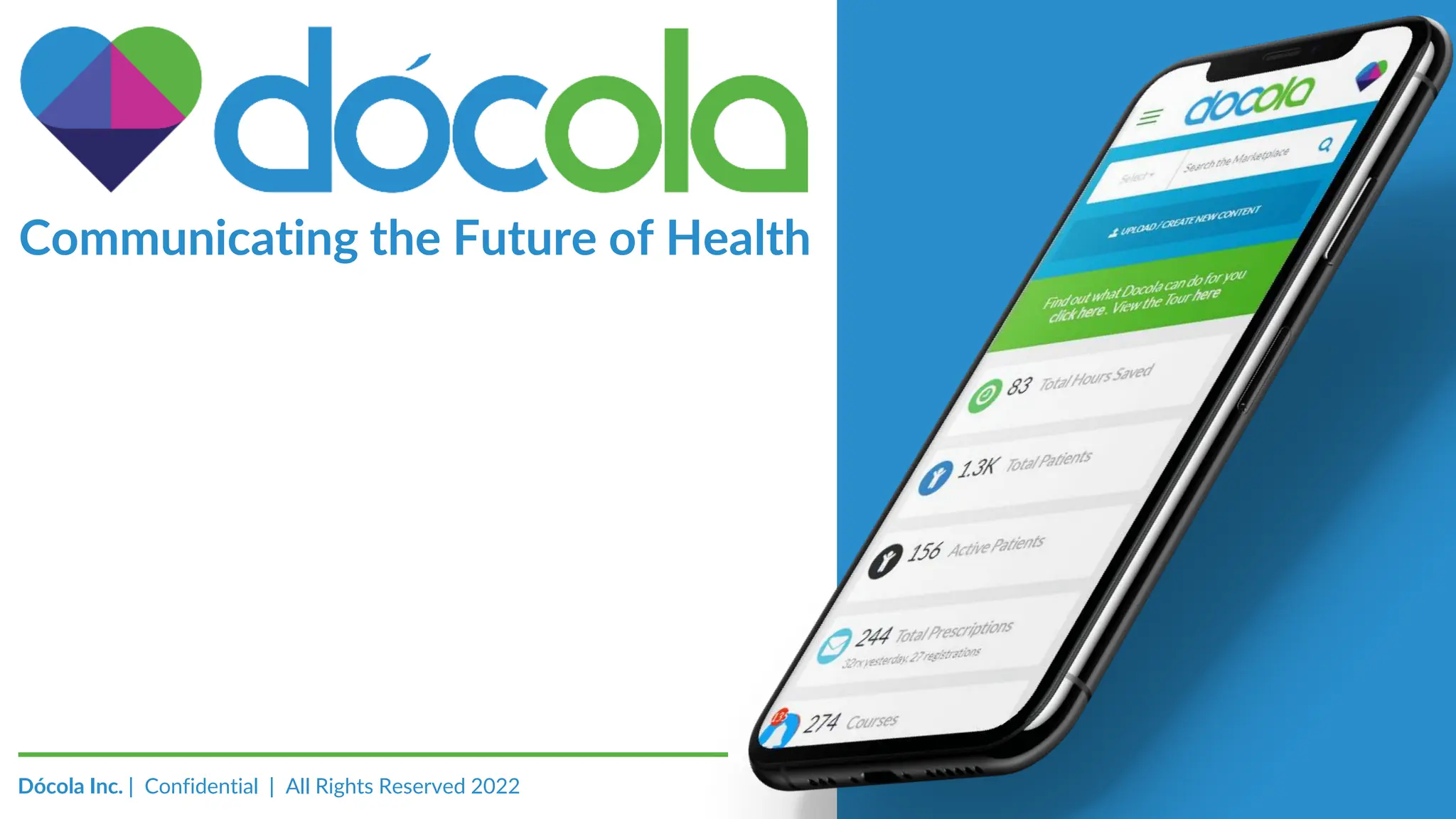
- The platform claims to have saved 83 total hours and managed 1.3K total patients according to the mockup on Slide 1.
- The team is highly experienced, featuring a CEO with 35 years in patient care and a COO who co-founded 6 tech companies on Slide 5.
- Differentiation is built on being a 'single point-of-contact' for patients to view info from multiple clinicians on Slide 4.
- The deck includes high-level testimonials from institutions like the Erie County Medical Center and Cincinnati Children's Hospital on Slide 6.
- There is no mention of revenue, pricing models, or customer acquisition costs in the provided slides.
- The deck lacks a 'The Ask' slide, leaving the intended funding amount and use of proceeds unknown.
Docola Pitch Deck Analysis
Docola is positioning itself at the intersection of patient education and telehealth. In an era where physician burnout is at an all-time high and patient face-time is dwindling, Docola proposes an asynchronous solution to maintain the quality of care without increasing the time burden on clinicians. The deck is structured to highlight the macro-crisis in healthcare before introducing their 'Telehealth-Plus' platform as the remedy.
Slide 1: Title and Initial Mockup
The cover slide introduces the brand with the tagline "Communicating the Future of Health." The most significant element here is the mobile phone mockup, which provides the only glimpse into the platform's metrics. The screen displays: "83 Total Hours Saved," "1.3K Total Patients," "156 Active Patients," "244 Total Prescriptions," and "274 Courses." These figures suggest the platform is designed to track efficiency and patient engagement. However, as this is a mockup on a title slide, it is unclear if these represent real-time aggregate data for the company or a sample dashboard for a single clinic.
Slide 2: The Challenges
Docola uses this slide to establish the 'Why Now?' of their business. They cite three heavy-hitting statistics to frame the problem:
"America will face a shortage of up to 124,000 physicians by 2034" (Source: Association of American Medical Colleges). · "National health spending is projected to grow at an average annual rate of 5.4 percent for 2019-28 and to reach $6.2 trillion by 2028" (Source: CMS.gov). · "Primary care consultations last less than 5 minutes for half the world's population" (Source: British Medical Journal).
By leading with these, Docola argues that the current healthcare model is unsustainable and that a technological intervention is mandatory to prevent a total collapse of patient-provider communication.
Slide 3: The Solution
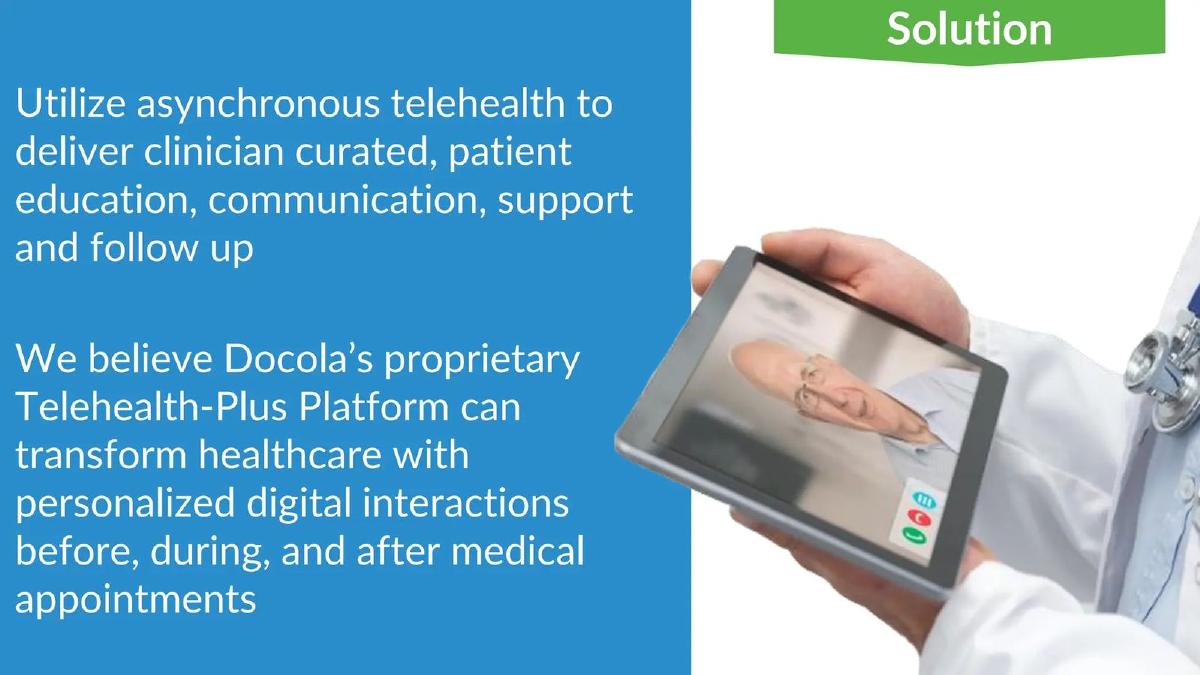
The solution slide defines the product category: "asynchronous telehealth." The platform is described as a way to deliver "clinician curated, patient education, communication, support and follow up." They name their product the "Telehealth-Plus Platform" and claim it can transform healthcare through "personalized digital interactions before, during, and after medical appointments." This suggests the product is not a replacement for the doctor's visit, but a digital wrapper that extends the visit's value.
Slide 4: Differentiation
This slide attempts to carve out Docola's unique space in the market. They list three core beliefs:
"We are a global solution" : Suggesting scalability beyond the US market. · "We enhance the relationships between patients and clinicians" : Positioning themselves as a facilitator rather than a disruptor of the traditional doctor-patient bond. · "We are a single point-of-contact for patients to view information from multiple clinicians" : This is the most important technical differentiator, implying a patient-centric portal that aggregates data across different providers.
Slide 5: The Team
The team slide is a strong point for Docola, showcasing a mix of clinical, technical, and financial expertise. Key members include:
Eran Kabakov, PT (CEO & CTO) : 35 years in patient care and 20 years in digital health. · Geri Lynn Baumblatt (Chief Engagement Officer) : 20 years in patient engagement, formerly Exec. Dir. at Emmi Solutions. · Itay Tsabari, MBA (CFO) : Former CFO at Copilot.CX and Finance Manager at Motorola Israel. · Jonathan Ascher, MD (CMO) : Director at New York Eye and Ear Infirmary. · Tomer Kabakov (COO) : 20 years in tech sales, co-founded 6 tech companies.
The presence of a Chief Engagement Officer is particularly relevant given the product's focus on patient education and communication.
Slide 6: Testimonials
The final slide in this set provides social proof through five quotes from healthcare professionals. Notable mentions include:
Joseph Caruana, MD from Erie County Medical Center, who notes a positive difference in "quality of life" in the practice. · Thomas H. Inge, MD from Cincinnati Children's Hospital, calling it a "tremendous addition" to patient education. · Sharon Krzyzanowski from Advent Health Celebration, who mentions the platform has "streamlined the process without losing that personal touch." · Paul G. Loberti from the Rhode Island Department of Health, expressing excitement about "new market horizons."
These testimonials suggest the product has been successfully piloted or implemented in large-scale hospital environments and state health departments.
What is Missing from the Docola Deck
While the vision and team are clear, the deck omits several critical components required for a successful fundraising round.
1. Business Model and Revenue Streams
There is no information regarding how Docola generates revenue. Is it a SaaS model charged per clinician? A per-patient-per-month (PPPM) fee? Or a licensing model for large hospital systems? Without a pricing strategy, investors cannot evaluate the potential for scale or the path to profitability.
2. Market Size (TAM/SAM/SOM)
While Slide 2 mentions the $6.2 trillion total health spending, it does not narrow down the specific addressable market for patient education software or asynchronous telehealth. Investors need to see the specific slice of the market Docola intends to capture.
3. Competitive Landscape
The telehealth space is crowded with giants like Teladoc and Amwell, as well as niche patient engagement tools. The deck does not provide a competitive matrix or a clear explanation of why a hospital would choose Docola over an integrated module within their existing Electronic Health Record (EHR) system like Epic or Cerner.
4. The Ask and Use of Funds
The most glaring omission is the lack of a funding request. The deck does not state how much capital is being raised, the valuation, or how the money will be spent (e.g., 50% engineering, 30% sales, 20% marketing). This makes it difficult to categorize the stage of the company (Seed vs. Series A).
What Founders Should Copy from This Deck
Despite the omissions, there are several elements that founders should emulate:
Macro-Problem Framing : Slide 2 does an excellent job of using authoritative sources (AAMC, CMS, BMJ) to prove that the problem is not just a nuisance, but a systemic crisis. · Role-Specific Team Highlights : Instead of just listing titles, the team slide highlights specific years of experience and relevant past companies (Motorola, Deloitte, Emmi Solutions), which builds immediate credibility. · Focus on 'Asynchronous' : By leaning into the word "asynchronous," Docola avoids being compared directly to the saturated market of live video telehealth providers. It defines a specific niche that solves a specific problem (clinician time). · Institutional Social Proof : The testimonials are not from anonymous users but from named directors and coordinators at reputable institutions like Cincinnati Children's and Advent Health. This is high-value validation for a B2B healthcare startup.
Frequently asked questions
- What problem is Docola trying to solve?
- Docola targets the inefficiency in healthcare communication. Specifically, it addresses the fact that primary care consultations last less than 5 minutes for half the world's population and the projected $6.2 trillion in health spending by 2028. By using asynchronous tools, they aim to provide the 'personal touch' without requiring real-time physician presence for every interaction.
- How does Docola differentiate itself from standard telehealth?
- Unlike traditional synchronous video calls (like Zoom or Teladoc), Docola emphasizes 'asynchronous' interactions. Slide 4 highlights that they act as a single point-of-contact for patients to aggregate information from multiple clinicians, positioning the platform as a hub for patient education rather than just a video conferencing tool.
- What is the current traction of the company?
- The deck is light on hard traction metrics. Slide 1 shows a mobile mockup with '1.3K Total Patients' and '83 Total Hours Saved,' but these appear to be placeholder or illustrative figures within a UI design. Slide 6 provides social proof through testimonials from medical directors and coordinators, suggesting the product is in use at several medical centers.
- Who are the key members of the leadership team?
- The team is led by Eran Kabakov (CEO/CTO), a PT with 35 years in patient care. The leadership includes Geri Lynn Baumblatt (Chief Engagement Officer), formerly of Emmi Solutions; Itay Tsabari (CFO), with experience at Motorola and Deloitte; Dr. Jonathan Ascher (CMO); and Tomer Kabakov (COO), a serial entrepreneur who has co-founded six companies.
- What is missing from this pitch deck?
- The deck is missing several essential components for a professional fundraise: a business model (how they make money), a competitive landscape analysis, detailed financials/projections, and a clear funding ask. Without these, it functions more as a product overview or a 'vision' deck than a complete investment memorandum.