The Doctor4US pitch deck outlines a vision for a global online healthcare platform using a SaaS model. While the company successfully onboarded 4,800 doctors by April 2016, it struggled significantly with demand, reporting only 30 registered patients at that time (Slide 6). The presentation relies heavily on external Deloitte market data from 2007-2013 to justify the opportunity, rather than internal growth trends. The revenue model is highly fragmented, listing seven distinct streams ranging from job boards to big data analytics (Slide 5). Despite ambitious targets to reach 100,000 patients…
Key takeaways
- The platform reported 4,800 registered doctors but only 30 registered patients as of April 2016 (Slide 6).
- The revenue model is diversified across seven streams, including PMS, advertisements, and a job board (Slide 5).
- Market validation relies on Deloitte data showing UK online health searches grew from 18% in 2007 to 43% in 2013 (Slide 4).
- The company set a target to reach 25,000 active doctors and 100,000 active patients by the end of 2016 (Slide 8).
- Doctor4US differentiates itself from competitors like ZocDoc and Practo by offering a job board and local health news publishing (Slide 7).
- The expansion strategy is based on acquiring country-based partners at a rate of one new country per quarter (Slide 8).
- The deck omits a team slide, financial projections, and a specific funding ask in the provided nine slides.
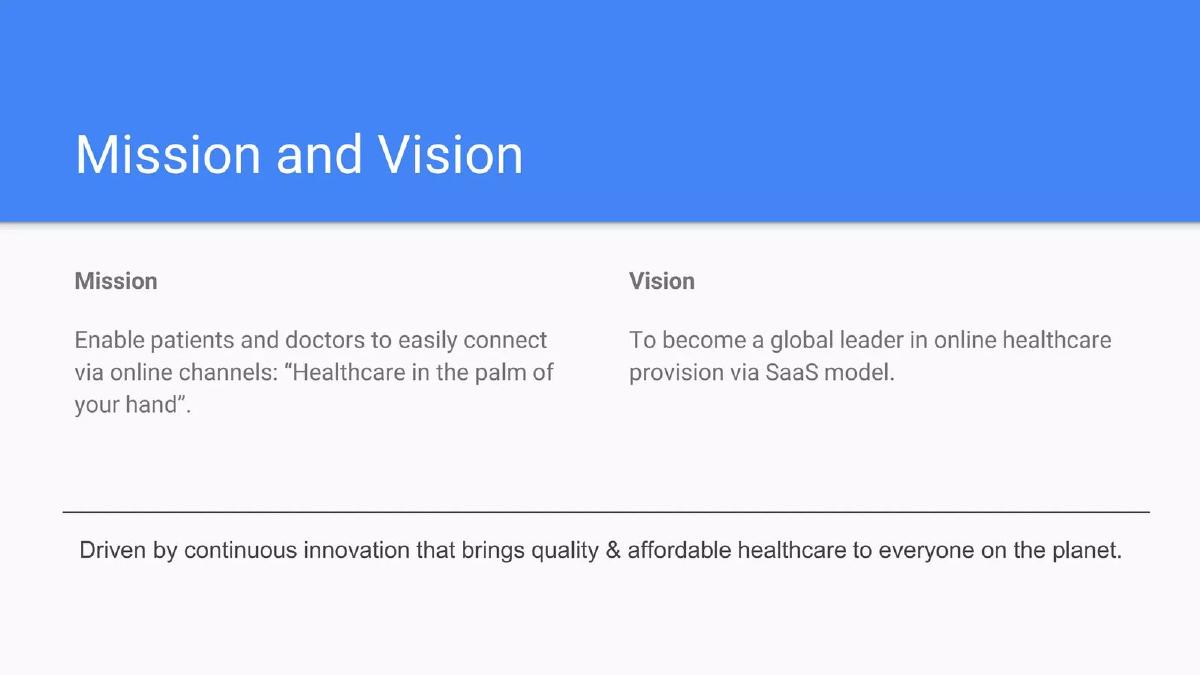
- The vision is to become a global leader in online healthcare provision via a SaaS model (Slide 2).
Doctor4US Pitch Deck Analysis
The Doctor4US investor presentation, dated April 2016, outlines a plan to build a global telehealth marketplace. The deck is characterized by a strong focus on the supply side of the medical market but reveals significant challenges in patient acquisition and a lack of focus in its revenue strategy.
Slide 1: Title Slide
The deck opens with a minimalist blue title slide featuring the company name, Doctor4US , and the subtitle "Investor pack." There is no tagline or immediate value proposition presented on the cover, requiring the reader to proceed to understand the business category.
Slide 2: Mission and Vision
Slide 2 defines the company's purpose. The mission is to "Enable patients and doctors to easily connect via online channels," summarized by the phrase "Healthcare in the palm of your hand." The vision is "To become a global leader in online healthcare provision via SaaS model." The slide also notes a commitment to quality and affordable healthcare for "everyone on the planet." While the vision is grand, it lacks specific geographic or demographic focus.
Slide 3: Market and Competitive Analysis Divider
This is a simple transition slide. In a 17-slide deck, using full slides for transitions can sometimes disrupt the flow, but here it signals a shift from philosophy to data.
Slide 4: Market Survey
Doctor4US relies on a Deloitte study titled "How digital technology is transforming health and social care" to validate its market. The slide lists online search statistics for health information across several countries: India (39%) , Russia (39%) , China (32%) , Brazil (29%) , Mexico (27%) , and the UK . The UK data shows a trend from 18% in 2007 to 43% in 2013, peaking at 59% for the 25-34 age demographic. The slide also mentions that "OMC" (presumably Online Medical Care) revenues were forecast to triple from 2014 to 2017. The use of 2013 data in a 2016 deck suggests a reliance on slightly dated secondary research rather than fresh primary market insights.
Slide 5: Revenue Streams (ROI)
This slide lists seven distinct revenue streams. The company intends to monetize through: 1. PMS (Patient Management System) , 2. Premium use , 3. Advertisements , 4. Job board , 5. Medical news publications , 6. Medical treatment and Services comparison , and 7. Analytics (Big Data solution) . Listing seven revenue streams at an early stage is often a red flag for investors, as it suggests a lack of focus. Most successful startups master one primary transaction or subscription model before diversifying into secondary streams like job boards or data sales.
Slide 6: Current State (April 2016)
This slide provides the most critical data point in the deck. As of April 2016, the company had 4,800 registered doctors but only 30 registered patients . This 160:1 ratio of doctors to patients indicates a massive failure in demand-side marketing. While having a large database of doctors is a strong start for a directory, a marketplace cannot function without a balanced user base. The low patient count suggests the product had not yet achieved any form of viral growth or effective consumer reach.
Slide 7: Competition - Feature Comparison
The company compares itself to ZocDoc , Healcon , and Practo . Doctor4US claims to be the only platform that offers all seven listed features, including a job board and the ability to publish local health news. Notably, they highlight that they do not charge for the service, allowing patients to pay doctors directly. This "free" model for the core service likely explains the high number of registered doctors but raises questions about the sustainability of the business if the secondary revenue streams (from Slide 5) do not materialize quickly.
Slide 8: Forecast on Product Take Up
The growth strategy involves "country based partners" and entering "1 new country per quarter." The targets for the end of 2016 are 25,000 active doctors and 100,000 active patients . Given that they only had 30 patients in April, reaching 100,000 by December would require an extraordinary and unexplained shift in their acquisition strategy. The deck does not explain how these "country based partners" are sourced or managed.
Slide 9: Contact Slide
The final slide provides contact information for an office in Dartford, Kent (UK) and a generic info@ email address. The background image is a black-and-white photo of a bridge (resembling the Golden Gate Bridge), which is an odd choice for a company based in Kent, UK, and may suggest a generic template was used.
What Doctor4US Does Well
The company successfully tackled the "cold start" problem on the supply side. Onboarding 4,800 doctors is a non-trivial task and provides a solid foundation for a directory-style service. The competitive matrix also shows a clear understanding of the feature sets offered by major players in the space, identifying gaps like job boards and news publishing that could theoretically keep doctors engaged with the platform even when patient volume is low.
Weaknesses and Omissions
The most glaring weakness is the patient registration count . A marketplace with 30 patients is not yet a marketplace; it is a database. The deck fails to address why patient numbers are so low or provide a specific marketing plan to fix this. Furthermore, the revenue model is too broad . By trying to be a PMS, an ad network, a job board, and a data broker all at once, the company risks spreading its limited resources too thin. The omission of a team slide is also a significant hurdle; investors need to know if the founders have medical, technical, or scaling expertise. Finally, the lack of a clear financial ask makes it unclear what the purpose of the presentation is—whether they are looking for seed funding, a bridge loan, or a strategic partner.
Lessons for Founders
Founders should learn from the transparency of Slide 6. While the numbers are poor, being honest about traction is better than hiding it. However, if your numbers show a massive imbalance, the very next slide must be a detailed, credible plan to correct that imbalance. Additionally, founders should avoid the "everything but the kitchen sink" revenue model. It is more effective to show one clear path to $1M in revenue than seven paths to $100k. Lastly, always include a team slide. In early-stage investing, the people are often more important than the current metrics, especially when the metrics (like the patient count here) are struggling.
Frequently asked questions
- What is the primary business model for Doctor4US?
- Doctor4US describes itself as a SaaS-based platform connecting patients and doctors. According to Slide 5, the company intends to generate revenue through seven channels: a Patient Management System (PMS), premium usage fees, advertisements, a job board, medical news publications, service comparison tools, and big data analytics. This multi-pronged approach suggests a marketplace model combined with enterprise software for practitioners.
- How does the company compare to its competitors?
- On Slide 7, Doctor4US compares itself to ZocDoc, Healcon, and Practo. It claims to offer a more comprehensive feature set for doctors, including the ability to create personalized websites, set their own charges, and access a job board. Notably, it highlights that it does not charge for the service, allowing patients to pay doctors directly, a feature it shares only with Healcon and Practo in its analysis.
- What was the company's traction at the time of the deck?
- As of April 2016, the company had a significant supply-side advantage with 4,800 registered doctors. However, the demand side was nearly non-existent, with only 30 registered patients (Slide 6). This represents a critical imbalance for a marketplace startup, indicating that while they could recruit professionals, they had not yet cracked consumer acquisition.
- What are the company's growth targets?
- Slide 8 outlines aggressive goals for the remainder of 2016. The company aimed to grow from 4,800 to 25,000 active doctors and from 30 to 100,000 active patients. To achieve this, they planned to enter one new country per quarter through local partnerships. The deck does not specify which countries were being targeted or how these partners would be incentivized.
- What key information is missing from this pitch deck?
- The provided slides lack several essential components for a professional fundraise. There is no team slide to establish credibility, no breakdown of unit economics (CAC/LTV), and no clear 'Ask' regarding the amount of capital sought or the valuation. Furthermore, the lack of a 'Problem' slide makes it difficult to understand the specific pain point they are solving beyond general 'connectivity'.