Chptr's pre-seed deck presents a compelling case for a modern, social-first approach to memorialization. By targeting Gen Z and Millennials, the company aims to disrupt the traditional $25B+ US death industry, which they claim currently only memorializes 21% of people with obituaries (Slide 4). The deck emphasizes the emotional frequency of loss, noting that a healthy person will experience 25-36 close personal losses in their lifetime (Slide 8). While the deck is visually polished and identifies a clear market gap, several key strategic slides—including the specific partnership growth strate…
Key takeaways
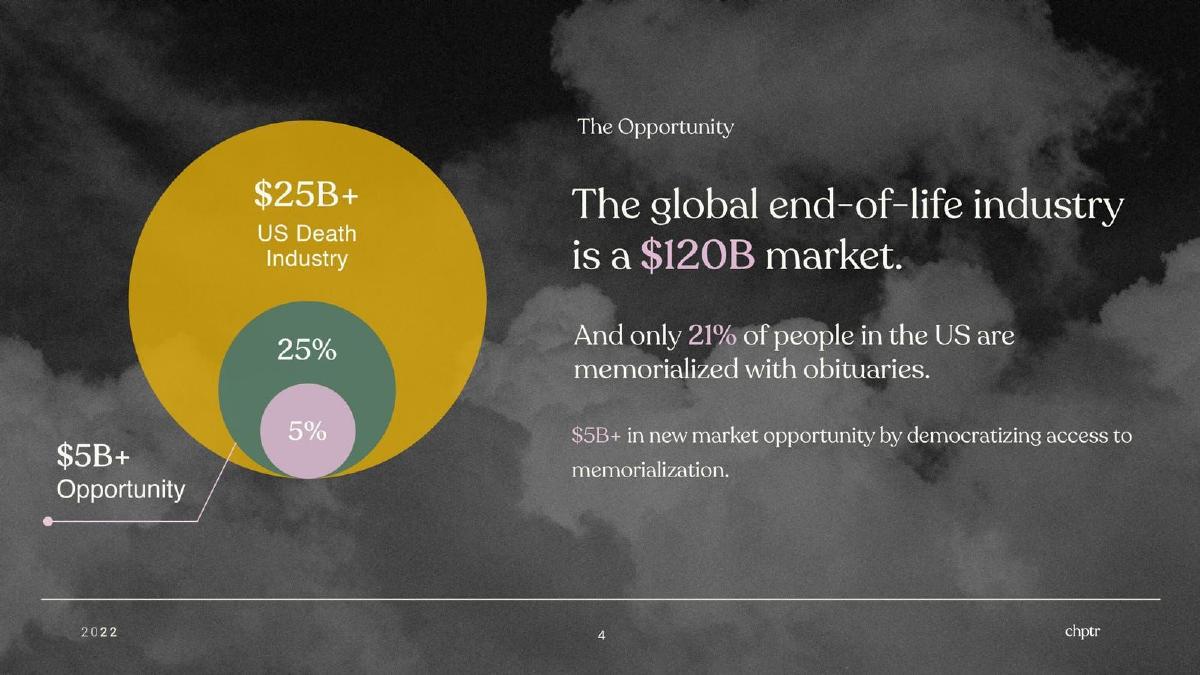
- The global end-of-life industry is valued at $120B, with the US death industry specifically exceeding $25B (Slide 4).
- Chptr identifies a significant gap in the market, stating that only 21% of people in the US are currently memorialized with obituaries (Slide 4).
- The product is specifically positioned as a 'Gen Z and Millennial content platform' for celebrating life (Slide 6).
- The platform features five core pillars: Discover, Contribute, Explore, Connect, and Remember Forever (Slide 6).
- Chptr claims a $5B+ new market opportunity exists by democratizing access to memorialization (Slide 4).
- The average person is expected to experience 25-36 close personal losses and 15+ losses of influential notable people in their lifetime (Slide 8).
- The business model relies on a freemium approach where memorials are free and last forever, while premium features drive revenue (Slide 12).
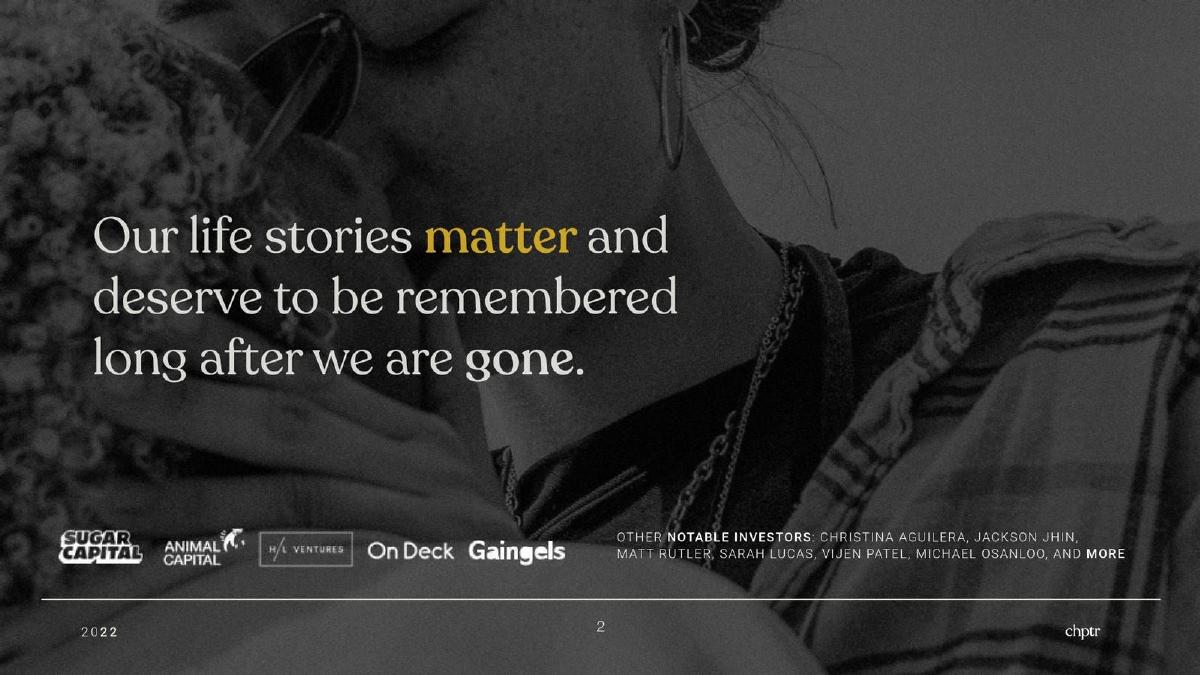
- The company secured backing from notable investors including Sugar Capital, Animal Capital, and Gaingels, as well as celebrity investor Christina Aguilera (Slide 2).
Introduction and Investor Social Proof
Slide 1: Title and Leadership
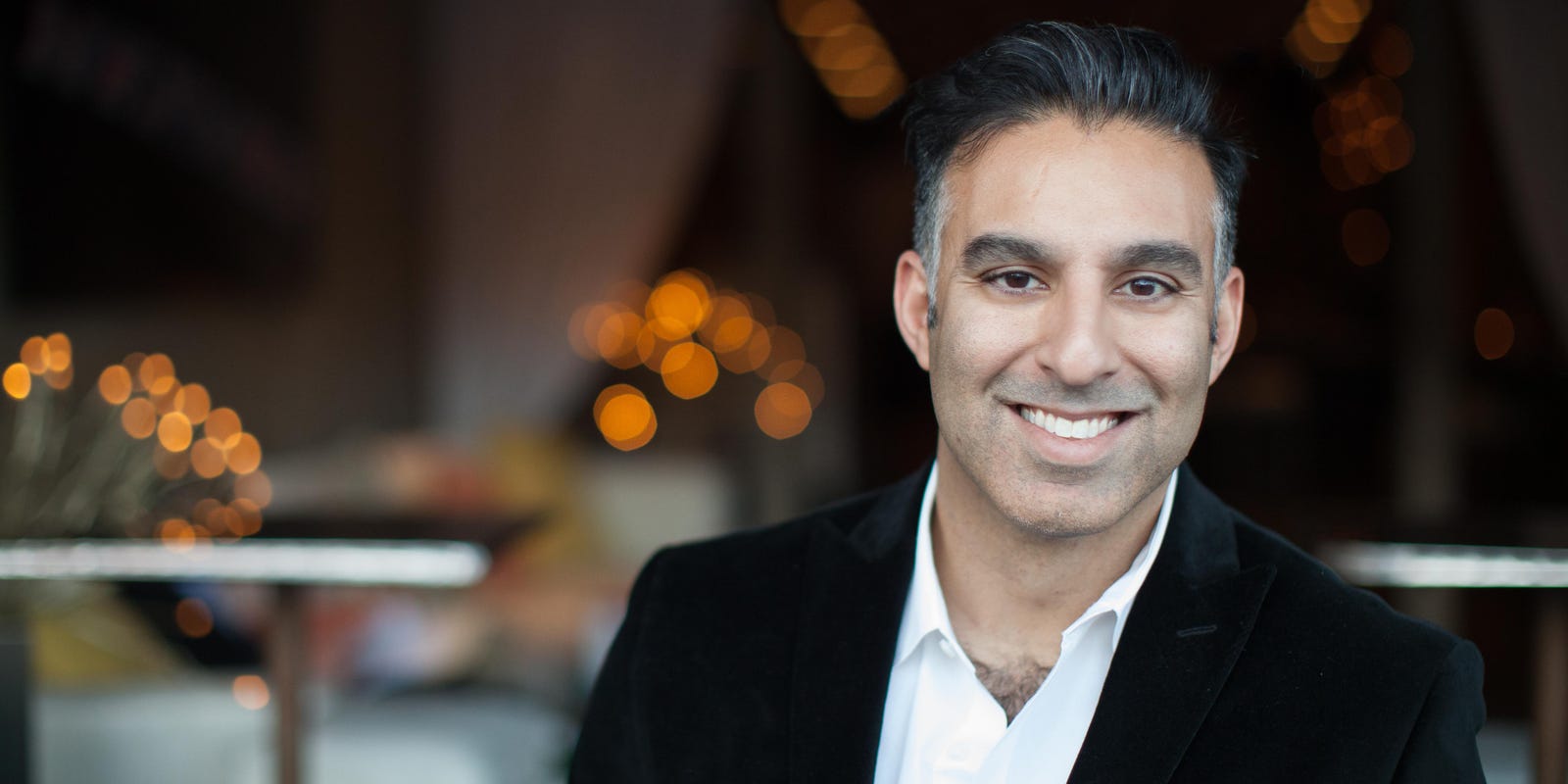
The deck opens with a portrait of Rehan Choudhry, identified as the co-founder of Chptr. This is a non-traditional opening slide that emphasizes founder identity and personal branding immediately, rather than a logo or a mission statement.
Slide 2: The Investor Roster
Slide 2 functions as a heavy social proof slide. It lists institutional investors including Sugar Capital , Animal Capital , H/L Ventures , On Deck , and Gaingels . It also highlights 'Other Notable Investors' such as Christina Aguilera , Jackson Jhin , and Matt Rutler . The slide includes the core thesis: 'Our life stories matter and deserve to be remembered long after we are gone.'
The Market Opportunity
Slide 4: The $120B Market
This slide defines the 'Opportunity.' It cites a $120B global end-of-life market and a $25B+ US death industry . The most critical data point here is that only 21% of people in the US are memorialized with obituaries . Chptr identifies a $5B+ new market opportunity by democratizing access to memorialization for the remaining 79% of the population.
Slide 8: The Dynamic of Loss
To justify the frequency of use for a death-related app, Slide 8 explains 'The Dynamic.' It claims the average healthy person will experience 25-36 close, personal losses and 15+ losses of notable people who influenced them. This slide attempts to shift the investor's perception of the product from a 'low-frequency' utility to a 'high-frequency' life companion.
Product and User Experience
Slide 6: The Gen Z and Millennial Content Platform
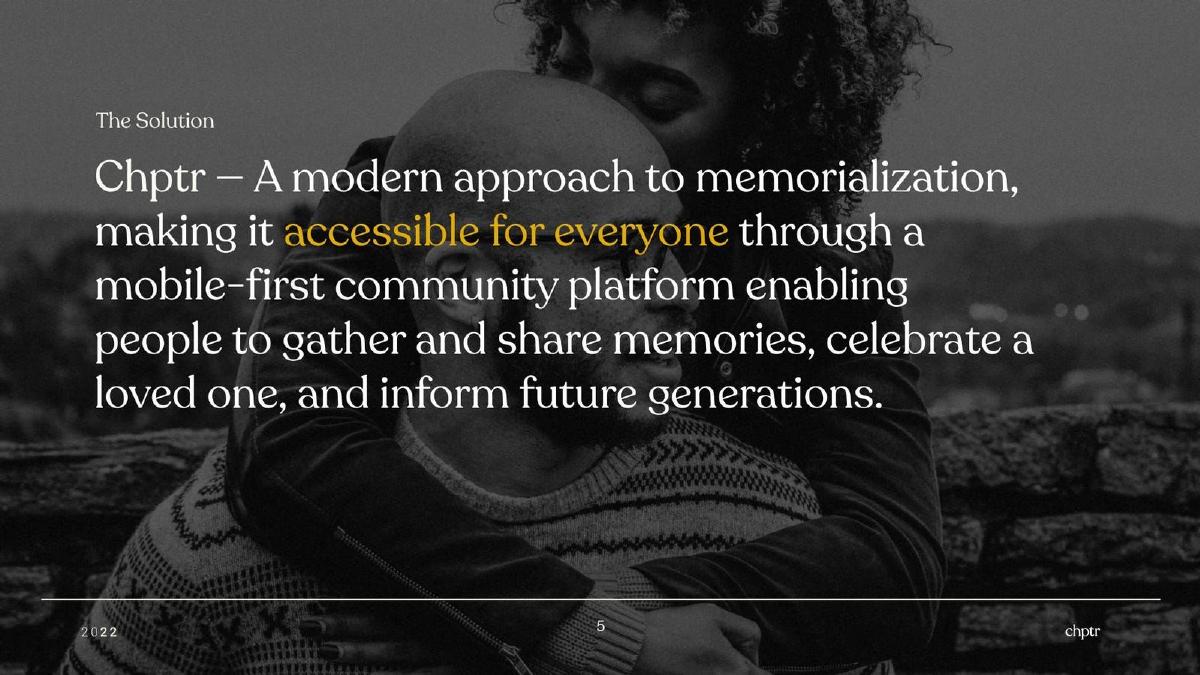
Slide 6 showcases the mobile interface. It positions Chptr as a content platform for younger generations. The product is broken down into five functions: Discover (ML-driven newsfeed), Contribute (creator tools for memories), Explore (threaded memorial videos), Connect (community-curated memories), and Remember Forever (a single, beautiful memorial). The UI shown is highly reminiscent of modern social media platforms like TikTok or Instagram Stories.
Growth and Business Strategy
Slide 10: Growth and Partnerships
Slide 10 states, 'We’re leveraging partnerships to go to market and lower use acquisition costs.' However, the specific details of these partnerships are redacted in the provided version. This is a common omission in public decks to protect trade secrets, but it leaves a gap in understanding their actual GTM strategy.
Slide 12: Business Model
The business model is described as 'Built for Scale.' It confirms that Chptr memorials are free and last forever . Revenue is intended to come from premium features . Like the growth slide, the specific breakdown of these features and their pricing is redacted .
Slide 16: Roadmap
Slide 16 sets a timeline, stating that the company is launching their MVP in Q3 2022 . The specific milestones and feature rollouts associated with this launch are redacted .
Team and Conclusion
Slide 14: The Team
Slide 14 claims the company is led by a 'diverse team of leading entrepreneurs, engineers, and community experts.' However, the names, photos, and specific backgrounds of the team members (other than the co-founder mentioned on Slide 1) are redacted .
Slide 19: Closing
The deck concludes with a simple 'Thank You' and the company's URL, chptr.com , set against a solid yellow background with the company logo.
What Works in the Chptr Deck
The 'Unserved 79%' Statistic: The strongest part of this deck is the identification of a massive market gap. By pointing out that 79% of people do not get an obituary (Slide 4), Chptr creates a compelling 'Why Now' and 'Why Us' narrative. They aren't just competing for the existing $25B market; they are expanding it.
Social Proof: For a pre-seed round, the level of investor transparency on Slide 2 is impressive. Having a mix of traditional VCs and high-profile celebrity angels like Christina Aguilera provides immediate credibility to a concept that might otherwise be viewed as niche or difficult to market.
Modern UI/UX: The product screenshots on Slide 6 look like apps that Gen Z and Millennials actually use. By avoiding the somber, dated aesthetic of traditional funeral home websites, Chptr makes the concept of memorialization feel like a natural extension of social media rather than a chore.
What is Missing from the Chptr Deck
The 'Ask' and Financials: The deck completely omits how much money is being raised, the valuation, and how the funds will be allocated. While this information is often removed for public distribution, its absence prevents a full analysis of the deal's structure.
Unit Economics: While Slide 12 mentions a freemium model, there is no mention of projected Customer Acquisition Cost (CAC) or Lifetime Value (LTV). In the consumer app space, especially one dealing with a sensitive topic like death, understanding the cost to acquire a user is paramount.
Competitive Landscape: The deck does not include a competitive matrix. It ignores existing players like Ancestry.com, Legacy.com, or even the 'Memorialized' features on Facebook. Acknowledging how they differ from these incumbents would strengthen their position.
What Founders Should Copy
Quantifying the 'Frequency' Problem: If you are building a product for a life event that seems infrequent (like death, weddings, or home buying), copy Slide 8. By aggregating 'close losses' and 'influential losses,' Chptr reframes the user need as something that happens dozens of times in a lifetime, rather than just once or twice.
Clear Product Pillars: Slide 6 is a masterclass in explaining a complex app. Instead of listing fifty features, they group everything into five clear verbs (Discover, Contribute, Explore, Connect, Remember). This makes the product easy to explain and easy to remember.
Market Expansion vs. Market Share: Most founders focus on taking a piece of an existing pie. Chptr focuses on the 'new market opportunity' (Slide 4). If your product serves people who are currently priced out or ignored by an industry, highlight that 'unserved' percentage as your primary target.
Frequently asked questions
- What is the primary problem Chptr is solving?
- Chptr addresses the lack of accessible and modern memorialization. According to Slide 4, only 21% of Americans receive an obituary. The company aims to 'democratize' this process for the 79% who are currently forgotten by traditional media, providing a digital-first platform for the younger generations who are already accustomed to sharing life stories through mobile content.
- How does Chptr plan to make money?
- Slide 12 outlines a 'Built for Scale' business model. The core service—creating a memorial—is free and intended to last forever. Revenue is generated through 'premium features' that allow the community to expand how they remember and connect. While specific premium tiers are redacted, the strategy follows a classic social-platform freemium funnel.
- Who are the key investors in Chptr?
- As shown on Slide 2, the company has attracted a mix of institutional and angel investors. Institutional backers include Sugar Capital, Animal Capital, H/L Ventures, On Deck, and Gaingels. Notable individual investors listed include Christina Aguilera, Jackson Jhin, Matt Rutler, Sarah Lucas, Vijen Patel, and Michael Osanloo.
- What are the core features of the Chptr app?
- Slide 6 details a mobile-first experience including a 'Discover' newsfeed driven by ML, a 'Contribute' tool for spontaneous recording of stories, 'Explore' tools for sorting memorial videos, and 'Connect' features that show an expanded view of a community's collective memories of a loved one.
- What is the 'Dynamic' mentioned in the deck?
- Slide 8 introduces 'The Dynamic,' which quantifies the frequency of the user need. It states that an average healthy person will experience 25-36 close losses and 15+ losses of influential figures. This frames the app not as a once-in-a-lifetime utility, but as a platform with recurring relevance throughout a user's life.